13 min read
Aluminum Windows Lifespan: What 20 Years of Factory Data Tells Us
When you’re specifying windows for a villa project in Miami or a commercial tower in Singapore, the lifespan isn’t just a number on a spec sheet — it’s a liability calculation. Every year of premature failure means warranty claims, tenant complaints, and costly mid-cycle replacements that eat into your project’s bottom line.
Here’s the reality: a properly manufactured aluminum window frame will last 30 to 45 years, with the powder coating or anodized finish lasting 20 to 30 years before requiring refinishing. But that’s only true when the window is engineered and built correctly from day one.
As a manufacturer operating our own aluminum processing workshops for over two decades at Jusen Doors & Windows, we see firsthand how material selection and production quality determine whether a window performs for 20 years or pushes past 50. We’ve pulled windows out of coastal installations after 15 years that looked brand new, and we’ve seen cheap imported units fail within five. The difference isn’t luck — it’s engineering discipline.
In this guide, we’ll break down what actually determines aluminum windows lifespan, where failures typically occur, and how our OEM/ODM manufacturing process is designed to maximize every component’s service life.
—
The Realistic Aluminum Windows Lifespan vs. Component Lifespan
Understanding lifespan requires separating the structural frame from its components. They don’t age at the same rate, and confusing the two leads to premature replacement decisions.
Structural Frame Longevity: The 40-Year Benchmark
The aluminum alloy extrusion itself is virtually immortal — it doesn’t rot, warp, or degrade biologically. What limits the frame’s lifespan is its surface protection. The powder coating or anodized layer is what shields the aluminum from oxidation, UV radiation, and atmospheric pollutants.
In our factory’s quality control process, we test coating adhesion and thickness on every production batch. A quality powder coat applied at 60-80 microns with proper pretreatment will protect the frame for 20-30 years in most environments. Anodized finishes can last even longer when properly sealed.
The key differentiator is what happens before coating. If the aluminum isn’t properly cleaned, etched, and conversion-coated, the powder coat will delaminate within 3-5 years, exposing the raw metal to corrosion. That’s why we maintain strict control over our pretreatment chemical baths — it’s invisible work, but it’s what separates a 10-year window from a 40-year window.
The “Weak Link” Components: Hardware and Seals
While the frame is the long-haul component, the moving parts have shorter service lives:
- Multi-point locking systems: 10-20 years depending on cycle frequency and lubrication
- EPDM rubber seals: 10-15 years before hardening and losing compression
- Rollers and friction stays: 15-25 years with proper maintenance
These components are designed to be replaceable. This means the system lifespan is actually longer than any individual component’s lifespan. When we engineer OEM projects for commercial buildings, we often recommend specifying high-grade stainless steel hardware and silicone-based seals from the start. The upfront cost premium is typically 5-8%, but it eliminates the need for mid-life hardware replacement in high-traffic applications.
Why “Lifespan” Varies Between Coastal and Industrial Projects
The same window specification will perform dramatically differently depending on where it’s installed. We build windows for projects across different climate zones, and our engineering team adjusts specifications accordingly:
- Coastal environments: Salt spray accelerates corrosion. We specify 6063-T6 alloy with a thicker anodized or PVDF coating, and we use stainless steel hardware exclusively. Fasteners must be marine-grade.
- Industrial zones: Acid rain and airborne chemicals attack the coating. We recommend a two-coat powder system with a polyurethane topcoat for enhanced chemical resistance.
- High-humidity tropical climates: Condensation management becomes critical. Our thermal break designs include drainage channels that prevent moisture from pooling inside the frame cavity.
The alloy composition matters too. We primarily use 6063-T5 and 6063-T6 alloys. The T6 temper provides higher strength, which is essential for large-span windows in wind-load zones, but it requires more careful extrusion and heat-treatment control. Our in-house processing lets us verify temper and hardness on every batch — something we’ve found inconsistent with some overseas suppliers.
—
How Our Factory Engineering Extends Aluminum Windows Lifespan
The lifespan of an aluminum window is determined more by how it’s assembled than by the raw material itself. This is where manufacturing quality makes the difference between a 20-year window and a 45-year window.
The Role of Precise Corner Crimping and Assembly
Water ingress is the #1 killer of aluminum windows. If moisture gets inside the frame joints, corrosion starts from the inside out — invisible until the damage is severe. The most common failure point is the corner joints.
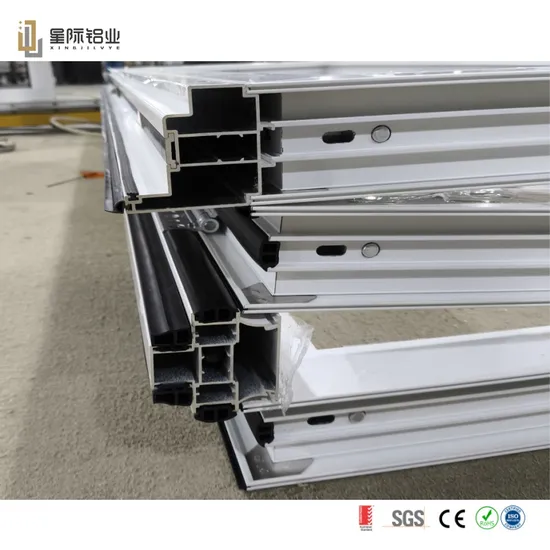
Our production line uses precision corner crimping machines that create mechanical joints with consistent, repeatable pressure. After crimping, we apply structural sealant to the internal corners before the frame is assembled. This two-step process — mechanical fastening plus chemical sealing — ensures watertight integrity that hand-assembled or poorly automated production simply can’t match.
We test this on every production run. Our quality control team performs water tightness testing on sample units from each batch, subjecting them to simulated rainfall at 600 Pa pressure differential. Frames that show any leakage are rejected, and the production parameters are adjusted before the next batch runs.
Custom Design for Thermal Stress (ODM Capabilities)
Aluminum has a high coefficient of thermal expansion — about 23 × 10⁻⁶ per °C. In a climate that swings from -10°C to 40°C, a 2-meter window frame will expand and contract by nearly 2.3 millimeters. If the design doesn’t accommodate this movement, the frame will warp, the seals will tear, and the glass will experience stress fractures.
This is where our ODM capabilities come into play. Our design team calculates expansion gaps and reinforcement rib placement based on your project’s specific climate zone. For extreme climates, we design sliding channels and flexible gaskets that absorb thermal movement without transferring stress to the glass or the building structure.
When you work with our engineering team, we don’t just copy a standard profile — we adapt the design to your project’s thermal environment. This level of customization is something we’ve developed over 20 years of serving projects across different climate zones, and it’s a major reason our windows outlast generic imported units.
Material Selection: Choosing the Right Alloy and Coating
Not all aluminum is created equal. The difference between virgin aluminum and recycled content affects both strength and corrosion resistance. Recycled aluminum can contain trace impurities that create micro-galvanic cells, accelerating localized corrosion.
Because we operate our own aluminum processing workshops, we maintain strict control over the alloy composition we use. We source billets from certified mills and verify chemical composition through spectrometric analysis before extrusion. Wall thickness is another critical factor — we typically work with 1.4mm to 2.0mm profiles, depending on the structural requirements of the project.
For high-rise applications, we recommend 2.0mm wall thickness to handle wind load pressures. For residential villa projects, 1.4mm is often sufficient. Our team reviews the architectural drawings and wind-load calculations before recommending the appropriate specification — we don’t let clients under-spec and then wonder why their windows fail prematurely.
—
Maintenance: The Manufacturer’s Checklist to Hit Maximum Lifespan
Even the best-engineered window requires basic maintenance to reach its full lifespan. We provide this checklist to every B2B client who works with us, and we recommend passing it along to the facility management team.
Annual Lubrication and Seal Inspection
Once a year, lubricate all moving parts with a silicone-based lubricant. Avoid petroleum-based products, which can degrade rubber seals and attract dust. Inspect the EPDM seals for compression set — if they’ve flattened and no longer spring back when pressed, it’s time to replace them.
Catching a failing seal early takes 15 minutes and costs a few dollars. Missing it for two years means moisture gets into the frame cavity, and now you’re looking at internal corrosion that will eventually require frame replacement.
Cleaning Protocols for Powder-Coated Surfaces
The powder coating is your window’s first line of defense, and how you clean it determines how long that defense holds. Use mild soap and warm water with a soft cloth or sponge. Avoid:
- Alkaline or solvent-based cleaners that strip the coating
- Abrasive pads that scratch the surface and create corrosion initiation points
- Pressure washers with narrow spray patterns that can force water past the seals
In coastal environments, we recommend a monthly rinse with fresh water to remove salt deposits that accumulate on the surface. This simple practice can add years to the coating’s life.
When to Replace Hardware vs. Full Frame Replacement
For B2B clients managing large property portfolios, this decision has significant cost implications. Here’s our guidance:
- Replace hardware when: The frame structure is sound, seals are in good condition, but locks are sticking, handles are loose, or rollers are worn. Hardware replacement is typically a 1-day fix per window and costs 5-10% of full replacement.
- Replace the full frame when: There’s visible corrosion on the frame surface, water has penetrated the thermal break, or the glass seal has failed and caused fogging. At this point, the frame’s structural integrity is compromised, and patching is throwing money at a failing system.
We supply replacement hardware for our OEM and ODM projects, so clients can extend the service life of their windows without a full replacement project. This is part of our comprehensive after-sales support — we don’t disappear after the shipping container leaves our factory.
—
How OEM/ODM Customization Directly Impacts Durability
Generic off-the-shelf windows are engineered for average conditions. Your project isn’t average. This is where our OEM/ODM capabilities become a lifespan differentiator.
Specifying Heavier Wall Thicknesses for High-Rise Projects
Wind load is the primary structural stress on high-rise windows. At 100 meters above ground, wind pressures can exceed 2,000 Pa, and the window frame must resist this without excessive deflection. Deflection isn’t just a comfort issue — it puts cyclic stress on the frame joints and glass seals, eventually causing fatigue failure.
Our custom size and design service allows contractors to specify 2.0mm wall thickness and additional reinforcement ribs for high-wind zones. This increases the frame’s moment of inertia and reduces deflection by up to 40% compared to standard 1.4mm profiles. The result is significantly extended fatigue life — the window won’t develop stress cracks or seal failures after years of wind loading.
Private Label and Branding for Dealers
If you’re a retail dealer or distributor, the lifespan of the window reflects directly on your brand. When a window fails prematurely, the customer doesn’t blame the factory — they blame the company whose name is on the product.
Our private label service lets you put your brand on a window backed by our 20 years of manufacturing stability. You get the credibility of a proven product without the massive capital investment required to build your own factory. We handle the engineering, production, and quality control; you handle the market relationship.
Prototyping and Sample Testing
Before committing to mass production, we provide customized shop drawings within 24 hours of receiving your inquiry. Once the design is approved, we can produce samples for water tightness and air infiltration testing before you commit to a full production run.
This prototyping step is critical for lifespan assurance. It’s much cheaper to discover a design flaw on a sample unit than after 500 windows are installed in a building. Our engineering team reviews the test results and makes adjustments before we scale up production.
—
Comparing Lifespan: Aluminum vs. uPVC (A Manufacturer’s Perspective)
As a manufacturer of both aluminum windows and solid wood doors, we’ve seen the full spectrum of material performance. Here’s how aluminum and uPVC compare when it comes to lifespan.
Structural Integrity Over Time
| Factor | Aluminum | uPVC |
|---|---|---|
| Typical frame lifespan | 30-45 years | 20-30 years |
| Structural rigidity | High — maintains shape under load | Moderate — can sag in large spans |
| Thermal expansion | 23 × 10⁻⁶/°C — manageable with proper design | 80 × 10⁻⁶/°C — requires expansion joints |
| UV resistance | Excellent — coating protects substrate | Moderate — can chalk and yellow over time |
| Recyclability | 100% recyclable with residual value | Difficult to recycle; downcycled to lower-grade products |
| End-of-life value | ~$1,500-2,000/ton scrap value | Near zero; disposal cost |
uPVC’s main advantage is lower thermal conductivity, which improves energy efficiency. However, modern thermally broken aluminum profiles close most of that gap. The trade-off is that uPVC is more prone to sagging in large window spans, which puts stress on the glass and hardware over time.
Recyclability and Lifecycle Cost
For B2B buyers focused on green building certifications like LEED, the end-of-life story matters. Aluminum is 100% recyclable without quality degradation. The scrap value of aluminum windows offsets a portion of the initial cost — something that doesn’t exist with uPVC, which typically ends up in landfills or is downcycled into lower-grade products.
From a lifecycle cost perspective, aluminum’s longer lifespan and residual scrap value make it more economical over a 40-year building life, even with a higher initial cost. This is why we see most commercial and high-end residential projects specifying aluminum, despite uPVC’s lower upfront price.
Choose aluminum if: You need large-span windows, your project is in a coastal or high-wind zone, you’re pursuing green building certification, or you’re planning for a building life of 30+ years.
Choose uPVC if: You have a very tight budget, the window spans are small, and you’re planning a building life of 15-20 years before major renovation.
—
Conclusion: Specifying for the Long Haul
The aluminum windows lifespan you achieve is a partnership between our manufacturing quality control and your maintenance schedule. Here’s what we’ve covered:
- The frame itself lasts 30-45 years — the coating and hardware are the limiting factors
- Manufacturing quality is the #1 determinant — watertight corner joints and proper surface treatment prevent internal corrosion
- Customization extends lifespan — specifying the right alloy, wall thickness, and thermal design for your climate zone prevents premature failure
- Maintenance is minimal but essential — annual lubrication and proper cleaning add years to every component
At Jusen Doors & Windows, we’ve spent over 20 years refining our aluminum window manufacturing process. We operate our own extrusion processing, surface treatment, and assembly lines, which gives us complete control over the factors that determine lifespan. Our engineering team provides customized shop drawings within 24 hours, and our flexible MOQs accommodate everything from single villa projects to large construction developments.
We’re ready to supply stable, long-lasting aluminum windows for your next project. Whether you’re a contractor needing custom sizes, a dealer looking for private label products, or a developer planning a large-scale build, our team can engineer the perfect specification for your climate and structural requirements.
—
Frequently Asked Questions
What is the average lifespan of an aluminum window frame?
The structural frame typically lasts 30 to 45 years. The powder coating or anodized finish usually lasts 20-30 years before needing refinishing, depending on environmental exposure. The hardware (locks and hinges) may need replacement sooner, but the frame itself is incredibly durable. We’ve seen frames from our early production runs still performing well after 15 years in coastal installations.
Can aluminum windows last longer than uPVC?
Yes, typically. Aluminum is a stronger material that does not warp or sag over time like uPVC can in extreme heat. While uPVC might last 20-30 years, a well-maintained aluminum frame from a quality manufacturer like Jusen can easily exceed 40 years. The thermal expansion of uPVC is roughly 3.5 times that of aluminum, which creates more stress on seals and hardware over time.
How does the quality of manufacturing affect the lifespan?
It is the most critical factor. If the corner joints are not sealed properly, water ingress will cause corrosion from the inside out. At our factory, we use precision crimping and sealing techniques to ensure the frame is watertight, which is the #1 way to extend the lifespan. We also control the pretreatment process before powder coating — if this step is skipped or rushed, the coating will delaminate within a few years.
Do you offer replacement hardware for older windows?
Yes, we support our products with comprehensive after-sales support. While we recommend specifying high-quality hardware initially, we can supply replacement parts for our OEM and ODM projects to ensure the windows continue to function perfectly for decades. Our engineering team can also advise on hardware upgrades if you’re looking to improve security or operability.
What is the minimum order quantity (MOQ) for custom-sized windows?
We offer flexible MOQs to accommodate both small villa projects and large construction developments. For standard profiles, we can work with relatively small quantities. For fully custom ODM designs that require new extrusion dies, there’s typically a higher minimum to justify the tooling investment. We welcome global distributors and builders; please contact our team with your project drawings to discuss specific requirements and lead times.
—
References
- American Architectural Manufacturers Association. “AAMA 910-21: Voluntary Specification for Life Cycle Assessment of Windows and Doors.” https://aamanet.org/“>https://aamanet.org/
- Aluminum Extruders Council. “Aluminum Extrusion Manual: Material Properties and Applications.” https://aec.org/“>https://aec.org/
- National Association of Home Builders. “Study of Life Expectancy of Home Components.” https://www.nahb.org/“>https://www.nahb.org/
- International Organization for Standardization. “ISO 10077-1: Thermal performance of windows, doors and shutters.” https://www.iso.org/“>https://www.iso.org/
- The Aluminum Association. “Recyclability of Aluminum: A Lifecycle Perspective.” https://www.aluminum.org/“>https://www.aluminum.org/