Content Menu
● 1. Why Choose an 8ft Entry Door? Specifying for Grand Entrances
● 2. Customization Options for Your 8ft Entry Door Project
● 3. The Jusen Factory Advantage: Manufacturing Oversized Doors at Scale
● 4. Logistics and Export: Shipping 8ft Doors Internationally
● 5. What We Have Learned About 8ft Door Specifications
● 6. Answering the Questions We Receive Most
11 min read
The request came in on a Tuesday. A developer in Vancouver needed forty 8ft entry doors for a boutique hotel lobby. The architect had specified a bronze anodized aluminum frame with a narrow stile—sightlines under 100mm. The catch? The building sat two blocks from the ocean, so the doors had to pass a 3-second gust wind load of 55 psf. Our first question wasn’t about price. It was about whether the profile could be reinforced internally without changing the exterior dimensions.
That is the reality of sourcing 8ft entry doors. It is not a catalog item. It is an engineered assembly. And if the factory you choose doesn’t understand the physics of an 8-foot-tall door leaf, you will discover the problem six months after installation, when the bottom corner starts dragging on the threshold.
We are Jusen Door and Windows Manufacturing Co., Ltd. We make oversized doors for projects that standard suppliers turn away. This article covers what we have learned from shipping thousands of tall doors across North America, Europe, and the Middle East—and what you need to specify before you sign a purchase order.
Why Choose an 8ft Entry Door? Specifying for Grand Entrances
Walk into any modern luxury lobby or custom villa, and the entrance is the first statement. A standard 80-inch door reads as functional. A 96-inch door reads as deliberate. The scale changes how the entire facade is perceived.
The trend toward 8ft entry doors is not merely aesthetic. Double-height foyers, commercial storefronts, and contemporary residential designs demand proportion. A 7-foot door under a 12-foot ceiling looks undersized—like a postage stamp on an envelope.
We manufacture both thermal-break aluminum doors and solid wood doors to meet this demand. Our aluminum line handles the modern, slim-profile look with sightlines that keep the glass area dominant. Our wood line serves the traditional or heritage-style project where a heavy, warm material is non-negotiable.
The Engineering Challenge Behind 8ft Doors
Here is where most buyers get into trouble. An 8ft door leaf made from standard 2-inch-thick profiles will sag. The weight of the glass—especially if you specify double or triple glazing—can exceed 200 pounds. Without internal reinforcement, the door will deform over time. The top hinge will work harder than it should. The lock stile will drop.
Our response is the adjustable profile structure. We design the internal aluminum core with additional bracing at the hinge locations and a pre-tensioned frame that accounts for the gravitational pull on the leaf. This is not a standard extrusion. It is a custom profile engineered for your specific door dimensions and glazing weight.
We also test every oversized door before it leaves our factory. The air-tightness, water-tightness, and wind resistance tests are not optional extras—they are part of our standard pre-shipment inspection. If a door cannot pass a 9A air-tightness rating or a 6A water-tightness rating, it does not get crated.
Material Selection: What Works for an 8ft Door
Not all materials are suitable for a 96-inch door leaf. Here is our honest assessment:
- Thermal-break aluminum: The best choice for large glass areas and slim frames. The multi-chamber profile provides structural rigidity while the polyamide thermal break prevents condensation on the interior surface in cold climates.
- Solid wood: Heavier, more luxurious, but requires careful moisture management. We use kiln-dried hardwoods with a moisture content below 12% to minimize warping. For high-humidity regions, we recommend aluminum cladding on the exterior face.
- Aluminum-clad wood: The compromise option. We offer this where the interior needs wood grain but the exterior faces harsh weather.
An 8ft door is not the place to save money on materials. The cost difference between a standard profile and a reinforced one is small compared to the cost of a failed installation.
Customization Options for Your 8ft Entry Door Project
When a buyer contacts us, they rarely have a standard specification. They have a rendering, a sketch, or a competitor’s door they want to improve upon. That is where our OEM and ODM services come into play.
Glass, Hardware, and Color Configurations
We do not limit you to a catalog. On glass, we can provide:
- Low-E coatings with specific solar heat gain coefficients
- Triple glazing for acoustic or thermal performance
- Laminated glass for security or hurricane resistance
- Obscured or decorative glass for privacy
On hardware, we work with leading manufacturers of multi-point locking systems, smart locks, and concealed hinges. The hardware is not an afterthought—for an 8ft door, you need hinges rated for the additional weight. We typically specify 3 heavy-duty hinges per leaf instead of the standard 2.
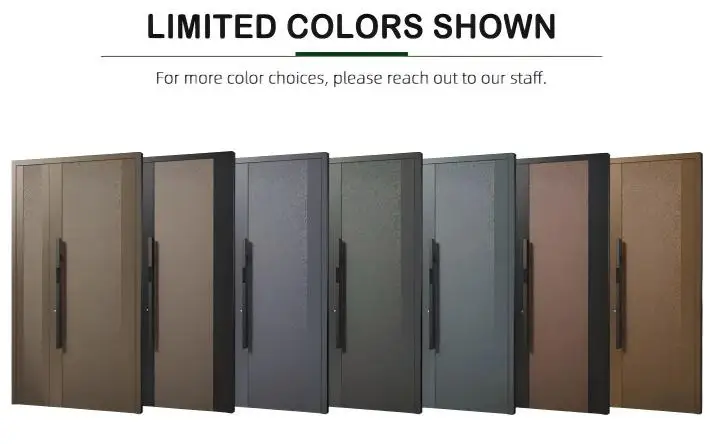
Color is fully customizable. We match RAL codes, anodized finishes, or wood stains. One recent project required a custom bronze tone that matched the building’s exterior cladding exactly. Our powder coating line accommodated it without a minimum quantity penalty.
Adapting to Local Building Codes
This is the most critical aspect of sourcing from overseas. A door that works in Dubai will not necessarily work in Boston. Wind load requirements differ. Thermal performance requirements differ. Even the direction of the door swing can be regulated by fire codes.
Here is what we do differently: We adjust our profile structure and fittings to match local building codes of target markets. If you are in a hurricane zone, we add additional locking points and impact-rated glass. If you are in a cold climate, we increase the thermal break width and specify low-conductivity spacers.
We do not wait for you to tell us your local code. We ask. Our export team maintains a database of common requirements for major markets, and we will review your project’s location before we quote.
The Role of Our Technical Team in Pre-Production
Before a single profile is cut, our engineers review your shop drawings. We check:
- Door leaf weight versus hinge capacity
- Frame anchoring points and wall construction
- Hardware compatibility with the profile system
- Glass spec versus wind load calculations
We provide technical drawings and installation guides prior to shipment. This is not a formality. An 8ft door is heavy and unforgiving if installed incorrectly. Our documentation ensures your local crew knows exactly how to level, anchor, and adjust the door.
The Jusen Factory Advantage: Manufacturing Oversized Doors at Scale
We have been making doors and windows since the company was founded. Our factory in China runs multiple production lines for aluminum systems and solid wood fabrication. This is not a small workshop—we have the capacity to handle project bulk supply for hotels, residential towers, and commercial complexes.
Direct Supply Chain, No Middleman Markup
When you buy from a trading company, you pay for their overhead. When you buy from us, you pay for production. Our pricing reflects the actual cost of materials, labor, and testing—not a markup added by an intermediary.
The cost difference is significant. For a custom 8ft entry door with thermal break aluminum and triple glazing, the factory-direct price can be 20-30% lower than what a trading company quotes. For large projects, that difference covers the cost of freight.
We are not the cheapest factory in China. We are the most transparent one. Our quotes break down the profile cost, glass cost, hardware cost, and testing cost separately. You know what you are paying for.
Pre-Shipment Inspection: What We Test and Why
We have seen what happens when doors arrive at a job site damaged or defective. The contractor blames the factory. The factory blames the freight company. The project schedule slips. To avoid this, we test every 8ft door before it is crated.
Our testing protocol includes:
- Air-tightness test: Measures air leakage through the closed door assembly
- Water-tightness test: Simulates rain and wind to check for water penetration
- Wind resistance test: Applies pressure to simulate wind loads on the door face
A door that passes these tests is a door that will perform in the field. We also inspect the finish, hardware function, and glazing seals before the unit is wrapped.
Managing Bulk Orders and Lead Times
For a project requiring 50 or 100 doors, consistency matters. We run our production lines to handle volume without sacrificing customization. Each door is manufactured to the same specifications, using the same profiles and hardware.
Lead times vary based on complexity. A standard 8ft aluminum door with double glazing might take 3-4 weeks. A fully custom solid wood door with intricate detailing could take 8-10 weeks. We provide a precise schedule upon inquiry and we hold to it. Construction schedules do not wait for late shipments.
Logistics and Export: Shipping 8ft Doors Internationally
Shipping an 8ft door is not the same as shipping a standard door. The length affects crating, container loading, and freight cost. Here is how we handle it.
FCL and LCL Shipping Solutions
For a full container load, we can typically fit 80-100 doors depending on the width and packaging. We use reinforced wooden crates with internal bracing to prevent movement during transit. Each crate is marked with the door type, dimensions, and installation instructions.
For less-than-container-load shipments, we consolidate cargo to maximize space and minimize cost. We have experience with both FCL and LCL shipments and can advise on the most economical option for your order volume.
Complete Customs and Documentation Support
The paperwork for international door shipments is extensive. We provide:
- Packing list with detailed contents and dimensions
- Proforma invoice for payment and customs valuation
- Bill of lading for freight
- Certificates of origin
- Any additional documentation required by your destination country
Our foreign trade experience means we know what documents are needed for specific markets. We have shipped to over 30 countries and have a clear understanding of customs requirements in North America, Europe, and the Middle East.
Crating for Oversized Doors
The crating is not an afterthought. For an 8ft door, we use a double-walled crate with corner protectors and a moisture barrier. The door is suspended inside the crate on padded blocks to prevent any direct contact with the outer frame. This is the standard we hold for every shipment, regardless of destination.
What We Have Learned About 8ft Door Specifications
The buyer who asks about price first is rare. Most of our clients ask about the engineering. They want to know how the door will perform in five years, not just on delivery day.
Here is an imperfect insight: an 8ft door is not automatically better than a 7-foot door. If your building does not have the ceiling height to justify the scale, the door will look disproportionate. We have had clients insist on 8ft doors for standard-height lobbies, and the result was overwhelming rather than elegant. Match the door height to the architectural context.
Another consideration: maintenance. An 8ft door with heavy glazing puts more stress on hinges and tracks. We recommend an annual maintenance check for commercial installations—lubricating hinges, checking seals, and adjusting tension. This is not a one-time installation. It is a long-term component of the building envelope.
Answering the Questions We Receive Most
Can you manufacture an 8ft entry door in both aluminum and wood?
Yes. We specialize in both solid wood doors and thermal-break aluminum doors. The choice depends on your aesthetic, structural, and budget requirements. We can guide you on which material suits your project best.
How do you prevent warping and sagging at that height?
The reinforcement is internal and invisible. We use a steel or aluminum stiffening channel inside the door leaf, combined with heavy-duty hinges rated for the additional weight. Our adjustable profile structure allows us to fine-tune the fit after installation.
What is the typical lead time for a custom order?
For a standard 8ft aluminum door, 3-4 weeks. For a fully custom solid wood door, 8-10 weeks. We provide a confirmed schedule when we quote, and we update you if anything changes.
Do you provide installation instructions for international clients?
Yes. We provide technical drawings and step-by-step installation guides with every order. Our engineering support team is also available for remote consultation if your crew encounters any issues.
Can you match a specific color or finish?
Absolutely. We offer full customization on color. Whether you need a specific RAL code, an anodized finish, or a custom wood stain, we can match it. Send us a sample or a color reference, and we will replicate it.
What if my project requires compliance with a specific building code?
We handle this routinely. Provide us with the applicable code or standard, and we will adjust the profile, hardware, and glazing accordingly. We have experience with wind load codes, thermal codes, and accessibility codes across multiple countries.
Making the Right Choice for Your Project
Choose an 8ft thermal-break aluminum door if you need slim sightlines, large glass areas, or enhanced thermal performance. This is the right choice for modern architecture, commercial storefronts, and projects where energy efficiency is a priority.
Choose an 8ft solid wood door if you need a traditional aesthetic, a warm material presence, or a heritage-style appearance. This is the right choice for luxury villas, historical renovations, and projects where the entrance is a design centerpiece.
Choose Jusen Door and Windows if you need a factory partner who understands the engineering, the compliance, and the logistics of oversized doors. We have been manufacturing doors and windows since our founding. We know what works, what fails, and how to build a door that lasts.
Send us your architectural drawings or specifications. We will review them, ask the right questions, and provide a quote that reflects the real cost of production—not a markup from a middleman.
References
[1] American Architectural Manufacturers Association (AAMA). “AAMA/WDMA/CSA 101/I.S.2/A440-17: North American Fenestration Standard.” https://aamanet.org
[2] National Fenestration Rating Council (NFRC). “Certified Product Directory and Rating Procedures.” https://nfrc.org
[3] International Code Council (ICC). “International Building Code (IBC) – Door and Window Requirements.” https://iccsafe.org
[4] Window and Door Manufacturers Association (WDMA). “Hallmark Certification Program for Doors and Windows.” https://wdma.com
[5] ASTM International. “ASTM E283 – Standard Test Method for Determining Rate of Air Leakage Through Exterior Windows, Skylights, Curtain Walls, and Doors Under Specified Pressure Differences.” https://astm.org
[6] ASTM International. “ASTM E547 – Standard Test Method for Water Penetration of Exterior Windows, Skylights, Doors, and Curtain Walls by Cyclic Static Air Pressure Difference.” https://astm.org
[7] U.S. Department of Energy. “Energy-Efficient Window and Door Selection.” https://energy.gov
[8] Passive House Institute. “Certification Criteria for Windows and Doors in Passive House Buildings.” https://passivehouse.com