Content Menu
● 1. Understanding 8′ Front Door Types and Applications
● 2. Quality and Performance Factors for 8′ Front Doors
● 3. How to Evaluate 8′ Front Door Suppliers
● 4. Key Quality Indicators for 8′ Front Door Buyers
● 5. Industry Standards and Certifications
● 6. Our 8′ Front Door Manufacturing Capabilities
● 7. Production Process: From Raw Material to Finished Door
● 8. Quality Control: Our Multi-Stage Inspection Process
● 9. Customization and OEM/ODM Options
● 10. Ordering Process: MOQ, Lead Time, and Shipping
11 min read
A contractor in Phoenix once ordered forty 8-foot aluminum entry doors for a luxury apartment complex. The first shipment arrived with bowed frames because the supplier used standard 2mm wall thickness profiles. Every single door had to be re-fabricated on site. That mistake cost the contractor six weeks and nearly $18,000 in labor overruns.
Oversized doors are not simply taller versions of standard doors. The engineering changes are fundamental. Weight increases, wind load pressure grows exponentially with height, and hardware requirements shift entirely. For B2B buyers—contractors, architects, importers, and hardware chains—sourcing 8′ front doors requires a different procurement framework than standard door orders.
This guide breaks down the technical specifications, quality benchmarks, and supplier evaluation criteria you need before placing a bulk order.
Understanding 8′ Front Door Types and Applications
An 8′ front door measures 96 inches in height, a full foot taller than standard residential doors. The extra height changes the structural dynamics of the door assembly, requiring reinforced framing, heavier hardware, and careful glass specification.
Three primary configurations dominate the market:
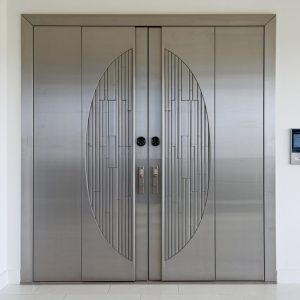
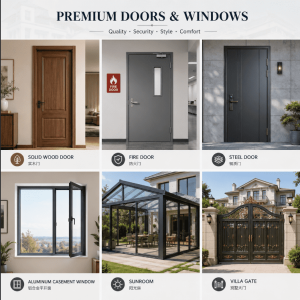
Aluminum alloy entrance doors use thermal-break profiles—two aluminum extrusions separated by a polyamide strip. This design interrupts thermal transfer, improving insulation performance significantly. For commercial storefronts, modern office buildings, and luxury villas, aluminum offers slim sightlines and high strength-to-weight ratios. A typical thermal-break profile uses 1.6mm to 2.0mm wall thickness for the main frame, with reinforcement in the meeting stile for tall panels.
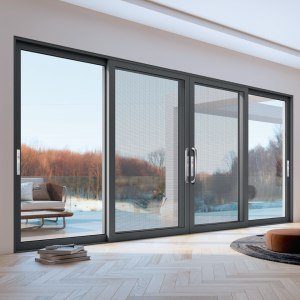
Sliding and gliding patio doors in the 8′ x 8′ configuration serve residential and light commercial applications. A 96″ x 96″ sliding panel can weigh between 180 and 350 pounds depending on glass specification. Standard sliders use two or three panels, but lift-and-slide systems handle heavier panels more smoothly by lifting the door slightly off the track before rolling.
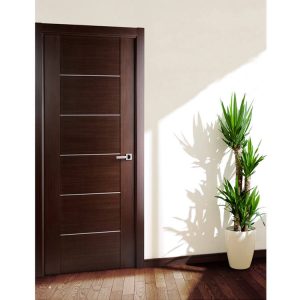
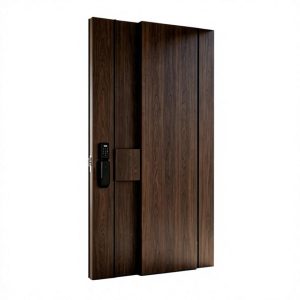
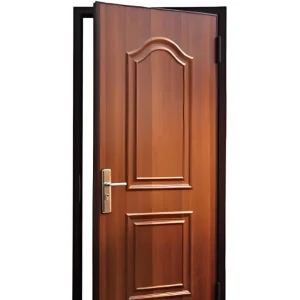
Solid wood and custom villa doors remain popular for high-end residential projects. The challenge with tall wood doors is warping. Engineered wood cores—layered veneers with alternating grain directions—resist dimensional changes better than solid lumber. Buyers should insist on stave-core or engineered construction for any wood door exceeding 84 inches in height.
The application determines the configuration. A hotel lobby needs aluminum pivot doors with automatic operators. A residential patio needs a sliding system with screens and low thresholds. A villa entrance needs the aesthetic of wood with the stability of engineered construction.
Quality and Performance Factors for 8′ Front Doors
Structural Integrity and Wind Load
Wind load pressure increases with the square of the height. An 8-foot door experiences roughly 40% more wind pressure than a 6-foot-8-inch door of the same width. This means the frame must resist deflection, not just support weight.
The critical specification is the profile’s moment of inertia—a measure of the cross-section’s resistance to bending. For 8-foot aluminum doors, look for profiles with a moment of inertia above 12 cm⁴ for the main frame. Below this threshold, the frame will bow under moderate wind loads.
Multi-point locking systems are not optional on oversized doors. A standard single-point lock leaves the top and bottom of the door unsecured, allowing flex and eventual warping. Multi-point locks engage at three, five, or seven points along the door height, distributing the clamping force evenly.
Glass and Glazing Specifications
Tempered glass is mandatory for any door panel exceeding 9 square feet in area. For 8-foot doors, laminated glass—two glass panes bonded with a PVB interlayer—offers additional safety and sound insulation. If the glass breaks, the interlayer holds the fragments in place.
Energy efficiency ratings matter for code compliance. Low-E coatings reflect infrared radiation while allowing visible light through. Argon gas fills between panes reduce heat transfer. The U-factor—heat transfer rate—should be below 0.30 for most climate zones. The Solar Heat Gain Coefficient (SHGC) should range from 0.25 to 0.40 depending on whether the climate is heating-dominated or cooling-dominated.
Dual-pane glass is standard for 8-foot doors. Triple-pane increases weight by roughly 15 pounds per square foot, which affects hardware selection and can make the door difficult to operate manually.
Hardware and Hinge Strategy
Standard residential hinges fail on 8-foot doors. The door’s weight—often 200 to 400 pounds—exceeds the rating of typical 4-inch butt hinges. Heavy-duty options include:
- Pivot hinges: Mounted at the top and bottom of the door, they carry weight along the vertical axis. Pivot systems handle doors up to 500 pounds and allow the door to swing in either direction.
- Heavy-duty butt hinges: Five-knuckle ball-bearing hinges in 5-inch or 6-inch sizes, rated for 300+ pounds. Use three hinges minimum on an 8-foot door.
- Continuous (gear) hinges: Full-height hinges that distribute weight evenly along the entire edge. Ideal for high-traffic commercial applications.
Weather-stripping and thresholds require attention on tall doors. The longer the door, the more surface area for air and water infiltration. Adjustable thresholds with compression seals compensate for floor irregularities and maintain a tight seal over time.
How to Evaluate 8′ Front Door Suppliers
The evaluation framework for oversized door suppliers differs from standard door procurement. You are not just buying a product—you are buying engineering capability, quality control systems, and logistics competence.
Assessment Criteria
Profile structure and customization capability. Ask the supplier whether their aluminum profiles can be adjusted to meet your region’s wind load requirements. A supplier with fixed profiles cannot adapt to varying building codes. The best suppliers offer adjustable profile structures with replaceable reinforcement bars.
Testing and inspection processes. Request documentation of air-tightness, water-tightness, and wind resistance tests. The European standard EN 12207 classifies air permeability from Class 1 (least airtight) to Class 4 (most airtight). For 8-foot doors, Class 3 or higher is recommended. Water-tightness under EN 12208 ranges from Class 1A to 9A. Wind load resistance under EN 12210 is graded A1 to A5. Ask for the specific class ratings of their test reports.
Manufacturing equipment. A factory using CNC machining centers produces more consistent results than one using manual cutting saws. Look for automated assembly lines and digital quality control checkpoints.
Red Flags to Avoid
- Suppliers who cannot provide test reports from independent laboratories
- Factories that refuse to adjust profiles for your local building codes
- Suppliers with minimum order quantities above your project scale without flexibility
- Companies that cannot provide proper export documentation—packing lists, proforma invoices, and certificates of origin
- Suppliers who quote lead times under 10 days for fully customized oversized doors—this usually means they are not actually manufacturing but reselling
Verification Questions
Before ordering, ask these five questions:
- What is the wall thickness of your aluminum profiles, and can you provide the moment of inertia calculation?
- Can you share independent test reports for air, water, and wind resistance on doors in the 96-inch height range?
- What is your process for handling non-conforming units in a bulk shipment?
- Can you provide references from projects in my region or climate zone?
- What packaging do you use specifically for oversized glass and door panels in export containers?
Key Quality Indicators for 8′ Front Door Buyers
| Quality Indicator | Acceptable Range | Testing Method |
|---|---|---|
| Profile wall thickness (aluminum) | 1.6mm – 2.0mm | Caliper measurement |
| Air permeability | Class 3 – 4 (EN 12207) | Pressure chamber test |
| Water tightness | Class 6A – 9A (EN 12208) | Spray rack test |
| Wind load resistance | A3 – A5 (EN 12210) | Structural pressure test |
| U-factor (glass + frame) | ≤ 0.30 W/m²K | Thermal simulation |
| Hardware cycle rating | 200,000+ cycles | Mechanical endurance test |
These indicators give you measurable benchmarks against which to evaluate any supplier’s product. Do not accept vague claims of “high quality” without test documentation.
Industry Standards and Certifications
The international standards framework for doors and windows includes:
- ISO 9001:2015: Quality management systems certification. This is the baseline—suppliers without it lack basic quality control infrastructure.
- CE marking: Required for construction products sold in the European Economic Area. The harmonized standard EN 14351-1 covers windows and pedestrian doorsets.
- ENERGY STAR: Voluntary program in the US requiring specific U-factor and SHGC ratings based on climate zone.
- ASTM E283 / E330 / E547: American test methods for air leakage, structural performance, and water penetration.
For fire-rated 8-foot doors—required in many commercial applications—look for certification to UL 10C or NFPA 252 in the US, or EN 1634 in Europe. Fire-rated doors are not simply about thicker slabs. The frame, seal, and hardware matter just as much. A fire-rated door with non-rated hardware fails the certification.
Our 8′ Front Door Manufacturing Capabilities
Here is how the industry standards translate to actual manufacturing practice. As a factory producing thermal-break aluminum doors, system windows, and custom villa doors, our approach to 8-foot doors is built around three pillars: customization, testing, and export readiness.
Manufacturing capability and customization. Our factory accepts full customization on size, color, glass, and hardware. Whether you need a standard 8′ slider or a custom aluminum pivot door with sidelights, we adjust the profile structure to match your project’s wind load requirements. Our CNC machining centers ensure precise cuts and consistent tolerances across bulk orders. For OEM and ODM projects, we manufacture to your exact specifications and can apply your private label.
Quality assurance and pre-shipment inspection. Every bulk order undergoes strict pre-shipment inspection. We test air-tightness, water-tightness, and wind resistance before the containers leave our factory. The test results are documented and provided to the buyer. This is not a checkbox exercise—it is the difference between receiving doors that install correctly and doors that require on-site rework.
Export experience and logistics. Our foreign trade team handles the documentation that trips up many first-time importers: packing lists, proforma invoices, certificates of origin, and full customs paperwork. We ship both FCL (Full Container Load) and LCL (Less than Container Load), depending on your order volume. For oversized doors, FCL shipping reduces handling and damage risk. Our packaging is designed specifically for tall glass panels—reinforced wooden crates with internal bracing to prevent movement during transit.
Production Process: From Raw Material to Finished Door
Understanding the manufacturing process helps you evaluate whether a supplier can deliver consistent quality at scale.
Step 1: Profile cutting and machining. Raw aluminum profiles are cut to length on CNC saws with precision to ±0.5mm. Machining centers drill holes and route slots for hardware, drainage, and reinforcement. This step determines the door’s dimensional accuracy.
Step 2: Surface treatment. Profiles are either powder-coated or anodized. Powder coating—applying dry paint that is cured under heat—provides durability and unlimited color options. The coating thickness should be 60-80 microns for exterior applications. Anodizing creates a thicker oxide layer, offering superior corrosion resistance for coastal environments.
Step 3: Glass fabrication. Glass panes are cut, edged, and tempered. For insulated glass units, the panes are assembled with a spacer bar, dessicant, and sealant, then filled with argon gas. The sealed unit’s dew point—the temperature at which condensation forms internally—should be below -40°F (-40°C) for quality assurance.
Step 4: Assembly. Frames are assembled with corner brackets or welding, depending on the profile system. Weather-stripping is installed, and hardware is mounted. For 8-foot doors, this is where the multi-point locking systems and heavy-duty hinges are fitted.
Step 5: Quality control inspection. Each door undergoes dimensional checks, hardware function tests, and visual inspection for surface defects. Sample units are tested for air and water infiltration.
Quality Control: Our Multi-Stage Inspection Process
The inspection process for bulk orders follows a documented protocol:
- Incoming material inspection: Aluminum profiles, glass, and hardware are checked against specifications upon receipt from suppliers.
- In-process inspection: Dimensional checks at each manufacturing stage—cutting, machining, assembly.
- Pre-shipment inspection: A final batch inspection where sample units are tested for air-tightness, water-tightness, and hardware function.
- Packaging inspection: Verification that crates are correctly built, doors are properly protected, and container loading follows the loading plan.
For buyers who want additional assurance, third-party inspection services can be arranged. We accommodate pre-shipment inspections by independent agencies such as SGS or Bureau Veritas at the buyer’s request.
Customization and OEM/ODM Options
Three partnership models are available for 8′ front door procurement:
OEM (Original Equipment Manufacturing). You provide the specifications, and we manufacture to your exact requirements. Your logo and branding are applied. This model suits hardware chains and distributors who want their own product line without owning a factory.
ODM (Original Design Manufacturing). We provide design support for projects requiring unique profiles or structural solutions. Our engineering team works with your architects to develop custom door systems that meet specific performance requirements. This model suits construction companies and developers with distinctive project needs.
Bulk supply for construction projects. We support large-scale commercial projects with phased delivery schedules and on-site coordination. If your project requires 200 doors delivered over six months in four shipments, we structure the production schedule to match your installation timeline.
Ordering Process: MOQ, Lead Time, and Shipping
Minimum Order Quantity (MOQ). For custom 8-foot aluminum doors, the MOQ is typically 10 units for standard configurations. Fully customized orders may have higher MOQs depending on the profile and hardware requirements. For standard sizes and configurations, lower MOQs can be negotiated.
Lead time. Production typically takes 15 to 30 days for bulk orders, depending on customization level and order volume. Standard configurations with in-stock profiles can ship faster. Factor in 5-10 days for ocean freight plus customs clearance when planning your project timeline.
Shipping. FCL shipping is recommended for oversized doors to minimize handling and damage risk. A 40-foot container can hold approximately 40-60 doors depending on size and packaging. LCL shipping is available for smaller orders but carries higher damage risk due to additional handling.
Documentation. Our export team provides complete documentation: commercial invoice, packing list, bill of lading, certificate of origin, and any additional documents required for your country’s customs clearance.
Making the Final Decision
Choosing between suppliers comes down to matching your project needs with supplier capabilities.
Choose a factory-direct supplier if: You need bulk quantities, want to eliminate middleman markup, and require customization. Factory-direct pricing typically runs 10-30% lower than buying through distributors.
Choose a local distributor if: You need small quantities (under 10 units), require immediate delivery, or need local installation support. The price premium is the cost of convenience.
Choose an OEM partner if: You are building a product line and need consistent quality with your branding.
Choose an ODM partner if: Your project requires unique designs that standard products cannot meet.
For 8-foot doors, the engineering requirements are demanding enough that working directly with the factory gives you the most control over specifications, quality, and cost. The key is choosing a factory with the testing infrastructure, export experience, and customization capability to deliver doors that meet your local building codes.
A wooden door is not always the right choice. For high-humidity or high-wind regions, aluminum thermal-break doors outperform wood in durability and structural performance. Know your project’s environmental demands before falling in love with an aesthetic.
If you have a project requiring 8′ front doors, contact our team to discuss your specifications. We will provide a detailed quote with production timeline and shipping options.
—
References
- EN 14351-1:2006+A2:2016, “Windows and doors – Product standard, performance characteristics,” European Committee for Standardization. https://www.cen.eu/
- ISO 9001:2015, “Quality management systems – Requirements,” International Organization for Standardization. https://www.iso.org/standard/62085.html
- ASTM E283-19, “Standard Test Method for Determining Rate of Air Leakage Through Exterior Windows, Skylights, Curtain Walls, and Doors Under Specified Pressure Differences Across the Specimen,” ASTM International. https://www.astm.org/e0283-19.html
- ENERGY STAR Program Requirements for Residential Windows, Doors, and Skylights, Version 7.0. https://www.energystar.gov/products/windows_doors_and_skylights
- UL 10C, “Standard for Positive Pressure Fire Tests of Door Assemblies,” UL Solutions. https://www.ul.com/