Content Menu
● 1. What Is a 4 Panel Glass Front Door? Types and Configurations
● 2. Is Having a Glass Front Door a Good Idea? Performance and Security Analysis
● 3. How Much Is a 4 Panel Sliding Glass Door? Cost Drivers and Pricing Framework
● 4. How to Measure and Specify a 4 Panel Glass Front Door
● 5. Can You Put a Glass Panel in a Front Door? Customization Options
● 6. How to Evaluate 4 Panel Glass Front Door Suppliers: A Procurement Framework
● 7. Relevant Industry Standards and Certifications
● 8. Production Process: From Raw Material to Finished Door
● 9. Quality Control: Multi-Stage Inspection Process
● 10. Customization and OEM/ODM Options
● 11. Ordering Process: MOQ, Lead Time, and Shipping
● 12. How Jusen Door and Windows Manufacturing Co., Ltd. Meets These Procurement Standards
15 min read
A contractor in Hamburg once spent three weeks sourcing a 4-panel glass front door for a villa renovation. The local dealer quoted €6,800 per unit with a twelve-week lead time. A direct inquiry to a Chinese factory produced the same specification — thermal break aluminum, triple glazing, multi-point locking — at €2,150 ex-works, with a 28-day production schedule. The difference was not quality. It was the supply chain.
This guide explains how 4-panel glass front doors are engineered, priced, and specified for B2B buyers. It covers configurations, glass technology, cost drivers, measurement procedures, and a supplier evaluation framework.
What Is a 4 Panel Glass Front Door? Types and Configurations
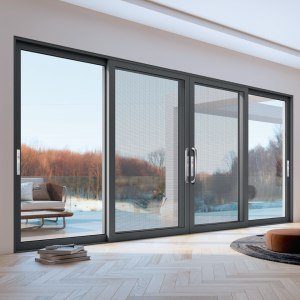
A 4 panel glass front door is an entrance system with four vertical panels within a single supporting frame. The configuration typically combines fixed sidelites with operable panels — hinged, sliding, or folding — to create a wide opening that maximizes natural light.
The term “panel” refers to the individual door leaves, not the glass lites within them. Each panel is a structurally independent unit.
Common Configurations
- 2 fixed + 2 hinged panels: The most common arrangement. Two fixed sidelites flank a pair of French-style hinged doors. Opening width typically ranges from 2,400 mm to 3,200 mm.
- 4-panel sliding system: All four panels slide on multi-track hardware. Two or three panels remain operable; the rest stack behind a fixed panel. Ideal for tight interior spaces.
- 4-panel folding (bi-fold) entry: Panels hinge together and fold to one side. This clears the full opening width but offers weaker weather sealing than sliding systems.
- 4 hinged panels: All four panels are operable, either as double pairs or a single sequence. This maximizes ventilation but requires substantial wall space.
Material Systems Compared
| Material | Sightline Width | Thermal Performance | Cost Index | Best Application |
|---|---|---|---|---|
| Thermal-break aluminum | 50–80 mm | Excellent (U-value 0.8–1.4 W/m²K) | $$$ | Modern villas, high-rise, coastal projects |
| uPVC | 70–90 mm | Good (U-value 1.0–1.6 W/m²K) | $ | Budget residential, renovation |
| Wood-clad / solid wood | 80–120 mm | Good (U-value 1.1–1.8 W/m²K) | $$$$ | Heritage projects, luxury villas |
| Standard (non-thermal) aluminum | 40–60 mm | Poor (U-value 3.0+ W/m²K) | $$ | Interior applications only |
Thermal-break aluminum dominates the premium segment. The polyamide strip separating the interior and exterior frames reduces heat transfer dramatically. For a 4-panel system spanning three meters, this is the difference between a comfortable entryway and a cold bridge that condensates all winter.
Engineering Considerations for Operable Panels
Operable panels introduce moving parts and seals. Fixed panels transfer load directly to the frame; operable panels transfer load through hinges or rollers, which become stress points.
For sliding systems, the track and roller hardware must match panel weight. A 1,200 mm wide panel with double glazing weighs approximately 60–80 kg. Budget-grade rollers fail within two years at this weight. European hardware brands — Roto, Siegenia, GU — rate their rollers for specific panel weights. Specify hardware before finalizing panel dimensions.
Is Having a Glass Front Door a Good Idea? Performance and Security Analysis
Yes — when specified correctly. A 4 panel glass front door delivers superior daylight and modern aesthetics, and can outperform solid doors on energy efficiency with appropriate glazing. The risks — security, privacy, thermal loss — are manageable through specification choices.
Thermal Performance
The glass-to-frame ratio is the dominant factor in a door’s U-value. This is offset by glazing technology:
- Low-E coatings: Microscopic metallic layers reflect long-wave infrared radiation. A double-glazed unit with low-E coating achieves U-values of 1.0–1.2 W/m²K.
- Argon or krypton gas fill: Inert gases between panes reduce convective heat transfer. Argon is standard; krypton offers marginal improvement at higher cost.
- Warm-edge spacers: Stainless steel or polymer spacers at the pane edges reduce heat loss at the glass perimeter.
For cold climates (Zone 5+ in North America, Central/Northern Europe), specify triple glazing with a total U-value of 0.8 W/m²K or below.
Security Considerations
- Laminated glass: A polyvinyl butyral (PVB) interlayer bonds the glass panes together upon impact. Specify laminated glass for at least the operable panels.
- Tempered glass: Heat-treated to increase strength four to five times over annealed glass. When it breaks, it crumbles into small, blunt pieces. This is a safety requirement, not a security feature.
- Multi-point locking: Engages bolts at the top, bottom, and center of the door leaf. European standards (EN 1627) classify burglary resistance from RC1 to RC6. For residential entry doors, RC2 or RC3 is recommended.
Privacy and UV Protection
- Frosted or acid-etched glass: Diffuses light while obscuring visibility.
- Reflective glass: Mirrors exterior light, making the interior less visible during daytime. Performance reverses at night.
- Switchable (smart) glass: Changes from transparent to opaque with an electrical current. Premium solution at $300–$600 per square meter.
- UV-blocking coatings: Standard low-E coatings block approximately 70–90% of UV radiation.
How Much Is a 4 Panel Sliding Glass Door? Cost Drivers and Pricing Framework
At factory-direct wholesale levels, a 4 panel sliding glass door in thermal-break aluminum ranges from $1,200 to $2,800 per unit ex-works. This is 40–60% below typical distributor prices in Western markets.
Breaking Down the Cost
| Component | Cost Share | Cost Drivers |
|---|---|---|
| Aluminum profiles | 25–35% | Profile weight, thermal break quality, surface finish |
| Glass | 20–30% | Thickness, coating, lamination, gas fill |
| Hardware | 15–25% | Brand (European vs. domestic), mechanism complexity |
| Fabrication labor | 10–15% | Panel count, machining complexity |
| Surface treatment | 5–10% | Anodizing, powder coating, wood-grain finish |
| Packaging | 3–5% | Export-grade wooden crates, protective film |
Key Cost Drivers
Size and panel weight. A 3,000 mm wide system uses more aluminum per linear meter than a 2,400 mm system. Every 300 mm of additional width adds roughly 8–12% to the unit price.
Glass specification. Double glazing is standard — approximately $60–$90 per square meter. Triple glazing adds 40–60%. Laminated glass adds $20–$40 per square meter. Low-E coatings range from $10–$25 per square meter.
Hardware brand. European hardware (Roto, Siegenia, GU) costs 2–3 times domestic Chinese equivalents. A full hardware set for a four-panel sliding system ranges from $180–$450 for European brands versus $80–$150 for domestic brands.
Customization. Non-standard RAL colors, wood-grain foil finishes, and special shapes each add 5–15% to the unit price. Custom RAL matching requires a $200–$400 setup fee amortized across the order.
Cost-Saving Strategies
- Standardize sizes across the project. Five identical units cost less per unit than five different sizes.
- Consolidate glass specifications. One glass type for all units simplifies procurement.
- Order in FCL quantities. A 40-foot container holds approximately 20–30 units. FCL shipping costs 25–35% less per unit than LCL.
- Accept standard RAL colors. Popular colors (RAL 7016 anthracite, RAL 9016 white, RAL 9005 black) are always in stock.
How to Measure and Specify a 4 Panel Glass Front Door
Accurate measurement is the difference between a smooth installation and a costly site adjustment.
Step-by-Step Measurement Guide
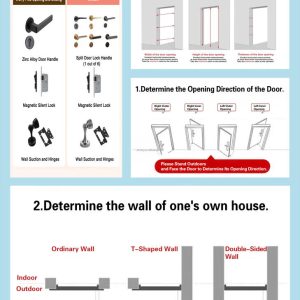
- Measure the rough opening width at three heights: top, middle, and bottom. Use the smallest measurement as your reference.
- Measure the rough opening height at three positions: left, center, and right. Again, use the smallest value.
- Check for plumb and level. Use a spirit level on each side of the opening. Record any deviations.
- Measure the wall thickness. This determines the frame depth required (standard: 60 mm to 120 mm).
- Verify the opening direction and handing. Stand outside facing the door. If hinges are on the left, it is a left-hand door.
Critical Specification Checklist
- Opening direction (inward/outward) and handing
- Panel configuration (fixed/operable) and track count for sliding systems
- Glass spec: thickness, type (tempered/laminated), coating, gas fill, spacer type
- Frame material and finish (RAL color code or wood-grain reference)
- Hardware: brand, mechanism type, finish
- Performance requirements: air-tightness class, water-tightness class, wind load resistance
- Threshold type: flush (barrier-free) or standard with drainage
Common Specification Errors
Ignoring wind load requirements. Standard profiles may not meet local building codes for coastal sites. The supplier needs the project location and building height to calculate wind load.
Specifying glass without safety certifications. Verify that the glass supplier’s certifications cover the destination market (ASTM E2190 in North America, EN 12150 in Europe).
Overlooking threshold drainage. The frame must include drainage channels and weepholes sized for the local rainfall intensity.
Can You Put a Glass Panel in a Front Door? Customization Options
Yes — two approaches exist. Retrofitting a glass panel into an existing solid door is possible for decorative applications. Full replacement with a 4 panel glass front door system is recommended for projects requiring thermal performance or security ratings.
Retrofit vs. Full Replacement
Retrofitting involves cutting an opening into an existing door slab and installing a glass insert. However:
- The insert frame disrupts the door’s thermal envelope
- Structural integrity is compromised at the cutout
- No improvement to the door’s security rating
- Limited to small glass areas (typically under 0.5 m²)
Full replacement is the only option when the project requires:
- Large glass areas (over 1 m² per panel)
- Thermal performance below U-value 1.5 W/m²K
- Burglary resistance ratings
- Wind load compliance
Customization Options
- Shape customization: Arched tops, geometric panels, and asymmetrical configurations are achievable with aluminum frames, which can be cut and welded to any angle.
- Glass customization: Colored interlayers, ceramic frit patterns, etched designs, and branded glass. Decorative interlayers add $50–$150 per square meter.
- Frame color matching: A spectrophotometer can match any color sample — bring a physical reference chip, not just a photo.
How to Evaluate 4 Panel Glass Front Door Suppliers: A Procurement Framework
Manufacturing Capability
- In-house production vs. trading company. A factory audit report from SGS, BV, or TÜV confirms production capability. Verify that the factory owns its extrusion lines, fabrication equipment, and assembly facilities.
- Production capacity. A serious aluminum door factory produces 5,000–15,000 units per month. Capacity below 1,000 units suggests limited ability to handle large orders.
- Equipment age and type. CNC machining centers, automatic glass cutting lines, and robotic welding stations indicate investment in quality.
Quality Control Process
- Pre-shipment inspection procedures. Reputable factories test air-tightness (EN 12207), water-tightness (EN 12208), and wind load resistance (EN 12211) before shipment.
- In-process inspection. Quality control should occur at raw material intake, machining, assembly, and final inspection.
- Traceability. Each unit should have a production number linked to its material batch records.
Export Experience
- Documentation capability. The supplier must provide packing lists, commercial invoices, proforma invoices, and certificates of origin. CE declarations for Europe, ICC-ES evaluations for North America.
- Target market knowledge. Ask for references from clients in your region.
- Logistics network. Confirm the supplier can arrange both FCL and LCL shipments, with experience in your destination port.
Red Flags to Avoid
- No verifiable factory address — a website with only an email contact is not a manufacturer
- Unwillingness to provide test reports or production samples
- Vague lead times with no clear production schedule
- No customization capability — “we only make standard sizes” signals limited manufacturing depth
- Payment terms requiring 100% upfront with no letter of credit or escrow option
Decision Guide
Choose a factory-direct manufacturer if:
- Your order volume exceeds 20 units
- You need custom sizes, colors, or hardware configurations
- You require OEM/ODM services or private labeling
- Price competitiveness is a priority
Choose a local distributor if:
- Your order is a single unit for immediate installation
- You need local installation support and warranty service
- Lead time is under two weeks
- You are not prepared to manage international logistics
Relevant Industry Standards and Certifications
| Standard | Region | Scope |
|---|---|---|
| ISO 9001:2015 | International | Quality management systems |
| EN 14351-1 | Europe | Windows and doors — product standard, CE marking |
| EN 1627 | Europe | Burglary resistance (RC1–RC6) |
| ASTM E2190 | North America | Laminated glass performance |
| NFRC 100 | North America | U-factor and SHGC ratings |
| ANSI/AAMA/WDMA 101/I.S.2 | North America | Aluminum door performance |
| GB/T 8478 | China | Aluminum alloy doors standard |
CE marking under EN 14351-1 is mandatory for doors sold in the European Union. A door without CE marking cannot legally be sold in the EU market. For North American projects, NFRC certification provides U-factor ratings that determine energy code compliance.
Production Process: From Raw Material to Finished Door
1. Profile Extrusion and Surface Treatment
Aluminum billets are heated and extruded through dies to create the frame profiles. The profiles then undergo surface treatment — anodizing or powder coating. A quality powder coat achieves 60–120 microns thickness and passes a 500-hour salt spray test.
2. Thermal Break Assembly
Polyamide strips are inserted into the aluminum profiles and crimped, creating a continuous thermal barrier between interior and exterior surfaces. Poor assembly results in gaps that compromise insulation.
3. Cutting and Machining
Profiles are cut to length using CNC saws with tolerances of ±0.5 mm. Machining centers then drill holes, cut drainage slots, and mill hardware recesses. CNC machining ensures consistency — manual drilling produces dimensional variation.
4. Glass Fabrication
Glass is cut, edged, and washed before assembly into insulated glass units (IGUs). Two or three panes are separated by spacers, sealed with butyl and polysulfide, and filled with argon gas. The seal quality determines the IGU’s lifespan — a failed seal causes condensation between panes.
5. Frame Assembly
Profiles are assembled into frames using corner crimping or welding. Hardware — hinges, locks, rollers — is installed and adjusted. Each panel is tested for smooth operation and correct alignment.
6. Glazing and Final Inspection
Glass units are installed into the frames with glazing tape and pressure plates. The finished door undergoes a final inspection covering dimensional accuracy, hardware function, and seal integrity. Units are then wrapped in protective film and crated for shipment.
Quality Control: Multi-Stage Inspection Process
Raw Material Inspection
Aluminum profiles are checked for alloy composition and surface defects upon delivery. Glass is inspected for chips, scratches, and inclusions. Hardware is sample-tested for function.
In-Process Inspection
After machining, profiles are checked for dimensional accuracy — hole positions, cut lengths, and drainage slot alignment. Hardware installation is verified before glazing.
Final Assembly Inspection
Each assembled door is tested for:
- Panel alignment and gap consistency (2–4 mm gaps, uniform)
- Hardware function — smooth opening, closing, and locking
- Seal integrity — gaskets and weatherstrips correctly seated
- Glass condition — no chips, scratches, or seal defects
Pre-Shipment Inspection
A final inspection verifies the order against the purchase order — quantities, sizes, colors, and hardware configurations. Air-tightness, water-tightness, and wind resistance tests are performed on sample units from each production batch.
Packaging for Export
Doors are wrapped in protective film, corner-protected, and packed in wooden crates. Each crate holds 1–3 units depending on size. Inadequate packaging causes more damage than rough handling.
Customization and OEM/ODM Options
OEM (Original Equipment Manufacturing)
The factory produces doors to the buyer’s specifications — dimensions, profiles, glass, hardware, and finishes. The buyer’s brand is applied to the product and packaging.
ODM (Original Design Manufacturing)
The factory provides the product design based on the buyer’s requirements. The buyer selects from the factory’s existing product range or requests modifications. ODM is faster and lower cost than OEM.
Customization Capabilities
- Sizes: Non-standard dimensions are standard practice.
- Colors: Custom RAL colors, wood-grain foils, anodized finishes. Minimum order quantities apply.
- Glass: Any combination of thickness, coatings, interlayers, and shapes.
- Hardware: European or domestic brands, custom finishes (PVD, brushed, matte black).
- Configurations: Hinged, sliding, folding, or fixed panels in any combination.
Private Label Services
- Custom branding on the frame, glass, or packaging
- Custom instruction manuals and installation guides
- Custom packaging design
- Brand-specific warranty documentation
Ordering Process: MOQ, Lead Time, and Shipping
Minimum Order Quantity (MOQ)
- Standard configurations: 10–20 units
- Custom colors or finishes: 50–100 units (due to powder coating batch requirements)
- OEM/private label: 50 units or more
- Sample orders: 1–2 units at sample pricing
Lead Times
- Sample production: 10–15 days from drawing approval
- Standard order production: 15–25 days from deposit and confirmation
- Custom orders: 25–40 days depending on complexity
- Sea freight: 15–35 days to major global ports depending on route
Shipping Options
| Mode | Suitable For | Cost per Unit | Transit Time |
|---|---|---|---|
| FCL (40ft container) | Orders over 20–30 units | Lowest | 20–35 days |
| FCL (20ft container) | Orders over 10–15 units | Low | 20–35 days |
| LCL (shared container) | Sample or small orders | Higher | 25–40 days |
| Air freight | Urgent samples | Highest | 3–7 days |
Payment Terms
Standard terms are 30% deposit with 70% balance before shipment. Letter of credit (L/C) is acceptable for larger orders from established buyers.
Documentation Provided
- Commercial invoice
- Packing list
- Bill of lading
- Certificate of origin (if required)
- Test reports for performance testing
- CE declaration of conformity (for EU markets)
How Jusen Door and Windows Manufacturing Co., Ltd. Meets These Procurement Standards
As a factory-direct manufacturer, we produce 4 panel glass front doors in thermal-break aluminum, solid wood, and aluminum-wood hybrid configurations. Our production facility handles the complete manufacturing process — profile fabrication, thermal break assembly, glass processing, and final assembly — under one roof.
Manufacturing and Customization Capabilities
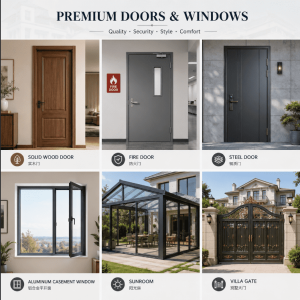
We offer full customization on size, color, glass, and hardware accessories. Our product range includes solid wood doors, thermal-break aluminum doors and windows, system windows, casement doors, sliding doors, custom villa doors and windows, sunrooms, and aluminum alloy entrance doors. OEM and ODM services are available for private label programs and construction project bulk supply.
Our engineering team works with buyers to adapt profile structures and fittings to local building codes. A project in Florida requires different wind load ratings than one in Munich. We adjust the profile thickness, glass specification, and hardware accordingly — as standard practice.
Quality Assurance
Every order undergoes pre-shipment inspection covering air-tightness, water-tightness, and wind resistance testing. These tests follow EN 12207, EN 12208, and EN 12211 standards. Test reports are provided with the shipment documentation.
Our quality control process includes raw material inspection, in-process checks at each production stage, and final assembly verification. Each unit is traceable to its production batch.
Export and Logistics Support
Our documentation team provides packing lists, proforma invoices, and full customs clearance documents. We arrange both FCL and LCL shipments with direct delivery from our China factory. For buyers new to importing, we provide guidance on documentation requirements, import duties, and logistics coordination.
Frequently Asked Questions
What is a four-panel door?
A four-panel door is an entrance system with four vertical panels within a single frame. The configuration typically combines fixed and operable panels — hinged, sliding, or folding — to create a wide opening that maximizes natural light.
Is having a glass front door a good idea?
Yes, when properly specified. Glass front doors offer superior natural light, modern aesthetics, and can improve energy efficiency with low-E double or triple glazing. Security is addressed through laminated or tempered glass and multi-point locking hardware.
How much is a 4 panel sliding glass door?
At wholesale factory-direct level, prices range from $1,200 to $2,800 per unit for thermal-break aluminum systems. This depends on configuration, glass specification, hardware quality, and customization. Retail prices with installation are typically 40–60% higher.
Can you put a glass panel in a front door?
Yes, either by retrofitting a glass panel into an existing door where structurally feasible, or by replacing the entire door with a glass-panel system. Full replacement is recommended when thermal performance or security ratings are required.
What is the difference between a 4-panel sliding door and a 4-panel folding door?
A sliding door operates on horizontal tracks with panels sliding past each other. A folding door has panels hinged together that fold to one side. Sliding doors offer better weather sealing and are more common for front entrances.
What glass thickness is recommended for a 4-panel glass front door?
For residential applications, double-glazed units with 5–6 mm glass on each pane (total thickness ~24–28 mm) are standard. For larger panels, wind load requirements, or security purposes, 8–10 mm tempered or laminated glass is recommended.
How long is the lead time for a custom 4-panel glass front door order?
Standard configurations take 15–25 days from order confirmation. Custom sizes, colors, or specialized glass may extend to 30–40 days. Shipping time depends on destination and mode — 20–35 days by sea freight to major ports.
Conclusion
Sourcing a 4 panel glass front door requires understanding configurations, performance requirements, cost drivers, and measurement precision. The difference between a successful project and a costly failure often comes down to specification accuracy and supplier capability.
Work with a supplier that provides factory-direct pricing, customization flexibility, test-backed quality assurance, and reliable export logistics. Verify every claim — ask for test reports, factory audit documentation, and client references.
Contact Our Team to discuss your project specifications, request samples, or obtain a detailed quotation.
References
- EN 14351-1:2006+A2:2010, “Windows and doors — Product standard, performance characteristics,” European Committee for Standardization. https://standards.cencenelec.eu/
- EN 1627:2011, “Pedestrian doorsets, windows, curtain walling, grilles and shutters — Burglar resistance,” European Committee for Standardization. https://standards.cencenelec.eu/
- ASTM E2190-19, “Standard Specification for Insulating Glass Unit Performance and Evaluation,” ASTM International. https://www.astm.org/
- ISO 9001:2015, “Quality management systems — Requirements,” International Organization for Standardization. https://www.iso.org/
- NFRC 100-2020, “Procedure for Determining Fenestration Product U-factors,” National Fenestration Rating Council. https://www.nfrc.org/
- GB/T 8478-2020, “Aluminum alloy doors and windows,” Standardization Administration of China. https://www.sac.gov.cn/
- ANSI/AAMA/WDMA 101/I.S.2-2017, “Voluntary Specification for Aluminum, Vinyl (PVC) and Wood Windows and Glass Doors,” American Architectural Manufacturers Association. https://www.aamanet.org/