## Core Conclusion: Which Lite Door Should You Choose?
If you are sourcing exterior doors for a commercial project, the lite configuration is not a stylistic afterthought—it is a performance specification. The **3/4 lite exterior door** (glass covering approximately 75% of the surface) is the most balanced choice for entryways requiring abundant daylight without the full transparency of a 1-lite (single full-glass) door.
For most B2B applications—retail storefronts, office lobbies, hospitality entrances—the 3/4 lite configuration offers the best compromise. It provides roughly 75% glazing for visibility and light transmission while retaining a solid bottom rail that protects against impacts, scuffs, and moisture damage. Compare this to a 1/2 lite door (50% glass), which sacrifices significant daylight, or a 9-lite door, which fragments the view and requires more frame material.
However, the “best” choice depends on your specific priorities: privacy, energy code compliance, or aesthetic uniformity. The table and detailed breakdowns below will help you match the configuration to your project’s technical requirements.
—
## Understanding Lite Door Configurations: From 1/4 to 15 Lite
A “lite” (also spelled “light”) is the glass panel within a door. The terminology can be confusing because it refers to two different dimensions: the **glass-to-door ratio** (e.g., 1/4, 1/2, 3/4) and the **number of individual glass panes** (e.g., 3, 4, 6, 9, 15 lite).
### Ratio-Based Configurations (Fractional)
These describe the percentage of the door’s surface area occupied by glass, measured from the top down.
| Configuration | Glass Coverage | Typical Bottom Rail Height | Best For |
|—|—|—|—|
| 1/4 lite | ~25% | 48-60 inches | Maximum privacy, security, minimal light |
| 1/2 lite | ~50% | 30-36 inches | Balanced light, moderate privacy |
| 3/4 lite | ~75% | 12-18 inches | High light, some privacy, impact resistance |
| 1 lite (full) | ~95%+ | 4-8 inches | Maximum visibility, modern aesthetics |
### Count-Based Configurations (Numeric)
These refer to the number of individual glass panes separated by mullions or grilles. The total glass area can vary; a 9-lite door may have a similar glass-to-door ratio as a 15-lite door, but the view is divided differently.
| Configuration | Pane Count | Visual Effect | Typical Glass Area* |
|—|—|—|—|
| 3 lite | 3 | Horizontal or vertical bands | 50-70% |
| 4 lite | 4 | 2×2 grid | 50-65% |
| 6 lite | 6 | 3×2 or 2×3 grid | 60-75% |
| 9 lite | 9 | 3×3 grid | 65-80% |
| 15 lite | 15 | 5×3 or 3×5 grid | 70-85% |
*Illustrative values; exact area depends on frame dimensions and mullion width.
**Key insight for buyers:** The 3/4 lite door is a ratio-based configuration, not a pane count. You can have a 3/4 lite door with a single large pane or with a 9-lite grid. When specifying, always clarify both the glass-to-door ratio AND the pane configuration.
—
## Detailed Comparison: 3/4 Lite vs. Other Popular Options
### 3/4 Lite vs. 1/2 Lite
The most common procurement decision is between these two. The difference is significant:
– **Light transmission:** A 3/4 lite door admits roughly 50% more daylight than a 1/2 lite. In a commercial lobby, this can reduce artificial lighting costs during daytime hours.
– **Privacy:** The 1/2 lite offers a higher solid panel at eye level for seated occupants, making it preferable for offices where confidentiality matters.
– **Structural integrity:** The 1/2 lite has a taller solid bottom rail, which provides more resistance to physical impact (e.g., carts, foot traffic). The 3/4 lite’s shorter rail means the glass is more exposed to damage.
– **Cost:** The 3/4 lite typically costs 5-10% more due to the larger glass panel and the need for potentially thicker glass to maintain structural performance.
**Verdict:** Choose 3/4 lite for public-facing entries where daylighting is a priority. Choose 1/2 lite for private offices or high-traffic service corridors.
### 3/4 Lite vs. 1 Lite (Full Glass)
A 1-lite door is essentially a glass panel with a narrow frame. It maximizes visibility and modern aesthetics but has critical drawbacks:
– **Privacy:** Essentially zero. Suitable only for retail storefronts or interior applications.
– **Code compliance:** Full-glass doors in commercial settings almost always require **tempered or laminated glass** and may need additional framing for wind load resistance, increasing cost.
– **Maintenance:** Full-glass doors show fingerprints, smudges, and scratches more readily, increasing cleaning frequency.
The 3/4 lite provides 90% of the visual openness at lower cost and with better privacy and durability.
### 9 Lite vs. 15 Lite
When comparing multi-pane configurations, the decision is driven by aesthetics and structural framing:
– **9 lite door (3×3 grid):** Provides a classic, traditional look. The larger individual panes are easier to clean and offer less visual obstruction. Each pane is larger, meaning if one breaks, the replacement is more expensive but the pane is more robust.
– **15 lite door (5×3 grid):** Creates a more intricate, craftsman-style appearance. More mullions mean more frame material, which:
– Reduces total glass area (less light)
– Increases weight
– Increases cost (more aluminum or wood framing)
– Provides more structural rigidity for wind load
**Verdict:** For commercial projects, a 9 lite door is generally the better value. The 15 lite door is a stylistic choice that costs more per square foot of glazing and offers no performance advantage.
—
## Comparison Table: Lite Door Configurations at a Glance
| Configuration | Glass Area | Privacy Level | Relative Cost* | Light Transmission | Best Application |
|—|—|—|—|—|—|
| 1/4 lite | ~25% | High | $ (Baseline) | Low | Utility rooms, storage, back entrances |
| 1/2 lite | ~50% | Moderate | $$ (+10-15%) | Medium | Private offices, conference rooms |
| 3/4 lite | ~75% | Low-Moderate | $$$ (+20-30%) | High | Lobbies, retail, hospitality |
| 1 lite (full) | ~95% | None | $$$$ (+40-60%) | Very High | Storefronts, showrooms |
| 3 lite | ~50-70% | Moderate | $$ (+15-20%) | Medium-High | Transitional style, sidelight replacement |
| 4 lite | ~50-65% | Moderate | $$ (+15-20%) | Medium | Craftsman style, residential-scale commercial |
| 6 lite | ~60-75% | Moderate | $$$ (+20-30%) | High | Prairie style, modern offices |
| 9 lite | ~65-80% | Low | $$$ (+25-35%) | High | Colonial, traditional commercial |
| 15 lite | ~70-85% | Low | $$$$ (+40-50%) | High | Craftsman, heritage buildings |
*Relative cost is compared to a solid door of the same material and size. Illustrative values based on 2026 market data; actual pricing varies by material, glass specification, and hardware.
—
## Buying Guide: Key Factors to Consider
### 1. Material and Frame Options
The door frame material determines durability, thermal performance, and maintenance requirements.
| Material | U-Factor (Typical)* | Durability | Maintenance | Best For |
|—|—|—|—|—|
| Aluminum (thermal break) | 0.30-0.45 | Excellent | Low | Commercial, high-traffic, coastal |
| Steel | 0.30-0.50 | Excellent | Low | Security-focused, industrial |
| Fiberglass | 0.25-0.40 | Very Good | Low | Residential, moderate climate |
| Solid Wood | 0.40-0.60 | Good | High | Heritage, interior, protected entries |
| Aluminum-clad wood | 0.30-0.45 | Very Good | Medium | Premium commercial, mixed climates |
*Lower U-factor = better insulation. Values depend on specific assembly, glass, and weatherstripping.
**For 3/4 lite doors in commercial settings, thermal-break aluminum is the industry standard.** It handles large glass panels without warping and provides adequate thermal performance when specified with the correct glass package.
### 2. Glass Specifications and Energy Efficiency
The glass is not a single component—it is a system. Key specifications:
– **Double vs. Triple Glazing:** Double glazing (two panes with an air gap) is standard. Triple glazing adds ~20-30% cost but improves U-factor by 15-25%. Rarely cost-effective for most commercial climates.
– **Low-E Coatings:** Low-emissivity coatings reflect infrared radiation. Specify a **Low-E coating with a solar heat gain coefficient (SHGC)** appropriate for your climate. For hot climates, choose a SHGC below 0.25 to reduce cooling loads. For cold climates, a SHGC above 0.40 can help with passive solar heating.
– **Tempered vs. Laminated Glass:** Building codes require **tempered glass** in doors (typically within 24 inches of the floor and within 60 inches of the door) due to impact safety. **Laminated glass** (two panes bonded with an interlayer) provides additional security and sound insulation. For a 3/4 lite door, the large lower pane must be at least tempered; laminated is recommended for ground-floor entries.
– **Gas Fills:** Argon or krypton gas fills between panes improve insulation by 5-10%. Argon is the cost-effective standard.
**Regulatory note:** Energy codes (ASHRAE 90.1, IECC) set maximum U-factors for doors based on climate zone. Always verify the door assembly’s **whole-unit U-factor**, not just the glass center-of-glass value, to ensure code compliance.
### 3. Building Code Compliance
Beyond energy codes, two critical safety codes apply:
– **Egress (IRC R311.2, IBC 1010):** If the door serves as an exit, the clear opening must be at least 32 inches wide and 24 inches high. The 3/4 lite configuration does not affect egress, but ensure the door width meets the required clear opening.
– **Glazing Safety (IRC R308, IBC 2406):** All glazing in a door is considered “hazardous” and must be tempered or laminated. For a 3/4 lite door, the bottom rail is typically 12-18 inches, meaning the glass starts below the 18-inch threshold where tempered glass is mandatory.
### 4. Cost Considerations
For a standard 3’0″ x 6’8″ (0.91m x 2.03m) door in 2026, approximate per-unit costs:
| Material | Entry-Level (Double Glaze, Tempered) | Mid-Range (Low-E, Argon) | Premium (Laminated, Triple Glaze) |
|—|—|—|—|
| Steel | $400-600 | $600-900 | $900-1,400 |
| Aluminum (thermal break) | $600-900 | $900-1,300 | $1,300-2,000 |
| Fiberglass | $500-800 | $800-1,200 | $1,200-1,800 |
| Solid Wood | $800-1,200 | $1,200-1,800 | $1,800-3,000+ |
*Illustrative 2026 ranges from multiple suppliers. Commercial bulk orders typically receive 10-20% volume discounts. Custom sizes add 15-30% to the base price.
**Cost optimization tips:**
– Standardize door sizes across your project to reduce per-unit costs.
– Specify a single glass package for all doors to simplify procurement.
– Consider a 9-lite configuration if you need the aesthetic but want to reduce glass replacement costs (smaller panes are cheaper to replace individually).
### 5. Installation and Maintenance
**Installation (brief):** Proper installation is critical for performance. Key steps:
– **Rough opening:** The rough opening must be square and plumb. For a 3/4 lite door, the opening should be 2 inches wider and 1 inch taller than the door unit.
– **Shimming:** Shim the door at the hinge locations and lock location. Do not over-shim, as this can warp the frame.
– **Flashing:** Proper flashing at the head and sill is essential to prevent water intrusion—especially critical for a door with a large glass panel.
**Maintenance:**
– **Aluminum/Steel:** Clean frames with mild soap and water. Inspect weatherstripping annually; replace when compressed or cracked.
– **Glass:** Use a non-abrasive cleaner. For the lower 12-18 inches of a 3/4 lite door, consider a protective film to reduce scratch damage from foot traffic and equipment.
– **Hardware:** Lubricate hinges and locks semi-annually. The larger glass panel increases door weight; ensure hinges are rated for the door weight (typically 100-150 lbs for a 3/4 lite door).
—
## Frequently Asked Questions About Lite Doors
### What is a 3/4 lite exterior door?
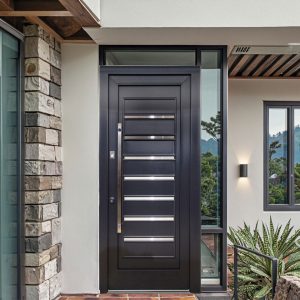
A 3/4 lite exterior door has glass covering approximately 75% of its surface area, typically starting from the top and extending down to a solid bottom rail of 12-18 inches. It maximizes natural light while maintaining a solid lower section for impact resistance and some privacy.
### How does a 3/4 lite door compare to a 1/2 lite or 1 lite door?
A 3/4 lite offers 50% more glass than a 1/2 lite, admitting significantly more daylight, but has less privacy and a shorter solid rail for impact protection. Compared to a 1 lite (full glass), the 3/4 lite provides better privacy, lower cost, and easier compliance with tempered glass codes, while sacrificing only a small amount of visibility.
### What are the benefits of a 9 lite door over a 15 lite door?
A 9 lite door (3×3 grid) uses fewer, larger panes, which means: (1) less frame material, reducing weight and cost, (2) easier cleaning, (3) less visual obstruction, and (4) lower replacement cost per pane. A 15 lite door (5×3 grid) offers a more intricate craftsman aesthetic but costs more and reduces total glass area.
### Which lite configuration offers the best balance of light and privacy?
The 3/4 lite configuration offers the best balance. The 75% glass coverage provides abundant daylight, while the 12-18 inch bottom rail blocks views of lower body movement and protects against impact. For applications requiring seated privacy, a 1/2 lite is better; for full visibility, a 1 lite is better.
### What are the typical price differences between lite configurations?
Based on 2026 pricing, a 1/4 lite door is the baseline. A 1/2 lite adds 10-15%, a 3/4 lite adds 20-30%, and a 1 lite adds 40-60%. Among pane configurations, a 9 lite adds 25-35% over a solid door, while a 15 lite adds 40-50% due to additional mullions.
### Are there energy efficiency differences between lite door options?
Yes, but the configuration matters less than the glass specification. A 3/4 lite door with double-glazed Low-E glass and argon fill can achieve a U-factor of 0.30-0.35, comparable to a 1/2 lite with the same glass. However, a 1/4 lite door with a solid lower panel will always have a lower U-factor than a 3/4 lite with the same glazing, because the solid panel insulates better than glass. For energy code compliance, always verify the whole-unit U-factor.
### What glass options are available for lite doors?
Standard options include: (1) double or triple glazing, (2) Low-E coatings with varying SHGC, (3) argon or krypton gas fills, (4) tempered or laminated safety glass, (5) tinted or reflective glass for solar control, and (6) decorative options like frosted, patterned, or fritted glass for privacy with light transmission.
### How do I choose the right lite door for my commercial project?
Follow this decision framework:
1. **Determine light requirements:** How much daylight does the space need? Public areas benefit from 3/4 lite or more.
2. **Assess privacy needs:** If the entry faces a street or neighboring building, consider 1/2 lite or frosted glass in a 3/4 lite frame.
3. **Check local building codes:** Verify egress requirements, tempered glass mandates, and energy code U-factor limits.
4. **Select material based on climate and traffic:** Thermal-break aluminum for most commercial; steel for security; fiberglass for coastal.
5. **Standardize sizes and glass packages:** Reduce cost through bulk procurement of identical units.
—
## Additional Considerations: Matching Your Needs
### Sizing and Custom Openings
Standard commercial door sizes are 3’0″ (0.91m), 3’6″ (1.07m), and 4’0″ (1.22m) widths, with heights of 7’0″ (2.13m) and 8’0″ (2.44m). For non-standard openings, a 3/4 lite door can be custom-fabricated, but expect a 15-30% price premium and 2-4 weeks additional lead time. Always measure the rough opening before ordering; a 3/4 lite door with a large glass panel has less tolerance for an out-of-square opening than a solid door.
### Matching the Right Configuration to Your Application
– **Retail storefront:** 3/4 lite or 1 lite. Maximize product visibility; use laminated glass for security.
– **Office lobby:** 3/4 lite. Balance daylight with some privacy for the reception area.
– **Hospitality (hotels, restaurants):** 9 lite or 15 lite for a classic aesthetic, or 3/4 lite for modern minimalism.
– **Healthcare facilities:** 1/2 lite or 3/4 lite with frosted glass for privacy compliance.
– **Educational institutions:** 1/2 lite or 3/4 lite with impact-resistant laminated glass for safety.
### Long-Term Durability Insights
The 3/4 lite configuration has a specific durability consideration: the junction between the glass and the bottom rail is a potential water intrusion point. Ensure the door spec includes:
– **Silicone glazing** (not dry glazing) for the bottom edge
– **A sloped sill pan** to direct water outward
– **Weep holes** in the bottom rail to allow drainage
With proper specification, a 3/4 lite door should last 20-30 years in commercial service with minimal maintenance beyond weatherstripping replacement and hardware lubrication.
—
## Sourcing Considerations for Your Project
When you move from specification to procurement, the sourcing strategy matters as much as the product specification. For commercial projects, you have two primary paths: working with a local distributor or sourcing directly from a manufacturer.
The direct-from-factory model has gained significant traction in recent years, particularly for projects with custom requirements or volume needs. This approach eliminates the middleman markup—typically 15-30%—and allows for full customization of the door configuration, glass package, and hardware to match your exact project specifications.
If you are sourcing from overseas manufacturers, verify these capabilities before committing:
– **Pre-shipment inspection:** Confirm the manufacturer performs air-tightness, water-tightness, and wind resistance tests on finished units. For a 3/4 lite door, water-tightness testing is critical given the large glass-to-frame interface.
– **Customization capability:** Ensure the factory can adjust profile structures and fittings to match your local building codes and climate zone. A door designed for a temperate climate may not perform in a coastal or extreme-cold environment.
– **Documentation:** For international shipments, verify the manufacturer can provide complete customs documentation, packing lists, and proforma invoices. This is especially important for construction projects with strict import timelines.
– **Logistics:** Confirm both FCL (full container load) and LCL (less than container load) shipping options. For a project requiring 20-50 doors, FCL is typically more cost-effective.
—
## Final Recommendations for 2026 Procurement
The 3/4 lite exterior door remains the most versatile choice for commercial applications requiring daylight and visibility without sacrificing privacy and impact resistance. Based on current market data:
1. **For most commercial projects, specify a 3/4 lite door with thermal-break aluminum frame, double-glazed Low-E glass with argon fill, and tempered glass.** This configuration offers the best balance of performance, cost, and code compliance.
2. **If budget is a primary constraint, consider a 1/2 lite door with the same glass package.** You save 10-15% but sacrifice significant daylight.
3. **For heritage or design-focused projects, a 9 lite door provides the classic aesthetic at a lower cost than 15 lite, with easier maintenance.**
4. **Always verify the whole-unit U-factor and SHGC against your local energy code before ordering.** The glass specification determines energy performance more than the lite configuration.
When you are ready to move forward with procurement, request quotes from multiple suppliers with your exact specifications. For projects requiring custom sizing, bulk volume, or specific code compliance, working directly with a manufacturer can provide better pricing and more flexibility than going through a distributor.