Content Menu
● 1. What Is a 2 Panel Exterior Door?
● 2. Types and Applications: Where 2 Panel Doors Perform Best
● 3. The Engineering of a Two-Panel Configuration
● 4. Thermal Performance and Air-Tightness: The Numbers That Matter
● 5. Multi-Point Locking and Hardware: The Hidden Backbone
● 6. How to Evaluate 2 Panel Exterior Door Suppliers
● 7. Key Quality Indicators for 2 Panel Exterior Door Buyers
● 8. Relevant Industry Standards and Certifications
● 9. Production Process: From Raw Material to Finished Door
● 10. Our 2 Panel Door Manufacturing Capabilities
● 11. Quality Control: Our Multi-Stage Inspection Process
● 12. Customization and OEM/ODM Options
● 13. Ordering Process: MOQ, Lead Time, and Shipping
● 14. Certifications and Industry Standards
● 15. Questions to Ask Before Placing an Order
12 min read
When a developer in Perth emails asking for 40 solid core 2 panel exterior doors with a specific walnut stain, the first question is never about price. It is about whether the factory can match the approved sample across all 40 units. Wood grain varies. Paint batches shift. Hardware tolerances stack up. The difference between a good supplier and a bad one is not the brochure—it is the process behind matching that sample at scale.
This guide breaks down what procurement professionals need to know about 2 panel exterior doors: the engineering constraints, material trade-offs, testing protocols, and the supply chain questions that separate a smooth project from a costly delay.
What Is a 2 Panel Exterior Door?
A 2 panel exterior door is a single door slab featuring two recessed or raised panels, arranged vertically or horizontally. This configuration offers a clean, symmetrical aesthetic while maintaining structural rigidity. It is distinct from a double door (two separate slabs) and from multi-panel designs like the traditional 6-panel colonial style.
The two-panel layout is the architectural “blank canvas.” It accommodates large glass lites, modern flush designs, or traditional raised panels. Because the design uses fewer panels, each panel surface is larger, which means the engineering must account for greater material stress across wider spans.
Types and Applications: Where 2 Panel Doors Perform Best
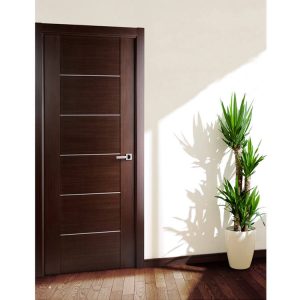
Solid wood 2 panel doors dominate the luxury residential sector. Oak, mahogany, and walnut are common choices for villa entrances where appearance justifies the higher material cost. These doors perform well in temperate climates with moderate humidity.
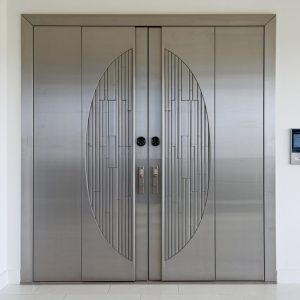
Aluminum alloy 2 panel doors with thermal breaks are the commercial workhorse. They handle wind loads better than wood, resist corrosion in coastal environments, and support larger glass panels without sagging. High-rise residential towers and commercial lobbies typically specify aluminum for these reasons.
Composite and hybrid doors (fiberglass skins over engineered cores) offer a middle path. They mimic wood grain, resist moisture better than solid timber, and cost less. Housing developers use them where budget constraints rule out solid wood but aesthetics still matter.
| Material | Best Application | Key Advantage | Primary Limitation |
|---|---|---|---|
| Solid Wood | Luxury villas, heritage projects | Aesthetic warmth, perceived value | Warping risk in humid climates |
| Aluminum (thermal break) | Commercial towers, coastal sites | Zero maintenance, high wind resistance | Higher upfront cost |
| Composite/Hybrid | Housing developments | Moisture resistance, cost balance | Lower resale value |
The application determines the material. A beachfront property in Miami has different requirements than a mountain villa in Colorado. Buyers who skip this analysis often face callbacks within the first year.
The Engineering of a Two-Panel Configuration
The vertical stile running down the center of a 2 panel door is the structural backbone. It must resist torsion—the twisting force that occurs when a door is opened and closed repeatedly. Wide doors (above 900mm) require either thicker stiles or internal reinforcement, especially if the design includes a full-height glass lite.
The bottom rail carries the most stress. It supports the door’s weight against the hinge side and absorbs impact from daily use. For solid wood doors, manufacturers typically use finger-jointed stiles or laminated construction to prevent warping. For aluminum, the extrusion profile must be reinforced at the lock rail to prevent flexing.
The meeting stile—where the door meets the frame—is the critical weak point. Air and water infiltration occur here first. Multi-point locking systems pull the door tight against the frame, compressing weather-stripping evenly along the entire height. A single-point lock leaves the top and bottom corners vulnerable to leakage and forced entry.
Thermal Performance and Air-Tightness: The Numbers That Matter
Thermal performance is measured by the U-value (heat transfer coefficient). Lower is better. For a 2 panel exterior door, the target depends on climate zone:
- ENERGY STAR certified doors for northern US climates must achieve U-values around 0.27 or lower
- Passive House standards require U-values below 0.14, demanding triple glazing and highly insulated frames
- European standards (EN ISO 10077-1) specify different thresholds by region
Air-tightness is measured in cubic meters per hour per square meter (m³/h·m²) at a given pressure differential. A well-sealed 2 panel door should achieve Class 4 under EN 12207 (the highest European classification), meaning minimal air leakage even at 600 Pa wind pressure.
The frame and door must be designed as a system. A high-performance door slab attached to a poorly insulated frame performs no better than a cheap door. Buyers should request the complete assembly’s test certificate, not just the door leaf rating.
Multi-Point Locking and Hardware: The Hidden Backbone
A 2 panel exterior door is only as secure as its locking system. Standard single-point locks are insufficient for wide doors—they create a pivot point that allows the opposite corner to be pried open.
3-point locking systems secure the top, middle, and bottom. 5-point systems add intermediate points for wider doors. These distribute pressure evenly along the meeting stile, compressing gaskets across the full height and improving both security and weather resistance.
Hinges bear the entire door weight. A solid wood 2 panel door can weigh 60-80 kg. Standard hinges fail under this load, causing the door to sag and bind against the frame. Stainless steel ball-bearing hinges rated for the specific door weight are the minimum specification. The frame must also be reinforced at hinge points—wood frames need solid blocking, aluminum frames need thicker extrusion walls.
For glass lites, tempered or laminated glass is mandatory in most jurisdictions. Tempered glass breaks into small, dull pieces rather than dangerous shards. Laminated glass holds together when shattered, providing security and sound insulation. Low-E coatings reflect infrared heat while allowing visible light through, improving energy efficiency. Argon gas filling between double or triple panes further reduces heat transfer.
How to Evaluate 2 Panel Exterior Door Suppliers
The evaluation starts with documentation. A legitimate manufacturer should provide test reports from accredited laboratories, not self-declared specifications. Look for certifications like:
- ISO 9001:2015 for quality management systems
- CE marking (for European markets) under EN 14351-1
- ENERGY STAR certification (for North American markets)
- ASTM E330 or EN 12211 for wind load resistance
Ask for the test reports. A factory that cannot produce third-party verification of air-tightness, water-tightness, and wind load is asking you to take a risk.
Verifying manufacturing capability requires specific questions:
- What is your production capacity per month for 2 panel doors?
- What is your defect rate and how do you measure it?
- Can I have a video call to see the production line?
- Do you have a pre-shipment inspection process? Who conducts it?
- What is your MOQ for custom sizes vs. standard sizes?
- What is your current lead time for a container order?
Red flags to avoid:
- Suppliers who cannot provide test reports with specific numbers
- Factories that outsource production without disclosure
- Quotations that are significantly lower than market average (something is being sacrificed)
- Reluctance to conduct video factory tours
- Vague answers about production capacity
A supplier’s willingness to answer technical questions reveals their competence. A genuine manufacturer knows their production process in detail. A trading company will give you vague answers and forward your questions to someone else.
Key Quality Indicators for 2 Panel Exterior Door Buyers
Moisture content for solid wood doors should be 8-12%, matched to the destination climate. Wood outside this range will warp or crack as it equilibrates to local humidity.
Surface finish durability matters more than initial appearance. Ask about the coating system: UV-resistant paints, polyurethane finishes, or factory-applied stains. The finish determines how the door looks after 3-5 years of sun exposure.
Dimensional accuracy should be within ±2mm for width and height, and ±1mm for diagonal measurements. Doors that are out of square cause binding, poor weather sealing, and premature hardware failure.
Glass seal integrity prevents condensation between panes. The spacer system and primary/secondary seals must meet manufacturer specifications. Fogged glass is a common warranty claim—prevent it by choosing suppliers who use proper desiccant-filled spacers.
Hardware compatibility is often overlooked. Not all locksets fit all doors. The backset, bore hole spacing, and latch size must match. When ordering custom doors, specify the hardware brand and model to the factory so they can machine the door accordingly.
Relevant Industry Standards and Certifications
The global landscape of door standards is fragmented. Buyers must know which standards apply to their target market:
| Standard | Region | Key Requirement |
|---|---|---|
| ISO 9001:2015 | International | Quality management system certification |
| EN 14351-1 | Europe | CE marking for windows and doors |
| ENERGY STAR | North America | Energy efficiency certification |
| ASTM E330 | North America | Structural performance under wind load |
| EN 12207 | Europe | Air permeability classification |
| EN 12208 | Europe | Water tightness classification |
| EN 12211 | Europe | Wind load resistance classification |
A supplier exporting globally should be familiar with multiple standards. The key is matching the door’s performance to the destination market’s building code requirements. A door that meets Chinese national standards may not comply with Australian or European codes.
Production Process: From Raw Material to Finished Door
Understanding the production process helps buyers identify genuine manufacturers versus trading companies.
For wood doors: The process begins with timber selection and moisture conditioning. Lumber is kiln-dried to the target moisture content, then machined into stiles, rails, and panels. The components are joined using either traditional mortise-and-tenon construction or modern dowel-and-glue methods. Panels are fitted into grooves that allow natural wood movement. The assembled door is sanded, sealed, and finished with multiple coats of paint or stain. CNC machining creates precision cuts for hardware and glass openings.
For aluminum doors: Extruded aluminum profiles are cut to length, then processed on CNC machining centers for hinge slots, lock holes, and drainage channels. Thermal break polyamide strips are inserted to separate the interior and exterior aluminum surfaces. The profiles are assembled, and glazing gaskets are installed. Glass panels are fitted, and the door is adjusted for smooth operation.
Quality checkpoints exist at every stage. Incoming material inspection verifies timber quality or aluminum alloy composition. In-process checks monitor dimensions and assembly accuracy. Final inspection tests door operation, hardware function, and visual appearance.
Our 2 Panel Door Manufacturing Capabilities
The industry reality is that many importers buy from trading companies, which adds a markup and creates a layer of separation between buyer and production. As a manufacturing factory, we control the entire production line. This means your 2 panel exterior door order is produced to the exact specifications in your contract, with direct communication between your team and our engineers.
Our production covers solid wood doors, thermal-break aluminum doors, and aluminum alloy entrance doors. The factory operates CNC machining centers for precision joinery and profile processing. Surface treatment lines handle painting, anodizing, and wood grain finishing. This vertical integration allows us to maintain consistent quality across production runs—essential when you are ordering 40 matching doors for a development.
Full customization is standard. Size, color, glass type, and hardware accessories are specified to your project requirements. Our engineering team adjusts profile structures and fittings to match the local building codes of your target market. A 2 panel door destined for Florida can be engineered for high wind load, while the same design can be adapted for the thermal requirements of a Scandinavian project.
Quality Control: Our Multi-Stage Inspection Process
Before any shipment leaves our factory, it passes through a multi-stage inspection protocol that mirrors the industry standards discussed earlier. We conduct air-tightness, water-tightness, and wind resistance tests on sample units from each production batch. These tests verify that the doors meet the performance specifications agreed upon in the contract.
The inspection process covers:
- Dimensional verification against approved drawings
- Surface finish quality checks under standardized lighting
- Hardware function testing (locks, hinges, handles)
- Glass seal integrity inspection
- Weather-stripping continuity checks
- Packaging verification for export readiness
Video evidence of these tests is available on request. For bulk orders, third-party inspection can be arranged at your cost.
Customization and OEM/ODM Options
The OEM/ODM distinction matters for procurement planning. OEM means we manufacture to your exact specifications and brand the product under your label. ODM means we assist in the design and engineering—useful if your team lacks in-house door engineering expertise.
For private label programs, we coordinate packaging, labeling, and documentation to match your brand. For construction projects, we provide shop drawings for approval before production begins. This eliminates the “we thought you meant something else” problem that plagues custom orders.
Hardware coordination is part of the customization. If you specify a particular lockset brand, we machine the door to fit that exact model. This prevents field modifications that void warranties and compromise security.
Ordering Process: MOQ, Lead Time, and Shipping
MOQs vary by material and size. Standard sizes are more cost-effective because they use production capacity efficiently. Custom sizes require longer lead times due to additional setup and engineering work.
Typical lead times:
- Standard sizes: 15-25 days after deposit confirmation
- Custom sizes: 25-40 days, depending on complexity
- Bulk projects: scheduled to align with your construction milestones
Shipping options:
- FCL (Full Container Load): Recommended for bulk orders. Reduces handling and transit damage risk.
- LCL (Less than Container Load): Suitable for testing a new market or smaller orders. Lower initial investment but higher per-unit shipping cost and greater handling risk.
We support both shipping methods, delivering directly from our factory in China to your project site. Export documentation—packing lists, proforma invoices, and customs documents—is prepared by our team to streamline your import process.
Payment terms typically require a 30% deposit with the balance before shipment. For established relationships, alternative terms can be discussed.
Certifications and Industry Standards
Our production processes operate under ISO 9001:2015 quality management systems. The factory’s test equipment is calibrated to industry standards, and we maintain records of performance testing for each product line.
For specific projects, we provide:
- Test reports for air-tightness, water-tightness, and wind load
- Material certificates for timber and aluminum sources
- Compliance documentation for target market building codes
The key is aligning our production standards with your project requirements. A door that meets European CE standards may not automatically satisfy Australian code requirements. We work with your specifications to ensure compliance.
Questions to Ask Before Placing an Order
Before you commit to a supplier, work through this checklist:
- What is the moisture content of the timber you use, and how is it controlled?
- Can you provide test reports for the specific door model I am ordering?
- What is your rejection rate for finished doors at final inspection?
- How do you handle warranty claims for doors that fail in the field?
- Can you provide references from projects in similar climates to my target market?
- What is your production capacity for my order size, and what other orders are in your current queue?
- How do you handle color matching across multiple production batches?
The answers reveal more than the supplier’s competence—they reveal their honesty. A supplier who acknowledges limitations is more trustworthy than one who claims perfection.
Choose the Right Supplier for Your Project
Choose a solid wood 2 panel door supplier if your project is luxury residential, the budget prioritizes aesthetics, and the climate is temperate or controlled.
Choose an aluminum 2 panel door supplier if your project involves commercial construction, coastal exposure, high wind loads, or requires minimal maintenance.
Choose a composite door supplier if you are a housing developer balancing cost against durability, or if the project is in a high-humidity environment where wood will struggle.
Choose our factory if you need direct manufacturer communication, full customization to meet local building codes, and a partner who understands the documentation and logistics requirements of international trade. We provide the technical depth discussed in this guide, backed by a production line that delivers consistent quality at scale.
The conversation starts with your project requirements. Send us your specifications, and our engineering team will respond with technical recommendations, not just a quote.
—
References
[1] ISO 9001:2015 Quality management systems — Requirements. International Organization for Standardization. https://www.iso.org/standard/62085.html
[2] EN 14351-1:2006+A2:2016 Windows and doors — Product standard, performance characteristics. European Committee for Standardization. https://standards.cencenelec.eu/
[3] ENERGY STAR Certified Doors. US Environmental Protection Agency. https://www.energystar.gov/products/windows_doors_and_skylights
[4] ASTM E330/E330M-14 Standard Test Method for Structural Performance of Exterior Windows, Doors, Skylights and Curtain Walls by Uniform Static Air Pressure Difference. ASTM International. https://www.astm.org/e0330_e0330m-14.html
[5] EN 12207:2016 Windows and doors — Air permeability — Classification. European Committee for Standardization. https://standards.cencenelec.eu/
[6] EN 12208:2000 Windows and doors — Water tightness — Classification. European Committee for Standardization. https://standards.cencenelec.eu/