
Content Menu
● 1. The Supply Chain Advantage: Why Factory-Direct Matters for Wooden Door Projects
● 2. Our Exterior Wooden Door Range: From Classic Villa to Modern Commercial
● 3. Flexible Collaboration Models: OEM, ODM, and Bulk Supply
● 4. Logistics and Delivery: Getting Your Doors to the Job Site on Time
● 5. Cost Competitiveness: Engineering Value Without Compromising Quality
● 6. After-Sales Support and Project Consultation
9 min read
When a contractor in Melbourne emails us about a 40-unit villa project, the first question is rarely about timber species. It is about whether we can hold a consistent finish across 80 door slabs and still hit the shipping window. That is the reality of sourcing wooden double doors exterior for a development. The aesthetics matter, but logistics and repeatability decide whether the project stays on schedule.
We are Jusen Door and Windows Manufacturing Co., Ltd., a factory in China that has spent over a decade shipping solid wood doors, thermal-break aluminum systems, and custom villa fenestration to buyers across five continents. This guide covers what B2B buyers need to know before placing an order for wooden double doors exterior—from our production floor to your job site.
The Supply Chain Advantage: Why Factory-Direct Matters for Wooden Door Projects
Large-format wooden doors are awkward. A single double-door set can weigh 80 to 150 kilograms depending on configuration. Shipping them halfway around the world involves container loading, moisture control, and customs clearance. If you source through a trading company, you add a layer of markup and lose direct control over production timelines.
Our structure eliminates that gap. You are dealing with the manufacturer, not a broker. When you request a quote for wooden double doors exterior, the price you receive reflects our actual production costs—materials, labor, overhead—not a middleman’s margin. We have seen buyers save 15 to 20 percent on comparable specifications simply by cutting out the intermediary [1].
Stable Sourcing and Production Capacity
Our factory runs dedicated lines for solid wood and engineered wood door fabrication. For bulk orders—say, 100 sets for a gated community—we allocate production slots to ensure consistent output. We maintain relationships with timber suppliers in Southeast Asia and South America, so raw material shortages do not stall your project. If a specific species is unavailable, our procurement team will flag it during the quotation stage, not after you have signed the contract.
Rigorous Pre-Shipment Quality Control
Every batch of wooden double doors exterior goes through a three-stage inspection before it leaves our floor. We test for air-tightness, water-tightness, and wind resistance. These are not optional checks. Exterior doors face constant weather exposure, and a door that fails on sealing will cost you warranty claims and reputation. Our QC team documents each test and includes the report with your shipment.
Pricing Transparency
Here is an imperfect insight: factory-direct pricing is not always the lowest number on paper. Shipping costs, customs duties, and payment terms can offset the base price. What factory-direct does guarantee is that you are not paying for a trading company’s office rent and sales commissions. The margin you save goes into better hardware or thicker glass—upgrades that actually matter to your end client.
Our Exterior Wooden Door Range: From Classic Villa to Modern Commercial
We do not make one type of wooden double door. Our product range covers the spectrum from traditional solid wood to hybrid configurations that combine timber aesthetics with aluminum structural performance.
Custom Solid Wood and Engineered Wood Configurations
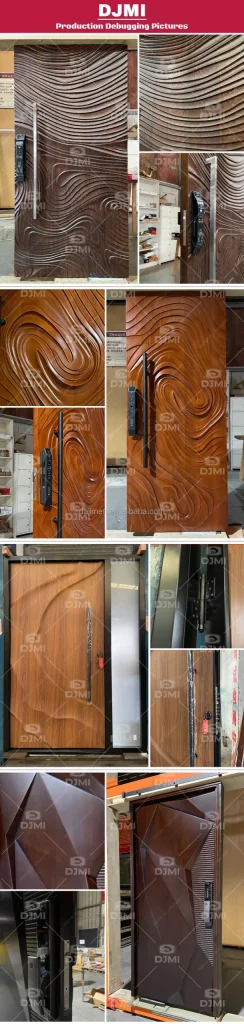
For buyers who want the full grain of natural timber, we offer solid wood doors in oak, mahogany, sapele, and other species. Solid wood has an unmatched visual depth, but it expands and contracts with humidity changes. That is why we also manufacture engineered wood doors—layered construction with a stable core and a wood veneer surface. Engineered doors resist warping better in climates with seasonal swings, and they are often more cost-effective for large projects.
Our team adjusts the profile structure based on door size and weight. A double door spanning 1.8 meters wide requires different internal framing than a single 0.9-meter door. We calculate the core density and hinge placement to prevent sagging over time.
Integration with Thermal-Break Aluminum Systems
This is where we differ from many door workshops. We also manufacture thermal-break aluminum doors and windows. That means we can build a wooden double door exterior with an aluminum sub-frame, sidelights, or transom windows. The wood gives you the curb appeal; the aluminum provides structural rigidity and thermal performance.
For a project in a cold climate, the thermal-break profile reduces heat transfer through the frame. For a coastal project, the aluminum resists corrosion better than wood in salt-laden air. You get the best of both systems from a single supplier, which simplifies coordination and reduces the risk of interface failures.
Hardware and Glass Customization
A door is only as good as its hardware. We offer full customization on size, color, glass, and hardware accessories. You can specify multi-point locking systems for security, concealed hinges for a clean look, or pivot hinges for oversized doors. Glass options range from double-glazed units for insulation to frosted or decorative patterns for privacy.
We do not lock you into a catalog. Send us your architectural drawings, and we will match the hardware and glazing to the design intent.
Flexible Collaboration Models: OEM, ODM, and Bulk Supply
Different buyers work differently. A distributor needs a product they can rebrand. A contractor needs doors that fit specific openings. A developer needs documentation that clears customs without delays. We structure our engagement around your business model.
Private Label and OEM Manufacturing
If you sell doors under your own brand, we manufacture to your specification and ship without any Jusen markings. We can adjust the profile structure and fittings to match the building codes of your target market. For example, European buyers often require specific locking mechanisms certified to EN standards. We source and install the correct fittings so your inventory is compliant from day one.
Custom Sizing for Construction Projects
Construction sites rarely have perfectly square openings. Our engineering team works with your measurements to produce doors that fit within tolerances. We provide adjustable profile structures that accommodate minor variations in the rough opening. This reduces on-site adjustments and installation time—a real cost saving when you are paying crews by the hour.
Documentation and Compliance Support
Importing from China involves paperwork: commercial invoices, packing lists, bills of lading, certificates of origin. Our foreign trade team has handled shipments to over 30 countries. We prepare the full customs documentation set, so your freight forwarder does not have to chase us for missing forms. For buyers unfamiliar with Chinese export procedures, we walk you through the process step by step.
Logistics and Delivery: Getting Your Doors to the Job Site on Time
Shipping large wooden doors is a test of packaging and planning. A damaged door is not just a replacement cost—it is a schedule delay. We design our logistics to minimize both risks.
FCL and LCL Shipping Solutions
For large developments, we recommend Full Container Load (FCL) shipments. An FCL container holds roughly 40 to 60 double door sets depending on dimensions, and it reduces handling because the container goes directly from our factory to your port. For smaller projects or sample orders, Less than Container Load (LCL) allows you to ship partial volumes. LCL costs more per unit but avoids overstocking.
We handle both modes with equal care. Our team coordinates with freight forwarders to book space and manages the inland transport from our factory to the departure port.
Secure Packaging for Long-Distance Transit
Wooden doors need protection against moisture and impact during sea freight. We wrap each door slab in a breathable film to prevent condensation, then add corner protectors and foam padding. The doors are crated or palletized depending on the size. We have shipped to humid ports in Southeast Asia and cold climates in Scandinavia—the packaging varies based on the route and season.
Cost Competitiveness: Engineering Value Without Compromising Quality
Price is a function of design, materials, and manufacturing efficiency. We control all three.
Vertical Integration
Our factory does not merely assemble components. We fabricate the frames, process the timber, and apply the finishes in-house. This vertical integration means we control labor costs and material waste. When timber prices fluctuate, we can adjust our sourcing strategy without changing the quality of the final product.
Long-Term Partnership Pricing
For buyers who commit to ongoing supply—say, a development company with multiple phases—we offer tiered pricing that rewards volume. A single large order gets one price. A 12-month supply agreement gets a better one. We prefer long-term relationships because they allow us to plan production capacity and secure raw materials at favorable rates.
After-Sales Support and Project Consultation
Our relationship does not end at the port. We provide technical installation guidance for your crew. This includes mounting details, sealing recommendations, and hardware adjustment instructions. For complex projects, we can review your installation drawings and flag potential issues before they become on-site problems.
We also keep records of every production batch. If a warranty issue arises, we can trace the materials and production parameters for that specific order. This traceability is rare among small workshops but essential for construction projects with multi-year liability periods.
Making the Right Sourcing Decision
Choose us if you need a manufacturer that can handle custom specifications, bulk volumes, and international logistics under one roof. We are not the cheapest option for a single door replacement. We are the right option when consistency, compliance, and delivery reliability matter more than the lowest unit price.
A few practical notes before you order:
Q: What is the minimum order quantity for custom wooden double doors?
Our MOQ depends on the configuration. We support both FCL and LCL shipments, so we can accommodate small trial orders as well as large development volumes. Contact our team to discuss your requirements, and we will propose a workable solution.
Q: Can you match specific architectural drawings?
Yes. We provide full customization on size, color, glass, and hardware. Send us your drawings, and our engineers will confirm the feasibility and suggest adjustments if needed.
Q: How do you handle weather resistance for exterior doors?
Every exterior door set is tested for air-tightness, water-tightness, and wind resistance before shipment. For extreme climates, we recommend integrating thermal-break aluminum sub-frames for additional structural performance.
Q: What export documents do you provide?
We supply a packing list, proforma invoice, bill of lading, and any certificates of origin required for your destination country. Our team has experience with customs procedures across major markets.
Q: How long does production take?
Typical production lead time is 20 to 35 days after design approval, depending on order size and complexity. We will confirm the schedule in your quotation and keep you updated throughout production.
—
The decision comes down to this: if you want a supplier who will disappear after the container leaves the port, there are cheaper options. If you want a factory that answers technical questions, provides documentation, and stands behind the product, we are ready to talk.
Ready to source wooden double doors exterior for your next development? Let us know your specifications and volume requirements.
References
[1] International Trade Centre, “The Role of Intermediaries in Export Supply Chains,” ITC Market Analysis, 2022. https://www.intracen.org/publications
[2] Wood Products Council, “Moisture Content and Dimensional Stability of Solid vs. Engineered Wood,” WoodWorks, 2021. https://www.woodworks.org/resources
[3] ASTM International, “Standard Test Methods for Air Leakage and Water Penetration of Exterior Windows and Doors,” ASTM E283/E331, 2019. https://www.astm.org
[4] UN Comtrade Database, “Global Trade in Wooden Doors and Windows,” United Nations, 2023. https://comtradeplus.un.org
[5] Builders’ Association of America, “Best Practices for Importing Building Materials: Documentation and Compliance,” BAA Technical Bulletin, 2022. https://www.buildersassociation.org





