Last updated: September 19, 2026
Understanding Patio Door Cost: What Drives the Price
Patio doors are exterior door systems—typically sliding, bifold, or accordion glass configurations—that connect indoor living spaces to patios or outdoor areas. For B2B buyers, the cost of a patio door is not a single number but the sum of a material profile, a glass package, hardware, fabrication complexity, and order volume. Understanding how these layers stack is the fastest way to read a supplier quote and spot where money is actually being spent.
Material is the first and largest cost driver. Aluminum systems sit at the accessible end of the commercial range, while thermal-break aluminum—where a non-conductive barrier separates interior and exterior profiles—costs more because it controls condensation and improves energy performance. Solid wood and wood-clad systems sit higher again, driven by timber grade and finishing labor. For exterior patio applications, thermal-break aluminum is the common baseline in many export markets because it balances durability, price, and code compliance.
Size and panel count follow closely. A wider opening needs more profile, more glass, heavier tracks, and stronger hardware. A two-panel slider is the simplest and cheapest configuration per square meter; three- and four-panel systems add rollers, interlocks, and structural reinforcement. Glass specification is the next lever: single glazing is rarely acceptable for exterior doors in most markets, double glazing is standard, and triple glazing or low-E coatings with argon fill push cost upward. Laminated or tempered safety glass adds a further premium and is often required by local building codes.
Hardware and customization complete the picture. Standard rollers, handles, and locks are inexpensive; stainless-steel roller assemblies, multi-point locking, and soft-close mechanisms raise both cost and service life. Any non-standard size, custom RAL color, or special glass pattern introduces tooling and setup time, which is why fully custom units carry a higher unit price than stock sizes—even when the material is identical.
Patio Door Pricing by Configuration: Sliding, Bifold, and Accordion
Configuration changes both the engineering and the price. As a general commercial range for factory-direct supply, sliding systems are the lowest cost per panel, bifold systems sit in the middle, and accordion (folding) systems are the highest because of the number of moving parts and the precision required in the track and hinge assemblies.
| Configuration | Typical Cost Positioning | Main Cost Drivers |
|---|---|---|
| 2-panel sliding | Lowest per panel | Profile, glass, basic rollers |
| 3-panel sliding | Moderate | Extra panel, track length, interlock |
| Bifold (2–4 panels) | Moderate to high | Hinges, top track, panel weight |
| Accordion glass | Highest | Many panels, complex hardware, alignment |
For sliding doors, the price of patio doors scales roughly with panel count and glass area rather than with a fixed unit rate. Bifold systems cost more per panel than sliders because each panel needs hinges, a top-hung or bottom-rolling track, and careful weight distribution. Accordion glass patio doors cost the most because a single opening may contain five or more folding panels, each requiring alignment hardware so the stack folds cleanly.
3-Panel Sliding and 3-Panel Patio Door Price Factors
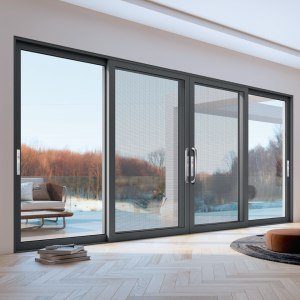
The 3-panel sliding patio door is one of the most requested configurations in B2B projects, and its price is shaped by a few specific variables. The first is panel width: a three-panel door covering a 2.4 m opening uses narrower panels than one covering a 3.6 m opening, and wider panels require thicker glass and heavier rollers. The second is the track system—a standard two-track layout is cheaper than a three-track design that allows all panels to slide past one another.
Glass choice moves the number significantly. A 3-panel patio door price quoted with double-glazed clear glass can rise by a meaningful margin once you specify low-E coating, argon fill, or laminated safety glass on the traffic panel. Hardware matters too: standard nylon rollers are adequate for light residential use, but stainless-steel roller assemblies rated for higher panel weights are the safer specification for high-traffic commercial or coastal projects.
Buyers should also confirm whether the quote includes the frame, the threshold, and the screen. A low headline price for a 3-panel patio door often excludes the screen track or uses a thinner profile, which becomes visible only when the units arrive. Asking for a full bill of materials per panel is the simplest way to compare two quotes that look identical on the surface.
Accordion Glass Patio Doors Cost and Bifold Patio Door Price
Accordion glass patio doors cost more than any other configuration because they combine a large number of panels with hardware that must keep every panel aligned through thousands of open-and-close cycles. The price of accordion systems rises with panel count, panel height, and the weight of the glass specified. A five-panel accordion door in double glazing will typically cost more than a three-panel bifold of the same opening width, because the folding mechanism and track complexity are greater.
The price of bifold patio doors is driven by similar logic but at a lower hardware count. Key factors include whether the system is top-hung or bottom-rolling, the number of panels per leaf, and the locking arrangement. Top-hung bifold systems carry the panel weight from an overhead track and generally cost more but operate more smoothly; bottom-rolling systems are simpler and cheaper but require a clean, level floor track.
For both types, the glass package is often the single largest line item after the frame. Specifying the same U-factor across a bifold and an accordion system will not produce the same price, because the accordion system needs more edge sealing and more glass units overall. Buyers comparing the cost of a patio door across configurations should normalize for opening size and glass specification before drawing conclusions.
How to Compare Patio Door Quotes from Suppliers
Comparing quotes line by line is where B2B buyers protect margin. A useful quote breaks out the frame profile and wall thickness, the glass make-up and U-factor, the hardware brand or specification, the finish, and the shipping terms. If a supplier returns a single lump-sum figure, ask for the breakdown before comparing it to anyone else.
Order volume, shipping, and Incoterms change the total cost as much as the product itself. FCL shipments lower the per-unit freight cost compared with LCL, where consolidation and handling add to the landed price. The chosen Incoterm—EXW, FOB, CIF, or DDP—determines who pays freight, insurance, and import duties, so two quotes at the same unit price can land at very different totals. Always compare quotes on a landed-cost basis for the same Incoterm.
Quality and compliance checks justify price differences and should be part of the comparison. Ask whether the supplier performs air-tightness, water-tightness, and wind-resistance testing before shipment, and whether the profile structure and fittings can be adjusted to match your local building codes. A slightly higher unit price from a supplier who tests and documents performance is usually cheaper than a low quote that fails inspection on arrival.
Why Work With a Direct Manufacturer
Once the pricing framework is clear, the practical question is where to source. Working directly with a manufacturer removes middleman markup and gives buyers control over specification rather than choosing from a fixed catalog.
As a manufacturer, our approach at Jusen Door and Windows is built around that control. We supply directly from our factory, so pricing reflects production cost rather than distributor margins. We offer full customization on size, color, glass, and hardware accessories, which means a 3-panel sliding patio door or an accordion glass system can be built to the exact opening and performance level your project requires. Before shipment, units go through air-tightness, water-tightness, and wind-resistance testing, and we can adjust the profile structure and fittings to match the building codes of your target market. For buyers new to importing, we provide packing lists, proforma invoices, and full customs documents, and we ship both FCL and LCL with direct delivery from our China factory. If you are sourcing for a construction project, resale, or OEM program, you can contact our team to discuss your specification.
Get a Quote for Your Patio Door Project
Patio door pricing comes down to material, size, glass, hardware, configuration, and volume—and the most accurate number comes from a supplier who knows your opening dimensions and performance requirements. If you are ready to move from ranges to a real figure, Get a Free Quote and share your drawings, quantities, and destination port.