9 min read
When you’re sourcing aluminum alloy door and window profiles for a large-scale construction project or a high-end villa development, the profile itself is the foundation of everything—thermal performance, structural integrity, and the final aesthetic. Yet many B2B buyers find themselves stuck between suppliers who offer low prices but inconsistent quality, or premium profiles that lack design flexibility. At Jusen Doors & Windows Manufacturing Co., Ltd., we’ve spent 20 years mastering both the art of solid wood processing and aluminum window production, building a factory that controls every step from raw billet to finished profile. This article walks through what makes a premium aluminum profile, how our manufacturing capabilities deliver on that promise, and why global contractors, interior designers, and developers trust us as their OEM/ODM partner. Whether you need custom sizes, private labeling, or bulk supply for a multi-story project, we have the engineering support and logistics to make it happen.
What Defines a High-Quality Aluminum Alloy Profile for Doors and Windows?
The difference between a profile that performs for decades and one that fails after a few seasons comes down to three factors: alloy composition, wall thickness, and surface treatment. Our factory has invested heavily in understanding these variables because we know that every project—whether a coastal villa or a commercial tower—demands specific properties.
Alloy Composition and T-Series Standards
The most common alloys for architectural profiles are 6063-T5 and 6060-T66. These offer an excellent balance of extrudability, strength, and corrosion resistance. We source only primary aluminum billets from certified mills, ensuring consistent chemical composition across every batch. In our self-built aluminum processing workshops, we perform in-house checks on hardness and tensile strength before extrusion begins. This is not a step we outsource—it’s part of our quality control system that has been refined over two decades. If a billet doesn’t meet our internal standards, it never reaches the extrusion press.
Wall Thickness and Structural Integrity
National standards for exterior window profiles typically require a minimum wall thickness of 1.4mm for load-bearing sections. However, we often see thin, unstable profiles in the market that save material at the expense of safety. Our approach is different: we maintain tight tolerances (typically ±0.1mm) even on complex custom shapes. Because we own our extrusion lines and aging workshops, we can adjust parameters in real time to maintain structural integrity. For projects requiring higher wind-load resistance, we can increase thickness to 1.6mm or 2.0mm without compromising the profile’s geometry.
Surface Treatment Options: Powder Coating, Anodizing, and Thermal Break
Surface finish is where aesthetics meet durability. Our in-house spraying workshops apply UV-resistant, fade-proof powder coatings that withstand years of sun exposure. For projects that demand a metallic look, we offer anodizing in multiple shades. But the most critical feature for energy-efficient buildings is the thermal break. We integrate PA66 nylon strips—reinforced with 25% glass fiber—into our profiles to create a barrier that reduces heat transfer. This is standard on our high-end window systems for villas and commercial projects, and it’s something we test rigorously in our own facility. We’ve seen thermal break profiles from other suppliers fail due to poor strip adhesion; our process ensures the nylon and aluminum bond permanently.
Our Factory Capabilities: From Raw Billet to Finished Profile
Bulk buyers and project developers need assurance that a supplier can deliver consistent quality at scale. Our factory is designed to meet that need. We don’t just assemble components; we control the entire production chain, which gives us unmatched flexibility in lead time, MOQ, and customization.
Advanced Extrusion and Processing Lines
Our aluminum processing workshops house multiple extrusion presses capable of handling profiles up to 6 meters in length. Beyond extrusion, we have CNC cutting centers, punching machines, and assembly lines that allow us to fabricate complete window and door frames. This vertical integration means we can take a custom drawing from your engineering team and turn it into a finished profile without relying on external subcontractors. For a recent villa project in Southeast Asia, we produced 2,000 linear meters of custom sliding window profiles in just 18 working days—a timeline that would be impossible if we had to outsource any step.
Self-Built Drying and Aging Workshops
After extrusion, profiles must undergo artificial aging to reach their final hardness (T5 or T6 temper). Many small manufacturers skip proper aging or use subcontractors who cut corners. We operate our own aging ovens with precise temperature control (±3°C), ensuring every profile achieves uniform mechanical properties. This is a lesson we brought from our 20 years of solid wood processing—where drying wood improperly leads to warping. We treat aluminum with the same discipline: consistency is non-negotiable.
Annual Output and Bulk Supply Guarantee
Our annual production capacity exceeds 500,000 square meters of finished windows and doors. For profile-only orders, we can handle multi-container shipments. We also maintain overseas warehouses in North America, which reduces shipping risk and logistics time for distributors in that region. When a contractor in California needs a rush order of thermal break profiles, we can ship from our local stock rather than waiting for a sea freight container from China. This is a direct result of our logistics strategy, built over years of serving global partners.
Custom Profiles for Specific Product Categories
Aluminum profiles are not one-size-fits-all. The geometry, chamber design, and finish must match the specific window type and building application. Our independent design team works closely with clients to adapt standard profiles to project-specific requirements.
Casement and Sliding Window Profiles
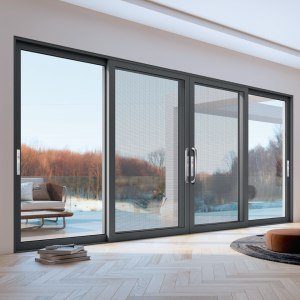
For casement windows, we design multi-chamber profiles that improve soundproofing and thermal insulation. The chambers also serve as drainage channels, preventing water ingress. Our sliding window profiles feature low-track designs with nylon rollers for smooth operation. When an interior designer in Dubai requested a custom color that matched their client’s façade, our team formulated a new powder coating shade and produced samples within 5 days. This level of responsiveness comes from having our own design and production teams under one roof.
Thermal Break Profiles for Energy-Efficient Villas
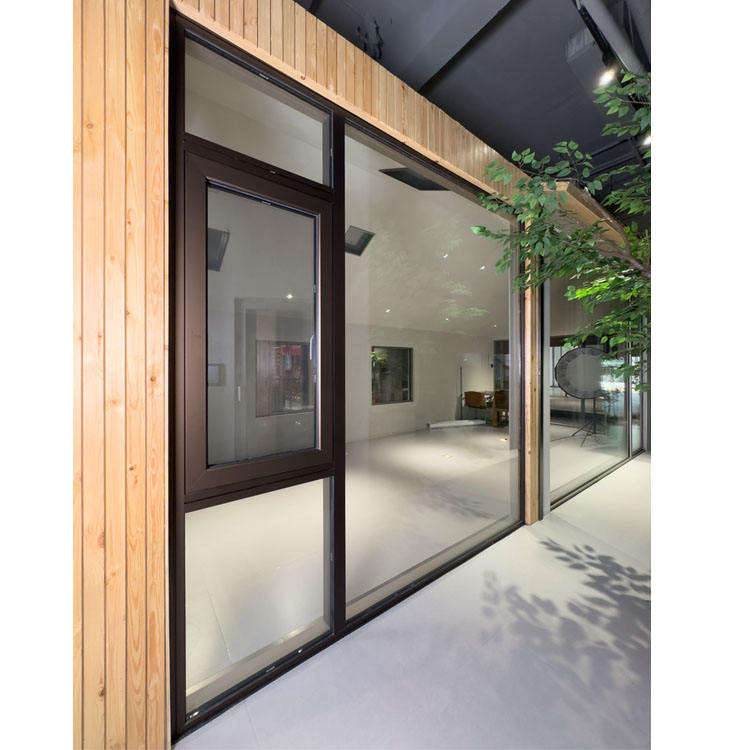
Energy codes in many regions now require U-values below 1.8 W/m²K for windows. Our thermal break profiles, combined with 3-seal weather-stripping systems, consistently achieve these targets. We offer multiple thermal break widths (from 14mm to 34mm) to match different climate zones. For a recent project in Germany, we supplied profiles with a 24mm polyamide strip and triple glazing, achieving a U-value of 0.9 W/m²K. Our engineers provided the thermal simulation data to support the building permit application—a service we offer as part of our OEM/ODM support.
Clad Profiles and Timber Door Frames: Hybrid Solutions
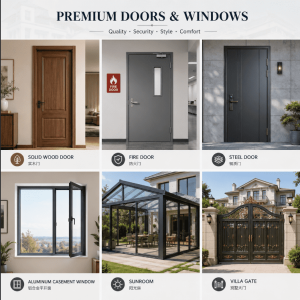
One of our unique advantages is that we manufacture both solid wood doors and aluminum windows. This allows us to engineer hybrid solutions that combine the warmth of wood with the durability of aluminum. For example, we can produce aluminum cladding profiles that wrap around timber door frames, protecting them from weather while maintaining a natural wood interior. This is ideal for villa developers who want the aesthetic of wood entry doors without the maintenance headaches. B2B buyers seeking a single-source vendor for both materials find this capability invaluable—it simplifies procurement, reduces lead times, and ensures consistent quality across the entire opening.
Quality Control: Ensuring Profile Consistency Across Every Batch
We’ve been in this industry for 20 years, and we’ve learned that quality isn’t a certificate—it’s a process. Every batch of profiles goes through multiple checkpoints before it leaves our factory.
In-House Testing for Dimensional Accuracy
Our quality team uses calibrated micrometers and optical comparators to check wall thickness, twist, and straightness on every production run. We know from experience that the most common failure points are at the corners of complex extrusions, where the metal can thin out. So we preemptively sample those areas. If the tolerance drifts beyond ±0.1mm, we stop the line and adjust the die. This level of control is only possible because we own the equipment and train our own technicians.
Surface Adhesion and Corrosion Resistance Tests
For powder-coated profiles, we conduct cross-hatch adhesion tests and salt spray tests (ASTM B117) on a sample from every batch. This ensures the coating will not peel or corrode in coastal or industrial environments. We recently tested a batch of white powder-coated profiles that had been exposed to 1,000 hours of salt spray—no blistering, no rust creep. That’s the standard we hold ourselves to.
Traceability for OEM and Private Label Orders
When we produce profiles under your brand name, every piece is tagged with a batch number that ties back to the raw material certificate, extrusion parameters, and coating records. If an issue arises on site, we can trace it to the exact production shift and correct it. This traceability is a requirement for many of our retail dealer and contractor partners, and it’s built into our production workflow.
Why Global Contractors and Developers Choose Our Profiles
Ultimately, the decision to partner with a manufacturer comes down to trust. Our clients tell us they stay with us because we solve their biggest pain points: engineering support, flexible ordering, and risk reduction.
One-Stop Service: From Drawing to Installation Guidance
We don’t just sell profiles; we provide customized construction drawings and formal quotations within 24 hours of receiving your inquiry. Our engineering team can review your architectural drawings and recommend profile designs that optimize both performance and cost. For a recent project in Australia, the contractor had a unique window shape that no standard profile could match. Our team designed a custom extrusion die, produced samples in 10 days, and provided installation guidance to the site crew. That’s the level of support we offer to every partner.
Flexible MOQ and Shipping Damage Guarantee
High minimum order quantities are a barrier for many B2B buyers. We support flexible MOQs—whether you need 50 linear meters for a prototype or 5,000 meters for a high-rise. And because profiles are prone to bending and scratching during transit, we offer a full shipping damage after-sales guarantee. If a profile arrives damaged due to handling, we replace it at no cost. This has been a key factor in building long-term relationships with distributors who cannot afford to disappoint their own customers.
Partnership Model for Distributors
We explicitly welcome global distributors. Our private label program allows you to sell profiles under your own brand, with customized packaging and marketing materials. We also offer exclusive territory agreements for qualified partners. If you’re a distributor looking to expand your product line with reliable aluminum profiles, contact our team to discuss a partnership.
Conclusion
Choosing the right aluminum alloy door and window profile supplier is a decision that affects your project’s performance, timeline, and reputation. At Jusen Doors & Windows Manufacturing Co., Ltd., we offer more than just profiles—we offer manufacturing depth, design flexibility, and a global service network backed by 20 years of experience. From our own extrusion lines and aging workshops to our North America warehouses and damage guarantee, every part of our operation is built to serve B2B buyers who demand quality and reliability.
How can we help with your next project? Whether you need a custom profile for a villa development, bulk supply for a commercial contract, or private labeling for your brand, we’re ready to provide a detailed quote and engineering support within 24 hours.
References
- The Aluminum Association. (2023). Standards for Aluminum Sand and Permanent Mold Castings. https://www.aluminum.org/standards
- American Architectural Manufacturers Association. (2022). AAMA 2604-22: Voluntary Specification, Performance Requirements and Test Procedures for High Performance Organic Coatings on Aluminum Extrusions. https://aamanet.org/
- European Committee for Standardization. (2021). EN 12020-2:2021 – Aluminium and aluminium alloys – Extruded precision profiles in alloys EN AW-6060 and EN AW-6063. https://www.cencenelec.eu/
- Jusen Doors & Windows Manufacturing Co., Ltd. (2024). Company Profile and Capabilities. https://doorwoodendoors.com
- National Fenestration Rating Council. (2023). NFRC 100-2023: Procedure for Determining Fenestration Product U-factors. https://www.nfrc.org/