
As global infrastructure investment, humanitarian construction, and institutional procurement projects continue to grow, international buyers are increasingly seeking procurement-ready suppliers with stable manufacturing systems, compliance capability, and large-scale project support experience.
In response to the growing demand for reliable engineering supply partners, JuSen Doors has officially completed registration on the United Nations Global Marketplace (UNGM), strengthening the company’s capability to participate in international procurement and global engineering supply chain projects.
UNGM is the official supplier and procurement platform of the United Nations system, connecting qualified suppliers with procurement opportunities from more than 30 UN organizations, including UNICEF, UNDP, WHO, WFP, UNHCR, and UNESCO.
A Standard Shift You Can’t Ignore
I’ve been in procurement long enough to know that the prettiest door in the showroom can become the ugliest problem on site. A warped stile. A finish that clouds over after one wet season. A factory that vanishes when you need a replacement panel for a 300-unit apartment block. I’ve lived through all of it.
Over time, my checklist has changed. I no longer start with veneer options or hinge finishes. I start with something much more fundamental: Is this manufacturer built to survive the scrutiny of global institutional procurement? In other words, could they supply a UN project?
That’s why JuSen Doors’ recent registration on the United Nations Global Marketplace (UNGM) caught my attention. It’s not a marketing badge. It’s a public declaration that a company’s operational backbone—its legal structure, production system, and export capability—has been formally verified. For those of us sourcing custom solid wood doors for global contractors, home designers, or villa real estate developers, this changes the conversation entirely. It shifts the focus from “what can you make” to “how reliably can you deliver.”
A Qualification That Does Your Due Diligence for You
Most buyers don’t interact with the UN procurement system, and that’s fine. But you should care about what it takes to enter it.
UNGM is the official portal for over 30 UN bodies, from UNICEF to WHO to UNDP. The annual procurement spend runs into billions of dollars across construction materials, healthcare infrastructure, and institutional facility development. To even appear on this platform as a qualified supplier, a manufacturer must submit, and have accepted, a dense dossier of evidence. We’re talking about company legal verification, operational transparency disclosures, product classification under international codes, and clear proof of international trade capability.
When I learned that JuSen Doors, a manufacturer with 30 years of solid wood craftsmanship, had completed this registration, one thought came to mind: “Someone has already done a deep audit for me.”
The project types that flow through UNGM mirror exactly what’s surging in the private sector: modular construction, emergency accommodation systems, government housing, educational buildings, healthcare facilities. If a door manufacturer can credibly bid for this work, they can certainly handle a boutique hotel in Scottsdale or a set of custom outdoor entry doors for a coastal villa development.
The Three Pillars of a Procurement-Ready Door Manufacturer
I’ve audited factories across Asia. The ones that consistently perform on complex international projects share three traits. I’m going to walk you through them, using JuSen Doors as the working case study, because their system illustrates exactly what I now insist upon.
Pillar One: Total Material Control Starts in the Kiln
A solid timber door’s fate is sealed long before it’s hung. It’s decided in the drying shed. Wood that leaves the factory with an internal moisture content unsuited to the destination climate will fail. It might take six months or a year, but joints will open, panels will rattle, and finishes will peel.
This is why an independent wood drying and painting workshop is the first thing I ask about. JuSen Doors operates its own drying kilns. This isn’t about owning equipment; it’s about refusing to outsource the most critical variable in dimensional stability. When they then move that properly dried timber into their own painting line, they’ve closed the loop. No finger-pointing between a drying subcontractor and a finishing shop when something goes wrong. Just one responsibility.
Pillar Two: The Design Desk Must Speak Engineering
A true OEM and ODM partner doesn’t just take your dimensions and fill in a template. It interrogates your drawing. An in-house design team—which JuSen maintains—will catch a clearance conflict, suggest a hardware matching solution that saves installation time on site, and return a technical drawing that a site manager can actually approve.
This is the source of the customized drawing and quotation within 24 hours promise. It’s not a sales gimmick. It’s a signal that the engineering desk is wired directly to the client-facing team. For a home designer or a retailer, this speed means you can present a professional, technically sound proposal to your client while your competitor is still waiting for an email reply.
Pillar Three: Your Supply Chain Needs a Physical Buffer
Bulk production capability is one piece. Smart logistics is the other. Large overseas warehouses across North America change the math entirely. They allow for flexible MOQs on fast-moving lines. They absorb the shock of port strikes or freight rate spikes. And they’re the foundation of a credible after-sales shipping damage guarantee.
When a manufacturer stocks inventory outside its home country, the commitment to the market is tangible. A damaged door on a Miami project isn’t a crisis that requires a 45-day sea freight drama. It’s a local replacement, dispatched from an in-region warehouse, keeping the project schedule and your reputation intact.
Where the Demand Is Growing, Quietly but Relentlessly
A lot of my industry friends ask me where the steady, large-volume door demand is coming from. My answer is consistent: modular and institutional construction.
Modular building systems, prefabricated construction, and government infrastructure projects are not speculative trends. They are the long-term response to urbanization rates and the critical shortage of affordable, durable housing. These projects consume doors at scale, but they demand products that meet exacting specifications: fire ratings for apartment developments, impact resistance for hospitals, moisture stability for educational buildings in tropical climates.
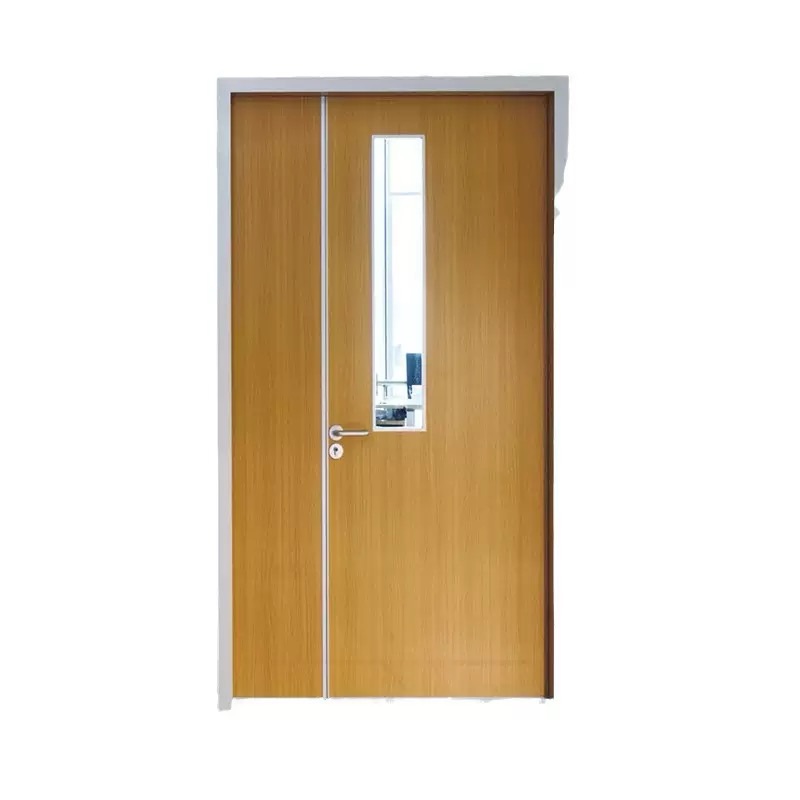
This is where a portfolio like JuSen’s becomes relevant. They’re not just turning out one type of indoor timber door. They’re manufacturing steel security doors, fire-rated doors, WPC doors, hospital doors, and wall panel systems—all from a single, managed quality system. That breadth, when it’s real and not just a catalog aspiration, is exactly what modular project buyers need. A single technical coordination point for a dozen different door types in one building complex.
A Personal Sourcing Checklist, Distilled from Too Many Mistakes
I’ve made the errors so you don’t have to. Here’s my five-step process for qualifying a long-term door manufacturing partner before a single dollar changes hands.
1. Demand the kiln conversation.
“Do you own and operate your own wood drying facility?” If the answer is hesitant or involves a third party, your risk profile has just jumped. Ask for moisture content logs for a recent shipment.
2. Send a sketch, not a spec sheet.
The first interaction shouldn’t be about price. Send a rough drawing with a challenging detail. Measure the response. Did you get back a considered, fully annotated technical drawing within a day? Or just a generic quote? The 24-hour drawing turnaround is a measurable test of engineering integration.
3. Probe the certifications, gently.
Don’t just accept a logo on a PDF. Ask softly: “We need this door tested to this specific fire standard. Can you coordinate that certification for this project, and which accredited body would you work with?” The difference between a “yes, we have certificates” and a detailed, standard-specific answer is the difference between a vendor and a partner.
4. Test the logistics mind.
Pose a realistic scenario: a split delivery, part to a warehouse, part to a live construction site, with different access constraints. Ask how they’d manage container loading optimization. A procurement-ready manufacturer will talk about loading plans and coordination, not just CIF terms.
5. Listen for the language of project management.
In early talks, does the factory use phrases like “production schedule management,” “change order procedure,” and “technical support documentation”? Or only “best price” and “fast delivery”? Language reveals operational reality. Choose the factory that sounds like a project engineer, not a stall at a trade fair.
A Verifiable Step Forward
The global market for doors is splitting into two tiers. The lower tier competes on price per unit, struggles with consistency, and fades when orders get complex. The upper tier, where JuSen Doors has positioned itself, competes on manufacturing depth, compliance transparency, and integrated global supply.
The UNGM registration is a public, verifiable marker of that upper tier. It says the company has invited third-party scrutiny of its legal, trade, and operational systems. Combine that with 30 years of wood craftsmanship, a closed-loop drying and painting system, a genuine in-house design team, and physical warehousing in North America, and you have a profile that should be on every serious buyer’s shortlist.
Your projects—and your professional reputation—deserve a door supplier that has been tested before you even pick up the phone.
Start your project specification now. Send your design brief to JuSen Doors’ engineering team and receive a complete technical drawing and quotation within 24 hours. [Link to Inquiry Page]
References
United Nations Global Marketplace (UNGM), About UNGM – https://www.ungm.org/Public/Pages/About
United Nations, Annual Statistical Report on United Nations Procurement – https://www.ungm.org/Public/ASR
JuSen Doors Official Website, Project Solutions – [Link to JuSen Doors Project Page]
Frequently Asked Questions
Why should I care if a door manufacturer is UNGM-registered when I don’t work for the UN?
UNGM registration acts as a free, third-party deep-dive on a manufacturer’s legal, financial, and operational stability. For any buyer of custom solid wood doors, it’s proof that the factory has passed a level of scrutiny far beyond a typical supplier audit, directly reducing your own due diligence burden and supply risk.
What is the real benefit of a factory having its own wood drying kilns?
It is the single most critical quality control point for timber doors. In-house kilns allow the manufacturer to precisely control moisture content for the target climate, preventing the warping, joint separation, and finish failure that plague doors made from improperly dried wood. It’s the foundation of a dimensionally stable, decades-lasting door.
How does an in-house design team improve my project, even if I’m just ordering a standard design?
A real engineering-backed design team doesn’t just copy. It checks your project details for conflicts, proposes hardware that suits your specific door weight and usage frequency, and produces technical submittals that architects and site managers can approve quickly. This cuts weeks of back-and-forth out of your pre-construction phase.
What advantage do North American overseas warehouses give me over a factory that just ships from China?
They fundamentally change your replenishment model. You can order smaller quantities at faster lead times, completely sidestepping the uncertainty of ocean freight for urgent needs. It also makes an after-sales shipping damage guarantee immediately actionable—a replacement door arrives from local stock, not from across the ocean.
What exactly should a “shipping damage guarantee” cover?
A professional guarantee means the manufacturer accepts liability not just for factory defects, but for damage occurring during international transit. It must include a pre-agreed claims process that provides replacement product or components without protracted dispute, protecting both your project’s installed cost and your construction timeline.





