Last updated: September 18, 2026
What Is a Retractable Screen Door for Patio Doors?
A retractable screen door for patio doors is a screen panel that rolls into a housing cassette mounted at the side or top of the opening, rather than swinging or sliding on a fixed track. When not in use, the mesh and its tensioning mechanism retract into the cassette, leaving the doorway clear. For most patio applications, the answer to “what size do I need” is straightforward: measure the clear opening, then match it to a standard unit width (30″, 32″, or 36″ for single panels; 60″ and up for double) and height (80″ or 96″), or specify a custom unit when the opening falls outside those increments.
The reason sizing matters more here than with a conventional screen door is that a retractable unit depends on a tensioned mesh and a guided track. If the housing is too short, the screen will not fully cover the opening; if the cassette is undersized for the span, the mesh sags and the latch misaligns. Sizing is therefore a fit-tolerance exercise, not just a width-and-height match.
How the Mechanism Affects Sizing
Retractable screens come in two motion types. A horizontal retractable screen door pulls sideways across the opening and stores in a vertical cassette on one jamb. A vertical unit pulls downward and stores in a horizontal header cassette above the door. Horizontal units dominate patio and single-door applications because they track the same path as the door swing or slide, while vertical units suit wide, low openings and some interior pass-throughs.
The mechanism dictates which dimensions are critical. On a horizontal unit, the cassette width plus the pull-bar and latch clearance must fit within the jamb-to-jamb opening. On a vertical unit, the header cassette depth must clear the door frame head. Both cases mean the finished opening, not the rough framing, is what you measure against.
Standard Size Chart: Widths, Heights, and Configurations
Retractable screen doors are sold in nominal sizes that correspond to common door openings. The table below reflects typical manufacturer offerings; confirm the exact tolerance with your supplier, because fit allowances vary by brand and by mounting method.
| Nominal size | Panel width | Height | Typical opening | Configuration |
|---|---|---|---|---|
| 30 x 80 | 30″ | 80″ | Single door, 30″–32″ clear width | Single panel |
| 32 x 80 | 32″ | 80″ | Single door, 32″–34″ clear width | Single panel |
| 36 x 80 | 36″ | 80″ | Single door, 36″–38″ clear width | Single panel |
| 32 x 96 | 32″ | 96″ | 8-foot single door | Single panel |
| 36 x 96 | 36″ | 96″ | 8-foot single door | Single panel |
| 60 x 80 | 2 x 30″ | 80″ | Double/French door, 60″–64″ clear width | Double panel |
| 72 x 80 | 2 x 36″ | 80″ | Double/French door, 72″–76″ clear width | Double panel |
| 96 x 96 | 2 x 48″ | 96″ | Oversized slider or patio opening | Double panel |
Two conventions matter when reading this chart. First, nominal width refers to the screen panel, not the cassette. A 36″ unit typically needs roughly 1″–2″ of additional jamb space for the housing and pull bar, so a 36″ screen usually fits a finished opening of about 37″–39″. Second, height is measured from the sill or threshold to the head of the frame; a 96″ unit assumes a true 8-foot opening, which is why “8 foot retractable screen door” is a distinct product category rather than a stretched 80″ unit.
Standard vs. Custom Sizes
Standard sizes cover the majority of residential patio and storm door openings in North America and Europe. Anything outside the standard grid — a 42″ single door, a 100″ slider, an arched or unusually tall opening — moves into custom territory. Custom sizing is not a niche; it is routine in export manufacturing, where profile lengths are cut to order. The trade-off is lead time and unit cost rather than feasibility.
How to Measure for Single, Double, and French Door Openings
Measurement errors cause more retractable screen returns than manufacturing defects. The method below applies to horizontal units, which represent most patio and storm door installations.
Inside Mount vs. Outside Mount
The first decision is mounting method, and it changes what you measure.
An inside mount (also called recessed mount) places the cassette and track within the door frame opening, flush with the jamb. It gives the cleanest appearance and preserves the full frame face. For inside mount, measure the narrowest point of the opening width and the shortest point of the height, then subtract the manufacturer’s required fit clearance — commonly 1/8″ to 1/4″ total, but confirm the figure, because some systems need more.
An outside mount (surface mount) attaches the cassette and track to the face of the frame or wall around the opening. It is the practical choice when the frame has obstructions, when the jamb is too shallow for the cassette, or when the opening is out of square. For outside mount, measure the full width and height you want the screen to cover, and add the frame face width on each side so the cassette has a flat surface to seat against.
Neither method is inherently better. Inside mount looks cleaner; outside mount tolerates imperfect framing and is easier to retrofit on older storm door openings.
Measuring a Single Door Opening
For a single door, work in this order:
- Measure the clear width at three points — top, middle, and bottom — and record the smallest.
- Measure the clear height at the left, center, and right, and record the smallest.
- Measure the jamb depth to confirm the cassette will fit if you are inside mounting.
- Check that the opening is square by comparing the two diagonals. A difference of more than about 1/4″ usually points toward outside mount.
A retractable screen door for single door opening applications typically resolves to the 30″, 32″, or 36″ standard widths. If your smallest clear width is 32″, a 32 x 80 retractable screen door is the nominal match — but verify the cassette allowance before ordering.
Measuring Double and French Door Openings
For a retractable screen door french doors or any double-door configuration, you have two options: a single wide unit spanning both leaves, or two independent units, one per leaf. The choice affects both measurement and daily use.
A single wide unit is measured as one opening: full clear width plus cassette allowance, with height measured once. It works well when the two leaves are rarely opened independently.
Two independent units suit French doors that open separately, since each screen can be operated with its own leaf. Measure each leaf opening separately and order matched pairs. A double retractable screen door set is normally specified as two nominal widths — for example, two 30″ units for a 60 x 80 opening.
For any double opening, check the center meeting point. If the two leaves meet with an astragal or T-bar, that hardware occupies width and must be accounted for in the clear-opening measurement.
Application Scenarios: Storm Doors, Sliders, Interior, and Oversized Openings
The right size depends as much on the door type as on the raw dimensions. The matrix below maps common scenarios to the appropriate configuration.
| Application | Typical opening | Recommended configuration | Notes |
|---|---|---|---|
| Patio door (single) | 32″–38″ x 80″ | Single horizontal, inside or outside mount | Most common residential case |
| Patio slider | 60″–96″ x 80″ | Double panel or single wide unit | Confirm track clearance at the fixed panel |
| French / double door | 60″–76″ x 80″ | Two independent units or one wide unit | Check center astragal width |
| Storm door | 30″–36″ x 80″ | Retractable storm door unit | Must clear the storm door closer arm |
| Interior door | 30″–36″ x 80″ | Interior retractable unit | Lighter mesh, lower tension |
| Oversized / 8-foot | 36″–100″ x 96″ | 32 x 96, 36 x 96, or custom | Verify header height before ordering |
Patio Doors and Sliders
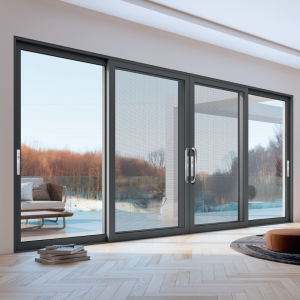
A retractable screen door for slider applications introduces one complication a swinging door does not have: the sliding panel and its track. The screen cassette must mount so it does not foul the slider’s rollers or the fixed panel’s weatherstrip. On many sliders, the screen is mounted on the exterior face of the frame rather than inside the opening, which effectively makes it an outside mount.
Storm Doors
A retractable screen storm door differs from a standard retractable screen in one important way: it is designed to work with the storm door’s own frame and hardware, including the closer arm and the glass/screen exchange system. The key sizing question is whether the storm door has a factory screen channel or whether the retractable unit mounts to the door frame independently. Measure the storm door’s clear opening, not the rough opening in the wall, and confirm the closer arm position — a low-mounted closer can interfere with the cassette.
Interior and Oversized Openings
An interior retractable screen door is sized the same way as an exterior unit but is usually specified with a lighter mesh and lower tension, since it does not face wind load. The measurement method is identical.
Oversized retractable screen doors — those beyond 8 feet in height or roughly 96″ in width — are almost always custom. The limiting factor is not the mesh but the cassette: longer spans need a stiffer housing to keep the track straight, and a sagging housing is the most common cause of premature failure on wide units.
Frame Colors, Mounting Options, and Lock Hardware
Frame Colors and Finishes
The three standard finishes are black, white, and bronze, with a growing range of custom colors for project work. A black retractable screen door is the most common specification for exterior patio applications because black frames visually recede against dark glazing and read as a slim line rather than a visible frame. White suits light trim and interior openings. Bronze sits between the two and hides dust and pollen better than either.
Finish choice is largely aesthetic, but on coastal projects the coating system matters more than the color — salt exposure attacks poorly coated aluminum, so specify a finish appropriate to the environment.
Mounting Options
Inside mount and outside mount are the two primary choices, as covered above. A third option, recessed mount, seats the cassette into a pocket in the frame and is typically only available on new construction or when the frame is being rebuilt. For retrofit work on existing patio and storm doors, inside or outside mount covers nearly every case.
Locks and Hardware
Yes — retractable screen doors are available with locks. A retractable screen door with lock typically uses a latch integrated into the pull bar, sometimes with a keyed cylinder. For patio doors, a keyed lock is a security feature; for interior doors, a simple magnetic or friction latch is usually sufficient. Other hardware to specify includes the pull handle, the tension adjustment mechanism, and — on double units — a center meeting stile that lets the two screens latch together.
Common Sizing Mistakes and Selection Tips
Most sizing problems trace back to a handful of recurring errors.
Measuring the rough opening instead of the finished opening. The rough opening is the framed gap before trim and jamb are installed. Retractable screens fit the finished opening. Measuring the rough framing produces a unit that is too large.
Ignoring the cassette allowance. A 36″ nominal screen does not fit a 36″ opening. Budget 1″–2″ of jamb space for the housing and pull bar, and confirm the exact figure with your supplier.
Assuming a double opening takes one wide unit. Sometimes it does, but two independent units are often the better fit — especially on French doors that operate separately.
Overlooking the storm door closer. On storm doors, a low-mounted closer arm can block the cassette path. Check the hardware layout before finalizing the mount side.
Forgetting egress. Patio doors are often part of a required emergency exit path. A retractable screen that blocks or complicates the door’s operation can create a code problem. The screen should retract fully and not interfere with the door’s own latch and swing.
Skipping the squareness check. Out-of-square openings are common in older homes. If the diagonal difference exceeds about 1/4″, plan for outside mount or a custom unit rather than forcing a standard size.
Related Considerations for Retractable Screen Door Buyers
A few adjacent decisions affect the specification as much as size does.
Mesh and durability. Standard insect mesh is fine for most patio doors, but pet owners should specify a heavier-duty mesh. The failure point on pet-damaged retractable screens is almost always the mesh at the pull bar, not the mechanism. Child safety is less about the mesh and more about the tension — a properly tensioned screen retracts predictably and does not create a loose loop.
Climate. Coastal salt exposure, high UV, and hard freeze cycles each stress different components. Salt attacks coatings and hardware; UV degrades low-grade mesh; freeze cycles affect track alignment on exterior units. Specify finishes and mesh accordingly.
Maintenance and lifespan. Retractable screens need periodic cleaning of the track and a tension check. A well-maintained unit typically outlasts a poorly maintained one by a wide margin, and the most common repair is mesh replacement rather than mechanism failure. Replacement mesh and pull-bar parts availability should factor into the purchase decision.
Total cost of ownership. Over a 5–10 year horizon, the purchase price is only part of the picture. Mesh replacement, tension adjustment, and hardware replacement add to the total, and parts availability varies significantly between suppliers. A unit with readily available replacement mesh is usually the better long-term value even at a higher upfront cost.
When a retractable screen is the wrong choice. If the opening is severely out of square, if the frame has no flat surface for a cassette, or if the door is operated constantly by children or pets with no supervision, a conventional screen door may hold up better. Retractable screens reward a clean, square opening and reasonable care.
Matching the Specification to Local Requirements
Because retractable screens are increasingly specified on export projects, buyers should confirm that the profile structure and fittings align with the target market’s building codes — particularly around egress clearance and wind-load requirements for exterior doors. This is one area where a supplier’s ability to adjust the profile and hardware matters more than the catalog size range.
For buyers who need sizes outside the standard grid — a 42″ single door, a 100″ slider, or a 96″ unit with a specific finish — working directly with a manufacturer on custom sizing is usually the practical route. As a manufacturer, our approach is to cut profiles and match hardware to the confirmed finished-opening dimensions rather than force a standard size, and to run air-tightness, water-tightness, and wind-resistance checks before shipment. We supply OEM and ODM orders with full customs documentation, and we can adjust the profile structure and fittings to suit the building codes of the destination market. If you are specifying retractable screens for a patio, storm, or French door project and need a size outside the standard range, send us your opening dimensions and we will confirm the fit.