What to Know Before You Buy French Doors
French doors are multi-panel door units with full-height glass lites, and the buying decision comes down to four variables that drive both cost and performance: material, size and configuration, glazing specification, and how the unit will be framed and finished. Get those four right and the rest — hardware, blinds, side windows — is detail work.
The most common procurement mistake is treating French doors as a single product category. A 48-inch exterior mahogany double door with Low-E laminated glass and a thermally broken frame has almost nothing in common with a 6 ft interior white French door with 4 mm tempered glass, except the name. They are sourced from different production lines, priced on different logic, and specified against different standards. Buyers who compare quotes without normalizing these variables end up comparing nothing.
A second reality: “standard size” means different things in different markets. North American stock sizes cluster around 5 ft, 6 ft, and 8 ft widths for double units; UK and EU stock sizes follow different module systems. If your project is outside North America, assume you are buying custom until you have confirmed a supplier’s actual stock list. This single check prevents most reorder situations.
Finally, price is not the same as cost. Installed cost includes the door unit, glazing upgrades, hardware, frame adaptation, labour, and disposal or shipping. For B2B buyers importing from overseas, add freight, duties, and the cost of a specification error discovered after the container ships. The sections below work through each decision in the order it affects the outcome.
French Door Types and Materials: Wood, Mahogany, Steel, and More
Material determines the maintenance cycle, the achievable profile slimness, the weight your frame must carry, and the price band. There is no universally “best” material — there is a best material for a given exposure, climate, and budget.
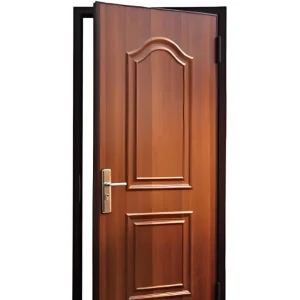
Solid wood (typically pine, oak, or fir) offers the warmest appearance and the easiest on-site refinishing. It is dimensionally stable when properly kiln-dried and sealed, but it moves with humidity. In exterior use, wood French doors need a maintained finish — recoat intervals are measured in years, not decades, and coastal or high-UV climates shorten that cycle. Wood is the natural choice for heritage and high-end residential work where the finish is part of the design intent.
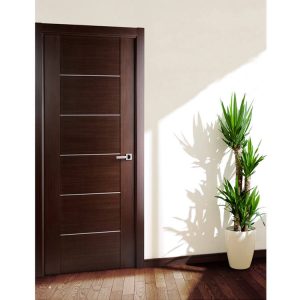
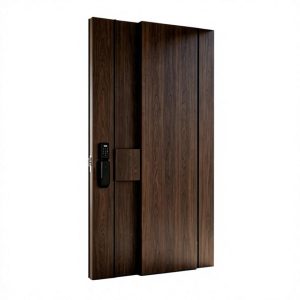
Mahogany sits at the premium end of the wood category. Its density and tight grain make it more resistant to moisture movement than softer species, and it holds a deep, uniform stain that many buyers associate with upscale entryways. Mahogany French doors are commonly specified for exterior front entries in humid or tropical markets. The trade-off is cost and weight: heavier slabs demand heavier hinges and more robust framing.
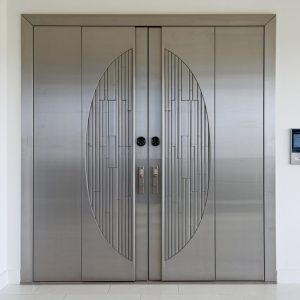
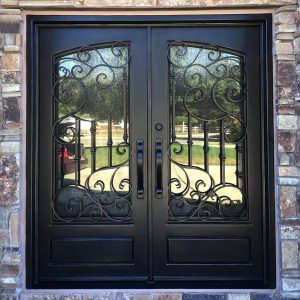
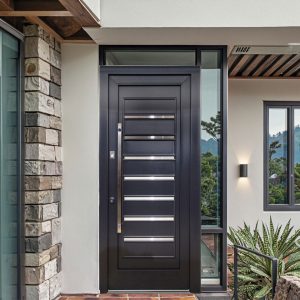
Steel — usually cold-formed or thermally broken steel profiles — allows the slimmest sightlines of any material while carrying large glass areas. Black steel French doors have become a standard specification for both exterior entries and interior partitions in commercial and high-end residential projects. Steel is dimensionally stable, non-combustible, and strong, but it requires a factory-applied finish and careful attention to thermal bridging; a non-thermally-broken steel frame will condense in cold climates.
Aluminum with a thermal break is the workhorse for exterior French doors and patio configurations. It is light relative to its strength, does not rot or warp, and holds powder-coat or anodized finishes well. The thermal break — a non-conductive separator between inner and outer profile — is what separates a modern system window from a basic aluminum frame. Without it, U-values suffer badly.
White finishes are a finish decision, not a material decision, but they matter commercially. White French doors are the default for interior applications because they disappear into trim and read as clean in resale. On exterior units, white powder coat or paint shows dirt and joint lines more than darker tones, which is worth noting for high-traffic commercial entries.
uPVC and composite options exist at the value end. They are low-maintenance and competitively priced, but profile bulk limits the glass-to-frame ratio, which works against the slender proportions that define the French door look.
Terms buyers should know
| Term | What it means | Why it matters when buying |
|---|---|---|
| Thermal break | A non-conductive separator between the inner and outer metal profile | Determines condensation resistance and U-value in aluminum and steel frames |
| U-value | A measure of heat transfer through the whole unit; lower is better | The only fair way to compare energy performance across suppliers |
| Low-E glass | Glass with a microscopically thin metallic coating that reflects heat | Reduces solar gain and heat loss; affects both comfort and energy compliance |
| Rough opening | The framed gap in the wall before the door unit is set | Drives whether a stock size fits or you need a custom unit |
Sizes and Configurations: 48-Inch, 60-Inch, 6 ft, 8 ft, and Custom
French door sizing is best understood as width-per-panel plus total height, not as a single number. A “60 inch French door” normally means a double unit with two 30-inch panels. A “48 inch exterior French door” is typically two 24-inch panels, which is a narrow pair suited to secondary entries or tight openings.
Common configurations:
- Single French door — one operable panel, often paired with a sidelite. Used where the opening is narrow.
- Double (pair) French door — two panels, both operable or one fixed. The classic configuration for patios and entries.
- 3/4 French door — a three-panel arrangement where one panel is narrower, often used to fit a specific opening or to create a service leaf. Buyers searching for a “3 4 French door” are usually trying to match a non-standard opening width.
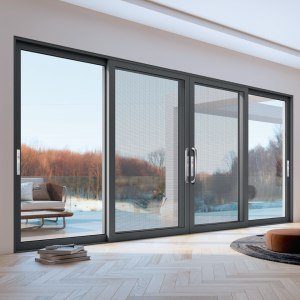
- Sliding French door — full-height glass panels that slide rather than swing, useful where swing clearance is unavailable.
Height is where projects most often go custom. A 6 ft French door suits interior room dividers and older buildings with lower ceilings. An 8 ft French door is now common in new-build residential and hospitality work, where high ceilings are standard. Tall French doors — 9 ft and above — are almost always custom and require attention to hinge capacity, slab weight, and header structure.
Standard stock sizes differ by region. If you are specifying for a North American project, expect stock widths around 4 ft, 5 ft, 6 ft, and 8 ft for double units. For UK and EU projects, confirm the supplier’s actual module system before committing to a drawing. Where an opening falls between stock sizes, the decision is usually custom manufacture versus reframing the opening — and reframing carries structural implications that need professional assessment, not a field fix.
For a detailed breakdown of how to measure and match an opening to a unit, see the size guide.
Exterior and Interior Applications: Front Doors, Patios, and Interior Glass
The exterior/interior split is the single most important application decision, because it changes the glass specification, the frame construction, the hardware, and the compliance requirements.
Exterior French doors — front entries, patios, garden rooms — must resist wind load, rain penetration, and air leakage. That means laminated or laminated-tempered safety glass, weather-sealed frames, multi-point locking hardware, and a tested watertightness rating. Glass french front doors are typically specified with laminated glass on at least the lower panel for security and impact resistance. Frame drainage and sill design matter more than most buyers expect; a poorly drained sill is the most common source of long-term water ingress.
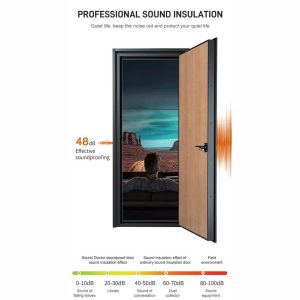
Interior French doors with glass serve a different function: light transmission and spatial division without a solid wall. They do not need weather ratings, so the frame can be lighter and the glass can be simple tempered or, in some applications, non-safety decorative glass. Interior French doors for sale are frequently specified in white, with clear or frosted glass depending on privacy needs. The critical specification here is acoustic performance and swing clearance, not U-value.
A practical distinction buyers often miss: exterior units are tested as a system — frame, sash, glass, gasket, and hardware together. Substituting a cheaper hinge or a different gasket on an exterior unit can void the tested performance. On interior units, component substitution is far more forgiving.
Frames, Side Windows, and Integrated Blinds
The frame is not an accessory; it is half the product. French doors and frame are specified together because the frame determines the achievable U-value, the maximum glass area, and the installation method.
For exterior units, look for a thermally broken frame with a defined drainage path and a tested air-tightness and water-tightness rating. Frame material should match the exposure: aluminum for low maintenance, wood for appearance, steel for slim sightlines.
Side windows (sidelites) extend the glazed opening on either side of the door pair. French doors and side windows together create a wider entry composition and increase daylight without widening the operable panels. Sidelites are usually fixed, which simplifies hardware but adds to the total frame width you must accommodate in the rough opening.
Integrated blinds — blinds sealed between the glass panes — solve a real problem: exterior French doors that face sun or overlook neighbours need privacy and glare control, but internal blinds collect dust and external blinds weather badly. Outside French doors with blinds use a sealed cavity that protects the blind from moisture and dirt. The trade-off is that a failed sealed unit means replacing the whole glazed panel, and integrated blinds add to the unit price and lead time. Specify them where privacy or solar control is a genuine requirement, not as a default upgrade.
French Door Prices and Value Comparison
French doors prices vary more by specification than by brand. The following ranges reflect typical ex-works or trade pricing bands and should be treated as directional — actual quotes depend on material, size, glazing, hardware, and order volume.
| Cost driver | Lower band | Mid band | Upper band |
|---|---|---|---|
| Material | uPVC / composite | Aluminum, softwood | Mahogany, thermally broken steel |
| Glazing | Single tempered | Double Low-E | Double or triple Low-E laminated |
| Hardware | Standard hinges, single lock | Multi-point lock | Multi-point lock, premium finish |
| Size | Stock 6 ft interior | Stock 6–8 ft exterior | Custom tall units, 9 ft+ |
| Blinds | None | Manual integrated | Motorized integrated |
Value factors that justify a higher price:
- Thermal break and glazing specification. These drive energy performance and are the most defensible reason to pay more.
- Tested performance data. A supplier who can provide air-tightness, water-tightness, and wind-resistance test results is selling a verified product, not a promise.
- Hardware quality. Hinges and locks are the first components to fail. Stainless hardware in coastal environments is not an upgrade; it is a requirement.
- Custom capability. If your opening is non-standard, the ability to manufacture to size avoids the far higher cost of structural reframing.
Where buyers overspend: decorative glass and premium finishes that do not affect performance. Where buyers underspend: drainage design, hardware, and glazing specification on exterior units — the three things that generate callbacks.
Comparison Table: French Doors for Sale at a Glance
| Type | Typical material | Common sizes | Best use case | Key limitation |
|---|---|---|---|---|
| Interior French door | Wood, MDF-core, aluminum | 6 ft, 8 ft, 48–60 in pairs | Room dividers, offices, light transmission | No weather rating; acoustic performance varies |
| Exterior wood / mahogany | Solid wood, mahogany | 6–8 ft, custom tall | Front entries, heritage projects | Requires maintained finish; weight |
| Exterior aluminum | Thermally broken aluminum | 6–8 ft, 48–72 in pairs | Patios, high-exposure exteriors | Bulkier sightlines than steel |
| Black steel | Thermally broken steel | Custom, 8 ft+ | Slim-sightline entries, partitions | Higher cost; finish critical |
| uPVC / composite | uPVC, composite | Stock sizes | Budget exterior, rental stock | Wider frames; fewer custom options |
| Sliding French door | Aluminum, wood-clad | 6–8 ft, wide openings | Patios with no swing clearance | Larger frame footprint |
Buying Recommendations and FAQ
Choose exterior aluminum or thermally broken steel if the project faces weather exposure and you want low maintenance with verified thermal performance. Choose mahogany or solid wood if appearance and finish quality drive the specification and the owner will maintain the finish. Choose uPVC or composite if the budget is fixed and stock sizes fit the opening. Choose interior wood or aluminum units if the goal is light transmission and spatial division rather than weather performance.
Before you place an order, confirm four things in writing: the exact rough opening dimensions, the glass specification and any certification, the hardware and locking configuration, and the lead time for custom versus stock. On custom orders, request the shop drawing before production begins — it is the cheapest place to catch a mistake.
How much do French doors cost? Pricing is driven by material, glazing, hardware, and size rather than brand. Interior stock units sit at the low end; custom exterior units in mahogany or thermally broken steel with laminated Low-E glazing sit at the high end. Request itemized quotes so you can compare like for like.
What sizes do French doors come in? Stock widths commonly include 48 in, 60 in, 6 ft, and 8 ft for double units, with 6 ft and 8 ft heights being most common. Tall units above 8 ft are usually custom. Standard sizes differ between North America, the UK, and the EU.
What’s the difference between interior and exterior French doors? Exterior units are tested systems with weather sealing, drainage, safety glazing, and security hardware. Interior units prioritize light, acoustic control, and swing clearance, and do not carry weather ratings.
Which material is best for French doors? Aluminum or thermally broken steel for low-maintenance exterior use; wood or mahogany where appearance and refinishability matter; uPVC or composite for budget-driven stock-size projects.
Can I buy French doors online with custom sizes and finishes? Yes, provided the supplier issues a shop drawing for approval and confirms the glass, hardware, and finish specification in the order documents. Buy custom sizes online only from suppliers who document their pre-shipment testing.
How we meet these standards
As a manufacturer, our approach to French door supply is built around the specification points above. We produce solid wood, mahogany, thermally broken aluminum, and steel French door systems, with full customization on size, color, glass, and hardware accessories — so a non-standard opening does not force a structural reframe. Because we supply directly from our factory, pricing reflects production cost rather than distributor markup, and profile structures and fittings can be adjusted to match the building codes of the target market.
Before shipment, units are inspected for air-tightness, water-tightness, and wind resistance, and we handle the export documentation — packing list, proforma invoice, and full customs paperwork — with both FCL and LCL shipment options. For buyers comparing French doors for sale across suppliers, the practical test is whether a supplier can show you the specification and the test result, not just the price.
If you want a quote against your actual opening dimensions and glass specification, Talk to Our Team.