Solid Wooden Doors at a Glance: Key Takeaways
A solid wooden door is constructed primarily from solid wood rather than hollow-core or veneered composite materials. For B2B buyers, the distinction matters because solid wood changes the performance envelope: these doors are heavier, offer better acoustic insulation, and can be refinished over decades of service. But they also cost more, require appropriate hardware, and behave differently across climates.
The purchase decision is not about finding the “best” door universally—it is about matching construction method, wood species, and configuration to the building’s function, location, and budget. This guide walks through the main types, the engineering differences between interior and exterior use, and the specific procurement criteria that separate a good bulk order from a problematic one.
Types of Solid Wooden Doors: From Classic Panels to Contemporary Designs
Understanding the core construction types is the first filter in any sourcing conversation. Each type has distinct structural logic, cost drivers, and visual outcomes.
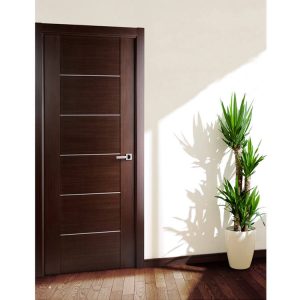
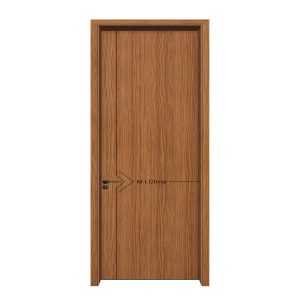
Flush doors are flat on both faces, typically built as a solid wood core covered with veneer or a single piece of timber. True solid flush doors are uncommon and expensive because wide, stable solid boards are hard to source. When a buyer requests a “solid wooden door” in a flush style, they usually mean a solid-core door with a timber frame and wood veneer—not a hollow interior. These suit modern interiors where clean lines matter and where painting is planned.
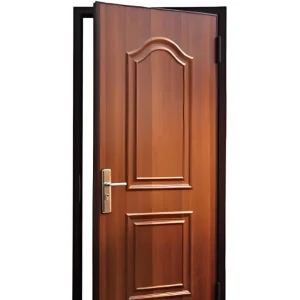
Panel doors (also called stile-and-rail doors) are the most common genuine solid wood configuration. The frame consists of vertical stiles and horizontal rails, with panels set into the frame. Panels can be flat, raised, or recessed. Because panels float within the frame, they accommodate natural wood movement better than a single solid slab. This is the critical advantage: seasonal expansion and contraction happen within the panel recesses, not across the whole door width. For exterior applications, a stile-and-rail panel door is the standard choice.
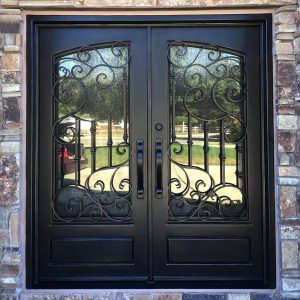
Glazed doors incorporate glass panels within the stile-and-rail frame. The glass can be a full-height vision panel, a fanlight above the door, or decorative side panels. Glazing changes the door’s weight distribution and requires a stronger frame structure around the glass opening. Double-glazed units are available for thermal performance, though the glass edge seal must be compatible with the door’s movement.
Rustic doors are a style category rather than a distinct construction method. They typically use thicker timber, visible joinery, and natural or distressed finishes. Reclaimed wood, live edges, and wrought-iron hardware are common. The construction is often more massive than standard panel doors, which means higher weight and the need for reinforced frames.
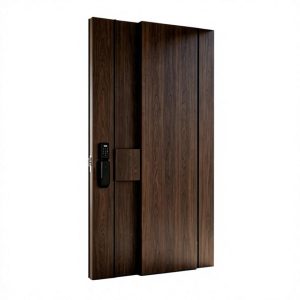
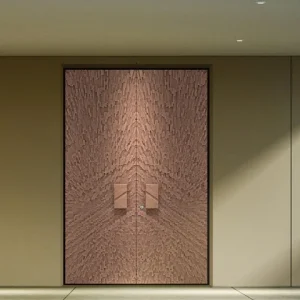
Contemporary doors favor minimalist flush surfaces, hidden hinges, and clean geometric panel layouts. They may use engineered wood cores with solid wood veneers to achieve stability at wider dimensions. Full-height doors (up to 3 meters) are increasingly specified in residential and hospitality projects, but these require careful engineering to prevent bowing.
Interior vs. Exterior Solid Wooden Doors: What’s the Difference?
The performance requirements for internal and external doors are fundamentally different. Choosing an interior-grade door for an exterior opening is one of the most common specification errors.
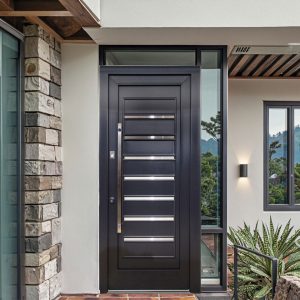
Exterior solid wooden doors face moisture, UV radiation, and temperature swings. The wood species must have natural decay resistance or be adequately protected by finish. The door must seal against air and water infiltration, which means the construction must remain dimensionally stable so gaskets and weatherstripping maintain contact. Key considerations:
- Moisture resistance: The end grain of stiles and rails is especially vulnerable to water absorption. A proper exterior door has sealed end grain and a weather-resistant finish system on all six faces, including the top and bottom edges that are often overlooked.
- Insulation: Solid wood provides reasonable thermal insulation, but the door-to-frame seal matters more than the wood itself. Look for doors with integrated thermal breaks in the threshold and multi-point locking systems that pull the door tight against the frame.
- Security: Exterior doors need robust hinge reinforcement and lock blocks. A solid wood door with a thin lock stile is a security weakness regardless of how thick the wood is.
Interior solid wooden doors have much simpler requirements. They need to resist humidity changes within a building (which are modest compared to exterior exposure), provide acoustic separation, and handle frequent operation. Interior doors can use less expensive wood species because they do not face weather exposure. The finish can be paint-grade rather than weather-resistant.
The cost difference between interior and exterior grades is substantial. An exterior-rated solid wood door typically costs 40–70% more than an equivalent interior door because of the wood quality, construction details, and finish system required.
Special Configurations: Double Doors, Sliding Doors, and Large Formats
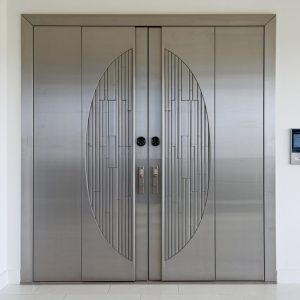
Double wooden doors are a common request for exterior entrances, particularly for villas, hotels, and commercial buildings where a wider opening creates a more imposing entry. The advantages go beyond aesthetics: double doors allow furniture and equipment to move in and out, improve natural light when glazed, and create a ceremonial entrance experience.
The engineering challenge with double doors is the meeting stile (the astragal). One door is typically fixed with flush bolts at top and bottom, while the active door carries the main locking mechanism. The astragal must seal properly when both doors are closed, and the floor threshold must handle the joint. For exterior double doors, consider:
- The active leaf should be the one used for daily passage—typically the right or left leaf based on traffic flow.
- Each leaf needs at least three hinges if the door exceeds 90 cm in width.
- The locking system should include a multi-point mechanism on the active leaf and flush bolts on the inactive leaf.
Large wooden doors (over 120 cm wide or 240 cm tall) require special attention to weight and movement. A solid wood door of this size can easily weigh 80–120 kg depending on species and thickness. The frame must be structurally adequate, and the hinges must be rated for the actual door weight—not a generic “heavy duty” label. For doors over 110 cm wide, consider whether a single leaf is wise; the leverage on hinges increases with width, and warping risk rises.
Sliding wooden doors are used for interior partitions, closet fronts, and some exterior applications. Interior sliding doors (often barn-style or pocket doors) are popular in contemporary designs. The critical point for solid wood sliding doors is the weight on the track system. A solid wood sliding door can be two to three times heavier than a hollow-core alternative, so the track and rollers must be specified for the actual weight. For exterior sliding doors, solid wood is rarely the best choice—thermal-break aluminum or wood-aluminum composite systems perform better on weather resistance and insulation.
Design Styles: Rustic, White, Glazed, and Custom Finishes
The visual language of a door must align with the architectural context. Two style families dominate the market: rustic and contemporary. The choice affects not just appearance but also wood species, finish, and hardware.
Rustic wooden doors work with natural, stained, or distressed finishes. They typically use oak, teak, or reclaimed timber. The construction often features visible pegged joinery or through-tenons. Rustic doors suit countryside villas, lodges, restaurants, and any project where a handcrafted feel is desired. The cost drivers are the wood grade (knots and character marks are acceptable or desirable) and the labor for hand-finishing.
Contemporary wooden doors favor clean surfaces, minimal paneling or flush faces, and consistent grain patterns. White-painted doors are a staple of modern interiors, but the paint quality matters enormously. A white exterior door requires a high-quality exterior-grade paint or a factory-applied finish system; cheap paint will crack and peel within two years of sun exposure. For contemporary doors, consider:
- White finishes: Factory-applied polyester or polyurethane finishes provide better durability than site-applied paint. If doors are to be painted on site, specify a primed door and use a professional-grade exterior paint system.
- Natural finishes: Clear or lightly tinted finishes show the wood grain. The wood must be selected for consistent color and minimal defects, which raises the cost.
- Stained finishes: Stains can match interior woodwork, but they offer less UV protection than opaque finishes. For exterior doors, a UV-resistant topcoat is essential.
Glazed doors deserve separate consideration because the glass specification affects both performance and cost. Options include:
- Single glazing: Suitable for interior doors or protected exterior locations. Offers no meaningful thermal insulation.
- Double glazing: Two panes with an air or argon gap. Reduces heat loss and improves acoustic performance. The unit must be sealed properly to prevent condensation between panes.
- Low-E glass: Has a microscopically thin coating that reflects heat while transmitting light. Recommended for exterior doors in most climates.
- Tempered or laminated glass: Required by building codes in many regions for doors and sidelights. Tempered glass breaks into small granules; laminated glass holds together when broken. For security, laminated glass is superior.
The glass-to-wood joint is a common failure point. A proper glazed door has the glass set into a rebate with a flexible sealant that accommodates wood movement. Rigid glazing compounds crack as the wood expands and contracts.
Solid Wooden Door Parts and Hardware: What to Look For
The components of a wooden door determine its service life as much as the wood itself. For B2B buyers, specifying the right parts prevents callbacks and warranty claims.
Hinges are the most critical hardware element. The rule of thumb is three hinges per door for standard heights (200–220 cm), and four for taller doors or doors over 100 kg. Hinge selection should be based on the actual door weight:
- A standard 80 × 200 cm solid wood door (40–50 kg) needs 3 hinges rated for at least 60 kg total.
- A large 100 × 240 cm solid wood door (70–90 kg) needs 4 heavy-duty hinges rated for 100 kg or more.
- The hinge must be long enough (typically 100–150 mm) to distribute the load across the stile.
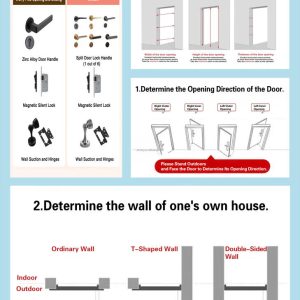
Handles and locks affect both security and daily usability. For exterior doors, a multi-point locking system is strongly recommended. These locks engage bolts at multiple points along the door edge, pulling the door tight against the frame and improving both security and weather sealing. The lock case must be properly sized for the door thickness—standard backsets are 45 mm or 55 mm, but thicker doors may need custom lock preparations.
Weatherstripping is what actually seals an exterior door. Look for:
- Magnetic or bulb-type gaskets on the hinge side and strike side.
- An adjustable threshold or sweep at the bottom.
- A door shoe or drip cap to shed water away from the bottom edge.
Wooden door parts that buyers should verify include the stile width (the vertical frame members), the rail height (horizontal members), and the panel thickness. A door with narrow stiles (under 100 mm) will have less material around hinges and locks, making it weaker. For exterior doors, stiles of 120–150 mm are preferable.
Comparison Table: Choosing the Right Solid Wooden Door
| Door Type | Best Application | Style | Key Features | Cost Considerations |
|---|---|---|---|---|
| Flush (solid core) | Interior rooms, offices | Minimalist, modern | Flat surface, paintable, good acoustic performance | Moderate; veneer over engineered core is economical |
| Panel (stile-and-rail) | Exterior entrances, classic interiors | Traditional to contemporary | Floating panels accommodate wood movement | Moderate to high; depends on wood species and panel complexity |
| Glazed | Entrances needing natural light | Varied; modern to traditional | Glass panels require reinforced frame | Higher; glass type and frame reinforcement add cost |
| Rustic | Villas, lodges, restaurants | Handcrafted, natural | Thick timber, visible joinery, distressed finishes | High; labor-intensive finishing and massive construction |
| Contemporary flush | Modern homes, hospitality | Clean lines, hidden hardware | Full-height options, engineered cores for stability | High; requires stable construction and premium finishes |
| Double (pair) | Main entrances, large openings | Formal, grand | Two leaves with astragal seal | Highest; double hardware, wider frame, more material |
Buying Guide for B2B Projects: Quality, Customization, and Supplier Selection
When sourcing solid wooden doors for a project, the evaluation criteria differ from a single-door purchase. You need consistency across units, reliable lead times, and a supplier who understands export requirements.
Quality verification starts with the wood itself. Specify the wood species, moisture content, and grade. Kiln-dried wood should have a moisture content of 8–12% for most climates. Wood that is not properly dried will warp, crack, or shrink after installation. Ask for the supplier’s moisture meter readings and drying documentation.
Construction details matter more than the wood species alone. A well-made door from a moderate species outperforms a poorly made door from premium timber. Check:
- Joint construction: Mortise-and-tenon joints are the standard for stile-and-rail doors. Doweled or screwed joints are weaker and may fail over time.
- Panel fit: Panels should float in the frame with room to move. Glued-in panels will crack as the wood expands.
- Edge treatment: All exposed edges should be sealed, especially the bottom edge of exterior doors.
Customization capability is essential for B2B orders. Projects rarely use standard sizes. A supplier should offer:
- Custom dimensions (width, height, thickness)
- Custom glass configurations and glazing options
- Choice of wood species and finish
- Hardware preparation (hinge locations, lock bore holes)
- Compliance with local building codes and fire ratings where applicable
Quality control and inspection separate reliable suppliers from trading companies. For bulk orders, ask about pre-shipment inspection procedures. A credible manufacturer will test for air-tightness, water-tightness, and wind resistance on exterior doors. They should also provide packing lists, proforma invoices, and full customs documentation for international shipments.
Logistics and shipping affect total cost significantly. Full container load (FCL) shipments are more economical for large orders, while less-than-container-load (LCL) suits smaller quantities. Confirm whether the supplier handles export packing—solid wood doors need proper protection against moisture and impact during transit.
Here is how we meet these standards at Jusen Door and Windows Manufacturing Co., Ltd. As a factory-direct manufacturer, we supply solid wood doors, thermal-break aluminum doors and windows, and custom villa doors and windows without middleman markup. Our production supports full customization on size, color, glass, and hardware accessories, and we adjust profile structures and fittings to match local building codes in your target market. Every order undergoes strict pre-shipment inspection covering air-tightness, water-tightness, and wind resistance. We handle FCL and LCL shipments with complete export documentation, and our foreign trade experience means you receive proper packing lists and proforma invoices. If your project needs consistent quality across a bulk order, contact our team to discuss specifications.
Frequently Asked Questions
What is the difference between solid wood and solid core doors?
Solid wood doors are made entirely from natural timber, either as a single slab or as stile-and-rail construction with wood panels. Solid core doors have an engineered interior—often particleboard or medium-density fiberboard—covered with wood veneer. Solid wood offers better longevity and can be refinished, while solid core is more dimensionally stable and less expensive.
How heavy is a solid wood door?
A standard 80 × 200 cm solid wood door weighs between 35 and 60 kg depending on the species. Oak at 45 mm thickness weighs approximately 45–55 kg; pine is lighter at 30–40 kg; dense tropical hardwoods can reach 70 kg or more for the same size. Weight affects hinge selection, frame strength, and installation logistics.
Do solid wood doors need special hinges?
Yes, for heavier doors. Standard interior hinges are rated for 25–40 kg per pair. A solid wood door typically needs three hinges rated for the door’s actual weight. Heavy doors over 80 kg require four hinges or specialized heavy-duty hinges with larger knuckles and thicker leaves.
How do I maintain a solid wood door?
Maintenance depends on the finish and exposure. Exterior doors need refinishing every 2–5 years depending on sun and rain exposure. Interior doors with quality factory finishes may need attention only every 5–10 years. Check the bottom edge and threshold area first—these see the most moisture. Use a flexible wood cleaner and avoid harsh chemical strippers that damage the wood fibers.
Are solid wood doors worth the cost?
For exterior entrances and high-traffic interior locations, yes. Solid wood doors offer superior acoustic insulation, can be repaired and refinished rather than replaced, and add perceived value to a property. For low-traffic interior rooms where budget is tight, a solid core door delivers most of the performance at lower cost. The decision should be based on the door’s location and the building’s expected service life.
What glass options work best for exterior solid wood doors?
Double-glazed low-E glass is the standard recommendation for exterior doors. It provides thermal insulation and reduces condensation. For security, laminated glass is stronger than tempered glass and holds together when broken. The glass unit must be properly sealed into the door frame with a flexible sealant to accommodate wood movement.