Core Conclusion: What Makes an Entrance Door ‘Best’?
For commercial projects, the “best” entrance door is not a single product—it is the one that best balances four non-negotiable criteria: security, thermal efficiency, durability, and lifecycle cost. Aesthetics matter, but they rank below performance because a commercial entrance handles thousands of cycles per year, faces weather exposure, and must meet building code requirements.
If you need a direct answer: aluminum and steel systems dominate commercial applications because they offer the highest structural rigidity and fire resistance. Composite doors are a strong contender for mixed-use or hospitality projects where insulation and design flexibility outweigh the need for extreme impact resistance. Solid wood is reserved for prestige projects—banks, boutique hotels, flagship retail—where the entrance is a brand statement.
The decision framework is simple: identify your building’s traffic volume, climate zone, and security requirements first. Then select a material. Do not start with aesthetics.
Entrance Door Materials Compared: Aluminum, Steel, Wood, Composite
Each material family has a distinct performance profile. Here is what a procurement professional needs to know before issuing an RFQ.
Aluminum Entrance Doors
Aluminum is the workhorse of commercial construction. Its extruded profiles allow for complex geometries, slim sightlines, and large glass areas, which is why you see it in office lobbies and retail storefronts.
Performance characteristics:
- Thermal performance: With thermal-break technology (polyamide strips between interior and exterior frames), modern aluminum achieves U-values competitive with other materials. A good thermal-break aluminum door can reach a U-value around 1.4–2.0 W/m²K, depending on glazing.
- Structural strength: Aluminum has an excellent strength-to-weight ratio. It handles wind loads well, making it suitable for high-rise applications.
- Corrosion resistance: Naturally resistant to rust; anodized or powder-coated finishes extend lifespan significantly.
- Maintenance: Minimal. Hinges and hardware need periodic adjustment, but the frame itself is nearly maintenance-free.
Trade-offs: Aluminum conducts heat rapidly without thermal breaks, so non-thermal-break versions are unsuitable for cold climates. It is also more expensive than steel for equivalent structural performance.
Steel Entrance Doors
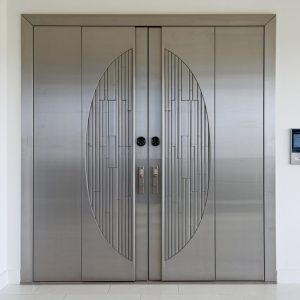
Steel is the default choice for security-focused entrances—service entrances, utility rooms, and any door that must resist forced entry.
Performance characteristics:
- Security: A 16-gauge steel door with a reinforced frame and multi-point locking system is significantly harder to breach than aluminum or wood.
- Durability: Steel does not warp, crack, or swell. It handles high-traffic abuse well.
- Fire resistance: Steel doors can achieve high fire ratings (up to 90 minutes or more) with proper core materials.
- Cost: Generally the most economical option per square foot for commercial-grade performance.
Trade-offs: Steel dents on impact, and the dents are difficult to repair. It is also a poor insulator by itself—a steel door without a polyurethane or honeycomb core will have poor thermal performance. Condensation can be an issue in cold climates if the door lacks a proper thermal break.
Wood Entrance Doors
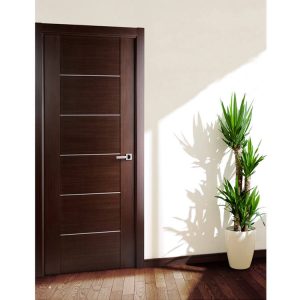
Wood is the aesthetic choice. It offers warmth, grain, and a level of craftsmanship that metal cannot replicate.
Performance characteristics:
- Aesthetics: Unmatched. Wood can be milled, carved, and finished in ways that create a distinct architectural identity.
- Insulation: Solid wood has naturally decent insulating properties, though not as good as composite cores.
- Repairability: Scratches and dents can be sanded and refinished. A damaged wood door is repairable; a damaged steel door is often replaced.
Trade-offs: Wood requires ongoing maintenance—refinishing every few years, especially on exterior faces. It is susceptible to moisture damage if not properly sealed. For high-traffic commercial entrances, wood is the least durable option. It also has the highest cost per unit for quality construction.
Composite Entrance Doors
Composite doors are engineered products, typically a fiberglass or steel skin over a polyurethane foam core. They are the fastest-growing category in commercial entry systems.
Performance characteristics:
- Insulation: The foam core provides excellent thermal performance, often achieving U-values below 1.0 W/m²K.
- Dimensional stability: Composite doors do not warp, swell, or shrink with humidity changes. This is a critical advantage over wood.
- Impact resistance: Fiberglass skins are highly resistant to dents and cracking.
- Design flexibility: Composite doors can be molded to mimic wood grain or smooth modern finishes.
Trade-offs: High-quality composite doors are not cheap—they sit in the same price range as premium aluminum systems. They are also less customizable than aluminum in terms of frame geometry and glazing options.
Composite Entrance Doors: A Closer Look
Because composite doors are often the least understood option, they deserve a deeper examination.
The construction is what sets them apart. A typical composite door has:
- A skin made of fiberglass-reinforced plastic (FRP) or steel, which provides impact resistance and weatherability.
- A core of polyurethane foam, which provides insulation and structural rigidity.
- A frame of wood, aluminum, or composite material, which holds the assembly together and provides the mounting surface for hardware.
Where composite doors excel:
- Climate-controlled buildings: The insulation performance reduces HVAC load, which is a measurable operational cost.
- Coastal environments: Fiberglass does not corrode like steel or rot like wood. Salt air is damaging to most materials; composite handles it well.
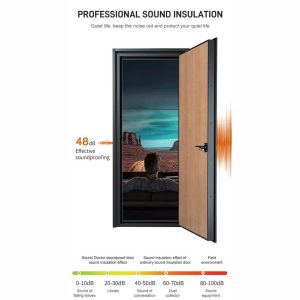
- Sound-sensitive applications: The dense foam core provides better acoustic insulation than hollow metal doors.
Where composite doors are not the best choice:
- High-impact zones: While fiberglass is tough, a steel door is still superior for areas prone to physical abuse—forklift traffic, rolling equipment, etc.
- Maximum security: Composite doors are strong, but the best forced-entry ratings still belong to steel systems with reinforced frames.
Cost reality: A good commercial composite door costs more than a comparable steel door but less than a premium aluminum system. The lifecycle cost, however, is often lower because of reduced maintenance and energy savings.
Top Door Manufacturers: How to Evaluate Suppliers
The phrase “best door manufacturers” does not point to a single global leader—it points to suppliers who can deliver against your project’s specific requirements. The evaluation criteria matter more than any brand name.
What to assess in a manufacturer:
- Testing and certification data. A credible manufacturer publishes test reports for air-tightness, water-tightness, and wind resistance. If they cannot provide these documents, they are not a serious supplier. Ask for the actual test values, not a claim of “passes standards.”
- Customization capability. Commercial projects rarely use off-the-shelf doors. The manufacturer must be able to adjust profile dimensions, glass specifications, and hardware to match your architectural drawings and local building codes.
- Export and logistics experience. If you are sourcing internationally, the supplier must handle packing lists, proforma invoices, customs documentation, and shipment consolidation (FCL or LCL). A manufacturer without export experience will create delays.
- Production capacity. Ask about lead times and MOQ. A manufacturer with a small workshop cannot handle a large construction project’s volume.
- Reference projects. Ask for examples of similar commercial installations. Verify that the references are real and relevant to your building type.
Here is how we meet these standards. As a factory-direct manufacturer (Jusen Door and Windows), we supply thermal-break aluminum, composite, and wood door systems for commercial projects. Our pre-shipment inspection includes air-tightness, water-tightness, and wind resistance testing on every order, not just on samples. We adjust profile structures and fittings to match the building codes of your target market, and we handle full export documentation. For buyers who need OEM or ODM, we produce to your specifications rather than forcing you to adapt to our standard catalog. You can reach us directly at our WhatsApp for a project-specific discussion.
Entrance Door Comparison Table
| Material | Security Rating | Thermal Efficiency (U-value) | Maintenance | Relative Cost | Best Application |
|---|---|---|---|---|---|
| Aluminum (thermal break) | Good | Good (1.4–2.0 W/m²K) | Low | High | Office lobbies, retail, high-rise |
| Steel | Excellent | Poor to Fair (2.5–4.0 W/m²K without thermal break) | Low (but dents) | Low to Medium | Service entrances, utility rooms, high-security zones |
| Wood | Good (with proper hardware) | Good (1.5–2.5 W/m²K) | High | High | Prestige projects, hotels, banks |
| Composite | Good to Excellent | Excellent (0.8–1.2 W/m²K) | Very Low | Medium to High | Mixed-use, hospitality, coastal buildings |
U-values are indicative ranges for commercial-grade assemblies; exact values depend on glazing, frame design, and core thickness.
Buying Guide: Key Factors to Consider
Security Requirements
Assess the risk level of your entrance location. A rear service entrance in an urban area requires a different door than a front lobby with a security desk. Look for:
- Multi-point locking systems (at least three locking points for exterior doors)
- Reinforced frames (the frame is the weakest point in most door assemblies)
- Hinge-side protection (hinge pins that cannot be removed from the outside)
Thermal and Air-Tightness Performance
For conditioned buildings, the entrance door is a significant source of energy loss. Review the manufacturer’s test data for:
- Air leakage rate (measured in m³/h·m² at a given pressure differential)
- Water-tightness classification (how much rain pressure the door withstands before leaking)
- Wind load resistance (critical for high-rise or exposed locations)
Traffic Volume and Usage
A door opening 50 times per day has different hardware needs than one opening 5,000 times per day. Specify commercial-grade hardware (ANSI/BHMA Grade 1 for high-traffic) and consider automatic operators for accessibility compliance.
Building Codes and Local Regulations
Fire ratings, accessibility requirements (ADA in the US, similar codes elsewhere), and energy codes vary by jurisdiction. Confirm your door’s specifications meet local requirements before ordering. A manufacturer that can adjust its product to different code regimes simplifies this process.
Frequently Asked Questions
Q: How much do commercial entrance doors cost?
A: Pricing varies significantly with material, size, glazing, and hardware. Steel doors are the most economical, aluminum and composite sit in the mid-to-upper range, and solid wood is the premium option. For accurate budgeting, request quotes with detailed specifications from at least three suppliers.
Q: What is the best material for energy efficiency?
A: Composite doors with polyurethane cores generally achieve the lowest U-values. Thermal-break aluminum with double or triple glazing is a close second. Steel without a thermal break is the weakest performer.
Q: How long does installation take?
A: This depends on the opening preparation and door type. A standard commercial door replacement can be installed in a few hours, but custom sizes or structural modifications take longer. The manufacturer’s lead time is usually the bigger scheduling factor—custom doors typically ship in 3–8 weeks depending on order volume.
Q: What security features should I prioritize?
A: Start with the locking system and frame reinforcement. A high-security door uses a multi-point lock with hardened bolts, a reinforced strike plate, and a frame anchored to the structure with heavy-duty fasteners. Glass, if present, should be laminated or impact-rated.
Q: How do I choose the right size?
A: Measure the rough opening precisely. Commercial doors often require non-standard sizes, which is why custom manufacturing is common. Ensure your supplier can produce to your exact dimensions rather than forcing you to modify the opening.
Additional Considerations: Sizing, Installation, and More
Customization options go beyond size. For commercial projects, you can typically specify:
- Glass type (insulated, laminated, low-E, tinted)
- Frame color and finish (anodized, powder-coated, wood veneer)
- Hardware (locksets, closers, push bars, automatic operators)
- Glazing patterns (mullions, transoms, sidelites)
Installation best practices: The best door will fail if installed poorly. Ensure the opening is square and level, the frame is properly anchored, and the flashing and sealant are correctly applied. For high-performance doors, installation quality directly affects air and water tightness.
Maintenance planning: Budget for periodic hardware adjustment, seal replacement, and finish touch-up. Aluminum and composite require the least attention; wood requires the most.
Choosing the right door for your project:
- Choose steel if security is the top priority and thermal performance is secondary.
- Choose thermal-break aluminum if you need large glass areas, modern aesthetics, and good energy performance.
- Choose composite if insulation, low maintenance, and coastal durability matter most.
- Choose wood if the entrance is an architectural statement and maintenance is acceptable.
For a project-specific recommendation, contact our team with your building type, location, and performance requirements. We will provide a specification-matched quote.