Core Conclusion: Choosing the Right Steel Exterior Door Width
For commercial projects, the 32-inch steel exterior door is a practical middle-ground option. It provides a wider passage than 28-inch or 24-inch doors while remaining more cost-effective than the standard 36-inch commercial door. The standard height for a 32-inch steel exterior door is 80 inches (6’8″), though custom heights up to 96 inches (8′) are available from most manufacturers. Your choice should be driven by three factors: building code egress requirements, the volume of foot traffic, and whether large equipment or furniture needs to pass through. A 32-inch door works well for side entrances, mechanical rooms, and offices; a 36-inch door is typically required for primary public entrances under most commercial building codes.
Size Breakdown: 24, 28, 32, 36, 42, and 48 Inch Doors
24-Inch and 28-Inch Steel Exterior Doors
Narrow doors in the 24-inch and 28-inch range serve specific utility purposes. They are commonly used for:
- Electrical and mechanical closet access
- Storage rooms and janitorial closets
- Secondary utility entrances
- Narrow hallway constraints where a wider door physically cannot fit
For commercial use, a 24-inch or 28-inch door can work if the space is not a required egress path. However, check your local building code carefully. Most commercial egress requirements mandate a minimum clear width of 32 inches when the door is open at 90 degrees. A 28-inch door may pass inspection for non-egress utility rooms, but it creates logistical challenges if any equipment needs to be moved in or out later. The cost savings over a 32-inch door are modest — typically 10-15% less — which rarely justifies the reduced functionality.
32-Inch Steel Exterior Door
The 32-inch width is the minimum for most commercial egress applications. The actual door slab measures approximately 31.5 inches wide to fit a 32-inch rough opening. This size accommodates:
- Single-person traffic comfortably
- Wheelchair access in most cases (when combined with proper door swing and threshold height)
- Side entrances and employee entrances
- Office suites and small retail spaces
The 32-inch door is the smallest width you should consider for any door that people use regularly. It provides adequate clearance while keeping material costs lower than larger sizes. For a commercial project, the 32-inch door is often the most cost-efficient compliant choice.
36-Inch Steel Exterior Door
The 36-inch steel exterior door is the standard for primary commercial entrances. The steel exterior door 36×80 configuration is the most common pre-hung size in the industry. This width provides:
- Comfortable two-way foot traffic
- Compliance with ADA requirements in most configurations
- Space for moving furniture, equipment, and carts
- A more imposing, professional appearance
The cost difference between a 32-inch and 36-inch steel exterior door is generally 15-25% more for the wider option, primarily due to additional steel and insulation material. For main entrances, reception areas, or any door that sees constant traffic, the 36-inch width is the safer choice.
42-Inch and 48-Inch Wide Steel Exterior Doors
Double-width doors in the 42-inch and 48-inch range are typically used for:
- Warehouse and loading dock access
- Large equipment rooms
- Accessibility requirements where a standard door cannot accommodate turning radius
- Architectural statements on commercial facades
These wider doors require reinforced frames and heavier-duty hinges to manage the additional weight. A 48-inch wide steel exterior door can weigh 150-200 pounds or more depending on gauge and insulation, which means the frame, jamb, and anchoring system must be specified accordingly. These are not standard stock items and require longer lead times for manufacturing.
Feature Comparison: Standard vs Built-in Blinds
Standard Steel Exterior Doors
A standard steel exterior door consists of two steel skins bonded to an insulating foam core, typically polyurethane or polystyrene. Key features include:
- Insulation: The foam core provides an R-value between R-5 and R-15 depending on thickness and core material. For comparison, a solid wood door typically provides R-2 to R-3.
- Security: The steel skin, typically 24-gauge to 22-gauge, resists forced entry far better than wood or fiberglass.
- Weather resistance: Factory-applied primers and finishes protect against corrosion, though the door edge and bottom require attention during installation.
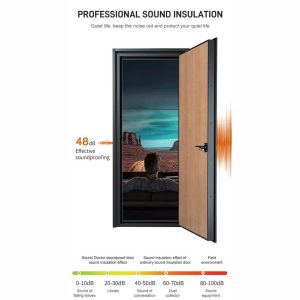
- Sound attenuation: The dense core and steel skin reduce noise transmission compared to hollow-core alternatives.
Steel Exterior Door with Built-in Blinds
A 36-inch exterior door with built-in blinds integrates the window blind mechanism between two panes of glass within the door’s lite. This feature addresses a common commercial problem: window coverings on exterior doors get damaged, dirty, or become a maintenance headache.
Benefits of built-in blinds:
- No exposed cords or strings: Eliminates a safety hazard and a common point of failure
- Reduced maintenance: Blinds are sealed between glass panes, protected from dust, weather, and vandalism
- Controlled light and privacy: Adjust the blind angle without opening the door
- Condensation management: The sealed unit reduces condensation between panes compared to traditional blinds mounted on the interior
The trade-off is cost. Built-in blinds add approximately 15-30% to the door price. The blind mechanism can also fail, and repair requires replacing the entire glazed unit. For commercial applications where the door is exposed to the public, the reduced maintenance burden often justifies the premium.
At-a-Glance Comparison Table
| Door Width | Typical Use | Price Range (USD) | Key Features | Best For |
|---|---|---|---|---|
| 24 inch | Utility closets, storage | $300 – $600 | Minimal clearance, basic security | Non-egress utility rooms |
| 28 inch | Narrow utility access | $350 – $650 | Slightly wider than 24″, still limited | Mechanical rooms, tight spaces |
| 32 inch | Side entrances, offices | $400 – $800 | Meets minimum egress, cost-efficient | Employee entrances, small retail |
| 36 inch | Primary entrances, ADA | $500 – $1,000 | Standard commercial width, comfortable traffic | Main entrances, public access |
| 42 inch | Wide access, equipment rooms | $800 – $1,500 | Requires reinforced frame, custom order | Warehouse, large equipment |
| 48 inch | Loading, large equipment | $1,200 – $2,500 | Heavy-duty hardware, custom fabrication | Loading docks, industrial access |
Price ranges reflect material costs only and vary with steel gauge, insulation type, glass lites, hardware, and finish. Labor and installation add $200-$600 per door depending on your region and wall construction.
Buying Guide: What to Check Before You Order
Rough Opening and Frame Dimensions
The rough opening for a 32-inch steel exterior door is typically 34 inches wide by 82.5 inches high for a standard 80-inch door. This allows for shim space and proper leveling. However, rough opening dimensions vary by manufacturer and frame type, so always check the specific door’s spec sheet before framing.
For different wall constructions:
- Wood frame: Standard shim space applies; use galvanized screws for the frame attachment
- Steel frame: The frame is typically welded or mechanically fastened; rough opening tolerance is tighter, often ±1/8 inch
- Masonry: Requires anchor bolts and a different installation approach; consult the manufacturer’s masonry installation guide
Building Codes and Egress Requirements
Commercial building codes, including the International Building Code (IBC), generally require:
- Minimum clear width of 32 inches for egress doors (measured with the door open 90 degrees)
- Maximum door height of 48 inches for the latch-side approach
- Fire ratings for certain applications (check your local code for occupancy type)
- Accessibility compliance under ADA where applicable
These requirements vary by jurisdiction and occupancy classification. Verify with your local building department before ordering.
Insulation and Energy Performance
Steel doors conduct heat readily unless properly insulated. Look for:
- Polyurethane foam core: Provides better insulation than polystyrene (typically R-7 to R-15 vs R-5 to R-7)
- Thermal break frame: Aluminum frames with a thermal break reduce heat transfer at the edges
- U-factor: The overall heat transfer coefficient, typically 0.30-0.50 for insulated steel doors. Lower is better for energy efficiency.
- ENERGY STAR certification: Available for doors meeting specific U-factor requirements based on climate zone
Hardware and Security
A steel door is only as secure as its hardware. Specify:
- Hinges: Commercial-grade ball-bearing hinges, 3 per door for doors over 7 feet tall
- Lockset: Grade 1 or Grade 2 commercial locksets; avoid residential-grade hardware
- Reinforcement: Steel reinforcement plates around the lockset area
- Weatherstripping: Magnetic or compression seals at the perimeter
Installation Considerations
Common installation issues include out-of-square openings, uneven floors, and improper moisture barriers. For replacement installations, measure the existing rough opening carefully — door sizes are nominal, and actual dimensions can vary by as much as 3/4 inch. If the opening is out of square by more than 1/4 inch across the diagonal, address the framing before installing the new door.
Additional Considerations: Matching Door Width to Project Needs
When 32 Inches Is the Right Choice
Choose a 32-inch steel exterior door when:
- The door serves a secondary entrance (employee, service, or side door)
- Building codes allow 32 inches for egress in your occupancy type
- Foot traffic is light to moderate (under 20 people per hour)
- Budget constraints make the 36-inch option cost-prohibitive
- The opening width is physically limited by existing construction
When to Size Up to 36 Inches
Choose a 36-inch steel exterior door when:
- The door is a primary public entrance
- Two-way foot traffic is expected
- ADA compliance requires a 36-inch clear opening (depending on approach direction and door configuration)
- Equipment or furniture will regularly pass through
- The building’s aesthetic calls for a more substantial entrance
When 42 or 48 Inches Makes Sense
Choose wider doors only when the opening genuinely requires them. A 42-inch single door is unusual and often unnecessary; if you need more than 36 inches of clear width, consider double doors (two 36-inch doors) instead. Double doors provide flexibility — one leaf can remain locked while the other operates — and they are more economical than a single oversized door. A 48-inch single door is rare and typically only specified for specialized equipment access.
Cost-Benefit Analysis
The price difference between widths is not linear. A 36-inch door costs roughly 20% more than a 32-inch door, but a 48-inch door can cost 100-150% more than a 36-inch door because it requires custom fabrication and heavier hardware. When planning your budget, factor in:
- Frame and jamb costs (wider doors need beefier frames)
- Hardware costs (heavier hinges, commercial locksets)
- Installation labor (larger doors require more work and often two-person crews)
- Shipping costs (oversized packages cost more to freight)
Lead Time Considerations
Standard widths (32 and 36 inches) are often stocked or have short lead times of 2-4 weeks. Non-standard widths (24, 28, 42, 48 inches) are typically made to order with lead times of 4-8 weeks. Built-in blinds add another 1-2 weeks. For construction projects on a schedule, confirm lead times before finalizing your door specification.
How We Meet These Standards
As a manufacturer of steel exterior doors, we understand that commercial buyers need consistent quality, reliable lead times, and documentation for their projects. Here is how we approach these requirements.
Customization and Compliance
Every commercial project has different requirements. We offer full customization on size, color, glass, and hardware accessories. Our adjustable profile structure and fittings can be matched to local building codes of your target market. Whether you need a 32-inch steel exterior door for a side entrance or a 36-inch exterior door with built-in blinds for a primary entrance, we can manufacture to your specification rather than forcing a stock product to fit your project.
Quality Control and Testing
Before shipment, every door undergoes strict pre-shipment inspection covering air-tightness, water-tightness, and wind resistance tests. These are not cosmetic checks — they validate that the door will perform in real-world conditions. For commercial projects, we can provide the test documentation you need to demonstrate compliance to building officials and project stakeholders.
Direct Factory Supply and Logistics
Because we supply directly from our factory, you avoid middleman markup. We handle both FCL and LCL shipments, with direct delivery from our China factory to your project site. For international orders, we provide packing lists, proforma invoices, and full customs documentation. Our experience in foreign trade means you can rely on the paperwork being correct the first time.
Bulk Orders and OEM Services
For construction projects requiring multiple doors, we support OEM and ODM arrangements. This means you can specify your own hardware preferences, finish requirements, and even private labeling if needed. Bulk orders benefit from our manufacturing capacity and streamlined logistics, which keeps per-unit costs predictable.
If you are comparing suppliers for a commercial steel door order, we would welcome the opportunity to quote your project. Our team works with you to confirm specifications, provide documentation, and schedule production to meet your construction timeline.
Frequently Asked Questions
What is the standard height for a 32-inch steel exterior door?
The standard height is 80 inches (6’8″). Custom heights up to 96 inches (8′) are available from most manufacturers. For commercial applications, verify that your chosen height meets local egress requirements, as some jurisdictions have specific height limits based on occupancy type.
How does a 32-inch door compare to a 36-inch door in terms of cost and application?
A 32-inch door typically costs 15-25% less than a 36-inch door. The 32-inch size is suitable for side entrances, employee entrances, and low-traffic commercial applications. The 36-inch door is the standard for primary entrances and areas requiring ADA compliance. If the door will see regular two-way traffic, the 36-inch width is worth the additional cost.
Are 24-inch or 28-inch steel exterior doors suitable for commercial use?
Yes, but only for specific applications. These narrow widths work for utility closets, mechanical rooms, and storage areas that are not egress paths. For any door that people use regularly, a 32-inch minimum is recommended and often required by building codes.
What are the benefits of a 36-inch exterior door with built-in blinds?
Built-in blinds are sealed between glass panes, protecting them from dust, weather, and damage. They eliminate dangling cords, reduce maintenance, and provide controlled light and privacy without opening the door. The trade-off is higher initial cost and the need to replace the entire glazed unit if the blind mechanism fails.
What is the typical price range for a 32-inch steel exterior door?
Material costs typically range from $400 to $800 depending on steel gauge, insulation type, glass lites, and hardware. Installation adds $200 to $600 per door depending on your region and wall construction. For bulk commercial orders, per-unit pricing is generally lower.
Can I customize the size and finish of a steel exterior door?
Yes. Custom sizes, colors, glass configurations, and hardware are standard offerings from most manufacturers. For commercial projects, custom sizes may extend lead times by 2-4 weeks. Factory-applied finishes are more durable than field-applied paint, so specify the finish you need at the time of order.
What certifications should I look for when buying steel doors in bulk?
Look for documentation of air-tightness, water-tightness, and wind resistance testing. For commercial projects, also verify fire ratings if required by your building code and check that the door meets ENERGY STAR criteria if energy efficiency is a project goal. Request test reports and certifications from the supplier before placing a bulk order.