What Is a Patio Pocket Door?
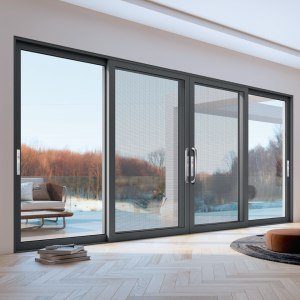
A patio pocket door is a sliding door system where the door panel retracts fully into a hollow cavity inside the adjacent wall. When closed, it functions like a standard sliding door. When open, the entire panel disappears, leaving an unobstructed opening with no track or door stack visible on the threshold.
This distinguishes it from a conventional sliding glass door, where one panel remains stationary and the other slides alongside it, blocking roughly half the opening. A pocket door system recovers that space entirely. For commercial settings—restaurants with terrace seating, hotels with poolside bars, showrooms that open onto courtyards—the difference matters operationally. A fully open 3-meter opening versus a 1.5-meter passage changes how people move, how furniture is arranged, and how the indoor-outdoor connection feels.
The mechanical principle is straightforward but demanding. The door hangs from rollers that run on a top-mounted track, with a guide at the bottom keeping the panel aligned. When pushed open, the panel travels into a wall pocket lined with a steel or aluminum frame that supports the structure above the opening. The engineering challenge lies in the wall pocket itself: it requires a header strong enough to carry the building load across the full opening width, and the pocket cavity must remain clear of insulation, electrical, or plumbing obstructions.
Types of Patio Pocket Doors: Slab, Multi-Slide, and Exterior Glass
Three configurations dominate the commercial market, and each serves a different purpose.
Slab pocket doors are single-panel systems. One large door panel slides into one pocket. This is the simplest and most common type, suitable for openings up to roughly 3.5 meters. The slab can be a solid aluminum panel, a glass panel, or a combination of both. For exterior applications, a slab pocket door is typically used where the opening is moderate and the pocket wall can be built deep enough to accommodate the panel width.
Multi-slide pocket doors use two or more panels that stack into a single pocket or into pockets on both sides. A common configuration is a 4-panel system where two panels slide into each side, opening the full width of the wall. These are specified for larger openings—5 to 8 meters or more—where a single slab would be too wide to handle. Multi-slide systems are heavier, require more robust track and roller hardware, and need deeper wall pockets. They also cost significantly more per square meter than single slabs.
Exterior sliding glass pocket doors are a subset focused on maximum transparency. The frame is minimized, the panels are almost entirely glass, and the system is designed to disappear visually when open. These are common in hospitality and commercial architecture where the view is the product. The trade-off is structural: glass-heavy panels are heavier, the hardware must be rated for higher loads, and the energy performance depends almost entirely on the glazing package rather than the frame.
The choice between these types comes down to three variables: opening width, pocket wall depth available, and the weight the structure can support.
Key Specifications to Consider
Frame Materials
Aluminum with thermal break is the dominant choice for exterior pocket doors in commercial projects. The thermal break—a polyamide strip separating the interior and exterior aluminum profiles—reduces heat transfer through the frame. This matters for both energy costs and condensation control. Steel-reinforced aluminum is used for larger panels where deflection under wind load is a concern.
Wood frames are used in high-end residential and boutique hospitality projects, but they require more maintenance and are less suitable for high-moisture or coastal environments. Vinyl (uPVC) is rare in commercial exterior pocket doors because it lacks the structural rigidity needed for large panels.
Glazing Options
For exterior applications, the glazing package is the most important specification after the frame. Double-pane insulated glass is the baseline for commercial projects. Triple-pane is specified in cold climates where heating loads dominate. Low-E coatings reduce radiant heat transfer and should be specified based on the local climate: a low solar heat gain coefficient (SHGC) in hot climates, a higher one in cold climates.
Tempered or laminated glass is a safety requirement in most commercial jurisdictions. Laminated glass also provides better acoustic insulation and, if specified with a PVB interlayer, improves security. The glass thickness typically ranges from 5mm to 12mm per pane, depending on panel size and wind load requirements.
Track and Roller Systems
The hardware determines the long-term reliability of a pocket door. Commercial-grade rollers should be rated for the actual panel weight, with stainless steel bearings and nylon or steel wheels. A common failure point is the bottom guide, which can wear or derail if the track is not perfectly level. Look for systems with adjustable rollers that allow vertical and horizontal alignment after installation.
Weather Sealing
This is the most underappreciated specification in exterior pocket doors. A sliding door has two sealing planes: the perimeter of the door panel and the junction between the door and the wall pocket. The latter is where water intrusion typically occurs. A proper system uses multiple compression seals, a sill with adequate drainage, and weatherstripping at the pocket entry point. Ask specifically how the manufacturer handles water management at the pocket cavity—this is where cheap systems fail.
Cost and Price Ranges
Patio pocket door pricing varies widely with size, material, glazing, and hardware specification. Rather than quoting a single figure, it is more useful to understand the cost structure.
| Component | Cost Influence |
|---|---|
| Frame material | Aluminum thermal break is the baseline; wood and steel-reinforced profiles add cost |
| Glazing package | Double vs. triple pane, low-E coating, laminated vs. tempered, glass thickness |
| Panel count | Single slab is cheapest; multi-slide systems increase cost per panel |
| Hardware grade | Commercial rollers, multi-point locks, and heavy-duty track add cost |
| Wall pocket construction | Steel pocket frames and structural headers are a separate construction cost |
| Installation complexity | Ground-level installation is cheaper than upper-floor or retrofit work |
As a rule of thumb, expect a commercial-grade exterior pocket door to cost more than a comparable sliding glass door of the same size, because the hardware and pocket framing requirements are more demanding. The premium is typically justified when the fully open opening provides operational value. For budget planning, obtain quotes from at least three suppliers with identical specifications, and be aware that regional labor rates and building code requirements cause significant variation.
How to Choose a Reliable Supplier or Installer
For a commercial project, the supplier and the installer are often different entities. The supplier manufactures or imports the door system; the installer handles the wall pocket construction and final fitting. Both need evaluation.
Supplier evaluation criteria:
- Request the thermal performance ratings (U-factor and SHGC) for the specific glazing package you are considering. If the supplier cannot provide certified numbers, treat it as a red flag.
- Ask about pressure test results: air infiltration, water penetration, and wind load resistance. Reputable manufacturers test to standards such as ASTM or EN and can share the reports.
- Confirm the hardware is replaceable and sourced from known manufacturers. Custom or proprietary hardware that cannot be sourced in your region creates a maintenance liability.
- For imported systems, verify that the supplier can provide the necessary customs documentation and that the profiles can be adjusted to meet your local building codes.
Installer evaluation criteria:
- The wall pocket requires structural framing that is not part of the door system itself. Confirm the installer has experience with header design and can coordinate with a structural engineer.
- Check references for projects of similar scale. A residential installer may not have the experience needed for a 6-meter commercial opening.
- Ask how they handle water management at the pocket cavity and what their warranty covers. Water intrusion at the pocket is the most common failure mode, and it is an installation issue as much as a product issue.
Installation Considerations and Building Codes
Building code requirements for exterior pocket doors vary by jurisdiction, but several considerations recur.
Egress requirements: If the door is on an emergency exit path, it must comply with local egress codes. Some jurisdictions require that the door be operable from the inside without keys or special knowledge. Pocket doors can be problematic here because the panel disappears into the wall—confirm that the hardware allows full opening from the interior.
Structural headers: The wall pocket removes the wall section that would normally carry the load above the opening. A structural header must be designed to span the full opening width. For multi-slide systems with wide openings, this can require significant steel reinforcement. This is a structural engineering decision, not a door supplier decision.
Wind load: In coastal or high-wind regions, the door system must be rated for the local wind load requirements. This affects both the frame strength and the glazing thickness. Verify that the system you are specifying has been tested for the relevant wind zone.
Accessibility: Threshold heights matter for wheelchair access and for compliance with accessibility standards. Many pocket door systems can be installed with a low-profile or flush threshold, but this must be specified in advance.
Maintenance and Durability
A well-specified commercial pocket door should operate reliably for 15 to 20 years with routine maintenance. The maintenance burden is concentrated in three areas:
- Track and rollers: Clean the track regularly and lubricate the rollers per manufacturer guidance. Roller bearings wear out and are replaceable—budget for replacement every 5 to 8 years depending on usage frequency.
- Weatherstripping: Compression seals degrade with UV exposure and temperature cycling. Inspect annually and replace as needed. This is a low-cost maintenance item that has a large effect on energy performance and water tightness.
- Drainage: The sill drainage channels must remain clear. In dusty or sandy environments, inspect and flush the drainage system quarterly.
The most common problems reported in commercial installations are sticking panels (roller misalignment or track debris), air drafts (worn weatherstripping), and water intrusion at the pocket cavity (failed drainage or improper installation). All three are addressable with proper maintenance and, for the water intrusion case, correct initial installation.
Why Choose Us for Your Patio Pocket Door Project
As a manufacturer rather than a distributor, our approach to these requirements is direct. We produce thermal-break aluminum pocket door systems and custom villa doors and windows at our factory, and we supply them to commercial projects worldwide. When you work with us, you are working with the factory that controls the profile design, the hardware specification, and the quality testing.
For exterior pocket doors, we test our systems for air tightness, water tightness, and wind resistance before shipment. We can provide the test documentation you need for your project file. Our profiles and fittings are adjustable to match the building codes of your target market, and we handle the full export documentation—packing lists, proforma invoices, and customs paperwork—so the procurement process is straightforward.
We offer full customization on size, color, glazing, and hardware, and we support OEM and ODM arrangements for projects that require private labeling or specific design modifications. We ship both FCL and LCL from our factory in China, and we can supply everything from a single door system to bulk quantities for construction projects.
One of our recent projects involved supplying multi-slide pocket door systems for a coastal restaurant renovation. The project required laminated glass for wind resistance, a low-E coating for solar heat control, and a drainage system designed for heavy rain exposure. We adjusted the profile structure to meet the local wind load rating and provided the test reports the architect required for approval.
If you are evaluating suppliers for a commercial pocket door project, we are happy to provide specifications, test data, and a quote based on your project requirements.