What Determines the Price of Interior Double Wood Doors
Interior double wood doors typically range from $400 to $2,500 per pair for standard sizes, with most mid-range options falling between $700 and $1,500. The final price depends on four primary factors: wood species, door construction (solid vs. engineered), finish level, and hardware configuration.
For commercial or custom residential projects, pricing can exceed $3,000 per pair when specifying exotic hardwoods, oversized dimensions, or specialized acoustic ratings. Understanding what drives these costs helps you evaluate quotes and avoid overpaying for features you do not need.
Wood Species and Their Price Impact
The choice of wood species is the single largest cost variable. Here is how common options compare:
| Wood Species | Price Range (per pair, prehung) | Durability | Grain Appearance |
|---|---|---|---|
| Paint-grade poplar | $400–$600 | Good | Minimal, even |
| Oak (red or white) | $650–$1,100 | Excellent | Prominent, open grain |
| Maple | $700–$1,200 | Very good | Subtle, smooth |
| Mahogany | $1,200–$2,200 | Excellent | Rich, straight grain |
| Walnut | $1,300–$2,500 | Very good | Dark, distinctive |
| Cherry | $1,100–$1,900 | Good | Warm, reddish tone |
Prices assume a standard 6-foot-8-inch by 3-foot-0-inch pair with a clear or semi-transparent finish. Paint-grade doors cost less because minor grain imperfections are acceptable when covered with opaque paint. Clear-finished doors require higher-grade lumber with consistent color and grain, which drives up material costs.
Solid Wood vs. Engineered Wood
Solid wood doors consist of a single piece of lumber or edge-glued staves. They offer the most authentic appearance and can be refinished multiple times over their lifespan. However, solid wood expands and contracts more noticeably with humidity changes, which can cause seasonal gaps between the door and frame.
Engineered wood doors use a veneer over a stable core, typically medium-density fiberboard (MDF) or a honeycomb structure. They resist warping better than solid wood, especially in climates with significant humidity swings. Most interior double doors in commercial settings use engineered construction for this reason, though buyers often specify solid wood for high-end residential projects.
For interior applications, engineered doors are not a downgrade. They provide better dimensional stability and acoustic performance when specified with the appropriate core. Solid wood remains the choice when you prioritize authenticity and the ability to re-finish over the door’s lifetime.
Standard Sizes and Rough Openings
Interior double doors are manufactured to fit standard rough openings. The most common configurations:
| Door Pair Size | Rough Opening Width | Rough Opening Height |
|---|---|---|
| 5 ft 0 in (two 2 ft 6 in doors) | 61.5 in | 82.5 in |
| 5 ft 6 in (two 2 ft 9 in doors) | 67.5 in | 82.5 in |
| 6 ft 0 in (two 3 ft 0 in doors) | 73.5 in | 82.5 in |
| 6 ft 8 in (two 3 ft 4 in doors) | 81.5 in | 82.5 in |
The rough opening must be approximately 1.5 inches wider and 1.5 inches taller than the actual door unit dimensions to allow for shimming and leveling. Standard door thickness is 1-3/8 inches for interior applications, though 1-3/4 inches is common for commercial projects or where higher acoustic ratings are required.
If you are retrofitting a single door opening to accommodate double doors, the header must be widened and the framing adjusted. This is a structural modification that requires a qualified contractor to assess load-bearing walls before work begins.
Prehung vs. Slab Doors
A prehung unit includes the door panels, frame, hinges, and pre-installed hardware. The entire assembly is installed as one piece into the rough opening. Prehung doors reduce installation time and ensure proper alignment between the door and frame.
Slab doors are just the door panels without a frame or hinges. They are used when the existing frame is in good condition and only the door panels need replacement. Slab installation requires precise fitting and is generally more labor-intensive than installing a prehung unit.
For double doors, prehung units are almost always the better choice. Double doors require precise alignment between the two panels, and a factory-assembled frame ensures the gap between the doors remains consistent. Field-fitting two slab doors into an existing frame is difficult and often results in uneven gaps or binding.
Hardware Considerations for Double Doors
Double doors require additional hardware compared to single doors. At minimum, you need:
- Astragal: A vertical strip mounted on the passive door that covers the gap between the two panels. It provides a seal for sound and light control.
- Flush bolts: Located at the top and bottom of the passive door. They extend into the frame and floor to keep the passive door stationary while the active door operates.
- Coordinator: A mechanism that ensures the active door closes before the passive door when both are operated together. Without a coordinator, the astragal can prevent the active door from latching properly.
These components add approximately $100 to $300 to the total cost depending on quality and finish. Buyers sometimes overlook this expense when budgeting for double doors, so factor it into your total project cost.
Acoustic Performance and Privacy
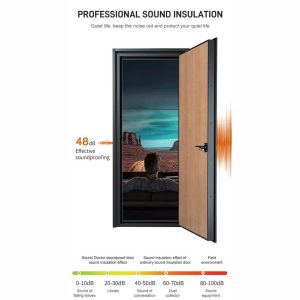
Interior double doors are often specified for spaces where noise control matters, such as home offices, media rooms, or conference areas. The sound transmission class (STC) rating indicates how well the door assembly blocks sound.
- A standard hollow-core interior door has an STC rating around 20–25.
- A solid wood door at 1-3/4 inches thickness achieves approximately 28–32 STC.
- A double door assembly with an astragal seal and perimeter gasketing can reach 35–40 STC.
For comparison, a standard interior wall with drywall on both sides has an STC rating of about 35–40. If your goal is to match the acoustic performance of the surrounding walls, specify solid-core doors with perimeter sealing. Engineered doors with a particleboard core perform similarly to solid wood at a lower cost.
Installation Considerations
Prehung double doors require a level and square rough opening. The floor must be flat across the entire width of the opening, as any slope will cause the doors to bind or swing open on their own. The frame is shimmed and secured to the wall framing, then the gaps are filled with expanding foam and covered with trim.
Installation typically takes 3–5 hours for a prehung double door unit, assuming the rough opening is properly prepared. Costs for professional installation range from $300 to $600 per pair. Verify that the installer has experience with double doors specifically, as the astragal and coordinator adjustments require more precision than single door installation.
Wholesale and Bulk Orders
For contractors, developers, or distributors, purchasing interior double wood doors in bulk changes the pricing structure significantly. Wholesale pricing typically applies to orders of 10 pairs or more, with the discount ranging from 15% to 30% off retail depending on volume.
When sourcing wholesale wood doors, clarify the following with your supplier:
- MOQ: Most manufacturers require a minimum order of 20–50 units for direct factory pricing. Some accept smaller orders through distributors.
- Lead time: Standard production runs take 2–4 weeks for popular wood species and sizes. Custom sizes or exotic woods extend this to 4–8 weeks.
- Container shipping: For international orders, a 40-foot container holds approximately 80–120 prehung double door units depending on packaging. Freight costs vary significantly by destination port.
- Packaging: Factory-direct shipments use plywood crates or cardboard with foam padding. Confirm that the packaging is suitable for your shipping method, especially for LCL (less than container load) shipments where handling is less controlled.
Bulk orders also allow for custom specifications at minimal cost premium. If your project requires a specific stain color or hardware finish across all units, manufacturers can adjust their production line to match your requirements without the per-unit customization fee typically charged for single-door orders.
Building Code and Compliance Considerations
Interior double doors in commercial or multi-family buildings may be subject to building code requirements that do not apply to single-family residential projects:
- Egress width: The active door must provide a minimum clear opening width, typically 32 inches, when the passive door is secured.
- Fire ratings: Doors in fire-rated walls must carry a fire label from a recognized testing laboratory. Not all wood doors are fire-rated, and fire-rated assemblies must include the frame, hinges, and hardware specified in the rating.
- ADA compliance: In accessible spaces, door hardware must be operable with a closed fist, and the force required to open the door must not exceed 5 pounds.
These requirements vary by jurisdiction and building occupancy type. Verify local codes before placing an order, as fire-rated doors and specialized hardware add significant cost and lead time.
How We Meet These Standards
As a factory-direct manufacturer, Jusen Door and Windows produces interior double wood doors for both residential and commercial projects. Our approach to the specifications discussed here is straightforward: we build to the standards your project requires, not to a generic default.
Our production line handles solid wood and engineered construction across oak, maple, mahogany, walnut, and cherry. We offer prehung units with astragal, flush bolts, and coordinator hardware installed at the factory, which eliminates field alignment issues and reduces installation time on site. For bulk orders, we provide adjustable profile structures and fittings to match local building codes in your target market.
Customization is a standard part of our process, not a premium service. We adjust door dimensions, finish colors, glass options, and hardware configurations to match your project specifications. Before shipment, every unit undergoes air-tightness, water-tightness, and wind resistance testing to verify performance.
For international buyers, we handle the full export process including packing lists, proforma invoices, and customs documentation. Both FCL and LCL shipments are available directly from our factory. Production lead time for standard interior double door orders is typically 3–5 weeks, with bulk pricing quoted based on your specific specifications and volume.
If you are planning a project that requires interior double wood doors, send us your dimensions and wood species preference for a quote. We will confirm pricing, lead time, and shipping costs based on your exact requirements.
For detailed questions about specifications or to discuss your project requirements, contact our team directly.