Understanding Door Handing: Left vs Right
Door handing is not a matter of preference — it is a geometric fact determined by your existing door frame and the direction you want the door to swing.
The rule is consistent across most manufacturers: stand on the outside of the door, facing it. If the hinges are on the left, it is a left-hand door. If the hinges are on the right, it is a right-hand door.
There is a second layer of terminology that often causes confusion: whether the door swings inward or outward. In the U.S. and many export markets, you will see terms like:
- Left-hand outswing (LHO): Hinges on the left when viewed from outside; door pushes outward.
- Left-hand inswing (LHI): Hinges on the left when viewed from outside; door pulls inward.
- Right-hand outswing (RHO): Hinges on the right when viewed from outside; door pushes outward.
- Right-hand inswing (RHI): Hinges on the right when viewed from outside; door pulls inward.
Some regions and manufacturers use the opposite reference point (viewing from inside), which is why you must confirm the reference point with your supplier. A door described as “left-hand” by one factory may be “right-hand” by another’s standard. Always ask for a diagram or confirm the hinge side explicitly.
For the purposes of this guide, we will use the outside-view standard, which is the most common in the storm door industry.
Inswing vs Outswing: Which One Do You Need?
Storm doors are almost always installed on the exterior side of the main entry door. This means the storm door’s swing direction must match the main door’s swing direction, with a few exceptions.
Outswing storm doors are the most common. They open away from the interior, which means they do not intrude into your entryway or hallway. They also provide better weather sealing because wind pressure pushes the door tighter against the frame. The trade-off is that the hinges and hardware are exposed to the elements, so they need to be made of corrosion-resistant materials.
Inswing storm doors are used when the main door swings inward and there is not enough exterior clearance for an outswing door. They are less common and can create a small vestibule effect. However, they can interfere with interior space and require careful attention to the door closer placement to avoid slamming.
Here is a practical way to decide:
- If your main entry door swings outward, your storm door must swing outward as well.
- If your main entry door swings inward, you can choose either, but an outswing storm door is usually the better choice for weather performance.
- If you are installing a storm door on a door that opens into a narrow hallway or tight space, consider an outswing unit to preserve interior clearance.
One more consideration: local building codes may regulate egress. In some jurisdictions, a door that serves as an emergency exit must swing in the direction of travel (outward). Verify this with your local authority before finalizing your order.
Arched Storm Doors: Adding Style and Function
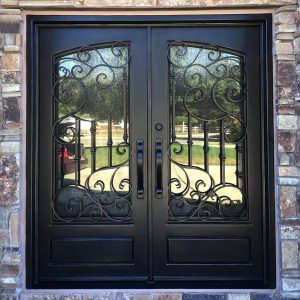
Arched storm doors are available in both left-hand and right-hand configurations. The arch does not change the handing logic — it only affects the top portion of the door frame.
The benefits of an arched design are primarily aesthetic. They complement arched entryways, which are common in Mediterranean, Spanish, and craftsman-style architecture. Functionally, an arched storm door provides the same protection as a rectangular unit, but there are two important trade-offs to consider:
- Cost: Arched frames require more fabrication labor and custom glass cutting. Expect a price premium compared to a standard rectangular door of the same size.
- Glass replacement: If the glass panel breaks, replacement is more expensive and may require a longer lead time because the glass is not a standard stock size.
When specifying an arched storm door, measure the arch radius carefully. A mismatch between the arch of your existing doorway and the arch of the storm door frame will create a visible gap that is difficult to seal.
Left Hand vs Right Hand: Comparison Table
| Feature | Left Hand Storm Door | Right Hand Storm Door |
|---|---|---|
| Hinge side (viewed from outside) | Left | Right |
| Swing direction | Outward (or inward, depending on model) | Outward (or inward, depending on model) |
| Typical use | Entry doors where the existing door hinges on the left | Entry doors where the existing door hinges on the right |
| Hardware placement | Door closer and handle on the right side | Door closer and handle on the left side |
| Availability | Equal availability from most manufacturers | Equal availability from most manufacturers |
| Price range | No price difference for handing alone | No price difference for handing alone |
| Common mistake | Ordering left when the door actually hinges on the right | Ordering right when the door actually hinges on the left |
The handing itself should never affect the price. If a supplier charges more for a left-hand unit, that is a red flag — it usually indicates a lack of inventory rather than a genuine cost difference.
Buying Guide: How to Choose the Right Storm Door
The selection process comes down to four decisions: handing, swing, material, and glass. Here is how to work through each one.
Step 1: Confirm the Handing
Stand outside, face the door, and look at the hinges. If you cannot see the hinges because they are on the interior side, check the door closer. The closer is typically mounted on the hinge side. Alternatively, open the door and look at the jamb from the inside — the hinge side will be obvious.
Step 2: Measure the Opening
Measure the rough opening, not the finished door. The rough opening is the framed gap in the wall, measured from stud to stud and from the floor to the header. Storm doors are typically sized to fit within this opening with a small allowance for shimming.
Standard residential sizes are 32, 34, and 36 inches wide, with heights of 80 or 82 inches. Commercial and custom projects may require non-standard dimensions. If your opening is not a standard size, plan for a custom fabrication lead time.
Step 3: Choose the Material
| Material | Pros | Cons | Best For |
|---|---|---|---|
| Aluminum | Corrosion-resistant, lightweight, low maintenance, available in many colors | Can dent, conducts heat | Most residential and commercial applications |
| Steel | Strong, secure, rigid | Heavier, prone to rust if the finish is scratched | High-traffic or security-conscious installations |
| Wood | Classic appearance, good insulator | High maintenance, warps over time | Interior or protected exterior applications |
Aluminum is the dominant choice for storm doors because it balances durability, weight, and cost. For coastal or high-humidity environments, look for powder-coated aluminum with stainless steel hinges and hardware.
Step 4: Select the Glass
Storm doors typically accept a glass panel, a screen panel, or a combination of both. The key decision is whether you want a full-view glass panel, a self-storing system that allows the glass to slide up and down, or a mid-view design with a fixed lower panel.
For energy efficiency, look for low-E glass with an argon fill. This reduces heat transfer and protects interior furnishings from UV damage. Tempered glass is recommended for safety, particularly in doors with large glass areas.
Quality Standards and Testing
When you are buying from a manufacturer, you are not just buying a product — you are buying the assurance that the product will perform under real conditions. The three tests that matter most for storm doors are:
- Air-tightness: Measures how much air leaks through the closed door. A lower number is better.
- Water-tightness: Measures resistance to water penetration under wind-driven rain. This is critical for exterior doors.
- Wind resistance: Measures the door’s ability to withstand wind loads without deformation or failure.
These tests are defined by standards such as ASTM E283 (air leakage), ASTM E547 (water penetration), and ASTM E330 (wind load). When comparing suppliers, ask which standards their products are tested to and request the test reports. A manufacturer that cannot provide this documentation is not a reliable source for a project that requires performance certainty.
Frequently Asked Questions
How do I determine if I need a left hand or right hand storm door?
Stand outside, facing the door. If the hinges are on your left, you need a left-hand door. If they are on your right, you need a right-hand door. This applies regardless of whether the door swings in or out.
What is the difference between inswing and outswing storm doors?
An outswing door opens away from the interior; an inswing door opens into the interior. Outswing is more common for storm doors because it provides better weather sealing and does not consume interior space. Inswing is used when exterior clearance is limited or when the main door swings inward.
Are arched storm doors available in left hand configuration?
Yes. The arch affects only the top of the frame, not the hinge side. You can order an arched storm door in left-hand, right-hand, inswing, or outswing configurations.
What materials are best for storm doors?
Aluminum is the most popular choice for its corrosion resistance and low maintenance. Steel offers greater strength but is heavier and more prone to rust. Wood is aesthetically pleasing but requires regular maintenance and is not recommended for exposed exterior use.
Can I customize a left hand storm door to fit my existing door frame?
Yes. Most manufacturers offer custom sizing for width, height, and color. You can also specify the glass type, hardware finish, and whether you need a self-storing screen system. Custom orders typically require a longer lead time than stock sizes.
What are the benefits of a left hand outswing storm door?
A left-hand outswing door keeps the interior clear, provides good weather sealing, and is the standard choice for most entry doors. The primary benefit of the outswing configuration is that wind pressure compresses the door against the frame, improving the seal.
Additional Considerations: Customization and Manufacturer Insights
By this point, you have the core knowledge to specify a storm door correctly. But there is a difference between knowing what you need and ensuring the manufacturer delivers it. Here is how the industry works in practice, and how we meet those expectations at Jusen Door and Windows.
The Handing Terminology Problem
We mentioned earlier that handing definitions vary by region. In our experience, this is the single most common source of order errors. When you send an inquiry, do not just say “left hand.” Provide a photo of your existing door from the outside, or confirm the hinge side explicitly. This eliminates ambiguity before production begins.
Customization Beyond Handing
If your project requires non-standard dimensions, a specific color match, or particular glass performance ratings, a factory-direct manufacturer is often the better choice compared to a distributor. Distributors carry stock sizes and standard colors. A manufacturer can adjust the profile structure and fittings to match local building codes in your target market, which is particularly relevant for commercial projects or export orders.
At our factory, we handle full customization on size, color, glass, and hardware accessories. This includes arched storm doors, left-hand and right-hand configurations, and inswing or outswing models. We also support OEM and ODM projects, so if you need a private-label product for your distribution channel, that is within our capability.
Quality Assurance Process
Before any shipment leaves our facility, every unit undergoes pre-shipment inspection for air-tightness, water-tightness, and wind resistance. This is not a sample-based check — it is a per-unit verification. For buyers who are sourcing from overseas, this matters because it reduces the risk of receiving a container of non-conforming product.
Logistics and Documentation
We ship both FCL and LCL, with direct delivery from our factory in China. For international buyers, we provide a packing list, proforma invoice, and full customs documentation. This is especially important for buyers who are not familiar with the import process, as missing documentation can delay customs clearance significantly.
If you are comparing suppliers, here is what we suggest you ask each one:
- Can you provide test reports for air, water, and wind performance?
- What is your process for verifying handing before production?
- Can you accommodate custom sizes and colors without a large price premium?
- What documentation do you provide for customs clearance?
These questions will separate manufacturers who understand the technical requirements from those who are simply reselling standard stock.
Ready to order a left-hand storm door that fits your exact specifications? We are happy to provide a quote with full technical documentation.