Vinyl Doors at a Glance: Key Takeaways
A vynil door is a cost-effective, low-maintenance entry or interior door made with a PVC (vinyl) skin stretched over a hollow or molded core. For commercial projects, the main advantages are predictable pricing, resistance to moisture and dents, and the ability to specify non-standard sizes without a major price penalty.
Before you compare quotes, understand these five points:
- Vinyl vs. molded is a construction difference, not a quality difference. A molded door is a type of construction (compressed wood fibers with a smooth skin). Vinyl doors use PVC skins over a core. Both can be hollow or solid.
- Standard sizes exist, but custom is common. The most common residential sizes are 20 x 80 and 23 1/2 x 80, but commercial projects routinely require custom widths and heights. Vinyl doors handle this well.
- Handing matters more than most buyers expect. A right-hand or left-hand door is determined by the side the hinges are on when the door swings toward you. Getting this wrong delays installation.
- Price correlates with core, not skin. An expensive door is usually expensive because of a solid core, fire rating, or acoustic performance—not because of the vinyl surface.
- Trim is a separate purchase. Door surround trim is not included with the slab. Budget for it and confirm the profile matches your wall thickness.
Vinyl vs. Molded Doors: What’s the Difference?
Buyers often use these terms interchangeably, but they are different products with different performance profiles.
A molded door starts with a wood-fiber composite skin that is pressed into shape, then bonded to a frame and core. The skin is primed and ready to paint. Molded doors are stiff, accept paint well, and are the standard for most residential and light commercial interiors.
A vinyl door uses a PVC skin that is vacuum-formed over the core. The vinyl is typically colored throughout, so it does not need painting. It is more resistant to moisture, scratches, and dents than a molded skin. Vinyl is the better choice where doors face humidity, frequent impact from carts or equipment, or where maintenance labor is expensive.
For commercial applications, the practical difference is lifecycle cost. A molded door that gets scuffed requires sanding, priming, and repainting. A vinyl door with the same scuff can often be wiped down. If a vinyl skin is punctured, the repair is a patch, not a repaint.
Choose molded doors when you need a paint-matched finish or a specific fire rating. Choose vinyl doors when you want the lowest maintenance over a 10-year period and the color palette of the vinyl skin works for the project.
Standard Sizes and Custom Dimensions
The most common standard sizes for vinyl doors are:
| Size (Width x Height) | Typical Use |
|---|---|
| 20 x 80 | Narrow closets, utility rooms, small openings |
| 23 1/2 x 80 | Standard interior passage doors in older construction |
| 28 x 80 | Standard interior doors in newer construction |
| 30 x 80, 32 x 80, 36 x 80 | Standard exterior and wide interior openings |
The 20 x 80 door and the 23 1/2 x 80 door are common in older buildings and retrofit projects. If your opening is a non-standard width, you have two options: order a custom slab or use a wider standard slab and cut it down. Vinyl doors can be trimmed, but only on the hinge or latch edge, and only within the manufacturer’s allowance—usually 1/4 to 1/2 inch. Never trim the top or bottom of a vinyl door, as the skin may separate from the core.
For doors for large openings, such as double doors, oversized entryways, or corridor widths over 36 inches, custom manufacturing is the standard route. Vinyl doors can be made up to roughly 48 inches wide and 120 inches tall, depending on the core material. Beyond that, you are in engineered door territory and should expect longer lead times.
When measuring for a custom door, provide the rough opening width and height, not the finished opening. The manufacturer needs the frame size, wall thickness, and the swing direction. If you are sourcing for a project in a specific region, such as custom doors san diego, local building codes may dictate wind-load requirements that affect the core and frame specification. A manufacturer with export experience will ask for these details upfront.
Door Handing: Right-Hand vs. Left-Hand
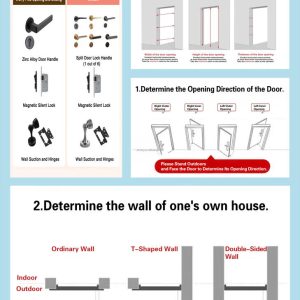
Door handing is a frequent source of ordering errors. The rule is simple: stand on the outside of the door (the side you approach from when entering the room or building) and face the door. If the hinges are on your right, it is a right-hand door. If the hinges are on your left, it is a left-hand door.
For interior doors, the “outside” is the corridor or common area. For exterior doors, it is the exterior side.
There are four possible configurations:
- Right-hand (RH): Hinges on the right when viewed from the outside. Door swings away from you.
- Left-hand (LH): Hinges on the left when viewed from the outside. Door swings away from you.
- Right-hand reverse (RHR): Hinges on the right when viewed from the outside. Door swings toward you.
- Left-hand reverse (LHR): Hinges on the left when viewed from the outside. Door swings toward you.
If you are replacing an existing door, the simplest method is to look at the current hinges. Stand so the door closes toward you, and note which side the hinge pins are on. That is your handing.
For new openings, determine the swing direction based on traffic flow and safety codes. Doors in egress paths must swing in the direction of travel. When ordering, specify the handing exactly as “RH” or “LH” and include the reverse designation if the door opens toward you. A manufacturer that produces for export will confirm this before production, but you should still double-check your own measurements.
Cost Considerations: Why Some Doors Are Expensive
The price range for vinyl doors is wide, and the difference is almost always in the core, not the skin.
A hollow-core vinyl door is the entry-level product. It is light, inexpensive, and suitable for closets and low-traffic interiors. It offers minimal sound insulation and no fire resistance.
A solid-core vinyl door is significantly more expensive for three reasons: material weight, manufacturing time, and fire-rating testing. A solid core is typically made of particleboard, mineral board, or a foam-filled composite. The core determines the door’s acoustic rating, thermal performance, and fire rating.
The factors that drive cost upward:
- Core material: Mineral cores for fire-rated doors are the most expensive.
- Fire rating: A 20-minute or 60-minute fire rating requires tested assemblies and specific hardware.
- Acoustic performance: STC-rated doors use dense cores and perimeter seals.
- Size: Custom widths and heights add material waste and production setup time.
- Hardware preparation: Pre-drilling for locksets, hinges, and panic bars adds labor.
- Finish: Colored vinyl skins cost more than white, and textured finishes cost more than smooth.
For budgeting purposes, expect a hollow-core vinyl door to be comparable to a hollow-core molded door. A solid-core vinyl door will be 2 to 3 times that price. A fire-rated solid-core door will be more again.
Do not cut corners on the core for high-traffic commercial openings. A hollow-core door in a corridor will show damage within a year. A solid-core door will last a decade or more. The lifecycle cost of replacing a hollow door far exceeds the upfront savings.
Door Surround Trim: Options and Installation
Door surround trim, also called casing or architrave, is the decorative and functional molding around the door frame. It covers the gap between the frame and the wall, protects the edges, and provides a finished transition.
There are three common trim profiles:
- Flat casing: A simple, rectangular profile. Common in modern and commercial buildings. Easy to clean, minimal visual weight.
- Colonial casing: A stepped profile with a rounded inner edge. Traditional look, slightly more expensive than flat.
- Brickmold: A thicker, rounded profile used on exterior doors. It transitions the door frame to the siding or stucco.
For vinyl doors, the trim must be compatible with the frame material. If you are using a vinyl-clad frame, the trim should be PVC or a composite that expands and contracts at a similar rate. Wood trim on a vinyl frame will create a thermal break mismatch and can crack over time.
Installation considerations for commercial projects:
- Wall thickness: Trim must match the depth of the wall. A 4-inch wall needs a different jamb extension than a 6-inch wall.
- Fire-rated assemblies: If the door is fire-rated, the trim must be part of the tested assembly. Do not substitute trim profiles on fire-rated doors.
- Flush vs. applied: Flush trim sits level with the wall surface. Applied trim projects beyond the wall. Flush trim is more common in commercial corridors where carts and equipment could damage protruding trim.
When ordering, specify the trim profile, material, and wall thickness. The manufacturer can supply matching trim, or you can source it locally. For large projects, supplying trim from the same manufacturer ensures color matching and consistent expansion behavior.
Comparison Table: Vinyl vs. Molded vs. Wood Doors
| Criteria | Vinyl Door | Molded Door | Solid Wood Door |
|---|---|---|---|
| Cost | Low to moderate | Low to moderate | High |
| Durability | High against moisture, scratches, dents | Moderate; dents and scratches require repainting | Moderate; susceptible to moisture and warping |
| Maintenance | Wipe clean; no painting required | Repaint every 3-5 years in high-traffic areas | Sand, stain, or repaint periodically |
| Customization | Custom sizes and colors available; limited to PVC finishes | Custom sizes available; paint any color | Custom sizes, wood species, and stains |
| Moisture Resistance | Excellent | Moderate; can swell if edges are exposed | Poor without proper sealing |
| Fire Rating | Available with mineral cores | Available with mineral cores | Limited; requires treatment |
| Sound Insulation | Good with solid core | Good with solid core | Excellent |
| Best For | Commercial corridors, bathrooms, exterior applications | Residential interiors, paint-grade applications | High-end interiors, architectural statement doors |
The decision framework is straightforward. If the door will face moisture, impact, or heavy use, vinyl is the strongest choice. If the door needs to match a painted interior and will see light use, molded is more cost-effective. If the project demands natural wood aesthetics and the budget allows, solid wood is the premium option.
How to Choose a Door Dealer or Manufacturer
The dealer or manufacturer you choose determines whether your project runs smoothly or stalls on delivery. For commercial projects, evaluate suppliers on four criteria:
1. Custom capability. Ask directly: Can you produce a 40 x 96 door with a solid core and a specific fire rating? If the answer requires a long pause, the supplier may not have in-house manufacturing. A factory-direct supplier can adjust the profile structure and fittings to match local building codes, which is essential for export projects.
2. Inspection and testing. A reliable manufacturer performs pre-shipment inspections covering air-tightness, water-tightness, and wind resistance. Ask for the test reports. If the supplier cannot produce them, treat the absence as a risk signal.
3. Documentation. For international orders, you need a packing list, proforma invoice, and full customs documents. A manufacturer with foreign trade experience will provide these without being asked. If you have to chase paperwork, the supplier is likely using a middleman.
4. Shipping flexibility. Confirm whether the supplier can handle both FCL and LCL shipments. Direct delivery from the factory avoids the markup and coordination issues of a trading company.
Here is how we meet these standards. As a factory-direct manufacturer, Jusen Door and Windows produces vinyl doors, molded doors, and solid wood doors with full customization on size, color, glass, and hardware. We run strict pre-shipment inspections on every order, including air-tightness, water-tightness, and wind resistance tests, and we provide complete export documentation for FCL and LCL shipments. Our adjustable profile structure and fittings are designed to match the building codes of your target market, which matters for projects like custom doors san diego where wind-load requirements are strict.
If you are comparing suppliers for a commercial project, the questions above will separate a manufacturer from a reseller. When you are ready to discuss specifications, our team can confirm sizing, handing, and core options for your openings. Contact Our Team to review your project requirements.
Frequently Asked Questions
Can vinyl doors be painted?
Some vinyl doors can be painted, but the paint will not adhere as well as it does to a molded door, and some manufacturers void the warranty if you paint the door. Check the warranty terms before painting. If you need a painted door, a molded door is the better starting point.
What is the difference between a 20 x 80 door and a 23 1/2 x 80 door?
The difference is width. A 20 x 80 door is 20 inches wide and 80 inches tall, typically used for closets and narrow openings. A 23 1/2 x 80 door is 23.5 inches wide, common in older homes and some commercial buildings. Both are standard sizes, but 23 1/2-inch widths are less common in new construction.
How do I measure for a custom vinyl door?
Measure the rough opening width and height at three points (top, middle, bottom for width; left, middle, right for height). Use the smallest measurement. Provide the wall thickness and the door handing. For large openings, also specify the required fire rating and acoustic performance.
Why are some vinyl doors so expensive?
The price difference comes from the core. Solid cores, fire-rated mineral cores, and acoustic cores add material and manufacturing cost. Custom sizes and hardware preparation also add cost. A hollow-core vinyl door is inexpensive, but it is not suitable for high-traffic commercial use.
How do I choose between a right-hand and left-hand door?
Stand on the outside of the door, facing it. If the hinges are on your right, it is a right-hand door. If the hinges are on your left, it is a left-hand door. For interior doors, the outside is the corridor. For exterior doors, it is the exterior side.
What is door surround trim and do I need it?
Door surround trim covers the gap between the door frame and the wall, protecting the edges and providing a finished look. You need it for any door installation. Choose trim that matches the frame material and wall thickness, and confirm it is part of the tested assembly for fire-rated doors.
Can vinyl doors be used for exterior applications?
Yes, vinyl doors are suitable for exterior use, particularly in climates with high humidity or salt air. The vinyl skin resists moisture and does not require painting. For exterior doors, specify a solid core and ensure the frame includes a proper thermal break.