## What to Know Before Buying a Front Door with Two Sidelights
A front door with two sidelights is an entry configuration where a central door is flanked by two narrow vertical windows. This setup is popular in both residential and light commercial projects because it solves a fundamental design problem: how to bring daylight into an entryway without compromising wall space or security.
The primary trade-off is straightforward. Sidelights increase glass area, which improves natural light and curb appeal, but they also introduce additional surface area for heat transfer, potential entry points, and long-term maintenance. The buying decision is not simply about aesthetics—it is about balancing light transmission against energy performance, security, and lifecycle cost.
For B2B buyers, the stakes are higher than for individual homeowners. You are specifying a product that must perform consistently across multiple units, meet local building codes, and withstand years of use. Understanding the technical distinctions between materials, glass packages, and operating mechanisms is essential before comparing supplier quotes.
## Types of Front Doors with Two Sidelights
### By Frame Material
**Aluminum (Thermal-Break)**
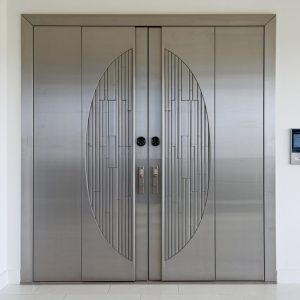
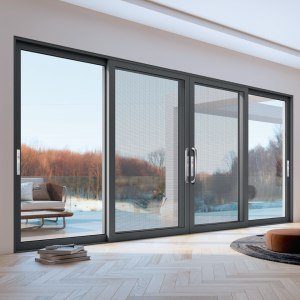
Thermal-break aluminum is the dominant choice for commercial and high-end residential projects. The frame is constructed with a polyamide or similar insulating barrier between the interior and exterior aluminum sections, significantly reducing thermal conductivity compared to standard aluminum.
The advantages are structural rigidity, slim sightlines that maximize glass area, and excellent corrosion resistance. Modern thermal-break systems also accommodate thick insulating glass units (IGUs) and multi-point locking hardware. The main drawback is cost—thermal-break aluminum is generally more expensive than uPVC and comparable to premium wood.
For projects requiring large spans, slim profiles, or specific wind-load ratings, aluminum is often the only practical option. It also offers the widest range of powder-coating colors and anodized finishes, which matters when matching a building’s exterior palette.
**Wood**
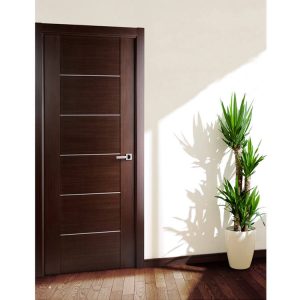
Solid wood doors with sidelights remain the preferred choice for period properties, high-end residential work, and projects where a natural material aesthetic is non-negotiable. Wood offers inherent thermal insulation and a warm appearance that neither aluminum nor uPVC can replicate.
However, wood demands ongoing maintenance. Exterior-grade finishes need reapplication every few years, and the frame joints—especially where the sidelights meet the main door—are vulnerable to water ingress if not properly detailed. For B2B buyers, this translates into higher lifecycle costs and a greater risk of callbacks if the product is not correctly specified for the local climate.
Engineered wood products, such as laminated veneer lumber (LVL) cores with wood veneer faces, improve dimensional stability and reduce warping compared to solid timber. If wood is specified, this is worth requesting.
**uPVC**
uPVC (unplasticized polyvinyl chloride) is the budget-friendly option. It offers decent thermal performance, low maintenance, and good weather resistance. The material does not require painting and is resistant to rot and corrosion.
The limitations are structural. uPVC frames are bulkier than aluminum to achieve equivalent rigidity, which reduces the glass area and can look less elegant. Color options are typically limited to white, woodgrain foils, and a few solid colors, and the material expands and contracts more than aluminum or wood with temperature changes. For large sidelight configurations, uPVC may not provide sufficient structural support without steel reinforcement.
uPVC is a reasonable choice for cost-sensitive projects in moderate climates, but it is rarely the right specification for high-end or performance-critical applications.
### By Sidelight Operation
**Fixed Sidelights**
Fixed sidelights are non-operable. They are glazed directly into the frame and serve purely as light-transmitting elements. This is the most common configuration because it is simpler, more secure, and less expensive than operable units.
Fixed sidelights should be specified with tempered or laminated glass, as they are often located near the entry path where accidental impact is possible. Building codes in many jurisdictions require safety glazing in this application.
**Vented Sidelights**
Vented (operable) sidelights open, typically via casement hinges or a sliding mechanism. They provide natural ventilation, which is valuable in entryways that lack cross-ventilation or in climates where passive cooling is desirable.
The trade-offs are significant. Operable sidelights introduce additional hardware, weatherstripping, and hinge points—all potential failure and air-leakage locations. They also complicate the security picture, as each operable panel is a potential entry point that must be secured with appropriate locking hardware.
Vented sidelights are most useful in mild climates or for spaces like sunrooms and covered entryways where the door itself is not the primary ventilation source. For standard front entries, fixed sidelights are generally the more practical specification.
## Comparison Table: Front Door with Two Sidelights Options
| Criterion | Thermal-Break Aluminum | Wood | uPVC |
|—|—|—|—|
| Thermal performance | Excellent with polyamide break | Good | Good to moderate |
| Structural rigidity | High | Moderate to high | Moderate |
| Maintenance | Low | High (periodic refinishing) | Low |
| Lifespan | 30+ years with proper finishing | 20-30 years with maintenance | 20-25 years |
| Customization | Wide color range, slim profiles | Natural material, limited colors | Limited colors, bulky profiles |
| Relative cost | High | High | Low to moderate |
| Best suited for | Commercial, high-performance, modern | Period, high-end residential | Budget, moderate climates |
## How to Choose the Right Front Door with Two Sidelights for Your Project
### Sizing and Rough Opening
The most common mistake in specifying sidelight configurations is failing to account for the total rough opening width. A standard single door is typically 36 inches (91 cm) wide. Adding two sidelights at 12–15 inches (30–38 cm) each brings the total unit width to roughly 60–66 inches (152–168 cm). This requires a structural header to support the load above the opening, which is a framing consideration that must be resolved before ordering.
Measure the rough opening width and height accurately. The unit you order must be slightly smaller than the rough opening to allow for shimming and proper flashing. A common rule is to allow 1/2 to 3/4 inch (13–19 mm) of clearance on all sides, but always follow the manufacturer’s specific installation instructions.
For sidelight height, matching the door height is standard. However, some designs use shorter sidelights with a transom above, which can be a solution when ceiling height or architectural style does not permit full-height sidelights.
### Energy Efficiency
Sidelights significantly increase the glazed area of an entryway, which directly impacts the unit’s overall U-factor (rate of heat transfer) and SHGC (solar heat gain coefficient). A lower U-factor means better insulation; SHGC indicates how much solar heat passes through the glass.
The frame material matters, but the glass package matters more. For sidelights, specify insulating glass units (double or triple glazing) with low-E coatings. Low-E coatings reduce heat transfer while allowing visible light to pass. In hot climates, a low SHGC coating reduces cooling loads; in cold climates, a high SHGC coating can contribute passive solar heating.
Argon or krypton gas fills between glass panes further improve insulation. The spacer system—the component that separates the panes—also affects both thermal performance and condensation resistance. Warm-edge spacers reduce heat loss at the glass edge and minimize condensation.
For B2B buyers, the practical takeaway is to request U-factor and SHGC values for the complete unit, not just the glass. The frame’s thermal performance significantly affects the whole-unit rating, especially with large sidelight configurations where the frame-to-glass ratio is higher than for a simple door.
### Security Considerations
Any sidelight configuration increases the number of potential entry points. The frame material and hardware quality determine the actual security level.
For aluminum and uPVC frames, multi-point locking systems are standard on the main door. These engage multiple locking points along the frame edge, making forced entry significantly more difficult than with a single-point latch. For sidelights, fixed units are inherently more secure than operable ones.
The glass itself is a consideration. Standard annealed glass shatters into sharp fragments. Tempered glass breaks into small, relatively harmless pieces but is not a barrier to determined intruders. Laminated glass, which consists of two glass layers bonded with a plastic interlayer, remains in place when broken and provides a genuine security benefit. For ground-floor sidelights, laminated glass is a reasonable specification.
### Cost Expectations
Pricing for a front door with two sidelights varies widely based on material, glass package, size, hardware, and whether the unit is pre-hung (mounted in a frame with hinges and threshold) or requires separate field assembly.
As a general framework, uPVC units sit at the lower end of the price range, thermal-break aluminum in the middle to upper range, and premium wood at the top. Custom sizes, laminated glass, triple glazing, and high-end hardware each add incremental cost. Labor costs for installation also vary by region and by whether the rough opening requires structural modification.
For budgeting purposes, obtain quotes that itemize the door unit, sidelights, frame, hardware, glass package, and delivery separately. This makes it easier to compare supplier pricing on an apples-to-apples basis.
## Vented Sidelights: Are They Right for You?
Vented sidelights make sense when natural ventilation is a genuine requirement. This occurs most often in entryways that are also used as airlocks, in climates with mild shoulder seasons, or in buildings where the main door must remain closed for security or climate control reasons.
The decision hinges on whether the ventilation benefit outweighs the additional complexity. Operable sidelights require hinges, handles, and locking mechanisms that fixed units do not. These components add cost, create potential air and water leakage points, and require periodic adjustment and maintenance.
From a security standpoint, operable sidelights must be lockable and should be specified with the same hardware quality as the main door. From an energy standpoint, operable units generally have slightly worse air-tightness than fixed units, which matters in extreme climates.
For most projects, fixed sidelights are the better default choice. Choose vented sidelights only when the ventilation requirement is explicit and cannot be met through other means, such as a mechanical ventilation system or an operable window elsewhere in the space.
## Evaluating Manufacturers for B2B Supply
When sourcing front doors with two sidelights for a project or ongoing supply arrangement, the evaluation criteria extend beyond the product itself. The manufacturer’s capability to deliver consistent quality, meet lead times, and support your documentation requirements is equally important.
Key questions to ask potential suppliers:
**What testing standards do your products meet?** Performance claims should be backed by test evidence. For exterior doors and sidelights, relevant tests include air-tightness, water-tightness, and wind-load resistance. Ask for the specific standards and results, not general assurances.
**Can you customize profiles and hardware to match local building codes?** Building codes vary significantly between jurisdictions. A manufacturer that can adjust profile structure, glazing options, and fittings to comply with your target market’s requirements is more valuable than one offering a fixed product line.
**What is your approach to pre-shipment inspection?** For international procurement, quality control before shipment is critical. A supplier that conducts performance testing on finished units—rather than only random sampling—reduces the risk of receiving non-conforming product.
**Can you provide complete export documentation?** If you are importing, the manufacturer should be able to supply packing lists, proforma invoices, and full customs documentation. This is not a given across all factories.
**What are your shipping options and minimum order requirements?** Confirm whether the supplier can handle both full container load (FCL) and less-than-container-load (LCL) shipments, and whether your order volume fits their production model.
As a manufacturer of thermal-break aluminum doors and windows, system windows, and custom villa entry doors, our approach at Jusen Door and Windows is to meet these criteria directly. We supply directly from our factory, which removes middleman markup, and we offer full customization on size, color, glass, and hardware. Every unit undergoes pre-shipment inspection for air-tightness, water-tightness, and wind resistance. We are experienced in foreign trade documentation, handle both FCL and LCL shipments, and adjust profile structures and fittings to match the building codes of your target market. If you are comparing suppliers for a project, we are happy to provide detailed specifications and a quote.
## Frequently Asked Questions
**What are the benefits of a front door with two sidelights?**
The main benefits are increased natural light in the entryway, improved curb appeal through architectural symmetry, and a more open and welcoming interior transition. Sidelights also make a narrow entry feel wider without expanding the actual door opening.
**What materials are available, and how do they compare?**
The three main options are thermal-break aluminum, wood, and uPVC. Aluminum offers the best combination of structural performance, slim profiles, and low maintenance. Wood provides natural aesthetics but requires ongoing upkeep. uPVC is the most budget-friendly but has structural and aesthetic limitations.
**What is the difference between fixed and vented sidelights?**
Fixed sidelights are non-operable and serve purely as light sources. Vented sidelights open to provide natural ventilation. Fixed units are simpler, more secure, and less expensive; vented units add functionality but also introduce more hardware, maintenance, and potential leakage points.
**How do I choose the right size?**
Measure the rough opening width and height precisely. The total unit width is the door width plus both sidelights, and the structural header above the opening must be capable of supporting the load. Allow for shimming clearance and follow the manufacturer’s installation instructions.
**What security features should I look for?**
Look for multi-point locking systems on the main door, fixed rather than operable sidelights for ground-floor installations, and laminated glass for the sidelight panels. The frame material should be structurally rigid, and all hardware should be of commercial-grade quality.
**How much does a front door with two sidelights typically cost?**
Costs vary significantly based on material, size, glass package, and hardware. uPVC is the most economical, thermal-break aluminum is mid-to-high range, and premium wood is the most expensive. Custom sizes and upgraded glazing add cost. Obtain itemized quotes from multiple suppliers for accurate comparison.
## Additional Considerations: Customization, Sizing, and More
For B2B buyers, the ability to customize is often the deciding factor between an adequate product and a truly suitable one. Standard sizes may not fit existing rough openings, and color matching to a building’s exterior finish is frequently required.
When evaluating customization capability, consider the following:
**Size and proportion.** Can the manufacturer produce non-standard widths and heights without excessive lead time or cost? Some factories are locked into fixed mold sizes and cannot deviate economically.
**Glass options.** Beyond standard clear insulated glass, can the supplier provide low-E coatings, laminated glass, tinted glass, or decorative options like frosted or textured finishes? Privacy glass is particularly relevant for sidelights facing the street or neighboring properties.
**Hardware and finishes.** Does the supplier offer a range of handle styles, lock types, and hinge options? Can hardware be matched to the building’s overall design language?
**Color and finish.** For aluminum, the range of powder-coating colors and anodized finishes matters. For wood, the type of veneer and finish options are relevant.
For projects with specific performance requirements, also confirm that the manufacturer can provide test data for the exact configuration you intend to order, not just for their standard products. A unit that performs well in a standard size may not have the same performance characteristics when scaled up or fitted with different glass.
Finally, consider the logistics of supply. If you are importing, factor in shipping time, customs clearance, and the potential for damage during transit. A supplier experienced in export packing and international shipping will minimize these risks. Direct communication with the factory—rather than through intermediaries—also simplifies issue resolution and ensures that your specifications are correctly understood.