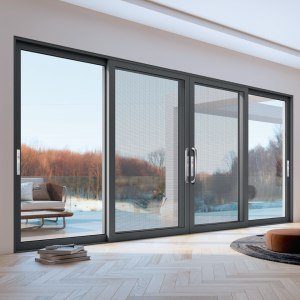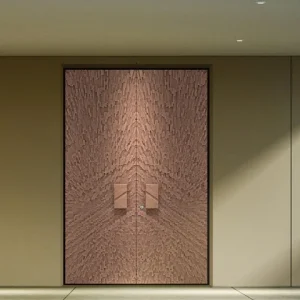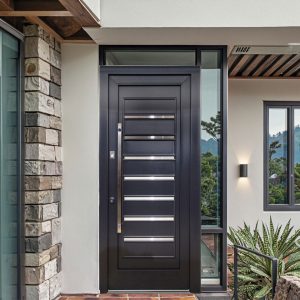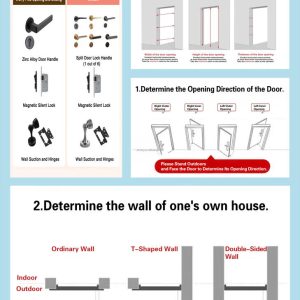
The main patio-door configurations include sliding, hinged, folding and multi-panel systems. The right choice depends on available clearance, desired opening width, weather exposure, maintenance and the way people move through the opening.
There is no single “best” patio-door type for every project.
Sliding patio doors
Sliding patio doors move horizontally along a track. They are useful when there is little interior space for a swinging door.
The trade-off is that part of the opening normally remains occupied by a fixed or parked panel. Roller quality, track alignment and sill drainage are important for long-term operation.
Hinged patio doors
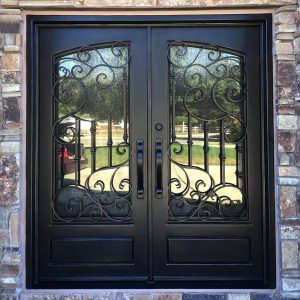
Hinged patio doors swing from hinges and can be configured as single or paired leaves.
They can provide a familiar opening action and a wider clear passage than some conventional sliders. The main planning issue is swing clearance.
Before ordering, check furniture, cabinets, exterior walkways and adjacent doors.
Folding and accordion patio doors
Folding or accordion systems use multiple connected panels that move along a track and stack or fold to the side.
Their main attraction is a potentially large open passage. They also require more hardware and more careful coordination of panel weight, track, frame and structural support.
A folding system should therefore be specified as a complete engineered assembly.
Outswing patio doors
Outswing systems open toward the exterior. They can preserve interior floor space, but the exterior swing area must remain usable.
Check decks, balconies, walkways, railings and adjacent openings before selecting an outswing configuration.
For exposed locations, the sill, weather seals and drainage details deserve particular attention.
Patio doors with screens
Screens can be integrated into some sliding, hinged or multi-panel systems.
Confirm how the screen operates and whether it follows the same opening pattern as the main door. A screen that works with a two-panel slider may not be compatible with a folding or outswing configuration.
Double outswing patio doors
A double outswing configuration uses two hinged leaves opening outward. It can provide a broad passage but requires enough exterior clearance for both leaves.
Confirm handing, meeting-stile configuration, hardware and weather sealing before ordering.
How to choose the right type
Start with the opening and circulation rather than the appearance.
Ask:
- How much interior swing space is available?
- How much exterior clearance is available?
- How wide should the clear opening be?
- Is a screen required?
- How much maintenance is acceptable?
- What weather exposure does the opening face?
- Does the project require a specific accessibility or performance specification?
Final takeaway
Sliding, hinged, folding and outswing patio doors solve different spatial problems. Choose the operating configuration first, then compare frame, glass, hardware and weather-performance options within that configuration.
Sliding versus outswing
A sliding patio door usually requires less swing clearance, which makes it useful beside furniture or narrow circulation zones. An outswing door preserves interior floor area but requires clear exterior space.
The choice should therefore begin with a plan of the opening and surrounding circulation.
Screens by door type
Screens are relatively straightforward on many sliding systems because they can use a dedicated track. Hinged and folding systems can require different screen arrangements.
If insect protection is important, specify the screen at the same time as the main door.
Double outswing systems
A double outswing system can create a wide hinged opening. The two leaves need enough exterior clearance and appropriate weather sealing at the meeting area.
Confirm which leaf is active, where the lock is located and how the meeting stile seals.
Folding systems
Accordion or folding patio doors can open a larger proportion of the wall than many conventional sliders. Their tracks and panel connections require more coordination, especially for large openings.
Selection checklist
Compare patio-door types using:
- Clear opening
- Interior clearance
- Exterior clearance
- Screen arrangement
- Panel weight
- Weather exposure
- Maintenance
- Hardware
- Rough opening
- Installation requirements
Final takeaway
The right patio-door type is determined by how the opening needs to operate. Select the operating system first, then compare materials, glazing and finishes within that system.