Content Menu
● 1. What Are Wooden Window Doors and Where Are They Used?
● 2. What Wood Is Best for Wooden Window Doors?
● 3. How Do You Evaluate Wooden Window Doors Quality and Performance?
● 4. How to Evaluate Wooden Window Doors Suppliers
● 5. What Are the Key Quality Indicators for Wooden Window Doors Buyers?
● 6. What Industry Standards Apply to Wooden Window Doors?
● 7. How Are Wooden Window Doors Manufactured?
● 8. What Are the Customization and OEM/ODM Options?
● 9. What Are the MOQ, Lead Time, and Shipping Considerations?
● 10. How a Direct Factory Manufacturer Meets These Standards
13 min read
When a procurement manager in Hamburg opens a drawing with 400 wooden window door units, the first call is rarely about price. It is about whether a factory on the other side of the world can hold a tolerance of ±1.5 mm on a 2.4-meter frame, treat the timber to survive coastal humidity, and ship it without a single cracked pane. Wooden window doors look simple. They are not.
The category sits at an awkward intersection. Architects love the thermal performance and aesthetics of timber. Contractors worry about maintenance and weather resistance. Procurement teams struggle with the fact that “wood” is not one material — it is a spectrum of species, engineering methods, and treatment standards. This guide breaks down what buyers actually need to specify, test, and verify before committing to a supplier.
What Are Wooden Window Doors and Where Are They Used?
A wooden window door is a door-sized unit with a timber frame and glazed panels, designed for human passage, ventilation, or both. Unlike a standard window, these units must support the weight of a door slab, withstand repeated opening cycles, and meet egress requirements.
The primary operational styles are:
- Casement (side-hinged): The most common configuration. Hinged on one side, opening outward or inward. Provides full ventilation and excellent thermal performance when closed.
- Tilt & Turn: A European standard. The sash tilts inward at the top for ventilation or swings fully open on side hinges. Requires specialized multi-point hardware.
- Sliding and Folding (Stacking): Used for large terrace openings. Panels slide or fold to one side. Wooden versions require reinforced glulam beams to prevent sagging.
- Fixed Picture Frames: Non-operable units that maximize light. Simpler construction, but the frame profile still needs correct thermal breaks.
The application determines the specification. A villa project in Dubai demands different wind-load resistance than a renovation in Oslo. A coastal property requires different wood treatment than an inland mountain cabin. Buyers who skip this context end up with beautiful doors that fail within three years.
What Wood Is Best for Wooden Window Doors?
There is no single “best” wood. The selection depends on structural requirements, climate, finish, and budget. The industry divides options into two broad families: hardwoods and softwoods.
Hardwoods (Oak, Meranti, Sapele, Mahogany) offer density, dimensional stability, and natural water resistance. Sapele, for example, is a favorite for exterior joinery because it resists rot and accepts paint well. The trade-off is cost — hardwood frames typically run 30–50% higher than softwood equivalents.
Softwoods (Pine, Larch, Spruce) are more affordable and easier to source. European Larch is naturally durable and often specified for Scandinavian projects. Pine requires pressure treatment for exterior use. The cost savings are real, but the buyer must accept a shorter lifespan or more frequent maintenance.
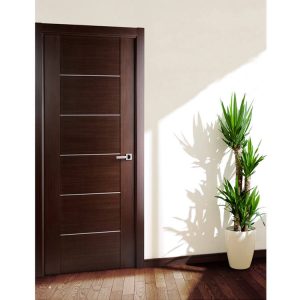
For interior doors that match wooden window frames, the equation shifts. The best interior wood prioritizes dimensional stability and finish quality. Engineered cores with a hardwood veneer (White Oak, Walnut) resist warping better than solid slabs in conditioned spaces.
Solid Wood vs. Engineered (Glulam) Frames
This is the most critical specification decision for exterior units.
Solid wood frames are traditional but problematic at scale. Large solid timber sections move with humidity changes. A 2.5-meter solid oak frame can twist or cup after installation, misaligning the hardware and breaking the air seal.
Glulam (Laminated Timber) solves this. Thin layers of wood are bonded with structural adhesives, with grain directions alternated. The result is a beam that is stronger than solid wood and dimensionally stable. For window doors exposed to the elements, glulam is the industry standard. It is not a compromise; it is an engineering improvement.
Buyers should specify glulam cores for all exterior units and reserve solid wood for interior doors where humidity swings are minimal.
Moisture Content and Treatment Standards
Raw wood is unusable for joinery. The target moisture content (MC) for window frames is 12% ± 2%. Anything higher risks shrinkage and cracking after installation.
The process matters as much as the number. Kiln-drying must be gradual to avoid case-hardening (where the outside dries faster than the core, creating internal stress). After machining, exterior-grade components should undergo Vacuum Pressure Impregnation (VPI) — a process that forces preservative deep into the cell structure. Surface brushing is not adequate for ground-contact or high-humidity applications.
How Do You Evaluate Wooden Window Doors Quality and Performance?
Quality is not visible in a photograph. It is measurable in test reports and physical inspection. For B2B buyers, three performance areas matter most: thermal efficiency, air/water tightness, and hardware durability.
Insulated Glass Units (IGU) and Glazing
The glass is 70–80% of the door’s surface area. Its specification drives both thermal performance and safety.
- Double vs. Triple Glazing: Double glazing (two panes) is standard for temperate climates. Triple glazing is specified for passive house projects, achieving U-values below 0.8 W/m²K. The added weight requires stronger hinges and frames.
- Low-E Coatings: A microscopically thin metallic layer reflects heat back into the room. This is not optional for energy-efficient projects.
- Argon or Krypton Gas Filling: Inert gas between panes reduces heat transfer. Argon is common; Krypton performs better but costs more.
- Safety Glass: For door panels, tempered or laminated glass is required by most building codes. Tempered glass shatters into small, blunt pieces. Laminated glass holds together when broken — important for security and injury prevention.
Hardware: The Weakest Link
A wood frame can last 50 years. The hardware rarely does. Buyers should specify:
- Multi-point locking systems (at least 5 locking points for exterior doors) to prevent forced entry and ensure even compression of the weather seals.
- Stainless steel hinges for coastal environments. Zinc alloy corrodes quickly in salt air.
- Adjustable hinges to compensate for seasonal wood movement.
The brand of hardware matters. German manufacturers (Siegenia, Roto, GU) set the benchmark. Lower-cost alternatives may work initially but fail after 10,000 cycles.
Performance Testing Standards
Every reputable wooden window door manufacturer tests to recognized standards. The two main frameworks are:
- European EN standards: EN 12207 (air permeability), EN 12208 (water tightness), EN 12211 (wind load resistance). These are graded (Class 1–4 or higher), with higher classes indicating better performance.
- ASTM standards (North America): ASTM E283 (air leakage), ASTM E547 (water penetration), ASTM E330 (structural wind load).
The test report is not a marketing document. It is a contractual guarantee. A Class 4 water tightness rating means the unit survived a specific water spray pressure for a defined duration. Buyers should verify that the test report matches the exact frame profile and glass configuration being ordered.
How to Evaluate Wooden Window Doors Suppliers
The supplier evaluation process is where projects succeed or fail. Here is a framework used by professional procurement teams.
Step 1: Verify Manufacturing Capability, Not Just Trading
Many companies selling “wooden window doors” are trading houses. They buy from multiple factories and add a margin. You can identify a factory by asking for:
- Production floor photos showing CNC machining centers, not just assembly lines.
- A list of machinery (e.g., Weining moulder, Homag CNC) — this indicates in-house processing.
- The factory’s export license and business registration.
Step 2: Request Performance Test Reports
Ask for current test reports for their standard profiles. Check:
- The testing laboratory (is it accredited to ISO 17025?).
- The date of the report (should be within 3 years).
- The exact profile and glass configuration tested.
Step 3: Audit the Quality Control Process
The question is not “do you have QC?” — every supplier claims that. The question is “what are the specific checkpoints?”
A reliable factory has:
- Incoming material inspection: Checking moisture content and grade of timber upon delivery.
- In-process checks: Dimensional verification of machined profiles.
- Pre-shipment inspection: Functional tests (opening/closing force, lock alignment) and visual checks for finish defects.
Step 4: Evaluate Communication and Documentation
A supplier’s response time and documentation quality reflect their operational maturity. A professional export team provides:
- A detailed proforma invoice with Incoterms.
- A packing list with dimensions and weights of each crate.
- Export documentation (Bill of Lading, Certificate of Origin, Commercial Invoice).
Red Flags: Avoid Suppliers Who…
- Offer prices 20%+ below the market average without explanation.
- Cannot provide test reports or are vague about the standard used.
- Insist on full payment before production without a third-party inspection option.
- Have no physical address or factory audit capability.
- Quote extremely short lead times (under 3 weeks for custom sizes is unrealistic).
What Are the Key Quality Indicators for Wooden Window Doors Buyers?
Beyond the test reports, these are the measurable indicators that differentiate a good unit from a problematic one:
| Indicator | Specification to Verify | Why It Matters |
|---|---|---|
| Frame profile depth | 68mm–92mm for exterior units | Thicker profiles allow deeper glazing and better insulation |
| Glulam lamella thickness | Max 40mm per layer | Thicker layers reduce stability |
| Moisture content at shipping | 10–14% | Higher MC causes post-installation cracking |
| Hardware cycle count | 20,000+ cycles tested | Indicates long-term reliability |
| Finish system | Water-based acrylic vs. solvent-based PU | Affects durability and VOC compliance |
| Glazing bead | Screwed vs. clipped | Screwed beads allow glass replacement; clipped beads fail faster |
What Industry Standards Apply to Wooden Window Doors?
The regulatory landscape is fragmented. Buyers must identify the standards that apply to their destination market.
- Europe: CE marking under EN 14351-1 is mandatory for windows and doors. This requires testing to EN 12207, EN 12208, and EN 12211. For fire-rated units, EN 1634-1 applies.
- North America: NAFS (North American Fenestration Standard) / AAMA/WDMA/CSA 101/I.S.2/A440. This standard covers performance classes (R, LC, CW, AW) based on design pressure.
- Australia/New Zealand: AS 2047 for windows and doors, plus AS 4055 for wind loads.
- International: ISO 10077 for thermal performance and ISO 8248 for window and door hardware.
The honest caveat: no factory holds every certification. The question is whether they can engineer to the standard required for your project. A capable manufacturer adjusts profile geometry, glass thickness, and hardware specifications to meet local codes.
How Are Wooden Window Doors Manufactured?
Understanding the production process helps buyers set realistic expectations for lead time and quality.
Step 1: Timber Selection and Conditioning
Kiln-dried timber is received and checked for moisture content (12% ± 2%). Boards are graded, and defects are cut out. The selected material is then finger-jointed and laminated into glulam beams.
Step 2: CNC Machining
The glulam beams are machined into frame profiles using CNC routers. This is where the precision happens. A high-quality machine holds tolerances of ±0.5mm. The profiles are milled for drainage channels, hardware mortises, and weather seal grooves.
Step 3: Surface Sanding and Priming
Frames are sanded to a smooth finish and primed. The primer seals the wood and provides a base for the final coat. For exterior units, all six sides of the frame must be primed — a common point of failure is the bottom edge, often left untreated.
Step 4: Glass and Hardware Assembly
Insulated glass units are installed with setting blocks and glazing beads. Hardware (hinges, locks, handles) is fitted and adjusted. The critical test is the closing force: the door should close smoothly with a consistent seal around the entire perimeter.
Step 5: Final Inspection and Packaging
Finished units undergo a functional test. Then they are wrapped in a moisture barrier, fitted with foam corner protectors, and crated for export.
What Are the Customization and OEM/ODM Options?
B2B buyers rarely order a “standard” wooden window door. The value of a capable factory lies in its ability to customize.
- Size: Non-standard dimensions are common, but each change requires new glulam beam calculations and hardware adjustments.
- Color and Finish: RAL color matching is standard. Options range from natural oil finishes to solid-color acrylic paints.
- Glass Configuration: From single-pane decorative glass to triple-glazed low-E units with security film.
- Hardware Brand and Finish: Buyers can specify Siegenia or Roto hardware, or choose a local equivalent that fits the budget.
- Profile Geometry: For projects targeting specific certification, the factory can adjust the profile depth and internal chambers.
OEM/ODM arrangements allow buyers to sell under their own brand. The factory manufactures to the buyer’s specification, packages with the buyer’s branding, and ships directly to the buyer’s customers. This is common for building material distributors who need a private-label product line.
What Are the MOQ, Lead Time, and Shipping Considerations?
MOQ (Minimum Order Quantity): For custom wooden window doors, the MOQ is typically 20–50 units, depending on complexity. Standard profiles with minimal customization may have lower MOQs. Buyers should confirm the MOQ early, as it directly impacts unit price.
Lead Time: For custom sizes and finishes, the realistic lead time is 4–6 weeks from drawing approval and deposit. This includes material conditioning, machining, finishing, and QC. Rushed orders (under 3 weeks) usually mean the factory is skipping the conditioning step — a risk to quality.
Shipping: Wooden window doors are shipped either as FCL (Full Container Load) or LCL (Less than Container Load) . FCL is more economical for bulk orders (over 20 units typically fills a 20ft container). LCL suits smaller orders but incurs higher per-unit freight costs.
The packaging is the unsung hero. A proper export crate uses:
- A plastic moisture barrier wrap around each unit.
- Foam corner protectors and edge guards.
- Plywood crating with cross-bracing.
- Desiccant packs for high-humidity routes.
Moisture damage during transit is the most common cause of claims. A factory that invests in proper packaging demonstrates logistics competence.
How a Direct Factory Manufacturer Meets These Standards
The technical requirements above are the baseline. The challenge for most B2B buyers is finding a partner who executes them consistently at scale. This is where working directly with a manufacturing factory changes the equation.
As a direct factory manufacturer, our approach to wooden window doors is built around the procurement realities our clients face.
The Factory Advantage: Pricing and Customization
Because we manufacture in-house rather than trading, there is no middleman markup. The price we quote is the production cost plus a margin — not a distributor’s markup. This matters for projects with tight budgets.
We also handle full customization. Size, color, glass configuration, and hardware accessories are adjusted to match the architectural drawings. When an architect specifies a non-standard profile depth or a specific RAL color, we engineer the frame to meet it rather than offering a “standard product that is close enough.”
Engineering for Global Compliance
Building codes vary drastically between markets. A profile that passes German standards may fail Australian wind-load requirements. We use adjustable profile structures and fittings that can be tuned to match local building codes. This flexibility is not a sales pitch; it is a necessity for a factory that ships to 30+ countries.
Our foreign trade team handles the paperwork that often trips up first-time importers. We provide packing lists, proforma invoices, and full customs documentation. The goal is a smooth clearance process at the destination port.
Quality Assurance and Logistics
Every batch undergoes strict pre-shipment inspection. We run air-tightness, water-tightness, and wind resistance tests on samples from the production run. The results are documented and shared with the buyer before shipment.
We support both FCL and LCL shipments, delivering directly from our China factory to the destination port. For buyers who need to verify quality independently, we welcome third-party inspections (SGS, BV, or similar) before the goods are sealed into containers.
Conclusion & Next Steps
Wooden window doors are a high-value, high-complexity purchase. The difference between a successful project and a costly failure lies in specification clarity, supplier verification, and quality control. Buyers who understand the material science, performance standards, and manufacturing process are the ones who get reliable products at fair prices.
If you have a project in hand — drawings, a bill of quantities, or just a specification sheet — send it over. We will review the feasibility and come back with a technical assessment and a quotation.
Frequently Asked Questions
Q1: What is the difference between a wooden window door and a regular window?
A “window door” (often a casement or tilt-and-turn unit) is large enough for human passage or egress, whereas a regular window is primarily for light and ventilation. They require heavier framing and multi-point locking hardware.
Q2: Can we use wooden window doors in high-humidity areas like bathrooms or coastal regions?
Yes, provided the wood is treated with high-pressure preservatives and the exterior is protected with a high-quality marine-grade finish or an aluminum-clad exterior. We recommend engineered wood cores for these environments to prevent warping.
Q3: What is the typical lead time for a bulk order of custom wooden window doors?
Standard lead times for custom sizes are typically 4-6 weeks after confirmation of drawings and receipt of the deposit. This includes material seasoning, machining, finishing, and quality control.
Q4: What are the main advantages of buying directly from a factory in China vs. a local distributor?
The primary advantages are cost (removing middleman margins), customization (factories can adjust profiles and hardware to your exact spec), and project support (direct access to engineers for technical clarifications).
Q5: How do you ensure the doors arrive without damage after a long ocean shipment?
We use export-grade packaging — typically a plastic moisture barrier wrap, plywood crating, and foam corner protectors. We also provide a detailed packing list for insurance purposes if transit damage occurs.
Q6: What is the new trend for interior doors that match wooden window frames?
The current trend is moving toward minimalist “flush” designs with vertical fluting or horizontal grooves (e.g., White Oak). This complements the clean lines of modern wooden window doors, creating a cohesive flow between interior and exterior aesthetics.
References
- EN 14351-1:2006+A2:2016, “Windows and doors — Product standard, performance characteristics,” European Committee for Standardization. https://standards.cen.eu/
- ASTM E283-19, “Standard Test Method for Determining Rate of Air Leakage Through Exterior Windows, Skylights, and Doors,” ASTM International. https://www.astm.org/e0283-19.html
- NAFS North American Fenestration Standard, AAMA/WDMA/CSA 101/I.S.2/A440. https://www.aamanet.org/
- “Glued Laminated Timber (Glulam) Design,” APA – The Engineered Wood Association. https://www.apawood.org/glulam
- “Timber Preservation,” Wood Protection Association. https://www.woodprotection.org/
- EN 12207:2016, “Windows and doors — Air permeability — Classification,” European Committee for Standardization. https://standards.cen.eu/
- “Passive House Requirements for Windows,” Passive House Institute. https://passivehouse.com/