Content Menu
● 1. What Are Wood Double Front Doors with Glass? Types and Applications
● 2. Key Performance Factors for Wood Double Front Doors with Glass
● 3. Glass Options for Double Front Doors: A Technical Guide
● 4. Wood Species Comparison for Double Door Applications
● 5. How to Evaluate Wood Double Front Door Suppliers
● 6. Production Process: From Raw Material to Finished Door
● 7. Customization and OEM/ODM Options
● 8. Ordering Process: MOQ, Lead Time, and Shipping
● 9. Relevant Industry Standards and Certifications
● 10. Partnering with a Factory-Direct Manufacturer
● 12. Decision Guide: Which Sourcing Approach Fits Your Project?
13 min read
A contractor in Ohio once called a supplier about a set of 8-foot-tall mahogany double doors. The sample looked perfect. The price was right. Then the shipment arrived with the glass units rattling inside the frames and the weatherstripping peeling off. The project stalled for three weeks while replacements were shipped.
That story repeats across the industry because most buyers focus on the photo, not the specifications behind it. Wood double front doors with glass carry a unique set of engineering requirements — moisture management, glass sealing, hinge loading, and code compliance — that determine whether they last five years or fifty.
This article covers the technical criteria, glass options, wood species, and procurement framework that professional buyers need before placing an order.
What Are Wood Double Front Doors with Glass? Types and Applications
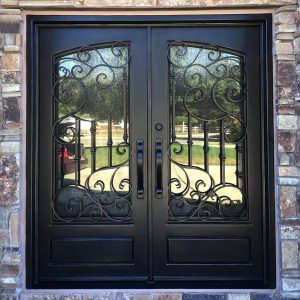
Wood double front doors with glass are a pair of hinged entry doors constructed from solid wood or engineered wood stile-and-rail assemblies, featuring one or more glass lites integrated into the door panels. They are commonly installed in luxury residential, hospitality, and light commercial projects where the entryway serves as a design focal point.
The product category splits into several configuration types:
| Configuration | Description | Typical Application |
|---|---|---|
| Prehung double unit | Doors factory-mounted into a frame with hinges and hardware | New construction, quick installation |
| Slab pair | Doors only, installed into field-built frames | Remodeling, custom framing |
| Inswing | Doors open inward | Residential, weather protection |
| Outswing | Doors open outward | Commercial, hurricane zones, space-saving interiors |
| Arch-top | Curved frame top, often with half-circle transom | Traditional, luxury aesthetics |
| Full-lite | Large single glass pane per door | Modern, maximum natural light |
| Split-lite | Multiple smaller glass panes (6-lite, 9-lite patterns) | Craftsman, colonial, traditional styles |
Double front doors with glass are not a single product; they are a family of configurations, each with distinct structural and code requirements.
Key Performance Factors for Wood Double Front Doors with Glass
The most common failure points for glazed double doors are not wood rot or broken glass. They are hinge sag, seal failure, and glass unit condensation.
Structural Dimensions and Tolerances
Standard residential heights are 6’8″ (2032 mm), 7’0″ (2134 mm), and 8’0″ (2438 mm). Custom heights work for commercial projects but will extend lead times and increase cost. Standard double-unit widths range from 5’0″ (1524 mm) to 6’0″ (1829 mm) total — each leaf measuring half the total width.
Frame jamb depth matters more than most buyers realize. A 4-9/16″ jamb suits standard 2×4 wall construction; 5-1/2″ fits 2×6 walls; 6-9/16″ handles thicker commercial assemblies. Ordering the wrong jamb depth creates field modification work and compromises the weather seal.
Weight and Hardware Load
A pair of wood doors with glass lites typically weighs 160–320 pounds combined — 80–160 pounds per leaf. That weight transfers through the hinges. A standard 3-inch residential hinge cannot handle it long-term.
Buyers should require:
- Three hinges per leaf, minimum
- Ball-bearing hinges rated for the specific door weight
- Multi-point locking systems to pull the door evenly against the frame
- Heavy-duty threshold with compression weatherstripping
Hinge placement also matters. Hinges spaced at equal thirds distribute load better than two top hinges and one bottom hinge.
Glass Sealing and Thermal Performance
The glass-to-wood interface is the most vulnerable point in the entire assembly. Wood expands and contracts with humidity changes; glass does not. Without proper glazing compound, flexible sealant, and expansion gaps, the seal will fail within a few seasons.
Thermal performance for glazed wood doors is measured by U-factor (how much heat transfers through) and SHGC (solar heat gain coefficient). A double-glazed Low-E unit in a wood door typically achieves a U-factor between 0.30 and 0.45 depending on the glass configuration and frame design. [1]
Wood Movement and Stability
Solid wood doors move. A 36-inch-wide solid wood door can change width by 1/8 inch or more across seasonal humidity swings. This movement affects the door-to-frame fit, the glass seal, and the operation of the locks.
Engineered construction — stile-and-rail with veneered panels or laminated cores — reduces movement significantly. Buyers in climates with high humidity variation should prioritize engineered construction over solid slabs, even if the solid option looks more premium.
Glass Options for Double Front Doors: A Technical Guide
The glass specification determines the energy performance, security level, and privacy characteristics of the door.
Insulated Glass Units (IGUs)
Most exterior doors require double-pane insulated glass. The two panes are separated by a spacer and sealed to create an air gap. Options include:
- Low-E coatings — thin metallic layers that reflect infrared heat while transmitting visible light. Low-E coatings can reduce heat loss through the glass by 30–50% compared to uncoated glass. [2]
- Argon or krypton gas fills — inert gases that reduce heat transfer between the panes. Argon is common; krypton performs better but costs more.
- Glass thickness — standard options are 3 mm, 4 mm, 5 mm, and 6 mm per pane. Thicker glass improves sound insulation and security but adds weight to the door leaves.
For cold climates, specifiers should look for a U-factor of 0.30 or below. For hot climates, a low SHGC (0.25 or below) reduces cooling loads.
Privacy and Decorative Glass
Frosted or etched glass provides privacy while transmitting light — a popular choice for front doors where the entry is close to the street. Sandblasted patterns achieve similar effects at lower cost.
For traditional aesthetics, leaded glass, beveled glass, and stained glass inserts remain in demand. A 6-lite Flemish pattern — six rectangular glass panes arranged in a grid — is a classic choice that works across colonial, craftsman, and transitional designs.
One design consideration: decorative glass patterns with many small lites reduce the visible glass area and can make the entry feel darker. Full-lite designs maximize light but expose the interior to view.
Safety and Security Glass
Building codes in most jurisdictions require tempered glass in doors and sidelites. Tempered glass breaks into small, relatively harmless pieces rather than sharp shards. It is typically required within 24 inches of the door edge and within 60 inches of the floor. [3]
Laminated glass — two panes bonded with a plastic interlayer — provides forced-entry resistance. Even when broken, the glass stays in the frame. This is a meaningful upgrade for entry doors in security-conscious projects.
For hurricane-prone regions, impact-resistant laminated glass with a reinforced frame system may be required by local building codes. This significantly increases cost but is non-negotiable in those markets.
Wood Species Comparison for Double Door Applications
The wood species affects appearance, dimensional stability, rot resistance, and price. There is no single “best” species — the right choice depends on climate, style, and budget.
| Species | Stability | Rot Resistance | Relative Cost | Best For |
|---|---|---|---|---|
| White Oak | High | Good | Medium | Modern, contemporary, durable exterior use |
| Red Oak | Medium | Fair | Low-Medium | Budget projects with proper finishing |
| Mahogany | High | Excellent | High | Luxury, traditional, classic entryways |
| Sapele | High | Excellent | Medium-High | Mahogany look at lower cost |
| Teak | Very High | Excellent | Very High | Extreme climates, premium budgets |
| Knotty Alder | Medium | Fair | Low-Medium | Rustic, craftsman styles |
| Pine | Low-Medium | Poor | Low | Interior or protected applications |
Mahogany and sapele remain the preferred species for exterior double doors in North America because they combine dimensional stability with natural rot resistance. White oak performs nearly as well and costs less, but its prominent grain pattern does not suit every architectural style.
Knotty alder has grown in popularity for rustic and craftsman designs. It is a softer wood, which means it dents more easily, but its warm appearance and lower cost make it attractive for certain projects. Buyers should ensure alder doors receive a durable exterior-grade finish.
For green building certifications such as LEED, FSC-certified wood sourcing is available from many manufacturers. This certification adds a small premium but may be required for certified projects.
How to Evaluate Wood Double Front Door Suppliers
Selecting a supplier for wood double front doors with glass requires a systematic check of manufacturing capability, quality control, and logistics. The following framework applies whether you are ordering one unit or a container load.
Verify Manufacturing Capability
Ask whether the factory produces doors in-house or outsources production. A factory that manufactures its own doors controls quality and lead times. A trading company or assembler adds markup and introduces coordination risk.
Questions to ask:
- What is your monthly production capacity for double doors?
- Do you manufacture the wood components in-house?
- What glass processing capability do you have on-site?
- Can you handle custom dimensions without a significant price increase?
Assess Quality Control Processes
Request the following documentation before placing an order:
- Air-tightness test reports (ASTM E283 or EN 1026)
- Water-tightness test reports (ASTM E547 or EN 1027)
- Wind load resistance test reports (ASTM E330)
- Glass certification (ANSI Z97.1 or EN 12150)
Ask about inspection checkpoints during production. A factory that conducts inspections at the raw material stage, after machining, after assembly, and before packing demonstrates a more mature quality system than one that only checks the finished product.
Check Customization Flexibility
Full customization is not just about dimensions. Confirm the factory can adjust:
- Glass type and configuration
- Hardware finish and brand
- Wood species and grade
- Paint or stain color matching
- Frame profile and jamb depth
For international buyers, confirm the factory can adjust profile structure and fittings to match the building codes of your target market. Some markets require specific locking systems or hinge types that differ from what the factory normally supplies.
Compare Pricing Structures Honestly
Factory-direct pricing eliminates the distributor markup, but the savings vary. A genuine factory can typically offer 15–30% lower pricing than a distributor for the same specification. Request an itemized quote showing the cost breakdown for materials, glass, hardware, and packaging separately.
For large orders, expect MOQ requirements of 10–50 units, depending on the factory. Volume pricing usually improves at 50+ units.
Review Logistics and Export Documentation
Confirm the factory handles both FCL (full container load) and LCL (less than container load) shipments. For bulk orders, FCL shipping reduces per-unit freight costs significantly.
Verify the factory can provide:
- Packing list
- Proforma invoice
- Commercial invoice
- Bill of lading
- Certificate of origin
- Customs documentation for your target market
Red Flags to Avoid
- No test reports available for the product
- Pricing that seems too good — it usually means lower-grade wood or thinner glass
- No clear process for handling defective units
- Inability to provide samples or visit the factory
- Long lead times without explanation
Production Process: From Raw Material to Finished Door
Understanding how wood double front doors with glass are manufactured helps buyers identify quality issues before they become field failures.
The production sequence typically follows:
- Lumber selection and conditioning — Kiln-dried hardwood is inspected for defects. Moisture content should be 8–12% before machining.
- Cutting and machining — Stiles, rails, and panels are cut to size. CNC machining creates the glass openings and hardware mortises.
- Frame assembly — Components are glued and clamped. Mortise-and-tenon or dowel joints are standard for quality doors.
- Glass unit fabrication — Glass is cut, edges are polished, and insulated units are assembled in a controlled environment. The seal quality of the IGU determines its lifespan.
- Glazing — Glass units are set into the door with glazing tape, setting blocks, and sealant. Proper glazing allows for wood movement without stressing the glass.
- Sanding and finishing — The door is sanded through progressively finer grits, then finished with primer, paint, or stain. The finish quality directly affects exterior durability.
- Hardware installation — Hinges, locks, and handles are installed and adjusted.
- Final inspection and packing — Doors are inspected for fit, finish, and operation, then protected with edge guards and wrapped for shipment.
Why Pre-Shipment Testing Matters
For international buyers, pre-shipment testing is not optional. Air-tightness and water-tightness tests identify seal failures that would only appear after installation. A factory that performs these tests before shipment can correct issues while the materials are still in production. A factory that ships without testing passes the risk to you.
Customization and OEM/ODM Options
Professional buyers often need more than a standard catalog product. Your project may require a specific glass pattern, a branded hardware set, or a wood species that the supplier does not list.
OEM vs. ODM
OEM (Original Equipment Manufacturing) means the buyer specifies the design, and the factory produces it to specification. This is suitable for buyers with established designs and quality requirements.
ODM (Original Design Manufacturing) means the factory provides the design, and the buyer selects from available options. This is faster and usually less expensive but offers less differentiation.
Private Label
For importers and distributors, private label manufacturing allows you to sell wood double front doors with glass under your own brand. The factory produces the doors to your specification and packages them with your branding.
Ordering Process: MOQ, Lead Time, and Shipping
The ordering process for wood double front doors with glass follows a standard sequence for factory-direct procurement:
- Specification and quote — Submit your dimensions, wood species, glass type, hardware, and quantity. The factory responds with a quote and production timeline.
- Sample approval — For custom orders, a sample or pre-production unit confirms the specification before full production begins.
- Production — Standard configurations typically take 15–25 days. Custom sizes, specialty glass, or OEM branding extend this to 30–45 days.
- Inspection — Pre-shipment inspection covers dimensions, glass seal integrity, hardware operation, and finish quality.
- Shipping — Ocean freight from China to North America or Europe adds 25–40 days. FCL is recommended for bulk orders.
Relevant Industry Standards and Certifications
| Standard | Scope | Relevance |
|---|---|---|
| ASTM E283 | Air leakage testing | Measures air infiltration through the door assembly |
| ASTM E547 | Water penetration testing | Verifies resistance to water under wind pressure |
| ASTM E330 | Structural wind load testing | Confirms the door withstands design wind pressures |
| ANSI Z97.1 | Safety glazing | Sets impact safety requirements for glass |
| EN 1026 / EN 1027 | Air and water testing (European) | European equivalents of ASTM standards |
| FSC Certification | Sustainable forestry | Required for LEED green building credits |
Partnering with a Factory-Direct Manufacturer
The procurement framework above describes what a reliable supplier should demonstrate. As a manufacturer, this is how we meet those standards.
Our Manufacturing Capability
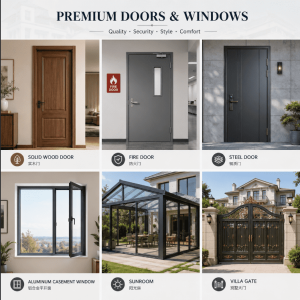
We produce wood double front doors with glass in our own factory, along with solid wood doors, thermal-break aluminum doors and windows, system windows, casement doors, sliding doors, and custom villa doors and windows. Because we manufacture in-house, we control the quality of every component from raw lumber to final assembly.
Our production line supports full customization on size, color, glass, and hardware accessories. If your project requires a specific glass pattern, a particular wood species, or hardware that meets local code requirements, we can adjust our adjustable profile structure and fittings to match your target market’s building codes.
Quality Control and Testing
Every unit undergoes strict pre-shipment inspection covering air-tightness, water-tightness, and wind resistance — aligned with the ASTM and EN testing methods referenced earlier in this article. These tests are performed before packing, not after the container is loaded.
For international buyers, this means the doors you receive have been verified against the same performance criteria you would apply locally.
OEM, ODM, and Private Label Support
We supply under OEM, ODM, and private label arrangements. Whether you need doors manufactured to your drawings, branded with your logo, or produced to a design we develop together, our factory supports the full range of B2B engagement models.
For construction project bulk supply, we coordinate production schedules to match your installation timeline.
Export and Logistics Documentation
Our foreign trade team handles both FCL and LCL shipments with direct delivery from our China factory. We provide complete documentation including packing lists, proforma invoices, and full customs paperwork.
Ready to discuss your project requirements? Contact Our Team to request specifications, samples, or a bulk quote.
—
Common Buyer Questions
Is a wood front door a good idea?
Wood front doors offer timeless aesthetics, excellent insulation properties, and high durability when properly manufactured and finished. For projects seeking premium curb appeal, wood double front doors with glass provide design flexibility that steel or fiberglass cannot match. Performance depends heavily on wood species selection, joinery quality, and the protective finish applied.
How much does a wood front door cost?
Entry-level wood double front doors with glass start around $1,500–$2,500 per unit. Premium hardwood configurations with decorative glass can exceed $6,000–$10,000. For bulk buyers, factory-direct sourcing typically reduces unit costs by 15–30% compared to distributor pricing.
Are double front doors a good idea?
Double front doors offer a wider opening — typically 5 to 6 feet — which is practical for moving furniture and creates a grander first impression. With proper multi-point locking and weatherstripping, double doors can match single-door energy efficiency.
How much is a front double door?
Front double doors generally cost 1.5–2 times the price of a single door due to doubled materials and hardware. For wood double front doors with glass, budget between $2,500 and $8,000+ per unit depending on wood species, glass complexity, and customization. Request a Quote for project-specific pricing.
What is the lead time for bulk orders?
Standard configurations typically ship within 15–25 days of order confirmation. Custom sizes, specialty glass, and OEM branding may extend lead times to 30–45 days. Ocean freight from China to North America or Europe adds 25–40 days.
—
Decision Guide: Which Sourcing Approach Fits Your Project?
Choose a factory-direct manufacturer if:
- You are ordering 10 or more units
- You need custom sizes, glass, or hardware
- You want to eliminate distributor markup
- You require test documentation for code compliance
- You need OEM or private label branding
Choose a local distributor or stock supplier if:
- You need a single unit immediately
- You cannot wait for ocean freight lead times
- You prefer to handle any field issues locally
- Your project budget does not justify custom manufacturing
Both approaches have their place. The key is matching the sourcing strategy to the project scale and timeline.
—
References
[1] Efficient Windows Collaborative. “U-Factor and SHGC for Windows and Doors.” https://efficientwindows.org/ufactor/
[2] U.S. Department of Energy. “Low-E Coatings for Windows.” https://www.energy.gov/energysaver/low-e-coatings-windows
[3] International Code Council. “International Building Code (IBC) — Safety Glazing Requirements.” https://www.iccsafe.org/