Content Menu
● 1. 1. Why Solid Wood Exterior Doors with Glass Are a Preferred Specification
● 2. 2. Core Construction and Material Options
● 3. 3. Performance Standards, Testing, and Compliance
● 4. 4. A B2B Procurement Framework for Sourcing
● 5. 5. Cost Structure and Price Drivers
● 6. 6. How a Factory-Direct Manufacturer Meets These Requirements
● 7. 7. Case Scenarios: How Buyers Use This Supply Model
● 8. 8. Common Questions Buyers Ask
14 min read
When a buyer at a regional distribution company opens a sample box from an overseas factory, the first thing they check is rarely the finish. It is the corner joints. Gaps there mean the door will move within a year. That kind of scrutiny is exactly what this market demands.
Solid wood exterior doors with glass sit in a specific niche. They are not commodity products like hollow-core interior slabs. They are specified for villas, boutique hotels, and high-end residential developments where the entry door sets the tone. For a B2B buyer — an architect, contractor, developer, or importer — the challenge is not finding a manufacturer. It is finding one that can deliver consistent quality at scale, with the right glazing, hardware, and documentation.
This guide covers what goes into these doors, how to evaluate suppliers, and what to expect from a factory-direct relationship.
1. Why Solid Wood Exterior Doors with Glass Are a Preferred Specification
Direct answer: Solid wood exterior doors with glass combine the natural insulation and aesthetics of wood with the daylighting and visual interest of glazing. They are specified in premium residential and light commercial projects for curb appeal, thermal performance, and long-term value.
1.1 Aesthetic Value and Architectural Versatility
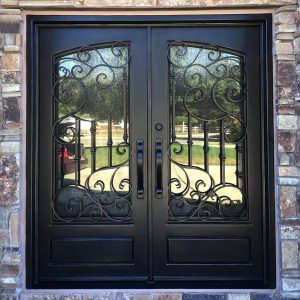
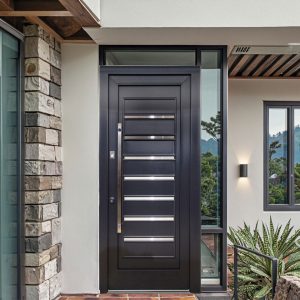
A solid wood door with a glass lite reads differently from a steel or fiberglass unit. The wood grain carries warmth, and the glass adds depth. Architects use this combination to achieve specific styles: craftsman bungalows with divided lites, contemporary villas with slim vertical glass slots, or traditional estates with arched transoms and sidelights.
The glass is not merely decorative. It brings natural light into entryways, reduces the need for artificial lighting during daytime, and can make a narrow entrance feel larger. For projects where the entry is a design statement, this combination is difficult to replicate with other materials.
1.2 Thermal and Acoustic Performance Potential
Modern double-glazed units (DGUs) have changed what a wood door can achieve. A well-built solid wood door with a double-glazed, Low-E coated, argon-filled glass unit can meet U-values around 1.0–1.4 W/m²K, depending on the glazing specification. That is comparable to a decent aluminum or uPVC door with thermal break.
Acoustically, a solid wood slab with dense grain and a properly sealed glazing unit provides better sound damping than hollow or foam-filled alternatives. For homes near roads or in urban settings, this matters.
1.3 Durability and Long-Term Lifecycle Costs
There is an honest caveat here: solid wood costs more upfront than steel or fiberglass. For a premium residential project, the lifecycle value justifies the premium — but not for every project.
A well-engineered wood door, using laminated stiles and rails with proper moisture control, can last 30 years or more with regular refinishing. Steel doors dent. Fiberglass doors can fade or delaminate. Wood doors, when maintained, age gracefully. The trade-off is maintenance: wood requires periodic re-sealing or refinishing, particularly in exposed climates.
2. Core Construction and Material Options
Direct answer: Solid wood exterior doors with glass are typically built using engineered stile-and-rail construction rather than solid-sawn slabs. This approach reduces warping, allows for larger glass openings, and improves structural stability.
2.1 Wood Species Selection
The species you choose drives both appearance and performance. Here is a practical comparison:
| Species | Hardness | Rot Resistance | Dimensional Stability | Typical Use |
|---|---|---|---|---|
| Oak | High | Moderate | Good | Traditional, paint-grade or stain |
| Mahogany | High | High | Excellent | Premium, coastal climates |
| Walnut | Medium-High | Moderate | Good | High-end interiors, mild climates |
| Teak | High | Very High | Excellent | Tropical, extreme exposure |
| Pine | Low | Low | Moderate | Budget projects, paint-grade |
For coastal environments, mahogany and teak resist moisture intrusion better than oak or pine. For inland, temperate climates, oak offers a strong balance of hardness and cost. Buyers should specify the species by its trade name (e.g., “Sapele mahogany” or “European oak”) and require a moisture content of 8–12% at delivery.
2.2 Engineered vs. Solid-Sawn Construction
A solid-sawn slab door is exactly what it sounds like: one piece of wood. It looks impressive but moves with humidity changes. For doors with glass, where the glazing pocket creates a stress point, solid-sawn construction is risky.
Engineered construction uses laminated stiles and rails — multiple layers of wood bonded with waterproof adhesive. This creates a door that resists warping and twisting. The lamination also allows manufacturers to use premium veneers on the exterior with more stable core materials, reducing cost without sacrificing appearance. For glass openings, engineered construction is the industry standard.
2.3 Glazing Options
The glass specification is as important as the wood. Common configurations include:
- Full-lite: A single large glass panel, often with a narrow wood frame around it. Maximizes light, minimal privacy.
- Half-lite: Glass in the upper half, solid wood below. Balanced light and privacy.
- Sidelights: Narrow glass panels flanking the door. Common in entry systems.
- Fanlights: Arched or curved glass above the door. Traditional aesthetic.
Within each configuration, the glazing unit itself varies:
- Double-glazed units (DGU): Two panes with an air or argon gap. Standard for exterior use.
- Low-E coating: A microscopically thin metallic layer that reflects heat. Reduces energy loss.
- Tempered glass: Heat-treated for strength. Required by code near doors in many jurisdictions.
- Laminated glass: Two panes bonded with an interlayer. Holds together on impact — required for sidelights in high-traffic zones.
The glazing bead — the trim that holds the glass in the frame — must be designed for weather resistance. Exterior glazing with an internal stop (the glass installed from inside) is more secure than external stop glazing, which can be pried out by intruders.
2.4 Factory Finishing vs. On-Site Finishing
Factory finishing is the difference between a door that performs and one that fails prematurely. UV-cured finishes, applied in a controlled environment, achieve a hardness that brush-applied field finishes cannot match. They also ensure the finish wraps around all six sides of the door, including the top and bottom edges where moisture enters most easily.
For B2B buyers, factory finishing reduces on-site labor risk. A contractor who has to finish 50 doors on-site is a risk — weather delays, inconsistent application, and warranty disputes. Factory finishing eliminates that variable.
3. Performance Standards, Testing, and Compliance
Direct answer: Exterior doors must pass air-tightness, water-tightness, and wind load tests. In the U.S., these are typically ASTM E283, E547, and E330; in Europe, EN 12207, EN 12208, and EN 12211. Buyers should request test reports before committing to a supplier.
3.1 The Three Key Performance Tests
- Air-tightness (ASTM E283 / EN 12207): Measures air leakage through the closed door assembly. Lower is better.
- Water-tightness (ASTM E547 / EN 12208): Applies water spray while simulating wind pressure. Class 7A or higher is recommended for exposed locations.
- Structural wind load (ASTM E330 / EN 12211): Tests the door’s resistance to wind pressure without permanent deformation or failure.
These tests matter because a door that leaks air or water will fail regardless of how good the wood looks. A supplier who cannot produce test reports is a supplier to avoid.
3.2 Hardware and Hinge Load Capacity
A solid wood door with glass is heavy. A 1,000mm × 2,200mm door in oak with a double-glazed lite can weigh 80–120 kg. Standard hinges will not hold that weight over time.
Buyers should specify:
- Heavy-duty hinges: Ball-bearing or adjustable hinges rated for the door weight. Three hinges minimum.
- Multi-point locking systems: Locking bolts at multiple points along the edge, not just at the handle. Improves security and reduces warping pressure on the frame.
- Reinforced frames: The door frame itself must be structurally capable of supporting the weight without flexing.
3.3 Building Code Compliance
Egress requirements, fire ratings, and energy codes all affect specifications. In the U.S., the International Energy Conservation Code (IECC) sets U-factor limits that vary by climate zone. In Europe, the Energy Performance of Buildings Directive (EPBD) and national Part L equivalents drive similar requirements.
Glass size is often the constraint. Large lites reduce the door’s overall U-factor and may trigger safety glazing requirements. A knowledgeable supplier will ask about your target market’s codes before quoting, not after.
4. A B2B Procurement Framework for Sourcing
Direct answer: A structured procurement process for solid wood exterior doors with glass involves four steps: defining a detailed specification sheet, evaluating factory capabilities against your requirements, verifying quality control processes, and planning logistics with realistic lead times.
4.1 Defining Your Specification Sheet
Before contacting any supplier, write down every variable:
- Door dimensions (width × height × thickness)
- Wood species and grade
- Glass configuration and glazing spec (DGU, Low-E, argon, tempering)
- Finish type and color (factory-applied)
- Hardware brand and model (hinges, lock, handles)
- Threshold type (aluminum, wood, thermal break)
- Quantity and delivery schedule
- Target standards (ASTM, EN, or local equivalents)
A standardized specification sheet serves two purposes. It reduces miscommunication with overseas factories, and it allows you to compare quotes on an apples-to-apples basis.
4.2 Evaluating Factory Capabilities
Minimum order quantity (MOQ) is the first filter. Some factories require 50+ units per design. Others accept 10–20 units for standard models. For construction projects, the ability to produce mixed sizes within one order is critical.
Customization flexibility matters equally. Can the factory adjust the door size without a price premium? Can they match a specific RAL color? Can they install a particular hardware brand? The answer determines whether the factory is a true partner or just a production line.
OEM and ODM capabilities matter for distributors. If you plan to private-label the doors, the factory must be willing to work with your branding. If you need design assistance, ODM capability means they can develop a door from a sketch or reference photo.
4.3 Quality Control and Pre-Shipment Inspection
The most important question to ask a supplier: “Can I send a third-party inspector to your factory before shipment?”
A factory that welcomes inspection has confidence in its process. A factory that resists is hiding something.
Key checks during inspection include:
- Moisture content of the wood (8–12% is acceptable)
- Glue joint integrity on stiles and rails
- Glass seal quality — no visible gaps or bubbles in the sealant
- Hardware function — lock, hinges, and handles operate smoothly
- Finish consistency — no runs, sags, or color variation
4.4 Logistics, Lead Times, and Documentation
Typical lead times for custom solid wood door batches are 30–60 days, plus 2–5 weeks of ocean freight. FCL (full container load) is more cost-effective for large orders; LCL (less than container load) works for smaller quantities but carries higher per-unit freight costs.
Export documentation should include:
- Packing list (itemized contents per crate)
- Proforma invoice (commercial value for customs)
- Bill of lading (shipping document)
- Customs declarations (export clearance from origin country)
Fumigation treatment for wooden crates is often required for import into Australia, New Zealand, and the U.S. Confirm this in advance.
5. Cost Structure and Price Drivers
Direct answer: The unit price of a solid wood exterior door with glass is driven by wood species, glazing specification, hardware grade, finish, and order volume. Factory-direct pricing removes middleman markup, but buyers must compare on a fully landed cost basis.
5.1 What Drives the Unit Price?
Wood species is the largest variable. Sapele mahogany commands a premium over pine. The glass specification adds cost — a triple-glazed, laminated, Low-E unit costs significantly more than a basic double-glazed unit. Hardware brands like Siegenia or Hoppe add 10–20% over unbranded hardware.
The factory’s location matters too. A factory in a region with abundant timber access will have lower raw material costs. Labor rates in the manufacturing region affect the final price as well.
5.2 Negotiation Levers
Three levers reduce unit cost:
- MOQ commitment: Committing to a larger order volume unlocks tiered pricing.
- Standardization: Limiting the range of sizes, finishes, or hardware reduces factory setup time.
- Repeat orders: A distributor who orders the same SKU quarterly gets better pricing than a one-time buyer.
5.3 Hidden Costs
Custom packaging for glass units adds cost. Fumigation treatment for wooden crates adds cost. Insurance for fragile goods adds cost. Request a full landed-cost breakdown — FOB (free on board) price, freight, insurance, duties, and inland transport — before comparing quotes.
6. How a Factory-Direct Manufacturer Meets These Requirements
The standards described above are not theoretical. At Jusen Door and Windows Manufacturing Co., Ltd., we build solid wood exterior doors with glass to meet them, and we have structured our supply model around the needs of B2B buyers.
6.1 Capabilities and Supply Model
As a direct factory supplier, we offer OEM and ODM services for solid wood exterior doors with glass. That means custom sizing, color matching, and selection of glass and hardware are all available. Our production line handles both construction project bulk supply and distributor programs — the two most common sourcing models for this product category.
Our manufacturing capability includes engineered stile-and-rail construction, factory-applied UV-cured finishes, and glazing units specified to your project requirements. We do not restrict buyers to a fixed catalog; we work from your specification sheet.
6.2 Quality Assurance and Testing
Every batch undergoes pre-shipment inspection covering air-tightness, water-tightness, and wind resistance. These are not just internal checks — we provide test documentation and full customs paperwork, including packing lists, proforma invoices, and export declarations. For importers, this means fewer surprises at customs and fewer rejected units at the job site.
6.3 Logistics and Compliance Support
We ship via FCL or LCL directly from our China factory. Our adjustable profile structures and fittings can be adapted to align with local building codes in your target market. If your project requires a specific hinge spacing or a particular threshold profile to meet local regulations, we can adjust the design before production — not after.
7. Case Scenarios: How Buyers Use This Supply Model
7.1 Scenario A: A Distributor Launching a Premium Door Line
A North American distributor wants to launch a private-label line of mahogany entry doors with decorative glass. They approach a factory with an OEM request: specific dimensions, a proprietary finish color, and a specific hardware brand.
The factory’s role is to translate that request into a manufacturable product. The distributor benefits from a lower unit cost than importing through a trading company, and the factory benefits from a repeat-order customer. The key is whether the factory can maintain consistent quality across batches — because the distributor’s brand depends on it.
7.2 Scenario B: A Contractor Sourcing for a Villa Project
A contractor is building a gated community with 50 custom-size solid oak doors with sidelights. The units are not standard sizes — each villa has slightly different dimensions.
The contractor needs a factory that can handle mixed sizes within one order, deliver on a tight schedule, and provide consistent finish across all 50 units. The factory’s pre-shipment inspection report gives the contractor confidence that the doors will install correctly and perform to the specification.
7.3 Scenario C: A Developer Standardizing on a Single Model
A developer is building a multi-phase residential project and wants to standardize on a single door model for all entryways. They order the same SKU in phases — 100 units in phase one, 150 in phase two.
The benefit of standardization is repeat-order pricing and faster lead times for identical SKUs. The factory can keep the tooling and setup ready, reducing production time and cost per unit.
8. Common Questions Buyers Ask
8.1 Can you still buy solid wood doors?
Yes. Solid wood exterior doors remain widely manufactured and are a premium specification in residential and light commercial construction. Buyers can source them factory-direct in custom sizes and finishes.
8.2 Can a solid core door have glass?
Yes. Solid core doors can be manufactured with factory-installed glass openings. The frame around the glass uses reinforced stiles and glazing beads to maintain structural integrity.
8.3 Are solid wood doors worth the money?
For high-end residential and architectural projects, yes. Solid wood doors with glass offer superior aesthetics, natural insulation properties, and long lifecycle value when properly finished and maintained. The total cost of ownership should be evaluated against expected service life and property value impact.
8.4 Can you add glass to a solid wood door?
Technically yes, but it requires cutting an opening, adding a structural frame, and properly sealing the glazing unit. Factory installation is preferable because it preserves the door’s warranty and ensures proper weather sealing.
8.5 What is the typical lead time for a bulk order?
For a standard batch, lead times typically range from 30 to 60 days depending on order size, customization level, and season. Buyers should factor in shipping time of 2–5 weeks for ocean freight.
8.6 What is the MOQ for factory-direct orders?
MOQs vary by manufacturer and product complexity. Many factories accept orders starting at 10–20 units for standard designs, while fully custom projects may require higher minimums.
8.7 How do I ensure the glass meets safety standards?
Specify tempered or laminated glass and request documentation confirming compliance with local safety glazing codes. For large lites or sidelights, laminated glass is often required by code.
9. Decision Guide: Choosing the Right Supply Path
Choose a factory-direct supplier if:
- Your order volume is above 10–20 units per design
- You need custom sizes, finishes, or hardware
- You want to private-label the product
- You need full export documentation for customs
- You want to eliminate middleman markup
Choose a trading company or local distributor if:
- Your order is a one-time small quantity (under 10 units)
- You need immediate delivery from local stock
- You are not prepared to manage international logistics
- You need a local warranty service provider
Avoid suppliers who:
- Cannot provide test reports for air-tightness, water-tightness, or wind load
- Resist third-party inspection
- Cannot specify the moisture content of their wood
- Quote prices without a detailed specification sheet
- Have no answer for building code compliance in your market
—
Solid wood exterior doors with glass are a high-value specification for premium projects. The buyer who succeeds in this market is the one who evaluates wood species, glazing, hardware, and testing standards before comparing prices. A factory-direct supply model offers cost advantages, customization flexibility, and full documentation support — but only if the factory can demonstrate the capability to meet the standards you require.
When you are ready to evaluate a supplier against the framework in this article, the next step is straightforward: send your specification sheet and ask for a detailed quote, including test documentation and a pre-shipment inspection plan.
References
- ASTM International. “ASTM E283-19: Standard Test Method for Determining Rate of Air Leakage Through Exterior Windows, Skylights, Curtain Walls, and Doors Under Specified Pressure Differences.” https://www.astm.org/e0283-19.html
- ASTM International. “ASTM E330/E330M-14: Standard Test Method for Structural Performance of Exterior Windows, Skylights, Curtain Walls, and Doors by Uniform Static Air Pressure Difference.” https://www.astm.org/e0330_e0330m-14.html
- CEN. “EN 12207:2016 – Windows and doors – Air permeability – Classification.” https://www.en-standard.eu/12207/
- CEN. “EN 12208:2000 – Windows and doors – Watertightness – Classification.” https://www.en-standard.eu/12208/
- International Code Council. “2021 International Energy Conservation Code (IECC).” https://www.iccsafe.org/codes-tech-support/codes/2021-i-codes/iecc/
- U.S. Department of Energy. “Low-E Coatings and Window Performance.” https://www.energy.gov/energysaver/energy-efficient-window-coverings