Content Menu
● 1. What Determines the Cost of Solid Doors?
● 2. Material Cost Factors: What You Are Actually Paying For
● 3. Labor and Manufacturing Cost Drivers
● 4. Logistics and Shipping Considerations
● 5. Hidden Costs Buyers Often Overlook
● 6. Total Cost Analysis: Cheap vs. Quality
● 7. How We Meet These Standards: Factory-Direct Solid Door Supply
● 8. How to Evaluate Solid Door Suppliers
12 min read
A project manager in Chicago once ordered 200 solid core doors for a hotel renovation. The sample was perfect. The first 50 units delivered had hollow sections where the core should have been. That shipment went back at a cost of $18,000 in freight alone.
That story explains why this guide exists. Solid doors are one of the most mis-specified products in commercial construction. The term “solid” gets thrown around loosely, and the difference between what you ordered and what arrives can be invisible until the door is cut open on site.
This article covers what solid doors actually are, how to verify performance claims, what drives pricing, and how to structure a supply chain that does not fail halfway through a project.
What Determines the Cost of Solid Doors?
The cost of a solid door is determined by four variables: core material, surface finish, size and cutouts, and certification requirements. A basic 1-3/4-inch solid core door with a primed face might cost $80–$150 at factory prices. The same door with a fire rating, acoustic seals, and veneer facing can exceed $400. The spread is not markup — it is material and labor.
Core Construction: The Hidden Cost Center
The core is where cost differences hide. Solid wood cores use stile-and-rail construction with wood blocks filling the interior. These are the most expensive option because they consume the most timber. Particleboard cores are cheaper and offer good sound damping but sag over time in humid environments. HDF (high-density fiberboard) cores sit between the two — denser than particleboard, more stable than solid wood in varying humidity, and commonly used in commercial interiors where impact resistance matters.
Mineral composite cores are the premium option. They add fire resistance and acoustic mass but weigh 30–50% more than wood-based cores. That weight drives up hinge requirements, frame specifications, and shipping costs. Buyers who specify mineral cores without checking the frame capacity often face costly field modifications.
Surface Material and Finish System
The face material changes cost more than most buyers expect. Paint-grade veneer is the economical choice — a smooth surface meant to be finished on site. Wood veneer in species like oak, maple, or walnut adds $30–$80 per door depending on grade. Laminate faces are durable and inexpensive but limit the design language of high-end projects.
Primed doors are standard for commercial work. The primer quality matters more than buyers realize. A cheap water-based primer may not seal the substrate properly, causing the topcoat to fail within a year. Factory-applied UV-cured finishes cost more upfront but eliminate on-site painting labor and produce a harder surface than field-applied paint.
Size, Cutouts, and Glazing
Every modification adds cost. Standard sizes are cut from stock panels with minimal waste. Custom heights and widths require reconfiguring the production line. Cutouts for glazing, louvers, or hardware add labor and material. A single-lite door with laminated glass adds roughly $40–$70 over a solid slab. Dual-lite configurations with privacy glass run higher.
Fire-rated doors with glazing are particularly expensive. The glass must be fire-rated, the frame must accommodate it, and the entire assembly needs certification. This is not an area to cut costs — a failed inspection on a fire-rated opening can delay occupancy.
Material Cost Factors: What You Are Actually Paying For
Material costs break down into three categories: the core, the face, and the edge treatment. Each carries its own cost index, and each responds differently to regional climate conditions.
Timber Species and Core Quality
Solid wood doors in premium species cost 3–5x more than engineered core doors. The timber itself is expensive, but the real cost is in the milling and drying. Wood must be kiln-dried to a moisture content of 6–10% before machining. If the factory skips this step, the door will warp, twist, or crack after installation.
For engineered cores, the quality of the particleboard or HDF determines performance. Low-density particleboard absorbs moisture and swells at the edges. High-density board resists this but costs more. Buyers should request the density specification in writing — it is the single most reliable indicator of core quality.
Edge Banding and Stile Construction
The edges of a solid door take the most abuse in commercial settings. Cheap doors use thin edge banding that peels away within a year. Quality doors use solid wood edges or thick PVC banding that matches the face material. This is a visible difference that inspectors check — a door with delaminating edges fails the punch list.
Regulatory and Certification Costs
Fire-rated doors carry certification costs that are passed to the buyer. Third-party testing through agencies like UL or Intertek costs thousands per assembly. That cost is spread across production volume, which is why certified doors from large manufacturers are often cheaper than from small shops. The certification must cover the complete assembly — door, frame, hardware, and glazing. A door certified on its own does not guarantee the installed assembly complies.
Labor and Manufacturing Cost Drivers
Manufacturing solid doors involves more labor than buyers assume. The production process runs through multiple stations: core assembly, pressing, edge banding, machining, sanding, and finishing. Each step adds labor cost, and each step is a potential quality failure point.
Production Process Steps
- Core preparation — cutting the core material to size and shaping stiles and rails
- Pressing — bonding the face material to the core under heat and pressure
- Edge banding — applying solid wood or PVC edges to seal the core
- Machining — routing for hinges, locks, and any cutouts
- Sanding — preparing surfaces for finish application
- Finishing — applying primer or prefinished coating systems
Each step requires skilled operators. A factory running all six steps in-house has better quality control than one outsourcing steps to subcontractors. When evaluating suppliers, buyers should ask which steps are performed in-house and which are outsourced.
Custom vs. Standard Manufacturing
Custom manufacturing disrupts production flow. Factories running standard sizes can optimize cutting patterns and minimize waste. Custom sizes force reconfiguration, increase scrap, and extend lead times. This is why custom doors cost 20–40% more than standard sizes from the same factory.
For large projects, buyers should standardize where possible. A project using three standard door heights instead of seven custom heights can reduce door costs by 15% or more. This is an easy saving that gets overlooked during design development.
Finishing Labor
Primed doors require less factory labor than prefinished doors. A basic primer coat might take 15 minutes of spray time plus drying. A UV-cured prefinished system involves multiple coats, sanding between coats, and quality inspection. The factory cost difference is $15–$35 per door.
The buyer’s total cost, however, may favor prefinished. On-site painting costs $50–$100 per door in labor and materials, plus the risk of field defects. For projects with tight schedules, prefinished doors eliminate a trade from the critical path.
Logistics and Shipping Considerations
Solid doors are heavy and bulky. A 1-3/4-inch solid core door weighs 70–100 pounds depending on core material. This weight drives freight costs and handling requirements that buyers often underestimate.
FCL vs. LCL Shipping
Full container loads (FCL) are the economical choice for large orders. A 40-foot container holds roughly 100–150 solid doors depending on size and packaging. Less than container load (LCL) shipping works for smaller orders but costs 30–50% more per unit due to consolidation fees and handling.
For projects requiring 500+ doors, FCL shipping is typically the right choice. The per-door freight cost drops significantly, and the buyer controls the entire container. LCL shipments involve third-party consolidation, which adds risk of damage and delay.
Packaging and Damage Prevention
Solid doors ship best in bundles with protective corner guards and moisture barrier wrapping. Each door should be separated by interleaving paper to prevent surface scratching during transit. Buyers should specify packaging requirements in the purchase order — factories that cut corners on packaging cause field damage that becomes a dispute.
Lead Time Planning
Production typically runs 2–4 weeks for solid doors, depending on volume and customization. Ocean transit adds 3–6 weeks depending on the route. Total lead time from order to delivery is usually 5–10 weeks.
For large projects, buyers should phase orders rather than placing one massive order. This de-risks supply chain interruptions and allows quality issues to be caught early. A phase-one order of 50 doors can validate the factory’s production quality before committing to the remaining 450.
Hidden Costs Buyers Often Overlook
The purchase price of a solid door is only part of the total cost. Several hidden costs routinely inflate project budgets.
Frame and Hardware Compatibility
Solid doors require heavier-duty frames and hinges than hollow doors. A 100-pound door on standard residential hinges will sag within months. Commercial-grade hinges, reinforced frames, and proper strike plates add $20–$50 per opening. Buyers who spec doors without checking frame compatibility face costly field modifications.
Acoustic and Fire Seal Systems
Doors specified for acoustic or fire performance require perimeter sealing systems. Automatic door bottoms, gasketing, and threshold seals add $30–$80 per door. These are often excluded from initial budgets because they are specified as separate line items. The door is not functional without them.
Waste and Damage Allowance
Industry standard practice allows 3–5% waste for doors damaged during shipping or installation. Buyers who order exact quantities risk project delays when a door arrives damaged and the replacement takes 8 weeks. Ordering 5% extra is cheaper than the delay cost.
Warranty Administration
Warranty claims require documentation — photos, inspection reports, and proof of correct installation. Buyers who lack a documentation process find warranty claims denied. The cost of proper documentation is administrative time, which is rarely budgeted.
Total Cost Analysis: Cheap vs. Quality
A $90 solid core door and a $180 solid core door look similar in a photograph. They perform very differently over a 20-year building life.
| Cost Factor | Economy Door | Quality Door |
|---|---|---|
| Initial purchase price | $90 | $180 |
| Installation labor | $120 | $120 |
| Frame and hardware | $60 | $90 |
| Expected service life | 5–8 years | 15–20 years |
| Replacement frequency | 2–3x per 20 years | 1x per 20 years |
| Maintenance cost (20 years) | $400–$600 | $100–$200 |
| Total cost (20 years) | $1,200–$1,800 | $700–$900 |
The economy door costs more over the building’s life. This is the core argument for quality procurement — not aesthetics, but lifecycle economics.
Where Economy Doors Make Sense
Temporary structures, renovation projects with short remaining building life, and budget-constrained developments where the door will be replaced during a future fit-out. In these cases, the lower upfront cost outweighs the replacement expense.
Where Quality Doors Are Mandatory
Hospitals, schools, hotels, and multifamily residential buildings have high traffic and long service life expectations. Door replacement in occupied buildings is disruptive and expensive. Quality doors are the cost-effective choice despite the higher initial price.
How We Meet These Standards: Factory-Direct Solid Door Supply
The procurement framework above describes what buyers should expect from any solid door supplier. As a factory-direct manufacturer, our approach to meeting these standards is straightforward: we control the entire production process, from raw material selection to pre-shipment inspection.
Direct Manufacturing Without Intermediary Markup
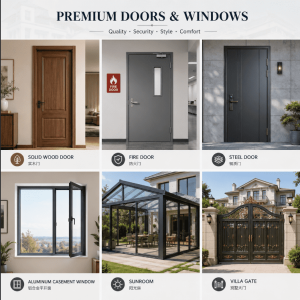
We manufacture solid wood doors, thermal-break aluminum doors and windows, and system windows from our factory in China. Because we sell directly to importers, distributors, and construction companies, our pricing reflects factory costs rather than a supply chain of middlemen. For bulk project supply, this direct model typically results in 15–30% savings compared to working through a trading company.
Our production lines handle both standard specifications and fully custom orders. Custom sizing, color matching, glass selection, and hardware specification are all managed in-house. For international buyers, our profile structures and fittings are adjustable to match local building codes — a critical requirement for fire-rated and acoustic-rated assemblies.
Quality Control and Documentation
Every order undergoes pre-shipment inspection covering air-tightness, water-tightness, and wind resistance — the same performance criteria referenced throughout this guide. We provide packing lists, proforma invoices, and full customs documentation to support international procurement.
Buyers should always request test reports and certification documents before committing to a supplier. We can provide these because we test every production batch, not just samples.
International Shipping and Project Logistics
We ship directly from our China factory using both FCL and LCL options. Our foreign trade experience means smooth customs clearance documentation for importers and distributors. For large-scale construction projects, we coordinate production scheduling to align with on-site installation timelines. This means phasing production to match your construction schedule rather than shipping everything at once.
If you are evaluating solid door suppliers for an upcoming project, the practical next step is to send your door schedule and specifications for a detailed assessment. We will respond with a per-door cost breakdown, production timeline, and shipping options.
—
How to Evaluate Solid Door Suppliers
Use this framework when comparing suppliers. It applies whether you are buying domestically or importing.
Questions to Ask Before Ordering
- What is your monthly production capacity for solid doors?
- Which production steps are performed in-house versus outsourced?
- What is the density specification of your core material?
- Can you provide test reports for fire rating, acoustic performance, and dimensional stability?
- Who conducts pre-shipment inspection, and what standards are applied?
- What is your defect rate over the past 12 months?
- Can you provide references from projects of similar scope?
Avoid Suppliers Who…
- Cannot produce third-party test reports for fire or acoustic ratings
- Quote prices significantly below the market average without explanation
- Cannot specify the core material density in writing
- Outsource finishing without quality control oversight
- Lack documented pre-shipment inspection procedures
- Cannot provide packing lists and customs documentation for international shipments
Choose A If… Choose B If…
Choose a domestic supplier if: Your project timeline is under 8 weeks, the order volume is under 50 doors, or you need on-site technical support during installation.
Choose an overseas factory-direct supplier if: Your order volume exceeds 100 doors, you have 10+ weeks of lead time, or you need custom specifications that domestic suppliers cannot accommodate at competitive pricing. For large-scale projects, the cost savings from factory-direct sourcing typically outweigh the logistics complexity.
Frequently Asked Questions
What is a solid door?
A solid door has a fully solid interior core, as opposed to a hollow-core door. The core can be solid wood, particleboard, HDF, or mineral composite. In commercial construction, “solid” typically refers to the core construction, not the surface material. Solid doors offer better sound insulation, fire resistance, and impact durability compared to hollow doors, which is why they are specified for commercial and institutional projects.
Is it worth getting solid core doors?
For commercial applications, yes. Solid core doors outperform hollow doors in acoustic performance, fire resistance, and long-term durability. The higher upfront cost is offset by lower replacement frequency and reduced maintenance. In high-traffic environments — hospitals, schools, hotels — solid core doors typically last 2–3 times longer than hollow alternatives. The decision becomes a question of lifecycle cost, not initial price.
How expensive are solid doors?
Solid door pricing varies widely based on core material, surface finish, size, and glazing. Entry-level solid core doors may cost 1.5–2x a comparable hollow door. Premium solid wood doors in exotic species can cost 5–10x more. For B2B buyers, the relevant metric is cost per door per year of service life — which often favors solid doors despite higher initial investment.
What are the disadvantages of solid doors?
The primary disadvantages are weight, cost, and installation complexity. Solid doors are significantly heavier than hollow doors, requiring heavier-duty hinges and frames. They are more expensive to purchase and ship. In humid environments, solid wood doors require proper sealing and acclimation to prevent warping. Installation requires skilled labor to ensure proper fit and hardware alignment.
What thickness should a commercial solid door be?
The industry standard for commercial interior solid doors is 1-3/4 inches (44.45 mm). This thickness supports standard fire-rated assemblies, acoustic seals, and commercial-grade hardware. Residential applications may use 1-3/8 inches (35 mm), but this is not recommended for commercial traffic or fire-rated openings.
Can solid doors be customized for specific project requirements?
Yes. Manufacturers like ours offer full customization on size, color, glass type, and hardware accessories. For international projects, the profile structure and fittings can be adjusted to match local building codes. Customization does affect lead time and unit cost, so buyers should factor this into project scheduling.
References
- https://www.ul.com/services/fire-resistance-ratings“>UL Fire Resistance Ratings – UL Solutions
- https://www.acousticalsurfaces.com/soundproofing-tips/stc-rated-doors/“>Sound Transmission Class (STC) Ratings – Acoustical Surfaces
- https://www.wdma.com/“>Wood Door Standards – WDMA (Window & Door Manufacturers Association)
- https://www.intertek.com/building-products/door-assembly/“>Intertek Certification Services
- https://www.astm.org/e0090-09.html“>ASTM E90 – Standard Test Method for Laboratory Measurement of Airborne Sound Transmission Loss