Content Menu
● 1. What Are House Double Doors? Types and Applications
● 2. How to Evaluate House Double Doors Quality and Performance
● 3. What Industry Standards Apply to House Double Doors?
● 4. How to Verify House Double Doors Supplier Credentials
● 5. Key Quality Indicators for House Double Doors Buyers
● 6. Production Process: From Raw Material to Finished House Double Doors
● 7. Customization and OEM/ODM Options for House Double Doors
● 8. Ordering Process: MOQ, Lead Time, and Shipping
● 9. What Are the Common Mistakes When Sourcing House Double Doors?
● 10. Our House Double Doors Manufacturing Capabilities
● 11. Questions to Ask Before Ordering House Double Doors
9 min read
A procurement manager in Hamburg once rejected a shipment of 40 aluminum double doors because the threshold profile was 4 mm too tall for the building’s accessibility ramp. The doors were perfectly manufactured. They just didn’t fit the code. That is the reality of sourcing house double doors for international projects—the gap between “factory correct” and “site ready” is where most deals fall apart.
This guide gives you the procurement framework to avoid that gap. You will learn what to specify, which tests to request, and how to evaluate a factory before you commit a container’s worth of budget.
What Are House Double Doors? Types and Applications
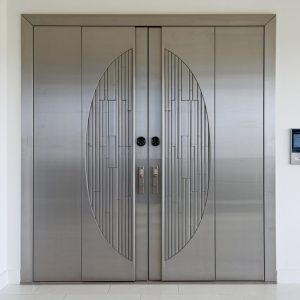
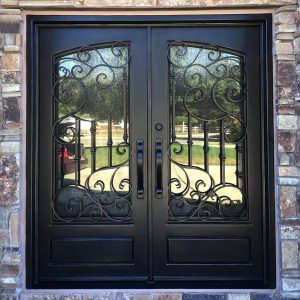
House double doors are a pair of door leaves mounted within a single frame, typically used for main entrances or patio openings. They range from 1,400 mm to 2,400 mm in total width. The two leaves can both be operable, or one can be fixed while the other functions as the primary passage.
There are three dominant configurations in residential projects:
| Type | Configuration | Best For |
|---|---|---|
| French doors | Both leaves hinged, open outward or inward | Patios, garden access, natural light |
| Double entry doors | One active leaf, one fixed or active | Main entrances, grand curb appeal |
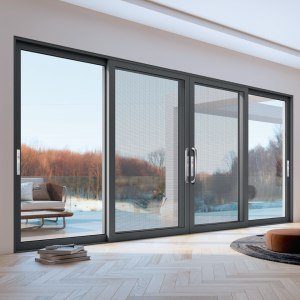
| Double sliding doors | Leaves slide on parallel tracks | Space-constrained openings, modern aesthetics |
Interior double doors (room dividers, closet entries) require less weatherproofing. Exterior house double doors demand robust thermal performance, security hardware, and drainage systems. Buyers should never apply the same specification to both.
How to Evaluate House Double Doors Quality and Performance
Quality in this category is not about how the door looks in a showroom photo. It is about measurable performance under real conditions. When you evaluate a supplier’s product, request test reports for these three metrics:
Air tightness measures how much air leaks through the closed door assembly. Under EN 12207, classes range from 1 (least efficient) to 4 (most efficient). For energy-conscious markets like Germany or Scandinavia, specify Class 3 or 4.
Water tightness indicates resistance to rain penetration under pressure. EN 12208 classifies this from 1A to 9A. For exposed coastal locations, Class 7A or higher is recommended. A hidden drainage system—small slots or channels in the frame that direct water outward—is essential for double doors because the meeting stile between leaves is a natural weak point.
Wind resistance tests structural integrity under load. EN 12210 classes range from A1 to C5. In hurricane-prone regions (Florida, Gulf states), local codes may require impact-rated glass and reinforced frames far beyond standard European classifications.
The material choice directly affects these numbers. Thermal-break aluminum performs best across all three metrics, which is why it has become the default specification for high-performance double entry doors. Solid wood offers aesthetics but requires careful finishing and maintenance. Steel is strong but conducts heat; fiberglass resists dents and corrosion with lower maintenance.
What Industry Standards Apply to House Double Doors?
Buyers should reference the following standards when writing specifications:
- EN 14351-1 — European standard for windows and pedestrian doors, covering air permeability, water tightness, wind load resistance, thermal transmittance, and operating forces.
- ASTM E283, E330, E547 — American equivalents for air leakage, structural performance, and water penetration.
- NFRC U-Factor and SHGC — North American energy performance ratings required for code compliance in many U.S. states.
- ADA / Universal Design — Applies when double doors serve commercial-adjacent residential buildings; requires clear passage width (typically 32 inches with one leaf open).
A factory that cannot produce test reports to at least one of these frameworks should be disqualified early in your evaluation.
How to Verify House Double Doors Supplier Credentials
The B2B sourcing landscape is crowded with trading companies posing as manufacturers. Their markup ranges from 15% to 30% above factory pricing. Here is how to separate a real factory from a middleman:
Ask for production floor evidence. A genuine manufacturer can schedule a video call showing their extrusion lines, assembly stations, and testing equipment. Trading companies typically deflect or offer stock footage.
Request a sample with your specified hardware. A factory can accommodate custom mortise depths, backset dimensions, and pre-drilled holes. A trading company will push catalog standards.
Check the test reports. Legitimate factories have third-party test results (SGS, TÜV, Intertek) with their name on the document. Verify the report number with the certifying body if necessary.
Avoid suppliers who refuse to share a packing list. Factories that handle their own exports provide detailed packing lists, proforma invoices, and certificates of origin as routine documentation. Reluctance here indicates a lack of foreign trade experience.
Key Quality Indicators for House Double Doors Buyers
Beyond the big three performance tests, inspect these details during sample evaluation:
- Meeting stile design — The gap between closed leaves should be minimal with a weatherstrip creating a tight seal. Poor designs show light gaps or require excessive force to close.
- Hinge capacity — Heavy door leaves need ball-bearing or continuous (gear) hinges rated for the door’s weight. Standard butt hinges on a 60 kg leaf will sag within months.
- Multi-point locking — Look for locks engaging at the top, bottom, and center. This improves security and pulls the door tight against the frame for weatherproofing.
- Glass specification — Verify the glazing unit’s U-value and whether it uses Low-E coating and argon gas fill. For code compliance, match these to your local energy requirements.
- Surface finish — Powder-coated aluminum should be checked for uniform thickness (60–80 microns) and scratch resistance. Wood doors need sealed edges—especially the bottom—to prevent moisture ingress.
Production Process: From Raw Material to Finished House Double Doors
Understanding the manufacturing sequence helps you predict lead times and spot quality issues before they reach your site.
For aluminum double doors, the process runs: extrusion of profiles → cutting to length → CNC machining of drainage slots and hardware locations → surface treatment (anodizing or powder coating) → assembly of frame and leaves → glazing insertion → hardware installation → final inspection and packaging.
The critical step is the surface treatment. Powder coating requires a clean, pre-treated surface. Factories that skip the pre-treatment stage (cleaning, phosphating or chromating) deliver doors whose coating peels within two years.
For solid wood doors, the sequence includes: kiln drying (to reduce moisture content to 8–12%) → finger-jointing or lamination for stability → panel construction → sanding → staining or painting → hardware fitting → protective packaging.
Kiln drying is non-negotiable. Wood that skips this step warps, cracks, or splits after installation—especially in climates with seasonal humidity swings.
Customization and OEM/ODM Options for House Double Doors
Most residential projects require non-standard dimensions. A typical project might call for a 1,800 mm wide opening with a specific sidelight configuration. This is where factory capability matters.
Full customization covers: overall dimensions (width, height, frame depth), color (RAL or NCS systems for aluminum; wood stain matching for timber), glass type (clear, frosted, Low-E, laminated, or decorative), and hardware accessories (handles, locks, hinges, smart lock integration).
For OEM and ODM work, buyers should confirm the factory’s ability to produce their private label—logo application on frames, packaging, and documentation. Also verify whether the factory can adjust its profile structure and fittings to match local building codes. For example, a standard European profile may not meet Australian wind-load requirements without reinforcement.
Ordering Process: MOQ, Lead Time, and Shipping
Minimum order quantity varies by material. Aluminum house double doors typically have a MOQ of 10–20 units. Solid wood doors often require 5–10 units due to the longer production cycle and material cost. Some factories accept smaller trial orders for sample approval, but expect a price premium.
Production lead times run 15–25 days for aluminum and 30–45 days for solid wood, depending on finishing complexity. Custom colors or specialty glass can add 5–10 days.
Shipping from China to North America or Europe takes 20–35 days by sea. For house double doors, choose Full Container Load (FCL) if your order exceeds roughly 20 cubic meters. Less-than-Container-Load (LCL) works for smaller orders but risks handling damage and longer transit times.
Packaging for ocean freight should include plywood crates, corner protectors, and moisture barriers. Confirm what the factory provides before signing.
What Are the Common Mistakes When Sourcing House Double Doors?
Specifying the wrong material for the climate. Solid wood doors in high-humidity coastal regions require frequent maintenance. Aluminum or fiberglass may be the better long-term investment despite higher upfront cost.
Ignoring the threshold height. Low-profile thresholds improve accessibility but may compromise water tightness in exposed locations. The opposite is also true—a tall threshold keeps water out but may violate accessibility codes.
Forgetting the delivery access. Double doors come in large, heavy crates. Verify that the delivery truck can access your site and that the crates can be maneuvered into the building. This sounds obvious but causes more project delays than any other logistics issue.
Choosing the cheapest quote. A 20% price difference between factories often reflects differences in profile wall thickness (1.4 mm vs. 1.8 mm), hardware brand (domestic vs. imported), or finishing quality. Ask for the specification sheet and compare line by line.
Our House Double Doors Manufacturing Capabilities
As a direct factory supplier, we approach house double doors production with the same framework outlined above. Our manufacturing lines cover thermal-break aluminum doors, solid wood doors, and system windows. This allows us to match your project’s material requirement without forcing a single product family.
Our pricing reflects production cost plus a transparent margin—no middleman markup. We offer full customization on size, color, glass, and hardware accessories, from RAL color matching to multi-point lock configurations.
Every batch undergoes pre-shipment inspection for air-tightness, water-tightness, and wind resistance, tested per EN/ASTM standards. Our adjustable profile structure and fittings are designed to match local building codes of target markets, so you do not pay for re-engineering. We provide packing lists, proforma invoices, and full customs documentation for smooth international clearance.
For logistics, we support both FCL and LCL shipments with direct delivery from our factory to your port of entry. On ongoing projects, we can schedule staggered production runs to align with your construction timeline.
Questions to Ask Before Ordering House Double Doors
Use this checklist when evaluating any supplier:
- Can you share third-party test reports for air, water, and wind performance?
- What is the profile wall thickness? (Ask for the technical drawing, not just a number.)
- Which hardware brand do you use as standard? (Hoppe, GU, Roto, or equivalent?)
- What is your MOQ for custom sizes and colors?
- What is your production lead time for a container order?
- Do you provide a pre-shipment inspection report?
- What packaging do you use for ocean freight?
- Can you adjust the profile for our local wind-load or energy codes?
Choose A if… Choose B if…
Choose aluminum double doors if you need slim sightlines, high thermal performance, and low maintenance for an exterior entry in a climate with temperature extremes.
Choose solid wood double doors if the project demands a traditional aesthetic, the location is sheltered from extreme weather, and the client accepts ongoing maintenance.
Choose steel double doors if security is the primary concern and the design allows for heavier, more industrial-looking frames.
Choose fiberglass double doors if you need a wood-like appearance with minimal maintenance in a coastal or high-humidity location.
The right choice depends on your project’s specific priorities. No single material wins every category—and any supplier who claims otherwise is not giving you the full picture.
—
References
- EN 14351-1:2006+A2:2016 — “Windows and doors — Product standard, performance characteristics” — https://www.en-standard.eu/
- ASTM E283 — “Standard Test Method for Determining Rate of Air Leakage Through Exterior Windows, Curtain Walls, and Doors Under Specified Pressure Differences Across the Specimen” — https://www.astm.org/e0283-19.html
- ASTM E330 — “Standard Test Method for Structural Performance of Exterior Windows, Doors, Skylights and Curtain Walls by Uniform Static Air Pressure Difference” — https://www.astm.org/e0330-14.html
- ASTM E547 — “Standard Test Method for Water Penetration of Exterior Windows, Skylights, Doors, and Curtain Walls by Cyclic Static Air Pressure Difference” — https://www.astm.org/e0547-00r16.html
- NFRC — “National Fenestration Rating Council — U-Factor and SHGC Ratings” — https://www.nfrc.org/
- ADA Standards for Accessible Design — “Department of Justice” — https://www.ada.gov/law-and-regs/design-standards/