Content Menu
● 1. What Is a Double Outside Door?
● 2. Double Outside Door Material and Construction Types
● 3. Sizing, Configuration, and Building Code Compliance
● 4. Performance Testing and Quality Assurance Framework
● 5. How to Evaluate Double Outside Door Suppliers
● 6. Key Quality Indicators for Double Outside Door Buyers
● 7. Relevant Industry Standards and Certifications
● 8. Production Process: From Raw Material to Finished Door
● 9. Customization and OEM/ODM Options
● 10. Ordering Process: MOQ, Lead Time, and Shipping
● 11. How Jusen Door and Windows Manufacturing Co., Ltd. Meets These Standards
● 12. What Is a Double Door Entry Called?
● 13. What Is the Standard Size of a Double Door Entry?
● 14. What Are the Best Double Entry Doors for Commercial Buildings?
● 15. Can Double Outside Doors Be Fire-Rated?
● 16. What Is the Typical Lead Time for a Custom Double Outside Door Order?
● 17. How Do I Verify the Quality of a Double Outside Door Before Bulk Order?
15 min read
What Is a Double Outside Door?
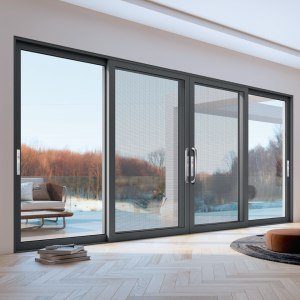
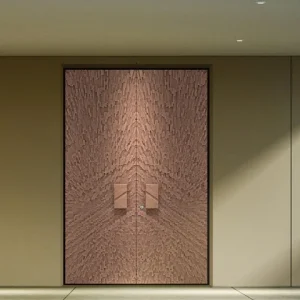
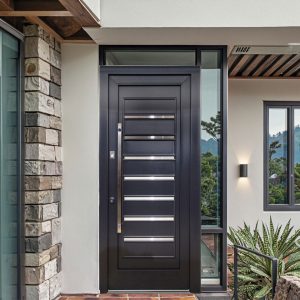
A double outside door is a paired door system installed in a single frame opening, where two panels operate together or one panel operates while the other remains fixed. In commercial and residential construction, these are also called “paired doors,” “double leaf doors,” or “French doors” when both leaves are fully glazed. The technical term for the operable panel is the active leaf; the fixed panel is the inactive leaf, secured with flush bolts at the head and sill.
For B2B buyers, the evaluation framework differs from residential purchasing. You are specifying a product that must meet building codes, withstand environmental loads, integrate with access control systems, and arrive in consistent quality across dozens or hundreds of units.
—
Double Outside Door Material and Construction Types
The material platform determines performance ceilings for thermal efficiency, security, and durability.
Aluminum Double Outside Doors with Thermal Break
Thermal-break aluminum doors separate the interior and exterior profiles with a polyamide strip, interrupting the conductive path for heat. This is the dominant choice for commercial applications and modern residential projects.
Performance benchmarks for thermal-break aluminum double doors:
- U-value range: 2.0–3.5 W/m²K depending on glazing specification
- Air permeability: Class 8 per EN 12207 (the highest classification)
- Water tightness: Class 9A per EN 12208
- Wind load resistance: Up to Class C5 per EN 12210
Aluminum’s natural corrosion resistance makes it the preferred platform for coastal buildings. The material does not warp, rot, or swell. Powder-coated finishes (typically 60–80 microns thickness) provide color retention and abrasion resistance.
The trade-off: aluminum conducts heat far better than wood or PVC. Without a thermal break, an aluminum door becomes a thermal bridge. Always verify the polyamide strip width—20 mm to 34 mm is standard for exterior-grade systems.
Solid Wood and Wood-Clad Double Outside Doors
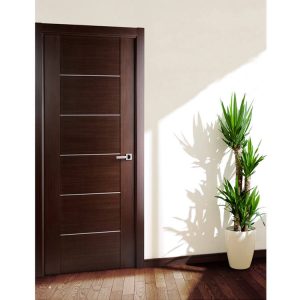
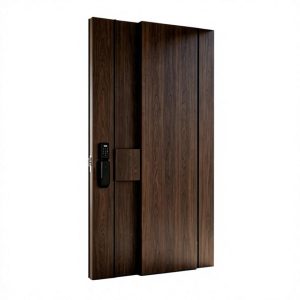
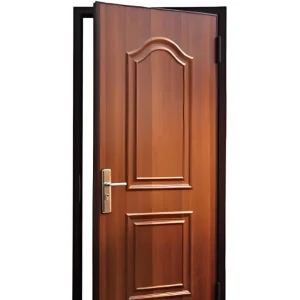
Wood remains the aesthetic benchmark for luxury residential and heritage projects. Species commonly specified include mahogany, oak, walnut, and teak. The critical engineering factor is the core construction.
Solid wood doors for exterior use should have engineered cores—LVL (laminated veneer lumber) or blockboard—rather than a single solid slab. Engineered cores resist warping and twisting that occur when a single piece of wood expands and contracts unevenly across its width.
Finishing systems matter as much as the wood itself. UV-cured paints and weather-resistant stains with moisture barriers extend service life significantly. A poorly finished wood door in a high-UV environment will show color fade within two years; a properly finished system maintains appearance for five to eight years.
The honest caveat: wood doors are not the best choice for every project. In high-humidity climates or buildings with poor overhang protection, wood requires more maintenance than aluminum or steel.
Steel and Wrought Iron Double Outside Doors
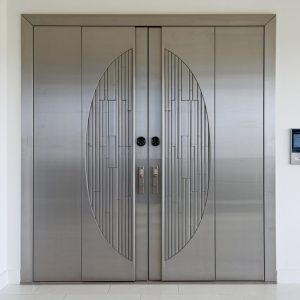
Steel double doors are specified when security and fire resistance are non-negotiable. Galvanized steel with powder coating (18–22 gauge, typically 1.2–1.6 mm thickness) provides structural rigidity that aluminum cannot match. Multi-point locking systems with 3–5 locking points are standard.
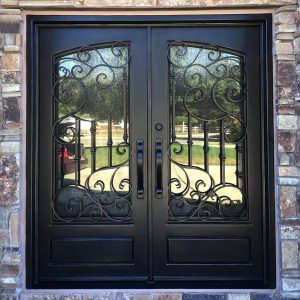
Wrought iron doors occupy a different niche: custom decorative panels, scrollwork, and artistic grille patterns. These are fabricated to order and can incorporate glass inserts, sidelights, and transoms. The differentiation here is aesthetic—iron allows for ornate designs that aluminum extrusion profiles cannot achieve.
For commercial applications, steel double doors with panic hardware and electromagnetic locks are common in high-security premises. Fire-rated steel assemblies are available up to 90 minutes per UL 10C / NFPA 252.
Glass and Glazing Options
The glazing specification often determines the door’s thermal and acoustic performance more than the frame material.
Double-glazed units (DGU) are the minimum standard for exterior doors. Triple-glazed units (TGU) are specified in cold climates or where acoustic isolation is critical.
Key glazing parameters:
- Low-E coatings: Reduce radiative heat transfer. Solar heat gain coefficient (SHGC) ranges from 0.20 to 0.70 depending on climate zone
- Argon or krypton gas fill: Improves U-value by 10–20% compared to air-filled units
- Tempered glass: Required by code for doors and sidelights in most jurisdictions (typically 4 mm or 5 mm thickness)
- Laminated glass: Provides impact resistance and security. Hurricane-rated assemblies meet Miami-Dade County protocols (TAS 201, TAS 202, TAS 203)
The “best” double entry door is not a single product—it is the configuration that meets your project’s specific performance targets.
—
Sizing, Configuration, and Building Code Compliance
Standard Double Door Dimensions
Standard residential double outside door widths are 60 inches (1524 mm), 64 inches (1626 mm), and 72 inches (1829 mm) for the total opening. Standard heights are 80 inches (2032 mm) for residential and 96 inches (2438 mm) for commercial applications.
The active leaf is typically 2–4 inches narrower than the inactive leaf to accommodate the astragal (the vertical weather seal between the two leaves). When both leaves are operable for egress, the configuration is called “double egress” or “pairs of doors.”
Building Code Factors
Egress requirements are the most common source of inspection failures for double outside doors. The International Building Code (IBC) requires a minimum clear opening width of 32 inches with both leaves open. For accessibility per the Americans with Disabilities Act (ADA), thresholds must not exceed 1/2 inch in height, and door opening force should not exceed 5 pounds for interior doors.
Fire-rated assemblies are mandatory for certain commercial locations—stairwells, corridors, and hazardous areas. Ratings typically range from 45 to 90 minutes. Fire-rated double doors require:
- Certified hardware (door closers, panic devices)
- Intumescent seals around the perimeter
- Fire-rated glazing (typically ceramic or wired glass)
Wind load ratings matter for coastal regions. The design pressure (DP) rating indicates the door’s resistance to wind pressure. Residential coastal applications typically require DP50 or higher; commercial applications may require DP70 or DP80.
—
Performance Testing and Quality Assurance Framework
Before a double outside door ships from a factory, it should pass a battery of standardized tests. These are the parameters buyers should demand documentation for.
Air Tightness
Tested per EN 12207 or ASTM E283. Air leakage is measured at standard pressure differentials (typically 75 Pa for exterior doors). Classification ranges from Class 1 (highest leakage) to Class 4 (lowest). Exterior double doors should meet Class 3 or Class 4.
Water Tightness
Tested per EN 12208 or ASTM E547. Water is sprayed at increasing pressure levels while the door is subjected to simulated wind-driven rain. Classification ranges from Class 1A to Class 9A. Exterior doors in exposed locations should meet Class 7A or higher.
Wind Load Resistance
Tested per EN 12210 or ASTM E330. The door is subjected to positive and negative pressure cycles. Deflection limits and permanent deformation thresholds are measured. Performance classes range from A1 to C5, with C5 being the highest.
Hardware Cycle Testing
Hinges and locking mechanisms are tested for endurance. Standard requirements:
- Hinges: 200,000+ operation cycles
- Multi-point locks: 100,000+ cycles
- Door closers: 500,000+ cycles per EN 1154
Finish Durability
Salt spray testing per ASTM B117 simulates coastal corrosion. A minimum of 500 hours without significant degradation is standard for exterior aluminum finishes. UV weathering per ASTM G154 (QUV) tests color retention—typically 1,000–2,000 hours for exterior-rated finishes.
Pre-shipment inspection matters because defects found after installation are expensive to remediate. Site rework, project delays, and liability issues far outweigh the cost of third-party inspection before the container leaves the factory.
—
How to Evaluate Double Outside Door Suppliers
When sourcing a double outside door for a commercial or residential project, the factory’s capability determines whether you receive a product that meets specification or a product that merely resembles it.
Manufacturing Capability Assessment
Ask for specifics about production equipment and capacity:
- CNC cutting centers: Precision machining of aluminum profiles and wood components
- Automatic welding lines: For steel door frames (verify weld quality and seam finishing)
- Powder coating lines: In-house vs. outsourced (in-house provides better quality control)
- Glass processing: Does the factory cut, temper, and laminate glass in-house, or outsource?
Verify daily and monthly production capacity against your order volume. A factory that produces 500 doors per month cannot deliver 2,000 units in four weeks without quality compromises.
Quality Control Systems
Three stages of inspection matter:
- Incoming material inspection: Aluminum billet grade (6063-T5 or T6), glass certification, hardware durability data
- In-process inspection: Welding seam quality, profile dimensions, surface finish, hardware installation
- Final pre-shipment inspection: Air/water/wind testing, hardware function, packaging integrity
Request documentation for each stage. A reputable factory will provide inspection reports without hesitation.
Documentation and Export Readiness
International orders require documentation beyond the commercial invoice:
- Packing list (itemized by container and pallet)
- Proforma invoice (before production)
- Bill of lading (after shipment)
- Certificates of origin
- Material test certificates (mill certificates for aluminum, glass certification)
The factory should also understand FCL (full container load) vs. LCL (less than container load) shipping nuances. LCL shipments require robust packaging to prevent damage in shared containers.
Red Flags to Avoid
Avoid suppliers who exhibit any of these signs:
- Inability to provide test reports or material certifications
- Unclear lead times or no written production schedule
- Poor communication responsiveness (critical for international orders)
- No sample policy or unreasonable sample charges
- Reluctance to provide video or live-streamed inspection during production
—
Key Quality Indicators for Double Outside Door Buyers
Beyond the test standards, here are the practical quality indicators to verify on samples and pre-production units.
| Quality Indicator | What to Verify | Acceptance Criteria |
|---|---|---|
| Profile thickness | Micrometer measurement of aluminum wall thickness | ≥ 1.4 mm for exterior doors |
| Surface finish | Visual inspection, gloss meter | No runs, sags, or orange peel |
| Glazing seal | Squeeze test, visual inspection of gaskets | No gaps, uniform compression |
| Hardware operation | Cycle test, torque test | Smooth operation, no binding |
| Weather seal compression | Feeler gauge test | Uniform contact along perimeter |
| Corner joint quality | Visual and tactile inspection | Flush joints, no visible adhesive |
—
Relevant Industry Standards and Certifications
Buyers should verify that the factory’s products and processes comply with applicable standards.
Product Standards
- EN 14351-1: CE marking standard for windows and pedestrian doors
- EN 1529: Door leaves—height, width, thickness, and squareness tolerance
- ASTM E283: Air leakage testing
- ASTM E330: Wind load resistance testing
- ASTM E547: Water penetration testing
Process Standards
- ISO 9001:2015: Quality management systems
- ISO 14001:2015: Environmental management
Fire Safety Standards
- UL 10C: Positive pressure fire tests for door assemblies
- NFPA 252: Standard methods of fire tests of door assemblies
- EN 1634-1: Fire resistance testing for door and shutter assemblies
—
Production Process: From Raw Material to Finished Door
Understanding the manufacturing process helps buyers identify where quality is built in—or compromised.
Aluminum Double Door Production
- Profile extrusion: Aluminum billets (6063-T5 or T6) are heated and extruded through dies to create the desired profile shapes
- Thermal break insertion: Polyamide strips are inserted and crimped into the profiles
- Cutting and machining: CNC cutting centers size the profiles to specification; drainage holes and hardware mounting points are machined
- Surface treatment: Powder coating (typically 60–80 microns) or anodizing
- Assembly: Profiles are joined with corner keys and structural sealant; gaskets and weather seals are installed
- Glazing: Glass units are fitted into the frames with setting blocks and glazing beads
- Hardware installation: Hinges, locks, handles, and closers are mounted and adjusted
- Quality inspection: Dimensional checks, hardware function tests, and visual inspection
Solid Wood Door Production
- Lumber selection and conditioning: Kiln-dried wood (6–8% moisture content) is graded and selected
- Core construction: LVL or blockboard cores are assembled
- Veneering: Face veneers are applied with hydraulic presses
- Machining: Profiles, rebates, and hardware mortises are cut
- Sanding and finishing: Multiple sanding stages followed by UV-cured paint or stain application
- Hardware installation: Hinges, locks, and handles are fitted
- Final inspection: Moisture content verification, dimensional checks, finish quality
Steel Door Production
- Sheet metal cutting: Steel sheets are cut to size (typically 1.2–1.6 mm thickness)
- Forming and welding: Frames and panels are formed and welded
- Surface preparation: Degreasing, phosphating, and priming
- Powder coating: Finished coating applied (70–100 microns)
- Hardware installation: Locks, hinges, and panic devices are mounted
- Final inspection: Weld quality, coating thickness, hardware operation
—
Customization and OEM/ODM Options
B2B projects rarely use off-the-shelf double outside doors. Customization is the norm, not the exception.
Size and Configuration Customization
- Non-standard widths and heights for renovation projects or architectural designs
- Asymmetric configurations (one wide leaf + one narrow leaf)
- Multi-point locking integration, panic bars, electromagnetic locks
Material and Finish Customization
- Aluminum: Powder coating in any RAL color, anodized finishes, wood-grain transfer films, dual-color options (different interior/exterior finishes)
- Wood: Species selection, stain color matching, veneer cut (plain, quarter, rift)
- Steel/iron: Custom decorative panels, glass inserts, grille patterns
Glass and Hardware Specification
- Glass: Tint, reflectivity, privacy (frosted/patterned), fire-rated glazing, acoustic laminated glass
- Hardware: Handle styles, hinge types (butt, pivot, continuous), locks (mechanical, electronic, smart access), door closers, floor springs
OEM vs. ODM
OEM (Original Equipment Manufacturing) means the buyer provides drawings and specifications, and the factory produces exactly to those requirements. ODM (Original Design Manufacturing) means the factory proposes designs based on the buyer’s functional needs.
Many B2B buyers start with ODM to leverage the factory’s design expertise, then transition to OEM once the design is finalized. Private label manufacturing applies the buyer’s brand to the product and packaging.
The sample development process typically follows this sequence: drawings → prototype → approval → mass production.
—
Ordering Process: MOQ, Lead Time, and Shipping
Production Lead Times
| Order Type | Lead Time (after sample approval) |
|---|---|
| Standard configurations | 15–25 days |
| Custom products (aluminum/steel) | 25–40 days |
| Custom products (wood) | 30–45 days |
| Sample production | 7–15 days |
Minimum Order Quantities
MOQs vary by factory and product type. For aluminum double doors, common MOQs are 20–50 units. For wood doors with custom finishes, MOQs may be 10–20 units. Some factories accommodate trial orders of 1–5 units for initial evaluation—but expect higher per-unit pricing.
Shipping Options
- FCL (Full Container Load): Recommended for large orders. A 20-foot container holds approximately 40–60 double doors (depending on size and packaging). A 40-foot container holds 80–120 units. Lower per-unit freight cost.
- LCL (Less than Container Load): Suitable for smaller orders or initial trial shipments. Shared container space with other cargo. Higher per-unit freight cost but lower absolute cost.
Packaging Standards
Doors should be protected with:
- Foam padding on corners and edges
- Stretch film wrapping
- Corner guards (cardboard or plastic)
- Wooden crates for glass doors
Payment Terms
Standard international terms:
- T/T (Telegraphic Transfer): 30% deposit, 70% before shipment
- L/C (Letter of Credit): For larger orders or first-time transactions
- D/P (Documents against Payment): Less common but available
—
How Jusen Door and Windows Manufacturing Co., Ltd. Meets These Standards
As a factory-direct manufacturer of double outside doors, our approach to these requirements is straightforward: we build to the standards discussed above because our clients demand them.
Our Manufacturing Capabilities
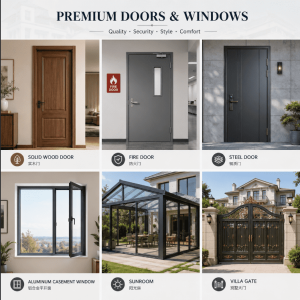
We produce double outside doors across three material platforms—thermal-break aluminum, solid wood, and steel/iron—within our factory in China. Our product line includes solid wood doors, thermal-break aluminum doors and windows, system windows, casement doors, sliding doors, custom villa doors and windows, sunrooms, and aluminum alloy entrance doors.
Because we are the factory, our pricing reflects manufacturing cost plus a fair margin—not the markup of a distribution chain. For B2B buyers comparing landed costs, this is the difference between a competitive bid and a non-starter.
Customization and Engineering Flexibility
We offer full customization on size, color, glass, and hardware accessories. Our engineering team works with your drawings or specifications to produce double outside doors that match your project’s performance targets.
Our profile structures and fittings are adjustable to match local building codes of your target market. If your project requires specific wind-load ratings, thermal performance targets, or fire-safety requirements, we can engineer the product accordingly.
Quality Verification Process
Every order undergoes strict pre-shipment inspection: air-tightness, water-tightness, and wind resistance testing—the same parameters outlined in the testing section above. We provide packing lists, proforma invoices, and full customs documentation to ensure smooth clearance at your destination port.
Shipping and Order Flexibility
We support both FCL and LCL shipments with direct delivery from our factory. For distributors and contractors testing the market, we accommodate initial small-volume orders before scaling to container quantities.
If you are evaluating a double outside door supplier for an upcoming project, we welcome your drawings or specifications for review. Our team can advise on profile structures, glazing options, and hardware configurations that meet your local requirements.
Contact Our Team to discuss your project requirements.
—
What Is a Double Door Entry Called?
A double door entry is commonly called a “double door,” “paired door,” or “double leaf door.” When both leaves are glazed, it is often referred to as a “French door.” In technical specifications, the terms “active leaf” (operable) and “inactive leaf” (fixed with flush bolts) are used to describe the two panels.
What Is the Standard Size of a Double Door Entry?
Standard residential double door widths are 60″, 64″, and 72″ (1524, 1626, and 1829 mm). Standard heights are 80″ (2032 mm) for residential and 96″ (2438 mm) for commercial applications. Custom sizes are common in commercial and architectural projects—most factories can manufacture non-standard dimensions with appropriate lead time.
What Are the Best Double Entry Doors for Commercial Buildings?
For commercial buildings, thermal-break aluminum double doors with double or triple glazing are most common due to their durability, low maintenance, and thermal performance. Steel or iron doors are preferred when security or fire resistance is the priority. The “best” choice depends on your project’s specific requirements: energy code, wind load, security level, and aesthetic direction.
Can Double Outside Doors Be Fire-Rated?
Yes. Double outside doors can be manufactured as fire-rated assemblies, typically rated at 45, 60, or 90 minutes depending on local codes. Fire-rated double doors require certified hardware (closers, panic devices), intumescent seals, and specific glazing. Verify that your supplier can provide the necessary fire-test documentation for your jurisdiction.
What Is the Typical Lead Time for a Custom Double Outside Door Order?
For custom double outside doors, typical production lead time is 25–40 days after sample approval, depending on material, finish, and hardware complexity. Standard configurations can ship in 15–25 days. Sample production typically takes 7–15 days. Factor in ocean freight (2–4 weeks to most destinations) when planning your project schedule.
How Do I Verify the Quality of a Double Outside Door Before Bulk Order?
Request pre-production samples and arrange a third-party inspection before shipment. Key checks include: profile thickness and finish, glazing certification, hardware operation (cycle testing), and documentation of air/water/wind testing. A reputable factory will provide video or live-streamed inspection during production.
—
Choosing the Right Supplier: A Decision Guide
Choose a full-service factory if:
- Your project requires custom sizes, finishes, or hardware configurations
- You need pre-shipment testing and documentation for code compliance
- You are ordering container quantities and need FCL shipping
- You want direct pricing without distributor markup
Choose a distributor or trading company if:
- You are ordering very small quantities (1–5 units)
- You need a local inventory for immediate availability
- You require local installation services
For most B2B projects—where customization, quality documentation, and volume pricing matter—a factory-direct relationship provides the best combination of cost and control.
—
References
[1] EN 14351-1:2006+A2:2016, “Windows and doors – Product standard, performance characteristics,” European Committee for Standardization.
[2] ASTM E283-19, “Standard Test Method for Determining Rate of Air Leakage Through Exterior Windows, Skylights, Curtain Walls, and Doors Under Specified Pressure Differences Across the Specimen,” ASTM International.
[3] ASTM E330/E330M-14, “Standard Test Method for Structural Performance of Exterior Windows, Skylights, Curtain Walls, and Doors by Uniform Static Air Pressure Difference,” ASTM International.
[4] ASTM E547-00(2016), “Standard Test Method for Water Penetration of Exterior Windows, Skylights, Doors, and Curtain Walls by Cyclic Static Air Pressure Difference,” ASTM International.
[5] International Building Code (IBC), 2021 Edition, International Code Council.
[6] Americans with Disabilities Act (ADA) Standards for Accessible Design, 2010.
[7] UL 10C-2019, “Standard for Positive Pressure Fire Tests of Door Assemblies,” UL LLC.
[8] NFPA 252-2017, “Standard Methods of Fire Tests of Door Assemblies,” National Fire Protection Association.
[9] EN 1634-1:2014, “Fire resistance and smoke control tests for door and shutter assemblies, openable windows and elements of building hardware,” European Committee for Standardization.
[10] ISO 9001:2015, “Quality management systems – Requirements,” International Organization for Standardization.
https://doorwoodendoors.com/contact-us/” style=”display:inline-block;padding:12px 24px;background:#2563eb;color:#fff;text-decoration:none;border-radius:6px;font-weight:600″>Get a Free Quote