Content Menu
● 1. Understanding Double Door Exteriors: Types and Applications
● 2. Quality and Performance Factors for Double Door Exteriors
● 3. How to Evaluate Double Door Exterior Suppliers
● 4. Key Quality Indicators for Double Door Exterior Buyers
● 5. Relevant Industry Standards and Certifications
● 6. Production Process: From Raw Material to Finished Double Door Exterior
● 7. Customization and OEM/ODM Options
● 8. Ordering Process: MOQ, Lead Time, and Shipping
● 9. Quality Control: Multi-Stage Inspection Process
● 10. Certifications and Industry Standards: What to Verify
● 11. Project References and Industry Applications
● 12. Choosing the Right Double Door Exterior Manufacturer
15 min read
When a contractor in Alberta orders double door exteriors for a 14-unit luxury townhouse development, the first question is rarely about price. It is about whether the factory can replicate the approved sample across 28 door leaves without variation in color, hardware alignment, or weather sealing. That concern is legitimate. Double door exteriors are not off-the-shelf products; they are engineered assemblies where the frame, glazing, hardware, and threshold must work as one system.
This guide covers the material options, performance specifications, and procurement frameworks that matter when sourcing double door exteriors for villa projects, commercial buildings, or distribution. The goal is to give buyers a decision-ready reference — not a sales pitch.
Understanding Double Door Exteriors: Types and Applications
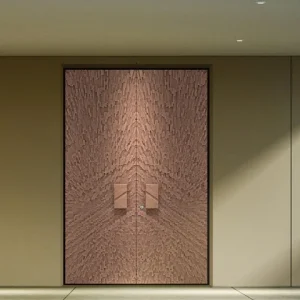
A double door exterior consists of two adjacent door panels within a single frame. Both leaves may be operational, or one leaf may be fixed (an “active/passive” configuration) depending on traffic flow and design intent. The system is specified in residential luxury projects for its symmetrical appearance and wide passage, and in commercial buildings for high-traffic access and compliance with accessibility standards.
Residential Applications
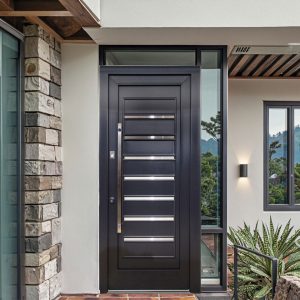
Custom villas and high-end townhouses commonly specify double door exteriors as the primary entrance. The standard clear opening width ranges from 60 to 72 inches (152–183 cm), with each leaf measuring 30–36 inches (76–91 cm). Standard heights are 80 inches (203 cm), though 96-inch (244 cm) doors are increasingly specified for grand entrances.
For residential projects, the decision between an active/passive configuration and double-active doors depends on usage. Passive leaves reduce hardware costs but limit the clear opening. Double-active leaves are preferred when furniture movement or wheelchair access is required.
Commercial and Institutional Applications
Office buildings, hotels, banks, and retail storefronts use double door exteriors where pedestrian traffic is continuous. The performance requirements shift: commercial-grade hardware (grade 1 per ANSI/BHMA A156.18), panic bars or push pads where required by local fire codes, and door closers rated for high cycle counts. Thermal performance also becomes critical — a poorly insulated double door in a hotel lobby creates a persistent draft and drives up HVAC costs.
Regional Preferences
North American buyers favor fiberglass and steel doors with wood-grain finishes for their impact resistance and low maintenance. European projects specify thermal-break aluminum systems with slim sightlines and U-values below 1.0 W/m²K. Middle Eastern and Southeast Asian markets prefer solid wood or aluminum composite doors for their resistance to heat, humidity, and sand abrasion.
Quality and Performance Factors for Double Door Exteriors
The performance of a double door exterior is defined by its air-tightness, water-tightness, and wind load resistance. These are not marketing terms — they are measurable values tested under controlled conditions.
Air-Tightness
Air leakage is measured in cubic meters per hour per square meter (m³/h·m²) at a given pressure differential. The European standard EN 12207 classifies air-tightness from Class 1 (highest leakage) to Class 4 (lowest leakage). For double door exteriors in energy-efficient buildings, Class 7 or Class 8 per the Chinese GB/T 7106 standard is typical. A Class 8 rating means air leakage below 1.5 m³/h·m² at 10 Pa — roughly equivalent to a well-sealed window system.
Water-Tightness
Water penetration resistance is tested under simulated rain and wind pressure. EN 12208 classifies water-tightness from Class 1A to Class 9A. For exposed building facades, Class 7A or higher is recommended. The test involves spraying water at increasing pressure while monitoring for penetration through the frame, gaskets, or threshold.
Wind Load Resistance
Wind load resistance (EN 12210 or GB/T 7106) determines the maximum pressure a door system can withstand without permanent deformation. For coastal or high-rise applications, this figure matters. A double door exterior with a wind load rating of 2.0 kPa can handle roughly 100 mph wind gusts — sufficient for most residential applications but inadequate for hurricane-prone regions, where 3.0 kPa or higher may be required.
Thermal Performance
The U-value (thermal transmittance) of a double door exterior is determined by the frame material, glazing, and edge spacers.
| Frame Material | Typical U-Value (W/m²K) | Best Suited For |
|---|---|---|
| Solid wood (oak, mahogany) | 1.6 – 2.2 | Heritage buildings, premium villas |
| Thermal-break aluminum | 0.8 – 1.4 | Modern architecture, energy codes |
| Steel | 2.0 – 2.8 | Security-focused applications |
| Fiberglass | 0.5 – 0.9 | Cold climates, low maintenance |
An imperfect insight: the lowest U-value is not always the right choice. A solid wood door with a U-value of 2.0 can outperform an aluminum door with a U-value of 1.0 in a heritage building — because the wood door’s mass provides acoustic damping and a traditional appearance that aluminum cannot replicate. Performance must be matched to context.
How to Evaluate Double Door Exterior Suppliers
Selecting a supplier for double door exteriors requires more than comparing price lists. The evaluation framework below applies to any manufacturer, regardless of location.
Verify Manufacturing Capability
Request the factory’s annual output by product category. A supplier producing 5,000 double door units per year has different capacity constraints than one producing 50,000. Ask about production line specifics: CNC machining centers for frame fabrication, glass tempering lines (if in-house), and finishing lines for powder coating or staining. The answers reveal whether the supplier is a manufacturer or an assembler who sources components from multiple vendors.
Assess Customization and Engineering Support
A reliable supplier should be able to adapt frame profiles, reinforcement, and hardware to local building codes. This is not a trivial request. For example, hurricane-rated double doors require impact-resistant glazing and reinforced locking points. A supplier without engineering staff cannot make these adjustments — they only sell from a fixed catalog.
Review Pre-Shipment Inspection Protocols
Quality control processes matter more than quality control claims. Ask for the specific tests performed before shipment: air-tightness, water-tightness, and wind resistance tests per the standards listed above. If the supplier cannot name the test standards or show inspection reports, consider it a red flag.
Request References and Visit the Factory
For bulk orders, a factory visit is non-negotiable. If travel is not feasible, request a video walkthrough of the production floor and the inspection area. Ask for contact details of at least two existing clients in your region who can speak to delivery timelines and after-sales support.
Avoid Suppliers Who…
- Cannot provide test reports from independent laboratories.
- Quote prices without clarifying whether hardware, glazing, and delivery are included.
- Offer “any size” without asking about your wall thickness, opening dimensions, or local wind load requirements.
- Promise delivery in under 10 days for custom double doors — realistic lead times for custom manufacturing are 25–45 days.
Key Quality Indicators for Double Door Exterior Buyers
When evaluating a double door exterior sample or a factory’s production, inspect the following six points:
- Frame corner joints — For aluminum doors, corners should be joined with corner cleats and structural adhesive, not simple screws. For wood doors, mortise-and-tenon joints with waterproof adhesive are the minimum standard.
- Gasket continuity — Gaskets should be continuous at corners, not cut and butted. A cut gasket is a guaranteed air and water leak point.
- Hardware alignment — Multi-point locking systems should engage smoothly. Misalignment indicates poor frame squareness.
- Glass edge coverage — The glass should be captured by at least 12–15 mm of frame on all sides. Less coverage risks glass failure under wind load.
- Threshold design — The threshold must include a thermal break and a drainage system. A flat threshold without weep holes will collect water and leak.
- Surface finish consistency — For powder-coated aluminum, check the coat thickness (60–80 microns is standard) and color consistency across multiple units.
Relevant Industry Standards and Certifications
Buyers should reference the following standards when specifying double door exteriors. These are the benchmarks used by reputable manufacturers and independent testing laboratories:
- ISO 9001:2015 — Quality management systems. A supplier with this certification has documented processes for production, inspection, and corrective action.
- EN 12207 / EN 12208 / EN 12210 — European standards for air-tightness, water-tightness, and wind load resistance.
- GB/T 7106 — Chinese equivalent standard for building doors and windows’ air permeability, water tightness, and wind load resistance.
- ANSI/BHMA A156.18 — American standard for hardware performance grades.
- Qualicoat / Qualanod — Quality labels for powder coating and anodizing. A Qualicoat-approved finisher must meet specific film thickness and adhesion requirements.
CE marking is relevant for doors sold into the European market, but the standard is harmonized at a basic level — it does not guarantee performance. For critical projects, request EN 12207/12208/12210 test reports from an independent laboratory such as ift Rosenheim or TÜV.
Production Process: From Raw Material to Finished Double Door Exterior
Understanding the manufacturing process helps buyers identify a genuine factory versus a trading company.
Step 1: Profile or Lumber Preparation
For aluminum doors, the production starts with multi-chamber profiles. The profiles are cut to length using CNC double-miter saws with tolerance of ±0.5 mm. For solid wood doors, lumber is kiln-dried to 8–12% moisture content and then processed through a CNC machining center for panel shaping, edge profiling, and joinery cutting.
Step 2: Frame Assembly
Aluminum frames are assembled with corner cleats and structural adhesive, then crimped or screwed. The thermal break (polyamide strips) is either rolled in or inserted before assembly. For wood doors, the stiles and rails are joined with mortise-and-tenon joints, glued, and clamped under pressure for 4–8 hours.
Step 3: Surface Treatment
Aluminum frames are either powder-coated or anodized. Powder coating involves electrostatic application of dry paint, followed by curing in an oven at 180–200°C. The film thickness is measured with a coating thickness gauge to ensure 60–80 microns. Wood doors are sanded through increasing grits (120 to 320) and then stained or painted with UV-resistant finishes.
Step 4: Glazing and Hardware Installation
Insulated glass units (IGUs) are assembled in a controlled environment to prevent dust contamination. The glass is then installed into the frame with setting blocks and gaskets. Hardware — hinges, locks, handles — is installed and adjusted. Each door is tested for opening and closing force, lock engagement, and gasket compression.
Step 5: Final Inspection and Packaging
The finished doors undergo final inspection: visual check, dimensional verification against the order, and functional testing. For export, doors are wrapped in PE film, protected with corner boards, and packed in plywood crates or steel-framed crates for glass protection during sea freight.
Customization and OEM/ODM Options
B2B buyers frequently need customization that goes beyond size and color. This is where the distinction between a manufacturer and a trading company becomes critical.
Size Customization
Non-standard sizes are common in renovation projects and custom architecture. A factory with CNC machining capabilities can adjust door heights up to 120 inches (305 cm) without compromising structural integrity — provided the frame profile is reinforced with steel or aluminum inserts.
Color and Finish Matching
RAL color matching is standard for aluminum doors. Wood-grain foil finishes that replicate oak, walnut, or mahogany are applied over aluminum profiles for a more residential look. For solid wood doors, custom stains can be matched to a supplied sample — but buyers should request a physical finish sample before mass production, since monitor colors are unreliable for matching wood tones.
Hardware and Glass Options
Hardware can be specified from major brands (e.g., Siegenia, Hoppe, or Chinese equivalents) or private-labeled. Glass options include tempered, laminated, low-E coated, and smart glass with switchable transparency. For security-sensitive projects, laminated glass with PVB interlayers provides resistance to forced entry.
OEM and Private Label
For distributors, OEM manufacturing allows the supplier to produce doors under the buyer’s brand. This requires the buyer to supply brand assets (logo files, packaging design) and agree on minimum order quantities. ODM services go further: the supplier designs and produces a product line based on the buyer’s target market requirements.
Ordering Process: MOQ, Lead Time, and Shipping
Minimum Order Quantities
MOQs vary significantly by product type and level of customization.
| Order Type | Typical MOQ | Lead Time |
|---|---|---|
| Standard double door exterior (stock profiles) | 10–20 units | 15–25 days |
| Custom size/color/glass | 1–5 units (sample order possible) | 25–40 days |
| OEM/private label (custom branding) | 50–100 units | 35–50 days |
Sample orders are the standard way to evaluate a factory before bulk commitment. A sample order of one or two units allows the buyer to verify quality, finish, and hardware function. The sample cost is typically deducted from the first bulk order if the order exceeds the MOQ.
Production Lead Times
Lead times depend on the production queue, not just the product complexity. A factory running at 80% capacity will take longer than one at 50%. Buyers should request the current production schedule and ask for a committed delivery date in writing. For construction projects, build in a 7–10 day buffer beyond the supplier’s quoted lead time.
Shipping and Logistics
Double door exteriors ship as FCL (full container load) or LCL (less than container load). LCL is suitable for sample orders and small projects, but the per-unit cost is higher and the risk of damage increases with additional handling. FCL is recommended for orders of 20+ units.
Packaging for sea freight: each door should be individually wrapped in PE film, with corner protectors and cardboard edge guards. Glass units require additional protection — typically a plywood crate or steel-frame crate. A 40-foot high-cube container can hold approximately 40–60 double doors depending on door size and packaging.
Customs Documentation
Experienced export suppliers provide the full documentation set: commercial invoice, packing list, bill of lading, certificate of origin, and — where applicable — inspection reports from third-party agencies. These documents must be accurate; errors cause customs delays and storage charges at the destination port.
Quality Control: Multi-Stage Inspection Process
Quality control for double door exteriors should be systematic, not ad hoc. A reliable factory follows a multi-stage process:
- Incoming material inspection — Aluminum profiles checked for alloy composition and surface defects; lumber checked for moisture content and knots; glass checked for dimensions and edge quality.
- In-process inspection — During frame assembly, dimensional checks at each station. Weld seams and corner joints are inspected before finishing.
- Pre-finish inspection — Before powder coating or staining, frames are checked for scratches, dents, and surface contamination. Any defect is repaired before finishing.
- Post-finish inspection — Coating thickness, color consistency, and adhesion tests.
- Final assembly inspection — Hardware function, glass installation, gasket compression, and overall appearance.
- Pre-shipment inspection — Random sampling per the order quantity. Performance tests (air-tightness, water-tightness) are conducted per the applicable standard. Third-party inspection can be arranged at the buyer’s cost.
Certifications and Industry Standards: What to Verify
A supplier’s certification claims should be verified. Here is what to check:
- ISO 9001:2015 certificate — Verify the certificate number on the certification body’s website. The scope of certification should include door and window manufacturing.
- EN 12207/12208/12210 test reports — These should come from an independent laboratory, not the factory’s own testing. Ask whether the test was conducted on the exact profile system you are ordering.
- CE marking — Confirm the product’s declaration of conformity, not just the packaging label.
An imperfect insight: certifications are point-in-time validations. They prove the factory’s capability at the time of the audit, but they do not guarantee that a specific shipment meets the same standards. That is why pre-shipment inspection of your actual order matters more than any certificate.
Project References and Industry Applications
The following patterns are typical of how double door exteriors are supplied for various project types. Specific client names are withheld for confidentiality, but the scenarios represent real procurement structures.
Villa and Residential Projects
A developer in the Middle East ordered 120 custom solid wood double door exteriors for a gated villa community. Each door was 72″ × 96″, with teak veneer and multi-point locking. The order was split into three shipments over six months to match the construction schedule. The supplier provided a dedicated project manager and adjusted the delivery dates twice when construction fell behind.
Commercial Developments
A hotel chain in Southeast Asia specified thermal-break aluminum double doors for guest room balconies and main entrances. The order included 400 units with laminated glass and custom RAL colors. The supplier produced a pre-production sample for approval, then completed the order in 45 days with two FCL shipments.
Construction Company Partnerships
A European construction firm established a framework agreement with a factory for ongoing supply of double door exteriors across multiple projects. The agreement defined pricing tiers based on annual volume, delivery terms, and a defect replacement policy. This arrangement reduced procurement lead times and ensured consistent quality across projects.
Choosing the Right Double Door Exterior Manufacturer
Here is how the industry works: manufacturers who produce double door exteriors at scale have invested in CNC machining centers, finishing lines, and testing equipment. They employ engineers who understand building physics — not just assembly. They have established quality control processes because their reputation depends on repeat orders from contractors and distributors.
As a factory specializing in solid wood doors, thermal-break aluminum doors and windows, system windows, casement doors, sliding doors, custom villa doors and windows, sunrooms, and aluminum alloy entrance doors, our approach to double door exteriors is straightforward. We manufacture in-house, which means we control the variables that affect performance: profile quality, corner joint integrity, glazing seals, and hardware alignment.
Every order undergoes strict pre-shipment inspection — air-tightness, water-tightness, and wind resistance tests aligned with the standards discussed in this guide. We provide full customization on size, color, glass, and hardware accessories. Our adjustable profile structures and fittings can be modified to match the local building codes of your target market.
We ship FCL and LCL, direct from our factory in China, with complete export documentation: packing lists, proforma invoices, and customs paperwork. We work with OEM and ODM partners, producing doors under your brand or engineering custom solutions for your projects.
If you are comparing factories for double door exteriors, ask each candidate the questions listed in the evaluation framework above. Then compare the answers. A factory should be able to show you test reports, production photos, and reference projects. If they can, you have likely found a reliable partner.
Choose a manufacturer with in-house production if you need consistent quality across large orders. Choose a trading company if you need a single unit and price is your only concern — but understand that you accept the risk of inconsistent quality and communication delays.
For construction projects with specific performance requirements, engage the factory early. Share your project drawings, local building codes, and performance targets. The earlier the factory is involved, the more the design can be optimized for manufacturability — which translates to lower cost and shorter lead times.
Ready to discuss your double door exterior requirements? Send us your project specifications and we will respond with a tailored quote.
https://doorwoodendoors.com/contact-us/” style=”display:inline-block;padding:12px 24px;background:#2563eb;color:#fff;text-decoration:none;border-radius:6px;font-weight:600″>Get a Free Quote
—
Frequently Asked Questions
What is a double door entry called?
A double door entry is commonly referred to as a “double door,” “twin door,” or “French door” when both leaves are hinged and open from the center. In architectural specifications, it may also be called a “paired door” system.
What is a double entry door?
A double entry door is a doorway system with two adjacent door panels that meet in the middle. Both panels can be operational, or one may be fixed while the other is active — depending on traffic flow and design preference.
What are the best double entry doors?
The “best” double entry door depends on your project’s climate, security requirements, and design goals. Thermal-break aluminum and solid wood are the most common high-performance choices. Aluminum offers superior weather resistance and slim sightlines; solid wood provides premium aesthetics and natural insulation. Evaluate based on local building codes and project budget.
What is the standard size of a double door entry?
Standard double door widths range from 60 to 72 inches (152–183 cm), with each leaf measuring 30–36 inches (76–91 cm). Standard heights are 80 inches (203 cm), with custom heights up to 96 inches (244 cm) available for commercial or luxury residential projects.
Can double door exteriors be fully customized?
Yes. Reputable manufacturers offer full customization on door dimensions, frame depth, glass configurations, colors (including RAL matching), hardware finishes, and locking systems — including non-standard sizes for renovation or special architectural requirements.
References
- EN 12207:2016. Windows and doors — Air permeability — Classification. European Committee for Standardization. https://standards.cencenelec.eu/
- EN 12208:2000. Windows and doors — Water tightness — Classification. European Committee for Standardization. https://standards.cencenelec.eu/
- EN 12210:2016. Windows and doors — Wind load resistance — Classification. European Committee for Standardization. https://standards.cencenelec.eu/
- ISO 9001:2015. Quality management systems — Requirements. International Organization for Standardization. https://www.iso.org/standard/62085.html
- ANSI/BHMA A156.18-2016. American National Standard for Hardware — Materials and Finishes. Builders Hardware Manufacturers Association. https://www.bhma.org/
- GB/T 7106-2019. Graduation and test methods of air permeability, water tightness and wind load resistance for building external windows and doors. Standardization Administration of China. https://www.sac.gov.cn/