Content Menu
● 1. Understanding Double Door Entrance Doors: Types and Applications
● 2. Double Door Entrance Doors: Quality and Performance Factors
● 3. How to Evaluate Double Door Entrance Doors Suppliers
● 4. Key Quality Indicators for Double Door Entrance Doors Buyers
● 5. Relevant Industry Standards and Certifications
● 6. Production Process: From Raw Material to Finished Doors
● 7. Customization and OEM/ODM Options
● 8. Ordering Process: MOQ, Lead Time, and Shipping
● 9. Our Double Door Entrance Doors Manufacturing Capabilities
● 10. Certifications and Industry Standards
● 11. Partnership Models: OEM, ODM, and Bulk Supply
16 min read
A developer once spent twenty minutes staring at a single hinge in our factory. He had been burned before — a shipment of double door entrance doors arrived with standard hinges rated for half the actual leaf weight. The doors sagged within eight months. That is the difference between buying a product and buying a specification.
This guide is written for procurement professionals, contractors, and distributors who need to source double door entrance doors with confidence. It covers material science, cost structures, quality verification, and the factory capabilities that actually matter.
Understanding Double Door Entrance Doors: Types and Applications
Double door entrance doors are a two-leaf door system where either both leaves are operable or one leaf is fixed and the other active. They are specified for openings wider than 1200 mm where a single door would be structurally impractical or visually underwhelming.
The architectural term is “double-leaf door.” In residential contexts, buyers often call them “double front doors” or “French doors” when both leaves contain glass panels and swing open. In commercial specifications, they appear as “paired entrance doors” or “double egress doors” depending on the configuration.
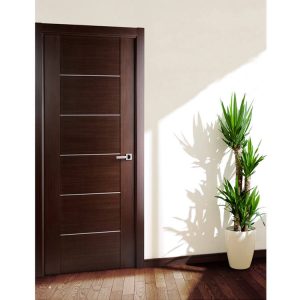
Solid Wood Double Entrance Doors
Solid wood double doors remain the default specification for luxury villas, heritage renovations, and boutique hospitality projects. The material options break down into two fundamental categories:
- Solid core timber: Mahogany, oak, walnut, and teak are the most common species. A true solid-core door uses thick timber stiles and rails with either solid timber panels or engineered wood cores.
- Engineered wood: Veneered over laminated veneer lumber (LVL) or medium-density fiberboard (MDF) cores. These offer better dimensional stability than solid timber at a lower price point.
The performance considerations are significant. Solid wood has a coefficient of thermal expansion roughly three times that of aluminum. In climates with high seasonal humidity variation, a 2000 mm tall solid wood door can move 6–10 mm across its width. This movement must be accommodated in the frame design and hinge specification, or the door will bind, warp, or drop.
Moisture resistance is the single biggest differentiator between a wood door that lasts twenty years and one that fails in three. Factory-applied UV-resistant finishes with proper end-grain sealing are non-negotiable. Buyers should specify the finish system in the purchase contract, not leave it as a supplier’s choice.
Aluminum Alloy Double Entrance Doors (Thermal-Break)
Thermal-break aluminum double doors have become the dominant specification in modern commercial and high-end residential projects. The construction is fundamentally different from wood:
- Profile construction: Extruded aluminum profiles (typically 6063-T5 alloy) are separated by polyamide thermal-break strips. These strips create a physical barrier between the interior and exterior aluminum surfaces, reducing thermal transfer.
- Multi-chamber design: Modern profiles have 3–5 hollow chambers that trap air, improving insulation and providing channels for drainage and reinforcement.
- Insulated glass units (IGU): Double glazing with low-E coatings and argon fill is standard. Triple glazing is available for cold climates but adds significant weight and cost.
The structural advantage is compelling. Aluminum has a strength-to-weight ratio that allows slim sightlines — you can achieve a 2000 mm wide double door with 50 mm visible frame widths, whereas wood requires 90–120 mm to achieve similar structural performance. This is why aluminum double doors dominate projects where maximizing glass area is a design priority.
System Double Doors
System doors represent the engineering ceiling of the category. These are not simply doors with better hardware — they are integrated systems where profiles, gaskets, hardware, and glazing are designed together as a single unit.
Key characteristics:
- Multi-point locking: 5–12 locking points distributed along the door perimeter, engaging with strike plates in the frame
- Continuous gasket sealing: Dual or triple gasket systems that compress when the door closes, creating a weatherproof seal
- Tested performance: System doors are tested as complete assemblies for air-tightness, water-tightness, and wind load resistance — not as individual components
The practical implication for buyers: a system door with a tested air-tightness rating of Class 4 (600 Pa) will outperform a non-system door with thicker profiles but poor gasket design. The performance is in the engineering, not the material thickness.
Double Door Entrance Doors: Quality and Performance Factors
The quality of a double door entrance door is determined by four factors: dimensional stability of the leaf, hardware specification, glazing performance, and the quality of the frame-to-wall interface.
Dimensional stability refers to how well the door maintains its shape and fit over time. For wood doors, this means properly kiln-dried timber (6–8% moisture content) and engineered construction. For aluminum, it means adequate wall thickness in the profiles and proper reinforcement in the hinge areas.
Hardware: The Most Common Point of Failure
Hinges, locks, and closers account for more field failures than any other component. The specification should be explicit:
| Component | Minimum Specification | Notes |
|---|---|---|
| Hinges | 3 per leaf for doors under 2500 mm height | Heavy-duty ball-bearing hinges rated for the actual leaf weight |
| Locks | Multi-point with anti-lift pins | Single-point locks are insufficient for double doors |
| Strike plates | Reinforced, with adjustable keepers | Must engage all locking points |
| Closers | Hydraulic, adjustable power size 3–6 | Required on active leaf for commercial applications |
A double door leaf weighing 80 kg requires hinges rated for at least 60 kg per hinge with three hinges per leaf. This is a basic calculation but one that is frequently ignored by suppliers cutting costs.
Glazing Performance
For double doors with glazed panels, the glass specification determines both thermal performance and safety compliance. Buyers should specify:
- Safety glass: Tempered or laminated glass is required in all door applications in most jurisdictions. Laminated glass also provides security benefits.
- Low-E coatings: These reduce heat transfer by reflecting long-wave infrared radiation. A low-E coating can improve the U-value of a double-glazed unit by 30–40%.
- Warm-edge spacers: The spacer bar between glass panes is a thermal bridge. Warm-edge spacers (stainless steel or polymer) reduce heat loss at the glass edge compared to standard aluminum spacers.
Air-Tightness, Water-Tightness, and Wind Load
These three test parameters define the weather performance of a door system. They are tested according to international standards:
- Air-tightness: Measures air leakage through the closed door assembly. Tested to EN 1026, classified per EN 12207. Class 4 (the highest) allows maximum 0.75 m³/(h·m²) leakage at 600 Pa.
- Water-tightness: Measures resistance to water penetration under wind-driven rain. Tested to EN 1027, classified per EN 12208. Class 7A–9A is typical for exposed locations.
- Wind load resistance: Measures structural deflection under wind pressure. Tested to EN 12211, classified per EN 12210. Class C5 (2000 Pa) is suitable for most applications.
A reputable supplier will provide test reports for these parameters. If they cannot, that is a red flag.
How to Evaluate Double Door Entrance Doors Suppliers
Supplier evaluation requires a framework that assesses manufacturing capability, quality control systems, and export logistics — not just price per unit.
Evaluation Criteria Matrix
| Criterion | Weight | What to Look For |
|---|---|---|
| Manufacturing capability | 25% | In-house profile machining, glass processing, and assembly |
| Quality control | 25% | Documented inspection process, test reports, third-party audits |
| Customization flexibility | 20% | Willingness to adjust profiles, hardware, and dimensions |
| Export experience | 15% | Documentation quality, packing standards, shipping coordination |
| Communication | 10% | Response time, technical knowledge, clarity of quotations |
| Financial stability | 5% | Company age, export volume, bank references |
Questions to Ask Before Ordering
The following questions will separate factories from trading companies:
- Can you provide test reports for air-tightness, water-tightness, and wind load resistance? — A factory with testing capability will provide these. A trading company will not have them.
- What is your profile wall thickness? — For aluminum doors, 1.4–2.0 mm is standard. Thinner profiles indicate cost cutting.
- What is your quality inspection process? — You want a documented multi-stage process, not “we check everything.”
- Can you adjust the profile structure to match our local building codes? — This requires engineering capability, not just assembly.
- What is your MOQ for custom sizes and colors? — Factories have minimums for custom production. Know these before you commit.
- Do you provide packing lists, proforma invoices, and customs documents? — This is basic export competency. Its absence is disqualifying.
- What is the lead time for a container order? — 15–45 days is typical. Longer times require justification.
Red Flags: Avoid Suppliers Who…
- Cannot provide test reports or certification documents
- Quote prices significantly below market average (quality is being cut somewhere)
- Use vague terms like “high quality” without specific technical data
- Have no physical factory address or refuse factory visits
- Require full payment upfront without an inspection clause
- Do not ask about your building codes or local regulations
Key Quality Indicators for Double Door Entrance Doors Buyers
Five quality indicators determine whether a double door entrance door will perform in service: profile wall thickness, hardware brand and rating, glass specification, gasket quality, and surface finish.
Profile Wall Thickness
For aluminum doors, the European standard EN 14024 specifies minimum wall thicknesses for different profile types. For door leaves, 1.5 mm is the practical minimum. Premium systems use 1.8–2.0 mm. Thicker walls provide better structural performance and resistance to hardware pull-out.
Hardware Brand and Rating
Hardware is the highest-failure component. Specify known brands or verify the rating of unbranded hardware. A multi-point lock should have a mechanical endurance of 200,000 cycles minimum (tested to EN 179 or EN 1125 where applicable).
Glass Specification
Verify that the glass is certified to the relevant safety standard (EN 12150 for tempered, EN 14449 for laminated). Check the glass thickness — a typical insulating glass unit for doors is 5+12A+5 or 6+12A+6.
Gasket Quality
EPDM (ethylene propylene diene monomer) gaskets are the industry standard. They maintain elasticity from -40°C to +120°C. Silicone gaskets are also acceptable. Avoid PVC gaskets, which harden and crack within a few years.
Surface Finish
For aluminum: anodizing (10–25 micron thickness) or powder coating (60–120 micron thickness). Powder coating to Qualicoat Class 1 or 2 provides excellent durability. For wood: verify the finish system and its UV resistance rating.
Relevant Industry Standards and Certifications
The key standards for double door entrance doors are EN 14351-1 (European), NFRC 100 (North American), and ISO 9001:2015 for manufacturing quality management.
Manufacturers should hold ISO 9001:2015 certification as a baseline. For product performance, the relevant standards are:
- EN 14351-1: The European product standard for windows and doors. It covers air permeability, water tightness, wind load resistance, thermal transmittance, and acoustic performance.
- EN 1627-1630: Burglar resistance ratings for doors. RC2 is the minimum for residential, RC3 for commercial.
- ASTM E283 / E330 / E547: The American standards for air leakage, structural performance, and water penetration.
- NFRC 100 / 200: American standards for thermal performance and optical properties.
- CE marking: Required for doors sold in the European Economic Area. Verify that the manufacturer has the appropriate Declaration of Performance.
For fire-rated applications, additional standards apply (EN 1634-1 in Europe, UL 10C in North America). Fire-rated double doors are a separate product category with specific requirements for frames, seals, and hardware.
Production Process: From Raw Material to Finished Doors
A double door entrance door undergoes 12–20 production steps depending on material. The critical stages are profile processing, surface treatment, glass fabrication, assembly, and final inspection.
Aluminum Door Production
- Profile extrusion: Aluminum billets (6063-T5 alloy) are heated to 450–500°C and forced through steel dies to create the profile shape.
- Thermal-break insertion: Polyamide strips are inserted between the interior and exterior aluminum sections, either by crimping or pouring and bridging.
- Cutting and machining: Profiles are cut to length with CNC saws, then machined for drainage holes, hardware cutouts, and corner joints.
- Surface treatment: Anodizing or powder coating. Powder coating involves electrostatic application of the powder, followed by curing at 180–200°C for 15–20 minutes.
- Glass fabrication: Insulating glass units are assembled in a controlled environment. The spacer frame is filled with desiccant, sealed with butyl, and the unit is pressed and sealed with a secondary sealant.
- Assembly: Profiles are joined with corner connectors, glass is installed with setting blocks and gaskets, and hardware is fitted.
- Inspection: Each door is checked for dimensional accuracy, hardware function, and surface defects.
Solid Wood Door Production
- Timber selection and drying: Timber is kiln-dried to 6–8% moisture content to ensure dimensional stability.
- Machining: Stiles, rails, and panels are machined to size with CNC routers.
- Joinery: Mortise-and-tenon or dowel joints are used for frame construction. The joints are glued and clamped.
- Panel fitting: Panels are fitted into grooves in the frame, allowing for natural wood movement.
- Sanding and finishing: The door is sanded progressively (typically 120 to 240 grit), then finished with multiple coats of lacquer or paint.
- Hardware fitting: Hinges, locks, and other hardware are fitted and adjusted.
- Final inspection: The door is checked for fit, finish, and hardware function.
Customization and OEM/ODM Options
Customization in double door entrance doors covers five dimensions: size, profile design, color, glass specification, and hardware configuration.
Size Customization
Double doors can be manufactured to any width from 1200 mm to 3000 mm or more. The height is typically 2000–3000 mm. For non-standard sizes, the profile structure must be checked for structural adequacy. A supplier with engineering capability will calculate the required profile reinforcement for your specific dimensions.
Color Customization
Aluminum doors can be powder coated in any RAL color. Anodized finishes are available in silver, bronze, and black. Wood-grain finishes (thermal transfer printing) replicate timber appearance on aluminum profiles. For wood doors, custom stain colors can be matched.
Glass Customization
Options include clear, frosted, tinted, reflective, and patterned glass. Low-E coatings and argon fill can be specified. For security applications, laminated glass with PVB interlayers is available.
OEM/ODM Services
- OEM: The factory manufactures to your exact specifications and applies your brand. You own the design.
- ODM: The factory provides its own designs, which you can adapt to your market. The factory manages the design and manufacturing.
- Private Label: The factory manufactures standard products with your branding applied.
Ordering Process: MOQ, Lead Time, and Shipping
The typical ordering process for double door entrance doors involves: specification confirmation, quotation, sample approval, production, inspection, and shipment.
Minimum Order Quantity (MOQ)
MOQ varies by product and customization level:
- Standard sizes, standard colors: 20–50 units
- Custom sizes, standard colors: 50–100 units
- Custom sizes, custom colors: 100+ units (or a sample order plus bulk order)
- Samples: 1–2 units available at sample pricing
Lead Times
Typical production lead times:
- Samples: 7–15 days after drawing approval
- Container orders (standard products): 15–25 days
- Container orders (custom products): 25–45 days
- Large projects (500+ units): 45–60 days
These times exclude shipping, which takes 15–35 days to most destinations depending on the route.
Shipping Options
- FCL (Full Container Load): Recommended for orders over 20 cubic meters. Lower per-unit freight cost and faster transit.
- LCL (Less than Container Load): Suitable for smaller orders. Higher per-unit cost and longer transit times due to consolidation.
Documentation
A competent export supplier provides:
- Packing list (itemized contents of each package)
- Proforma invoice (quotation in invoice format)
- Commercial invoice (for customs clearance)
- Bill of lading (shipping document)
- Certificate of origin (may be required for tariff preference)
- Test reports (product performance verification)
Now, here is how we meet these standards.
Our Double Door Entrance Doors Manufacturing Capabilities
As a manufacturer of solid wood doors and thermal-break aluminum doors and windows, our approach is straightforward: the specifications above are our minimum production standard, not our selling point.
Direct Factory Supply
We supply direct from our China factory. There is no trading company in the chain, no middleman markup. When you request a quotation, you receive the factory price — the same price we would quote to a domestic Chinese project.
Full Customization
We provide full customization on size, color, glass, and hardware accessories. Our engineering team will adjust the profile structure and fittings to match the building codes of your target market. If your local code requires a specific wind load rating, we calculate the required profile reinforcement. If your market requires specific lock brands for replacement availability, we fit those locks.
Pre-Shipment Quality Assurance
Every order undergoes a multi-stage inspection process:
- Incoming material inspection: Aluminum profiles, glass, and hardware are checked against specifications.
- In-process inspection: Dimensional checks and visual inspection during machining and assembly.
- Pre-shipment inspection: Each door is tested for air-tightness, water-tightness, and wind resistance. Hardware function is verified on every unit.
- Packing inspection: Doors are packed with protective film, corner protection, and moisture barriers in wooden crates or cartons.
Test reports are provided with each shipment. You know exactly what is being shipped because we test it before it leaves the factory.
Export-Ready Logistics
With our experience in foreign trade, we provide packing lists, proforma invoices, and full customs documents. We support both FCL and LCL shipments, with direct delivery from our factory to your port or project site. Our export team coordinates with your freight forwarder to ensure smooth clearance at destination.
Certifications and Industry Standards
Our manufacturing facilities operate under ISO 9001:2015 quality management systems. Our doors are manufactured to meet EN 14351-1 performance standards, with test reports available for air-tightness, water-tightness, and wind load resistance.
For projects requiring specific certifications, we work with third-party testing laboratories to provide the documentation your project requires.
—
Partnership Models: OEM, ODM, and Bulk Supply
The right partnership model depends on your market position and technical requirements. OEM suits established brands with their own specifications. ODM suits distributors entering new markets. Bulk supply suits construction projects with defined requirements.
OEM (Original Equipment Manufacturing)
We manufacture double door entrance doors to your exact specifications. You provide the drawings, the hardware specifications, and the finish requirements. We manufacture, inspect, and ship. Your brand goes on the product.
ODM (Original Design Manufacturing)
We offer our own door designs and adapt them to your market’s preferences and building codes. This is the fastest path to market if you do not have your own technical team. You select the design, specify the customization, and we handle the engineering.
Private Label and Construction Project Supply
For distributors, we apply your branding to our standard products. For construction projects, we provide bulk supply with consistent quality and timeline management. Project orders of 500+ units receive dedicated production scheduling.
—
Why Partner with a Factory-Direct Supplier?
The procurement decision comes down to a simple question: do you want to buy from a trading company that adds a markup and has no control over production, or from a factory that manufactures the product and stands behind it?
Price competitiveness: Factory-direct pricing eliminates the middleman markup. You pay for manufacturing, not for a trading company’s overhead.
Quality control: Direct communication with the production team means issues are caught early. When you visit the factory, you see the actual production line — not a showroom.
Scalability: From sample orders to full container loads, a factory partner can scale with your business. You do not need to find a new supplier when your order volume grows.
Long-term reliability: A stable supply chain matters more than one-off low pricing. A factory that has been producing for international clients understands the documentation, packing, and quality standards required for export.
—
Are double front doors a good idea?
Yes, for properties where aesthetic impact and natural light are priorities. Double doors add architectural presence and can improve ventilation when both leaves are operable. The trade-offs are cost, space requirements, and the need for proper thermal-break specification and multi-point locking in energy-efficient designs.
What do you call a front door that has two doors?
The common term is “double door” or “double front door.” When both leaves are operable and contain glass panels, it is called a “French door.” In architectural specifications, the term is “double-leaf door.”
How much do new double front doors cost?
Costs vary widely by material, size, glazing, and hardware. Entry-level aluminum double doors start around $1,500–$3,000 ex-works. Premium solid wood or thermal-break aluminum systems can exceed $8,000–$12,000 per unit. For B2B pricing, request a detailed quote with a full cost breakdown — ex-works price, freight, duties, and installation should be itemized separately.
What are the disadvantages of double doors?
Higher cost, larger swing radius, potential thermal bridging, and more complex security requirements. These are managed with proper specification: multi-point locks, thermal-break profiles, and careful installation planning. For tight spaces, sliding double doors eliminate the swing radius issue entirely.
What is the lead time for custom double door entrance doors?
Typical lead times are 15–45 days depending on order volume and customization level. Confirm the production schedule with your supplier and factor in shipping time for FCL or LCL deliveries. Large project orders require longer scheduling.
Can double doors be made to non-standard sizes?
Yes. Custom sizes are standard in the industry. A reputable factory will adjust the profile structure and fittings to your exact dimensions while maintaining structural integrity and code compliance. Always verify that the supplier can provide structural calculations for non-standard sizes.
What documentation should I request from a door supplier?
Request a packing list, proforma invoice, test reports (air-tightness, water-tightness, wind load), and full customs documents. This ensures smooth import clearance and verifies product quality. If a supplier hesitates to provide test reports, that is a red flag.
—
Choose a factory-direct partner if you need consistent quality at competitive pricing, you want direct communication with the production team, and you plan to scale your orders over time.
Choose a trading company if you need one-off procurement without long-term commitment, you are not concerned about per-unit cost, and you accept the risk of inconsistent quality.
The decision is yours. If you are ready to evaluate a factory partner, the next step is to discuss your specifications — get a detailed quotation, review the test reports, and verify the documentation. That is the process we follow with every client.
—
References
- European Committee for Standardization. (2016). EN 14351-1:2006+A2:2016 — Windows and doors. Product standard, performance characteristics. https://www.en-standard.eu/
- International Organization for Standardization. (2015). ISO 9001:2015 — Quality management systems. https://www.iso.org/standard/62085.html
- European Committee for Standardization. (2021). EN 1627:2021 — Pedestrian doorsets. Burglar resistance. https://www.en-standard.eu/
- American Society for Testing and Materials. (2019). ASTM E283-19 — Standard Test Method for Determining Rate of Air Leakage Through Exterior Windows, Skylights, Curtain Walls, and Doors. https://www.astm.org/e0283-19.html
- National Fenestration Rating Council. (2020). NFRC 100-2020 — Procedure for Determining Fenestration Product U-factors. https://www.nfrc.org/
- Qualicoat. (2021). Qualicoat Class 1 and Class 2 — Specifications for Powder Coating on Aluminium. https://www.qualicoat.net/