Content Menu
● 1. 1. Understanding Cottage Style Entry Doors: Types and Applications
● 2. 2. Quality and Performance Factors for Cottage Style Entry Doors
● 3. 3. How to Evaluate Cottage Style Entry Doors Suppliers
● 4. 4. Key Quality Indicators for Cottage Style Entry Doors Buyers
● 5. 5. Relevant Industry Standards and Certifications
● 6. 6. Our Manufacturing Capabilities
● 7. 7. Production Process: From Raw Material to Finished Doors
● 8. 8. Quality Control: Our Multi-Stage Inspection Process
● 9. 9. Customization and OEM/ODM Options
● 10. 10. Ordering Process: MOQ, Lead Time, and Shipping
● 11. 11. Certifications and Industry Standards
● 12. 12.
11 min read
A contractor in Ohio once ordered 120 “cottage style” doors. The first 40 arrived with the wrong glass grille pattern — a specification gap, not a manufacturing flaw. The buyer wrote “3-lite cottage doors” on the purchase order; the factory built 3 vertical lites. The architect wanted a 3-lite configuration with a transom. That is a $12,000 mistake born from a four-word description.
This guide prevents that. It covers technical specifications, material trade-offs, testing standards, and supplier evaluation criteria for sourcing cottage style entry doors for volume projects.
1. Understanding Cottage Style Entry Doors: Types and Applications
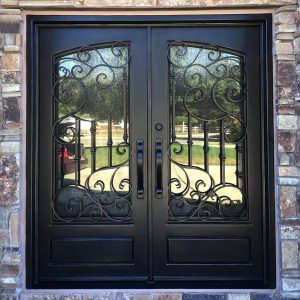
Cottage style entry doors are characterized by paneled wood or wood-look construction, divided lites (multi-pane glass), and earthy, muted color palettes. They serve residential single-family homes, townhouses, and mixed-use developments.
The term covers several architectural traditions — English cottage, American craftsman, and modern farmhouse — unified by warmth and handcrafted detail.
Common Design Configurations
Buyers should be familiar with these configurations:
- Single door with sidelites: The most common setup for suburban homes. Sidelites range from 12 to 18 inches wide. The EX-1337 pattern — a knotty alder door with 3-lite sidelites — is a standard.
- Double doors: Used for larger entries, often with a center meeting stile.
- Door plus transom: A transom sits above the door frame, adding height and light. A signature of English cottage style.
- Dutch doors: Split horizontally so the top half opens independently. Popular for cottages near patios or gardens.
Glass and Grille Options
The glass configuration is the single most defining visual element.
| Grille Pattern | Description | Typical Use |
|---|---|---|
| 3-lite | Three vertical rectangular panes | Classic cottage, farmhouse |
| 7-lite | Seven panes, often with a larger center pane | Modern cottage, transitional |
| Colonial | 4, 6, or 8 square panes | Traditional, colonial revival |
| Prairie | Rectangular panes around a solid perimeter | Craftsman, prairie style |
Glass types matter beyond aesthetics:
- Low-E insulated glass: Required for ENERGY STAR compliance in most climate zones. U-factor should be 0.30 or lower for cold climates.
- Grilles-between-glass (GBG): Grille inside the insulated unit. Easier to clean, better energy performance.
- True divided lites (TDL): Individual panes separated by muntin bars. More authentic, but heavier and more expensive.
- Tempered or laminated glass: Required near entryways in many building codes. Laminated offers better security and sound reduction.
Applications Across Project Types
- Single-family developments: The largest volume segment. Builders typically select 2–3 models to standardize.
- Townhouse communities: Often require narrower doors (30–32 inches) with slim sidelites.
- Mixed-use developments: Ground-floor units may need residential aesthetics plus commercial fire ratings.
- Renovation projects: Older homes often have non-standard rough openings, requiring custom sizing.
2. Quality and Performance Factors for Cottage Style Entry Doors
Cottage style entry door quality is determined by material stability, glass seal integrity, hardware durability, and structural performance under wind load. Buyers should verify test reports rather than rely on visual inspection alone.
Material Selection and Its Consequences
Solid wood (knotty alder, oak, mahogany): Knotty alder dominates the segment because its natural grain creates the rustic look buyers want. It stains well and accepts hardware easily. The trade-off is maintenance — solid wood requires periodic refinishing on exterior surfaces.
Aluminum with thermal break: Increasingly common for coastal or extreme-weather regions. Polyamide strips separate interior and exterior frames, reducing heat transfer. Powder-coating can replicate wood grain closely.
Fiberglass with wood-grain texture: The budget-to-midrange workhorse. Resists dents, moisture, and temperature expansion better than wood. The downside is a slightly “plastic” feel.
Performance Standards That Matter
Request test reports for each:
- ASTM E330: Structural performance under wind load.
- ASTM E283: Air leakage testing. Lower is better for energy efficiency.
- ASTM E547: Water penetration testing.
- AAMA/WDMA/CSA 101/I.S.2/A440: The North American performance grading standard referencing the above.
Hardware and Security Considerations
Multi-point locking systems are standard on quality entry doors.
| Hardware Feature | Why It Matters |
|---|---|
| Multi-point lock | Distributes force across frame; resists pry attacks |
| 3–4 hinges per door | Prevents sagging, especially on solid wood |
| Reinforced strike plate | Critical for frame security; must be anchored to framing |
| Smart lock compatibility | Increasingly requested; check cylinder type |
Multi-point locks require skilled installers and occasional tuning — a maintenance consideration for high-volume projects.
3. How to Evaluate Cottage Style Entry Doors Suppliers
Evaluate suppliers on four criteria: manufacturing capability, quality control processes, documentation quality, and logistics reliability. Price is a lagging indicator.
Step 1: Verify Manufacturing Capability
- Does the factory operate CNC machining centers? CNC ensures dimensional consistency across large orders.
- What is the kiln-drying capacity for solid wood? Properly dried wood (6–8% moisture content) is essential.
- Does the factory produce its own glass units? In-house fabrication means better seal integrity control.
Step 2: Examine Quality Control Processes
- Incoming inspection: Are raw materials inspected upon arrival?
- In-process checks: Are there checkpoints during machining, assembly, and finishing?
- Pre-shipment inspection: Who conducts final inspection, and what tests are performed?
Step 3: Request Documentation Samples
Legitimate suppliers can provide:
- Test reports from accredited laboratories (ASTM, AAMA)
- ISO 9001:2015 certificates
- Packing lists and proforma invoices with detailed specifications
- Export documentation examples (bill of lading, certificate of origin)
Red Flags to Avoid
- Vague answers about testing standards: Likely no testing.
- “Lowest price” quotes without specification sheets: A promise, not a commitment.
- Reluctance to provide references: Reputable factories connect buyers with clients.
- No documented QC process: Verbal assurances are worthless.
4. Key Quality Indicators for Cottage Style Entry Doors Buyers
Key quality indicators include dimensional accuracy (±2 mm on width and height), moisture content of wood (6–8%), glass seal integrity (no fogging), and finish adhesion (no peeling or blistering).
Dimensional Accuracy
Standard tolerance is ±2 mm on width and height. For sidelite assemblies, tolerance tightens to ±1.5 mm. Measure door slabs diagonally; a difference over 3 mm means the slab is racked.
Moisture Content and Wood Stability
Wood at 6–8% moisture content is stable in most applications. Above 10%, the wood is prone to warping and splitting. Request the factory’s kiln-drying logs.
Glass Seal Integrity
The most common field failure is seal failure in insulated glass units, causing fogging. Quality indicators: warm-edge spacer systems (stainless steel or foam), continuous sealant, and a warranty of at least 5 years against seal failure.
Finish Quality
| Finish Defect | Likely Cause | Field Impact |
|---|---|---|
| Peeling or blistering | Inadequate surface prep or poor coating | Moisture infiltration, wood decay |
| Color mismatch between units | Batch variation in stain or paint | Aesthetic failure on multi-unit projects |
| Visible brush marks | Poor spray application | Cosmetic defect, difficult to repair |
5. Relevant Industry Standards and Certifications
Cottage style entry doors must comply with ASTM E330 (wind load), ASTM E283 (air leakage), ASTM E547 (water penetration), and applicable energy codes such as IECC or Title 24. ISO 9001:2015 indicates a quality management system, not product performance.
Product Performance Standards
- ASTM E330 / E283 / E547: Core structural and weather-resistance tests.
- ENERGY STAR: Voluntary program. U-factor limits vary by climate zone (0.30 for Northern, 0.32 for North-Central).
- NFRC Certification: Provides certified U-factor and SHGC ratings. Required for ENERGY STAR compliance.
Quality Management Standards
- ISO 9001:2015: Certifies the factory’s processes, not the product.
Building Code Compliance
- IRC (International Residential Code): Applies to single-family and townhouse construction.
- IBC (International Building Code): Applies to commercial and multi-family buildings; may impose fire rating and accessibility requirements.
- Title 24 (California): The most stringent US energy code.
6. Our Manufacturing Capabilities
As a factory specializing in solid wood doors, thermal-break aluminum doors and windows, and aluminum alloy entrance doors, we approach cottage style entry doors as a systems engineering problem. Our production line handles both standardized and fully custom designs.
Direct Supply and Engineering Communication
Buyers work directly with our engineering team — no trading company or distributor. Specification changes reach the engineers who program the CNC machines, not a salesperson.
Customization Without Sub-Supplier Coordination
We manufacture the door and frame in-house and coordinate glass and hardware through established supply chains. One point of accountability for the entire assembly.
Adapting to Local Building Codes
Our profiles and fittings adjust to target markets. Florida projects get impact-rated glazing and higher wind load ratings; European projects can get passive house-level insulation.
7. Production Process: From Raw Material to Finished Doors
The production process involves kiln-drying, CNC machining, assembly, glass fabrication, finishing, and final inspection. Each stage has specific quality control checkpoints.
Stage 1: Material Preparation
Solid wood arrives at 12–15% moisture content and is kiln-dried to 6–8% over 7–14 days, then inspected for defects. Aluminum profiles are cut and CNC-machined for drainage holes, hardware cutouts, and corner joints.
Stage 2: CNC Machining
Door stiles, rails, and panels are machined on CNC routers, creating panel configurations and cutting grooves and mortises. CNC produces the same cut to ±0.5 mm across 1,000 doors; manual machining drifts.
Stage 3: Assembly
Doors are assembled with waterproof adhesive and clamped under pressure. Frames are assembled with steel-bracketed corners. For aluminum, thermal-break polyamide strips are inserted and crimped in place.
Stage 4: Glass Fabrication
Insulated glass units are assembled in a controlled environment: spacer filled with desiccant, sealant applied, panes pressed together, then inspected for seal integrity.
Stage 5: Finishing
Wood doors are sanded, sealed, and finished with multiple coats, cured in a controlled environment. Aluminum doors are powder-coated and cured in an oven at 200°C.
Stage 6: Final Inspection
Every door undergoes visual and dimensional inspection. Failures are marked for rework, not shipped.
8. Quality Control: Our Multi-Stage Inspection Process
Our quality control includes raw material inspection, in-process checks at each stage, and pre-shipment testing of air-tightness, water-tightness, and wind resistance. Each batch is documented and traceable.
Raw Material Inspection
- Wood moisture content verified against kiln-drying logs
- Aluminum profile dimensions checked against drawings
- Glass inspected for seal integrity and coating defects
In-Process Checks
- CNC parts checked for dimensional accuracy (first article, then every 50th unit)
- Assembly inspected for joint tightness and adhesive squeeze-out
- Finish checked for coverage, color match, and surface defects
Pre-Shipment Inspection
Every batch undergoes testing aligned with ASTM standards: air-tightness under pressure differential, water sprayed under pressure, and structural wind resistance. Documentation — packing lists, proforma invoices, customs documents — is provided for every shipment.
9. Customization and OEM/ODM Options
Customization options include door dimensions, wood species, glass configuration, hardware brand and finish, and door style. OEM follows buyer drawings; ODM is design-and-build based on market trends.
OEM: Building to Your Specifications
If your project has detailed drawings — door schedule, frame details, hardware schedule — we produce to those drawings exactly.
ODM: Design and Build
If you need a cottage door line without detailed drawings, our design team develops options based on market trends. You select, we build.
Private Label
For distributors, we offer private labeling. Your brand goes on the door, packaging, and documentation.
10. Ordering Process: MOQ, Lead Time, and Shipping
Typical MOQs are 10–50 units per design for solid wood and 20–100 units for aluminum or fiberglass. Production lead times are 3–8 weeks for wood, 3–6 weeks for aluminum. Ocean freight from China adds 25–40 days.
Stage 1: Specification and Quotation
You provide specifications: door style, material, dimensions, glass, hardware, finish, quantity. We provide an itemized quotation with each component priced separately.
Stage 2: Sample or Pre-Production Approval
For large orders, we recommend a pre-production sample built to your exact specification. You approve it, and we match it in production.
Stage 3: Production
Production begins after sample approval and 30% deposit. Progress photos are provided at key stages.
Stage 4: Inspection and Packing
Your representative or a third-party inspector can attend pre-shipment inspection. Doors are packed in wooden crates with corner protectors and moisture barriers.
Stage 5: Shipping
We ship FCL or LCL depending on volume. FCL is more cost-effective for large orders; LCL suits samples or small projects. We handle all export documentation.
11. Certifications and Industry Standards
We maintain ISO 9001:2015 quality management certification. Product performance is verified through testing aligned with ASTM E330, E283, and E547 standards. Documentation for all shipments includes packing lists, proforma invoices, and full customs paperwork.
ISO 9001:2015 certifies our quality management system. Product performance is verified through testing to ASTM standards. Test reports are available upon request.
12.
Frequently Asked Questions
What is the best front door design for a cottage style house?
Paneled wood doors with divided lites (3-lite or 7-lite), often paired with sidelites or a transom. Knotty alder is the most commonly specified species. For coastal climates, aluminum doors with wood-grain powder coating offer better durability.
What is a cottage style door?
An entry door with a cozy, craftsman-inspired aesthetic — paneled construction, multi-pane glass, and earthy or muted tones — designed to complement cottage, farmhouse, and craftsman architecture.
What are the three colors not to paint your front door?
Avoid bright purple or neon hues, pure white on white-sided homes (washed-out look), and dark brown or muddy tones that lack contrast. Sage green, navy blue, black, and warm cream are safer choices.
What are some ideas for a front door for a small cottage?
Consider a single door with a full-lite or half-lite glass panel to maximize natural light, a Dutch door for charm and ventilation, or a compact 3-lite configuration with slim sidelites.
What is the typical MOQ for custom cottage style entry doors?
MOQs range from 10 to 50 units per design for solid wood, and 20 to 100 units for aluminum or fiberglass. Some factories accommodate lower MOQs for sample orders at adjusted pricing.
How long does it take to manufacture and ship cottage style entry doors internationally?
Production takes 3–8 weeks depending on material and customization. Ocean freight from China to North America or Europe adds 25–40 days depending on the port.
Can doors be adapted to local building codes?
Yes. Reputable manufacturers adjust profile structures, glazing, and hardware to meet regional codes, including energy performance and wind load ratings. Always request compliance documentation for your target market.
Choosing the Right Supplier
Choose a factory-direct supplier if you need consistent quality across volume orders, full customization, and direct communication with production engineers. Choose a distributor if you need small quantities quickly and are willing to pay a markup.
- Choose a factory-direct supplier if: Your project involves 50+ doors, requires custom specifications, or needs documented test reports.
- Choose a distributor if: You need fewer than 10 doors, require immediate delivery, or are sourcing a standard catalog product.
References
- ASTM International. “E330/E330M-14 Standard Test Method for Structural Performance of Exterior Windows, Doors, Skylights and Curtain Walls by Uniform Static Air Pressure Difference.” https://www.astm.org/e0330_e0330m-14.html“>https://www.astm.org/e0330_e0330m-14.html
- ASTM International. “E283-19 Standard Test Method for Determining Rate of Air Leakage Through Exterior Windows, Skylights, Curtain Walls, and Doors Under Specified Pressure Differences Across the Specimen.” https://www.astm.org/e0283-19.html“>https://www.astm.org/e0283-19.html
- AAMA/WDMA/CSA. “101/I.S.2/A440-17 Standard/Specification for Windows, Doors, and Unit Skylights.” https://www.aamanet.org/“>https://www.aamanet.org/
- ENERGY STAR. “Windows, Doors, and Skylights Program Requirements.” https://www.energystar.gov/products/windows_doors_skylights“>https://www.energystar.gov/products/windows_doors_skylights
- International Code Council. “2021 International Residential Code.” https://codes.iccsafe.org/“>https://codes.iccsafe.org/
—
https://doorwoodendoors.com/contact-us/” style=”display:inline-block;padding:12px 24px;background:#2563eb;color:#fff;text-decoration:none;border-radius:6px;font-weight:600″>Get a Free Quote