Content Menu
● 1. ## 1. Understanding Big Wooden Doors: Types and Applications
● 2. ## 2. Quality and Performance Factors: What Determines a Big Door’s Behavior
● 3. ## 3. How to Evaluate Big Wooden Door Suppliers
● 4. ## 4. Key Quality Indicators for Big Wooden Door Buyers
● 5. ## 5. Industry Standards and Certifications
● 6. ## 6. Production Process: From Raw Material to Finished Door
● 7. ## 7. Our Door Manufacturing Capabilities
● 8. ## 8. OEM, ODM, and Customization Options
● 9. ## 9. Pricing, Lead Time, and Ordering Process
10 min read
The warehouse manager in Rotterdam had a problem. His client had approved a sample door six months ago. But when the container arrived, the 3-meter-tall oak doors had warped, the finish cracked, and the hardware pockets were misaligned. The shipment was rejected. The supplier’s response was silence.
Large-format wooden doors fail differently than standard doors. They warp, sag, and bind in ways that 80-inch residential doors never do. Buyers who succeed with oversized wooden doors understand the engineering, testing, and supplier verification process before placing the order.
This guide covers what B2B buyers need to know about sourcing big wooden doors — from material science to logistics. No fluff. Just the technical and commercial framework for a confident purchasing decision.
## 1. Understanding Big Wooden Doors: Types and Applications
Direct answer: A big wooden door generally exceeds 8 feet (2.4 meters) in height or 4 feet (1.2 meters) in width. These dimensions require thicker cores, reinforced framing, heavy-duty hardware, and specialized engineering.
Architects typically specify one of three configurations:
Pivot doors. These rotate on a vertical axis rather than swinging on side hinges. The offset pivot point distributes weight differently than a traditional hinge. Pivot doors can reach 10–14 feet in height and 4–6 feet in width without the sagging problems of oversized hinged doors.
Double doors. Two leafs side by side, each typically 3–4 feet wide, creating a 6–8 foot opening. The challenge is coordinating the astragal so both leafs seal properly.
Sliding and barn-style doors. These carry weight on overhead tracks. They can be 12 feet wide or more, but the track system and floor guides need precise specification.
### 1.1 Where Big Wooden Doors Get Used
- Luxury residential entryways (8–12 foot heights)
- Commercial lobbies and office entrances
- Hotels and resort properties
- Wine cellars and private libraries (often with acoustic requirements)
- Boardrooms and conference facilities
- Religious and institutional buildings
The application determines the engineering. An exterior pivot door in Florida faces hurricane wind loads. A recording studio door faces acoustic requirements. A wine cellar door faces constant humidity. Each use case changes the material specification, core construction, and hardware.
## 2. Quality and Performance Factors: What Determines a Big Door’s Behavior
Direct answer: The three factors that most determine a big wooden door’s long-term performance are core construction, moisture content management, and hardware load ratings. A door that fails typically fails because of one of these.
### 2.1 Core Construction: Solid Wood vs. Engineered Cores
Solid wood has classic appeal, but for large formats it is risky. Wood moves with humidity changes. A solid 3-meter-tall door can move 6–10 millimeters across its width seasonally, stressing joints, cracking finish, and causing binding.
Engineered cores solve this problem:
Glulam (glued laminated) cores. Thin veneer layers are laminated with alternating grain directions, cancelling natural expansion. A glulam core door can be 3 meters tall and remain stable within 1–2 millimeters.
Stave cores. Narrow wood strips are edge-glued together. More stable than solid, less stable than glulam. A good middle-ground for doors up to 2.4 meters.
Veneered construction. Real wood veneer (0.6–3 mm thick) bonded over an engineered core. For big wooden doors, veneered-over-engineered-core is the most common commercial specification.
Moisture content matters. Industry standard is 8–12% for interior doors and 10–14% for exterior [1]. Buyers should ask for moisture content readings in the inspection report.
### 2.2 Hardware: The Silent Failure Point
A 3-meter solid oak door can weigh 150–250 kilograms. Standard residential hinges rated for 40–60 kg per pair will fail.
The hardware specification for oversized doors includes:
- Heavy-duty ball-bearing hinges rated for 100+ kg per pair, or pivot hinge sets rated for 200+ kg
- Multi-point locking systems with 3–5 locking points
- Floor springs or overhead closers with adjustable closing force
- Reinforced frames with steel or aluminum sub-frames
Hardware cost is typically 15–25% of total door cost. Buyers who save money here get sagging doors within two years.
### 2.3 Thermal and Acoustic Performance
The U-value of a typical solid wood door is 2.5–3.0 W/m²K, poor compared to thermal-break aluminum at 1.5–2.0 W/m²K. To improve thermal performance, manufacturers use:
- Insulated cores (polyurethane foam or cork)
- Thermal-break aluminum frames with wood cladding
- Double or triple glazing
- Full-perimeter weather-stripping
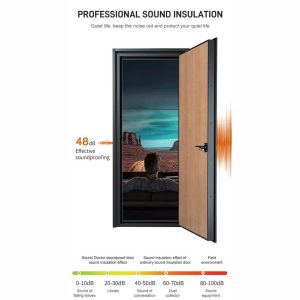
For acoustics, a standard hollow-core door is 20–25 STC. Solid wood is 30–35 STC. A properly engineered acoustic door with a dense core and perimeter seals can achieve 40–50 STC [2]. Heavier doors achieve better acoustic performance but require stronger frames and hardware.
## 3. How to Evaluate Big Wooden Door Suppliers
Direct answer: Evaluate suppliers on four dimensions: manufacturing capability, quality control, export experience, and commercial flexibility (OEM/ODM, MOQ, pricing transparency).
### 3.1 Factory vs. Trading Company
For big wooden doors, the trading company model has drawbacks:
- No direct control over production quality
- Higher markups — typically 15–30%
- Slower problem resolution — coordination adds weeks
- Less customization control
A direct factory relationship gives price transparency, direct communication, and accountability.
### 3.2 Red Flags to Watch For
- Vague lead times. A reputable factory quotes within ±1 week.
- No pre-shipment inspection process.
- Poor documentation experience. Ask for a sample packing list.
- Unwillingness to share test reports.
- MOQ rigidity. For custom oversized doors, a reasonable MOQ is 1–5 units. Demanding 50 units signals a stock manufacturer.
### 3.3 Questions to Ask Before Ordering
- What is the maximum door height and width your production line can handle?
- What core construction do you recommend, and why?
- What is your moisture content control process?
- What hardware load ratings do you specify for doors over 100 kg?
- Can you share test reports for air-tightness, water-tightness, and wind resistance?
- What is your pre-shipment inspection process?
- What export documentation do you provide?
- What is your MOQ for custom dimensions?
- What is your production lead time?
- What is your claims process for damaged arrivals?
## 4. Key Quality Indicators for Big Wooden Door Buyers
Direct answer: The five key quality indicators are dimensional accuracy (±2 mm), flatness (max 3 mm bow), moisture content (8–12% interior, 10–14% exterior), finish consistency, and hardware function.
### 4.1 Dimensional Tolerance
For a big wooden door, a 3 mm height error is not acceptable. The frame is built to precise dimensions — a door too tall binds, too short leaks. Industry-standard tolerance is ±2 mm on all dimensions.
### 4.2 Flatness and Twist
Inspection should check:
- Flatness across the diagonal (maximum 3 mm deviation)
- Edge straightness along full height
- Squareness of corners (maximum 2 mm deviation)
Measurements should be taken with the door standing vertically.
### 4.3 Finish Quality
Check for:
- Color consistency across panels and stiles
- No brush marks, runs, or sags
- No bubbles or blisters in veneer
- Proper seal at joints and edges
- UV protection for exterior doors
### 4.4 Hardware Function
Every locking point, hinge, and closer should be tested. The door should open and close smoothly. The multi-point lock should engage all points with a single turn.
## 5. Industry Standards and Certifications
Direct answer: The most relevant standards are EN 12207 (air-tightness), EN 12208 (water-tightness), EN 12210 (wind resistance), and ISO 9001:2015. Request test reports before ordering.
### 5.1 European Standards
- EN 12207 classifies air permeability from Class 0 to Class 4. Class 3 or 4 recommended for exterior doors.
- EN 12208 classifies water-tightness from Class 1A to 9A. Class 7A or higher recommended for rainy climates.
- EN 12210 classifies wind load resistance from Class A1 to C5.
### 5.2 Quality Management
ISO 9001:2015 indicates documented, audited processes. Ask for the certificate and verify it is current.
### 5.3 Other Relevant Standards
- ASTM E283 and ASTM E330 are US equivalents.
- FSC certification for sustainably sourced wood is required for green building projects.
- Fire-rated door standards (UL 10C, BS 476) apply in fire-rated wall assemblies.
Fire-rated doors require specification early — the frame, seals, intumescent strips, and hardware all contribute to the rating.
## 6. Production Process: From Raw Material to Finished Door
Direct answer: Production involves seven stages: timber selection and kiln drying, core construction, veneering, CNC machining, sanding and finishing, hardware installation, and final inspection.
### 6.1 Timber Selection and Kiln Drying
Wood must be free of knots and cracks, sustainably harvested, and kiln-dried to 8–12% (interior) or 10–14% (exterior). Most reputable factories use two-stage drying: air drying followed by kiln drying.
### 6.2 Core Construction
The core is assembled from glulam beams or stave strips, glued and pressed under controlled conditions. Glue must be moisture-resistant (Type I or II PVA or polyurethane).
### 6.3 Veneering
Veneer is applied with a hot or cold press, matched for grain and color. Tall doors often require a single continuous sheet or carefully matched joints.
### 6.4 CNC Machining
CNC centers cut final dimensions, route hardware pockets, and create edge profiles, ensuring ±1 mm accuracy.
### 6.5 Sanding and Finishing
Sanding progresses from 80 to 220 grit. Finish is applied in a dust-free, climate-controlled booth. Exterior finishes include UV-resistant primer, multiple topcoats, and edge sealing.
### 6.6 Hardware Installation and Final Inspection
Hardware is installed and tested on a test frame. The door is then wrapped and packed.
## 7. Our Door Manufacturing Capabilities
Direct answer: As a factory-direct manufacturer, we engineer big wooden doors with adjustable profile structures that align with target market building codes. Our production covers solid wood doors, thermal-break aluminum systems, and custom villa doors/windows.
### 7.1 Engineering and Customization
Our factory produces big wooden doors up to 4 meters in height and 2 meters in width. We offer thermal-break aluminum frames with wooden cladding for exterior doors in cold climates or energy-efficient buildings.
### 7.2 Quality Control and Testing
Every order undergoes pre-shipment testing for air-tightness, water-tightness, and wind resistance per EN 12207/12208/12210. We provide test reports with every shipment and can coordinate third-party inspections.
### 7.3 Export Experience and Documentation
Every order includes a packing list, proforma invoice, and full customs documentation. We handle both FCL and LCL shipments. Our profile structure and fittings can be adjusted for hurricane-rated assemblies or energy-code compliance.
## 8. OEM, ODM, and Customization Options
Direct answer: We offer OEM manufacturing, ODM design support, and full customization on size, color, glass, and hardware. Importers get private label programs. Developers get project-based bulk pricing and staged deliveries.
### 8.1 OEM and Private Label
We manufacture to your specifications and apply your brand for a consistent product line.
### 8.2 ODM and Design Support
Our engineering team refines design concepts for manufacturability and adapts existing designs to new market building codes.
### 8.3 Bulk Supply for Construction Projects
We offer project-based pricing and staged deliveries aligned with your construction schedule.
## 9. Pricing, Lead Time, and Ordering Process
Direct answer: Production lead time is typically 4–8 weeks. Shipping is approximately 25–35 days sea freight to North America or Europe. MOQ starts at 1–5 units for OEM/ODM orders.
### 9.1 Pricing Structure
Direct factory pricing eliminates trading company markup. Price is determined by:
- Wood species and grade
- Core construction
- Dimensions and configuration
- Finish specification
- Hardware specification
- Glass specification
We provide a detailed quotation with every line item broken out.
### 9.2 How to Request a Quote
Send us:
- Door schedule or drawings with dimensions
- Quantity and configuration
- Wood species and finish preference
- Hardware requirements (or let us recommend)
- Destination port
We respond with a detailed quotation. Contact Our Team to discuss your project.
## 10.
Frequently Asked Questions
### What is the maximum size for a custom big wooden door?
Our production line handles doors up to 4 meters in height and 2 meters in width. Pivot doors can be taller with appropriate hinge systems and wind load engineering.
### Can I get a big wooden door with thermal break performance for exterior use?
Yes. We offer thermal-break aluminum frames with wooden cladding. For fully wooden exterior doors, we use insulated cores and full-perimeter weather-stripping.
### How do you ensure the door won’t sag or warp over time?
Three layers of protection: engineered core construction, moisture content control (8–12% interior, 10–14% exterior), and heavy-duty hardware. For doors over 2.4 meters, we recommend pivot hinge systems.
### What is the MOQ for a custom big wooden door order?
MOQ starts at 1–5 units for OEM/ODM orders. Bulk project supply offers volume pricing and staged deliveries.
### What export documents do you provide for customs clearance?
We provide a packing list, proforma invoice, bill of lading, certificate of origin, and required test reports.
### How long does shipping take from your factory to the US or Europe?
Sea freight is approximately 25–35 days to North America and 20–30 days to Europe. We provide accurate ETAs with every quotation. Both FCL and LCL options are available.
## Decision Guide: Choose Based on Your Project
Choose a factory-direct manufacturer if:
- You need custom dimensions and specifications
- You want price transparency without middleman markup
- You need direct communication with production
- You require test reports and compliance documentation
- You are placing regular orders
Choose a trading company if:
- You need to consolidate products from multiple factories
- You are placing a one-off order
- You have a very small order
For most B2B buyers of big wooden doors, the factory-direct route is the better choice. The doors are too custom, too expensive, and too dependent on precise engineering to leave quality control to a middleman.
## References
[1] Wood Products Council. “Moisture Content in Wood.” https://www.woodworks.org/
[2] Acoustical Surfaces. “STC Ratings for Wood Doors.” https://www.acousticalsurfaces.com/
[3] European Committee for Standardization. “EN 12207:2016 Windows and doors — Air permeability.” https://www.cen.eu/
[4] European Committee for Standardization. “EN 12208:2016 Windows and doors — Water-tightness.” https://www.cen.eu/
[5] International Organization for Standardization. “ISO 9001:2015 Quality management systems.” https://www.iso.org/
—
When you are ready to move forward with your big wooden door project, the next step is straightforward. Send us your door schedule, drawings, or dimensional specifications. We will respond with a detailed quotation, including technical specifications, test reports, and logistics options.
https://doorwoodendoors.com/contact-us/” style=”display:inline-block;padding:12px 24px;background:#2563eb;color:#fff;text-decoration:none;border-radius:6px;font-weight:600″>Get a Free Quote