Content Menu
● 1. Wooden Patio Doors: A Complete B2B Sourcing Guide to Materials, Costs, and Factory Selection
● 2. 1. Understanding Wooden Patio Doors: Types and Applications
● 3. 2. Are Wooden Patio Doors a Good Choice? Material Performance Analysis
● 4. 3. What Is the Average Cost of a New Wooden Patio Door? Price Benchmarking
● 5. 4. What Is the Best Material for a Patio Door? Comparative Procurement Guide
● 6. 5. Patio Door vs. Sliding Door: Understanding the Structural Difference
● 7. 6. Key Technical Specifications to Look For
● 8. 7. How to Evaluate Wooden Patio Doors Suppliers: A Sourcing Framework
● 9. 8. Production Process: From Raw Material to Finished Doors
● 10. 9. Quality Control: What to Verify Before Shipment
● 11. 10. Customization and OEM/ODM Options
● 12. 11. Ordering Process: MOQ, Lead Time, and Shipping
● 13. 12. What to Expect from a Reliable Wooden Patio Door Manufacturer
14 min read
Wooden Patio Doors: A Complete B2B Sourcing Guide to Materials, Costs, and Factory Selection
When a contractor opens an RFQ for 120 units of wooden patio doors, the first question is rarely about price. It is about consistency. Can the factory replicate the approved sample across multiple shipments, with the same joinery, finish, and glazing seals? This guide walks through what B2B buyers need to know before committing to a supplier — from material science to factory evaluation.
—
1. Understanding Wooden Patio Doors: Types and Applications
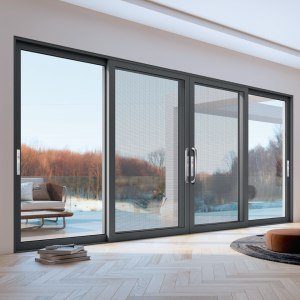
Wooden patio doors are exterior doors providing access to patios, gardens, or balconies. They come in several configurations, each suited to different architectural contexts.
Types of Wooden Patio Doors
| Type | Configuration | Best For | Space Consideration |
|---|---|---|---|
| Sliding | Panels glide horizontally on tracks | Narrow openings, balconies | Requires track space, no swing clearance |
| Hinged (French) | One or two doors swing inward/outward | Classic architecture, wide access | Needs swing clearance |
| Folding (Multi-panel) | Multiple panels fold to one side | Large terraces, indoor-outdoor flow | Requires track and stacking space |
| Lift-and-Slide | Heavy panels lift slightly before sliding | Large formats, high wind areas | Heavy hardware, needs structural support |
Where Wooden Patio Doors Are Used
Residential villas and single-family homes remain the largest segment. Wooden patio doors are also specified in:
- Hotels and resorts — aesthetics directly affect guest experience and rates
- Heritage renovations — building codes require matching original materials
- High-end commercial spaces — restaurants and retail with outdoor seating
- Coastal properties — wood-clad systems offer exterior durability with interior warmth
The key takeaway: wooden patio doors are a family of configurations, not a single product. Buyers should specify the exact opening style in their RFQ, as framing, hardware, and glass specifications differ significantly.
—
2. Are Wooden Patio Doors a Good Choice? Material Performance Analysis
Wooden patio doors deliver strong thermal and aesthetic performance, but suitability depends on wood species, finish quality, and climate.
2.1 Thermal Insulation and Energy Efficiency
Solid wood has a naturally low thermal conductivity — approximately 0.12–0.15 W/m·K — compared to aluminum at 205 W/m·K. Wood frames reduce thermal bridging at the door perimeter.
Modern energy performance depends more on glazing than the frame. Double-glazed units with low-E coatings and argon filling achieve U-values between 1.0 and 1.5 W/m²·K for the complete assembly. Triple glazing can push this to 0.7–0.9 W/m²·K. Buyers should request the complete door’s U-value, not just the glass specification.
2.2 Durability, Maintenance, and Lifespan
Wood species vary significantly in natural durability:
- Oak — High density, naturally rot-resistant, 50+ year lifespan with proper maintenance
- Mahogany — Excellent dimensional stability, resistant to swelling and warping
- Meranti — Cost-effective, moderate durability, common in tropical climates
- Pine — Softwood, lower cost, requires more frequent refinishing
The main concern is moisture. Wood expands and contracts with humidity, causing warping, cracking, or seal failure. Factory-applied finishes — typically multiple coats of marine-grade varnish — mitigate this. End-grain sealing quality determines whether the door performs for decades or fails within years.
For coastal environments, consider wood-clad systems with aluminum exteriors, combining interior wood aesthetics with exterior protection against salt, UV, and moisture.
2.3 Aesthetic and Architectural Value
Wood remains the preferred material where visual warmth and architectural authenticity matter. Unlike uPVC or aluminum, wood can be milled, carved, and finished to match specific designs — from minimalist Scandinavian to ornate traditional paneling. No other material offers the same range of grain patterns and textures.
—
3. What Is the Average Cost of a New Wooden Patio Door? Price Benchmarking
Factory-direct pricing for standard wooden sliding patio doors typically ranges from $400 to $1,200 per unit. Custom configurations, premium species, and high-end hardware push higher.
3.1 Price Ranges by Configuration
| Configuration | Price Range (Factory-Direct) | Notes |
|---|---|---|
| Standard sliding door (2 panels, 1800mm) | $400–$700 | Meranti or pine, double glazing, standard hardware |
| French hinged door (2 panels) | $500–$900 | Oak or mahogany, decorative glass options |
| Lift-and-slide door (large format) | $900–$1,800 | Heavy-duty hardware, structural reinforcement |
| Multi-panel folding door (4–6 panels) | $1,500–$3,500 | Complex hardware, larger glass areas |
| Custom oversized or wood-clad systems | $2,000+ | Aluminum exterior, specialized engineering |
3.2 Why Factory-Direct Pricing Matters for B2B Buyers
The price structure follows a predictable pattern:
- Manufacturer cost — raw materials, labor, overhead, factory margin
- Distributor markup — typically 15–30% above factory price
- Retailer markup — typically 30–50% above distributor price
For a door costing $500 at the factory, the end consumer might pay $900–$1,100 through retail. B2B buyers sourcing directly eliminate two markup layers. Project-based purchasing — where volumes justify container shipments — almost always favors direct factory sourcing.
3.3 Cost Drivers: Customization, Hardware, and Glazing
The biggest cost variables in a quote:
- Wood species — Oak and mahogany cost 40–80% more than meranti or pine
- Glass specification — Tempered, laminated, low-E, and argon-filled units add $50–$200 per door
- Hardware grade — Multi-point locking, concealed hinges, branded hardware (Roto, Hoppe, GU) add $80–$250
- Finish quality — Factory-applied multi-coat finishes cost more than a single primer coat
- Custom sizing — Non-standard dimensions require additional engineering
—
4. What Is the Best Material for a Patio Door? Comparative Procurement Guide
There is no universally “best” material. The right choice depends on climate, budget, and aesthetics.
4.1 Wood vs. uPVC vs. Aluminum vs. Composite — Comparison
| Property | Wood | uPVC | Aluminum | Wood-Clad (Alu-Exterior) |
|---|---|---|---|---|
| Thermal insulation | Excellent (0.12–0.15 W/m·K) | Good | Poor (thermal break required) | Excellent (wood interior + insulated aluminum) |
| Structural strength | High | Moderate | Very high | High |
| Aesthetic flexibility | Excellent — millable, paintable | Limited color options | Powder-coated colors only | Wood interior, any exterior color |
| Maintenance | Moderate — refinish every 3–7 years | Low | Low | Low exterior, wood interior maintenance |
| Cost (factory-direct) | $400–$1,200 | $200–$500 | $300–$800 | $800–$2,000 |
| Lifespan | 50+ years (proper care) | 20–30 years | 30–50 years | 40–60 years |
4.2 When to Choose Solid Wood vs. Wood-Clad Systems
Choose solid wood when:
- The door is in a climate-controlled environment
- The project requires authentic wood on both interior and exterior
- The building style demands traditional materials (heritage, luxury residential)
- The buyer accepts refinishing every 3–7 years
Choose wood-clad (aluminum exterior) when:
- The door faces coastal or extreme weather
- Exterior maintenance access is difficult
- The project requires specific exterior color matching
- Building codes demand higher wind load resistance than solid wood provides
4.3 Matching Material Choice to Project Type
- Luxury villas — Solid hardwood, preferably oak or mahogany, with premium hardware
- Hotels and resorts — Wood-clad systems balance durability with guest-facing aesthetics
- Commercial offices — Aluminum or wood-clad, depending on architectural style
- Renovation projects — Match existing wood species and profiles where possible
—
5. Patio Door vs. Sliding Door: Understanding the Structural Difference
These terms are often used interchangeably, but they mean different things in product specifications. This confusion leads to misquoted RFQs and wrong deliveries.
5.1 Definitions
A sliding door is a specific configuration where panels slide horizontally on tracks. A patio door is a broader category including sliding, hinged French, and folding doors — any door opening to an outdoor space.
5.2 Operational Differences and Space Requirements
Sliding doors save space — no swing clearance needed — ideal for narrow openings. Hinged French doors provide a wider opening and classic look but require swing clearance. Folding doors maximize opening width — best for large terraces where merging indoor and outdoor spaces is the goal.
5.3 How This Affects Your RFQ
When drafting an RFQ, specify:
- Opening type — sliding, hinged, or folding
- Panel count and dimensions — exact width and height per panel
- Track system — top-hung or floor-mounted
- Load-bearing requirements — for large or heavy panels
- Wind load rating — especially for coastal or high-rise projects
- Local building code compliance — some jurisdictions require specific U-values or air-tightness levels
—
6. Key Technical Specifications to Look For
Buyers who understand the technical parameters behind a quote are better positioned to compare suppliers and negotiate.
6.1 Core Structure and Glazing Standards
Frame depth is a primary structural indicator. Common profiles are 68mm, 80mm, and 92mm. Deeper frames accommodate thicker glazing and provide better rigidity — important for large panels or high wind areas.
Glazing options and typical specifications:
- Double glazing — Two panes with 12–16mm air gap, U-value 1.1–1.4 W/m²·K
- Triple glazing — Three panes with argon fill, U-value 0.7–1.0 W/m²·K
- Low-E coating — Reflects heat back into the room, reduces heat loss by 30–50%
- Laminated glass — Safety glass that holds together when shattered
- Tempered glass — Heat-treated for strength, required in many jurisdictions
6.2 Hardware and Fittings
Hardware quality often determines long-term performance more than the wood. Multi-point locking systems (typically 5–8 points) distribute locking force along the door height, improving security and weather sealing. Lift-and-slide mechanisms use rollers that lift the panel before sliding, reducing effort for heavy doors. Stainless steel tracks and concealed hinges resist corrosion.
6.3 Weather Performance Standards
European standards EN 12207, EN 12208, and EN 12210 define performance levels for air-tightness, water-tightness, and wind load resistance. Equivalent ASTM standards apply in North America.
| Standard | What It Measures | Performance Classes |
|---|---|---|
| EN 12207 | Air permeability | Class 1–4 (higher = better) |
| EN 12208 | Water-tightness | Class 1–9 (higher = better) |
| EN 12210 | Wind load resistance | Class A1–E5 (higher = better) |
Buyers should request test reports for the specific door model — not generic “our factory meets these standards” statements.
—
7. How to Evaluate Wooden Patio Doors Suppliers: A Sourcing Framework
7.1 Step 1: Define Your Technical and Commercial Requirements
Before contacting suppliers, create a detailed spec sheet:
- Dimensions — exact width, height, and panel configuration
- Wood species — specify species and grade
- Finish — color, gloss level, application method
- Glass — type, thickness, coatings, U-value target
- Hardware — brand, finish, security features
- Test standards — required performance classes
- Packaging — export-grade requirements
- MOQ — minimum order quantity you can commit to
- Target price band — based on market research
7.2 Step 2: Evaluate Factory Capabilities
Ask every shortlisted supplier:
- Do you have in-house production? — Outsourced components mean less quality control
- Can you customize sizes, colors, and hardware? — Standard-only suppliers cannot serve project-specific needs
- What is your pre-shipment inspection process? — Documented inspections are non-negotiable
- Can you provide test reports? — For the specific model, not generic claims
- What is your production capacity? — Determines whether they can handle your volume and timeline
Red flags to watch for:
- No test reports available — the product has not been tested
- Unclear lead times — vague promises indicate poor planning
- No customization options — limits project flexibility
- No export experience — expect customs documentation problems
7.3 Step 3: Understand Logistics and Documentation
Overseas sourcing requires specific documentation:
- Packing list — itemized contents of each package
- Proforma invoice — commercial invoice for customs declaration
- Bill of lading — shipping contract between shipper and carrier
- Certificate of origin — required for tariff assessment
- Customs declarations — export documentation from the factory’s country
FCL (Full Container Load) is cost-effective for large orders — 20-foot containers hold 60–80 doors, 40-foot containers hold 120–160. LCL (Less than Container Load) suits smaller initial orders but carries higher per-unit costs.
7.4 Step 4: Plan for Compliance with Local Building Codes
Building codes vary by country and region. A door meeting European EN standards may not comply with North American ASTM or Australian AS requirements. Reliable suppliers should adjust profiles, fittings, and glazing to match your target market’s codes. Ask this question directly during evaluation.
—
8. Production Process: From Raw Material to Finished Doors
8.1 Material Selection and Conditioning
The process begins with kiln-dried lumber, conditioned to 8–12% moisture content. Wood that is too wet will warp and crack after installation. Reputable factories measure and record moisture content for every batch.
8.2 Machining and Assembly
CNC machines cut frame components to precise dimensions — typically within ±0.5mm tolerance. The assembly process:
- Frame construction — joining stiles and rails with mortise-and-tenon or dowel joints
- Glue-up — applying waterproof adhesives (D4 class or higher) to all joints
- Sanding — progressive from coarse to fine grit (P80 to P180)
- Finish application — multiple coats of primer, paint, or varnish with sanding between coats
8.3 Glazing and Hardware Installation
Glass units are installed with structural sealants and glazing beads, then hardware — hinges, locks, handles, tracks — is fitted. Every door undergoes functional testing: opened, closed, and locked to verify alignment.
—
9. Quality Control: What to Verify Before Shipment
Pre-shipment inspection is the final quality gate:
| Inspection Point | What to Check | Passing Criteria |
|---|---|---|
| Dimensional accuracy | Width, height, diagonal | Within ±2mm of spec |
| Surface finish | Scratches, dents, finish uniformity | No visible defects |
| Hardware function | Locking, sliding, hinging | Smooth operation without binding |
| Glazing seal | No gaps, no condensation inside | Airtight seal |
| Weather performance | Air-tightness, water-tightness | Meets agreed test class |
| Packaging | Export-grade protection | No damage risk during transit |
Buyers should request photos or video of the inspection, and ideally arrange third-party inspection (SGS, Bureau Veritas) for large orders.
—
10. Customization and OEM/ODM Options
B2B buyers rarely need standard, off-the-shelf products. Customization is a core requirement for most projects.
10.1 What Can Be Customized
- Dimensions — any size within production capability
- Wood species — from available or buyer-specified species
- Finish — custom colors matched to RAL, NCS, or Pantone
- Glass — type, thickness, coatings, decorative options
- Hardware — brand, finish, security configuration
- Profile design — custom milling for specific architectural styles
10.2 OEM vs. ODM vs. Private Label
- OEM (Original Equipment Manufacturing) — Buyer provides design and specifications; factory manufactures to those specs. Best for established brands with their own designs.
- ODM (Original Design Manufacturing) — Factory provides design and engineering support, then manufactures. Best for importers without in-house R&D.
- Private Label — Factory manufactures a standard or custom product with the buyer’s branding. Best for companies building their own brand without manufacturing infrastructure.
—
11. Ordering Process: MOQ, Lead Time, and Shipping
11.1 MOQ (Minimum Order Quantity)
MOQs vary by factory — some require 10–20 units minimum, others are more flexible. Discuss MOQ and staged delivery options early. LCL shipping can reduce initial order commitments — often the right approach for first-time orders to evaluate quality before committing to full container loads.
11.2 Lead Time
| Order Type | Lead Time |
|---|---|
| Standard sizes, standard finish | 15–25 days |
| Custom sizes, standard finish | 25–35 days |
| Custom sizes, custom finish, premium hardware | 35–50 days |
| Large volume (100+ units) | 45–60 days (staged delivery possible) |
These times assume material is in stock. During peak seasons, lead times can extend by 1–2 weeks. Always confirm current lead times before ordering.
11.3 Shipping Options
- FCL (Full Container Load) — Most cost-effective for large orders. A 20-foot container holds 60–80 doors; a 40-foot container holds 120–160.
- LCL (Less than Container Load) — Suitable for smaller orders. Higher per-unit shipping costs and often longer transit times due to consolidation.
—
12. What to Expect from a Reliable Wooden Patio Door Manufacturer
12.1 Direct Factory Supply and Transparent Pricing
As a manufacturing company, we operate on a direct-supply model. Our pricing reflects factory cost structures — raw materials, labor, overhead — without distributor or retailer layers. When you request a quote, you receive a breakdown reflecting actual production costs, not a reseller’s markup.
12.2 Full Customization and Flexible OEM/ODM Support
We offer full customization across our wooden patio door range — dimensions, species, finishes, glass, and hardware. We support OEM and ODM projects, including private label branding. Our adjustable profile structures can be adapted to match your target market’s building codes.
12.3 Pre-Shipment Quality Control
Every order undergoes strict pre-shipment inspection covering air-tightness, water-tightness, and wind resistance. This is standard workflow, not a spot-check. The inspection covers dimensional verification, hardware function testing, and finish quality. You receive inspection records with your shipment documentation.
12.4 Export Documentation and Logistics
With years of foreign trade experience, we provide complete export documentation — packing lists, proforma invoices, customs paperwork. We ship via FCL and LCL from our factory in China. For new importers, we walk you through documentation requirements for your destination country.
—
Frequently Asked Questions
Are wooden patio doors good?
Yes — wooden patio doors offer superior thermal insulation, natural aesthetics, and long-term durability when properly manufactured and finished. They outperform uPVC and aluminum in visual appeal and thermal comfort, though they require more maintenance than aluminum-clad alternatives. For premium residential and hospitality projects, wood remains the preferred choice.
What is the average cost of a new wooden patio door?
For B2B buyers, factory-direct pricing for standard wooden sliding patio doors ranges from $400 to $1,200 per unit, depending on wood species, glass, hardware, and size. Custom oversized or folding configurations run higher. These figures assume direct factory sourcing — distributor and retail markups can add 30–50% or more.
What material is best for a patio door?
There is no single “best” material — it depends on climate, aesthetics, and budget. Solid wood offers the best aesthetics and natural insulation. Wood-clad (aluminum exterior) offers durability with a wood interior. uPVC is most budget-friendly but lacks structural strength and visual appeal. For premium projects, wood or wood-clad is recommended.
What’s the difference between a patio door and a sliding door?
A sliding door is a specific configuration — panels that slide horizontally on tracks. A patio door is a broader category including sliding, hinged (French), and folding doors that open to an outdoor space. In RFQs, be specific about the configuration, as it affects framing, hardware, and pricing.
How do I choose a reliable wooden patio door supplier?
Look for: (1) in-house manufacturing, (2) documented pre-shipment testing (air-tightness, water-tightness, wind resistance), (3) full customization options, (4) export documentation experience, and (5) flexible shipping (FCL/LCL). Request test reports and references before committing.
Can I customize the size, color, and hardware of wooden patio doors?
Yes — reputable manufacturers offer full customization on dimensions, wood species, finishes, glass types, and hardware. For B2B buyers, this is a standard expectation, not a premium. Always confirm customization flexibility before placing a bulk order.
What is the typical MOQ for factory-direct wooden patio doors?
MOQs vary by manufacturer. Some require 10–20 units minimum; others are more flexible. Discuss MOQ and staged delivery options early. LCL shipping can also help reduce initial order commitments.
—
Decision Guide
Choose a factory-direct supplier if:
- Your order volume justifies container shipping (20+ units)
- You need customization that retail channels cannot provide
- You want pricing reflecting actual manufacturing costs
- You require documented quality control and test reports
Choose a local distributor if:
- Your order volume is very small (1–5 units)
- You need immediate delivery
- You require in-person product inspection before purchase
- Your project timeline cannot accommodate overseas shipping
—
The best time to evaluate a supplier is before you need them. When a project timeline tightens, there is no room to test a new factory’s quality control or documentation reliability. Start the conversation early, request test reports, and verify customization capabilities against your project’s specific requirements.
—
References
- EN 12207:2016 — Windows and doors. Air permeability. Classification. https://www.en-standard.eu/
- EN 12208:2000 — Windows and doors. Water-tightness. Classification. https://www.en-standard.eu/
- EN 12210:2016 — Windows and doors. Wind load resistance. Classification. https://www.en-standard.eu/
- American Architectural Manufacturers Association (AAMA) — Window and Door Testing Standards. https://www.aamanet.org/
- Wood Products Council — Wood Structural Design Data. https://www.woodworks.org/
- Forest Products Laboratory, USDA — Wood Handbook: Wood as an Engineering Material. https://www.fpl.fs.usda.gov/