Content Menu
● 1. Understanding Wooden Patio Door Types and Applications
● 2. Wooden Patio Door Quality and Performance Factors
● 3. How to Evaluate Wooden Patio Door Suppliers
● 4. Key Quality Indicators for Wooden Patio Door Buyers
● 5. Relevant Industry Standards and Certifications
● 6. Production Process: From Raw Material to Finished Door
● 7. Quality Control: Our Multi-Stage Inspection Process
● 8. Customization and OEM/ODM Options
● 9. Ordering Process: MOQ, Lead Time, and Shipping
● 10. Certifications and Industry Standards
12 min read
A project manager in Rotterdam once showed me a photo of a warped patio door that arrived from a supplier in Southeast Asia. The frame had twisted 12 millimeters in transit—the timber had not been properly kiln-dried before fabrication. That mistake cost the developer three weeks of schedule delay and a replacement order that ate the entire margin.
That story summarizes the core challenge of sourcing wooden patio doors. The product looks simple, but the difference between a door that performs for twenty years and one that fails in twenty months comes down to material science, machining tolerance, and quality control protocols that most buyers never see.
This guide covers the technical specifications that matter, the cost drivers behind pricing, and a practical framework for vetting suppliers before you commit a container order.
Understanding Wooden Patio Door Types and Applications
A wooden patio door is a large-format door system, typically 1.5 to 2.4 meters wide, designed for access between interior living spaces and exterior areas like gardens or balconies. The defining characteristic is the timber construction, which provides natural insulation and aesthetic warmth that aluminum and uPVC cannot replicate.
Hinged Patio Doors (French Doors)
Hinged doors swing open on side-mounted hinges. They come in single or double configurations. The double version, often called French doors, offers a fully unobstructed opening when both panels swing outward.
Key specifications for hinged units:
- Panel thickness: typically 68 to 78 mm for exterior-grade doors
- Maximum panel width: 900 to 1100 mm per leaf
- Maximum panel height: up to 2700 mm without additional reinforcement
- Hinge type: 3D-adjustable stainless steel with load ratings of 100 to 150 kg per hinge
The main advantage is the ability to open 100% of the aperture. The drawback is the swing clearance required.
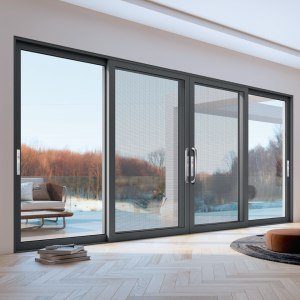
Sliding Patio Doors
Sliding doors move horizontally on tracks. The panels do not swing, which makes them ideal for tight interior spaces. However, only half the total width opens at any given time.
Technical parameters for sliding units:
- Panel thickness: 68 to 92 mm for thermally broken timber profiles
- Track system: aluminum with stainless steel rollers rated for 150 kg per wheel
- Maximum panel size: 1200 mm width by 2700 mm height
- Number of tracks: 2 or 3 depending on panel count
Sliding systems require precise track alignment. A deviation of even 2 millimeters can cause premature roller wear. Buyers should specify track systems from established European hardware manufacturers like Roto or Siegenia.
Multi-Panel Stacking Systems
Stacking systems combine sliding panels that park behind each other, creating a wider opening. Configurations range from 2 to 7 panels. These are popular in commercial settings like restaurants and hotels.
The structural challenge is weight distribution. A 3-meter-tall timber panel can weigh 80 to 120 kg depending on wood species and glazing. Industry practice limits panel weight to 150 kg per wheel for smooth operation.
Folding (Bi-Fold) Systems
Bi-fold doors fold like an accordion, stacking panels at one or both ends. They provide the widest possible opening among all configurations.
Hardware requirements are demanding. Top-hung tracks must support the full panel weight, and stainless steel hinges must prevent sagging. The mechanical complexity makes bi-fold systems the most expensive configuration per square meter.
Wooden Patio Door Quality and Performance Factors
Material Selection: Timber Species and Engineering
The wood species determines the door’s dimensional stability, durability, and cost. Common choices for exterior-grade patio doors:
| Species | Density (kg/m³) | Stability | Durability Class | Relative Cost |
|---|---|---|---|---|
| Oak | 700-800 | High | Class 2 (durable) | High |
| Meranti | 550-650 | Moderate | Class 3-4 | Medium |
| Mahogany | 600-700 | High | Class 2 | High |
| Larch | 550-650 | Moderate | Class 3-4 | Medium |
| Thermally Modified Ash | 650-700 | Very High | Class 1-2 | High |
Engineered timber, such as laminated veneer lumber (LVL) or glued laminated timber (glulam), reduces expansion and contraction rates by up to 75% compared to solid timber. This is critical for large panels exposed to temperature and humidity differentials.
Glazing: The Performance Bottleneck
Glass accounts for 70 to 80% of a patio door’s surface area. This means the glazing specification determines overall thermal performance more than the timber frame.
Standard glazing options:
- Double glazing: 4mm glass / 16mm argon gap / 4mm glass — U-value around 1.1 W/m²K
- Triple glazing: 4/12/4/12/4 configuration — U-value around 0.6 to 0.8 W/m²K
- Low-E coating: applied to the inner surface of the outer pane to reflect heat
- Tempered glass: 4x stronger than annealed glass, required for safety in door applications
Buyers should verify that the glass carries appropriate certification marks (e.g., CE marking per EN 12150) and that glazing units have proper edge sealing to prevent condensation between panes.
Hardware: The Silent Failure Point
Hardware failures account for the majority of warranty claims on patio doors. The critical components are:
- Rollers for sliding doors: stainless steel with ball bearings
- Hinges for swinging doors: 3D-adjustable with corrosion-resistant coating
- Multi-point locking systems: engage at 3 to 5 points along the panel edge
- Weatherstripping: EPDM rubber with minimum compression set resistance
The hardware specification should match the panel weight. A 100 kg panel requires hinges rated for at least 150 kg total load. Undersized hardware leads to sagging, binding, and eventual failure.
How to Evaluate Wooden Patio Door Suppliers
The Audit Checklist
Before placing an order, verify these five areas:
- Kiln-drying capacity. Ask what moisture content the timber is dried to before machining. The industry standard is 12% ± 2%. Suppliers who skip proper kiln-drying produce doors that warp after installation.
- Machining equipment. CNC machining centers produce consistent joinery tolerances. Manual machining introduces human error. Ask for photos or videos of the production floor.
- Glass sourcing. Verify that the supplier uses certified glass manufacturers. Ask for the glass supplier’s name and certification numbers.
- Hardware partnerships. Established hardware brands (Roto, Siegenia, GU) have distribution networks that prevent counterfeiting. Ask for proof of purchase or partnership agreements.
- Test documentation. Request air-tightness, water-tightness, and wind load test reports for the specific product line you are considering.
Red Flags to Avoid
- Unwillingness to share test reports. If the supplier deflects or sends generic marketing brochures instead of test data, walk away.
- Suspiciously low pricing. If a quote is 40% below the market average, it could mean lower-grade timber, thinner glass, or substandard hardware.
- No physical factory visit allowed. Reputable manufacturers welcome visits. Evasiveness suggests something to hide.
- Vague lead times. A factory with real production capacity can state precise lead times. Vague answers suggest the supplier is a trading company brokering orders.
Questions to Ask Before Ordering
- What is the moisture content of the timber at the time of shipment?
- What is the U-value of the complete door system, not just the glass?
- Can you provide a video of the water-tightness test on this specific model?
- What is your defect rate on the last 500 units shipped?
- What is your policy for replacement parts on warranty claims?
- Can you provide references from buyers in similar climate zones?
Key Quality Indicators for Wooden Patio Door Buyers
Air-Tightness
Measured in cubic meters per hour per square meter (m³/h/m²) at a standard pressure differential of 50 Pa. The European standard EN 12207 defines classes from 1 (lowest) to 4 (highest). For patio doors in residential applications, Class 3 or higher is recommended. Class 4 is optimal for passive house projects.
Water-Tightness
Tested by spraying water at increasing pressure levels. The European standard EN 12208 defines classes from 1A to 9A. Class 7A or higher (tested at 450 Pa) is recommended for exposed locations. For coastal areas with high wind-driven rain, Class 9A (600 Pa) is advisable.
Wind Load Resistance
Per EN 12210, wind load classes range from A1 to C5 based on the maximum test pressure the frame can withstand without permanent deformation. A rating of C3 (up to 1600 Pa) is typical for low-rise residential. High-rise applications may require C5 (up to 2000 Pa).
The Verification Method
Ask the supplier to send the test report from a recognized laboratory. In the EU, this would be an accredited testing body operating under ISO/IEC 17025. The report should list the specific product model, dimensions tested, and results for each performance category.
Relevant Industry Standards and Certifications
The two primary standards frameworks for wooden patio doors are:
European: EN 14351-1 — This harmonized standard covers windows and pedestrian doorsets. It includes requirements for air permeability, water tightness, wind load resistance, thermal transmittance, and acoustic performance. Doors bearing the CE mark under this standard have been tested for these characteristics.
North American: AAMA/WDMA/CSA 101/I.S.2/A440 — This standard establishes performance classes for windows, doors, and skylights. It covers air leakage, water penetration, structural load, and forced entry resistance.
Additional certifications to look for:
- ISO 9001:2015 — Quality management system certification. A baseline indicator of manufacturing consistency.
- FSC (Forest Stewardship Council) certification — Verifies that timber comes from responsibly managed forests. Increasingly required for green building certifications like LEED.
- PEFC (Programme for the Endorsement of Forest Certification) — An alternative sustainable forestry certification.
For projects in hurricane-prone regions, additional testing per ASTM E330 (structural performance) and ASTM E547 (water penetration) may be required.
Production Process: From Raw Material to Finished Door
Step 1: Timber Selection and Kiln-Drying
Raw lumber arrives at the factory with a moisture content of 30% or higher. It is stacked with stickers between boards and placed in kilns. The drying process takes 2 to 4 weeks, gradually reducing moisture to the target level of 12% ± 2%.
Step 2: Defect Cutting and Finger-Jointing
After drying, the timber passes through a scanner that detects knots, cracks, and color variations. Defective sections are cut out. The remaining pieces are finger-jointed under pressure, producing structural timber with better dimensional stability than solid pieces.
Step 3: CNC Machining of Profiles
The engineered timber is fed through CNC machining centers that cut profiles, mill drainage channels, and drill hardware mounting holes. Tolerances are held to ±0.3 millimeters.
Step 4: Frame Assembly and Glazing
The frame pieces are joined using double-dowel construction with waterproof adhesive. After assembly, the glazing unit is installed with setting blocks and sealed with structural silicone.
Step 5: Surface Finishing
The assembled door receives 3 to 5 coats of UV-resistant varnish or water-based stain, applied in controlled environments with sanding between each coat.
Step 6: Hardware Installation and Adjustment
Multi-point locks, hinges, and weatherstripping are installed. Each door is adjusted to ensure the panels meet the frame evenly.
Step 7: Final Inspection and Packaging
Doors are inspected for surface defects, hardware function, and dimensional accuracy. They are then wrapped in protective film and packed in reinforced cartons with edge protectors for export shipping.
Quality Control: Our Multi-Stage Inspection Process
Many suppliers perform a simple visual inspection before shipping. The buyer discovers performance issues only after installation. As a manufacturer, our approach addresses this gap. Every batch of wooden patio doors undergoes a three-stage inspection protocol before leaving our plant.
Stage 1: Incoming Material Verification. We test the moisture content of the timber upon receipt. Timber exceeding 14% moisture is rejected. Glass units are checked for certification marks and edge seal integrity.
Stage 2: In-Process Quality Checks. During CNC machining, every 20th piece is measured against CAD specifications. After assembly, each door is tested for squareness and twist. A door that deviates more than 2 millimeters from square is reworked.
Stage 3: Pre-Shipment Performance Testing. We run air-tightness, water-tightness, and wind resistance tests on sample units from each production batch, per EN 12207, EN 12208, and EN 12210. Results are documented and provided to the buyer.
This process is not unique, but it is not universal either. Buyers should ask potential suppliers to describe their inspection protocol in detail. Vague answers focused only on visual checks signal to keep looking.
Customization and OEM/ODM Options
The Customization Landscape
Wooden patio doors are rarely an off-the-shelf product. Each project has unique dimensions, aesthetic requirements, and performance targets. The question is not whether customization is possible, but how much it costs and how long it takes.
OEM Production (Private Label)
For importers and distributors building their own brand, OEM production means the factory manufactures doors to your specifications and packages them under your brand name. This includes your logo on hardware and packaging, your model numbers, and your warranty terms. The requirement is that you provide detailed specifications or work with the factory’s engineering team.
ODM Production (Design and Manufacturing)
ODM means the factory provides the design. You select from existing models, customize dimensions and finish, and the factory handles production engineering. This is faster than OEM because the product design is already validated.
How Our Factory Handles Customization
We manufacture doors to order rather than for stock. Every unit is fabricated to the specific dimensions of your project. Our CNC machining center handles non-standard sizes without surcharge—a door that is 2100 mm wide instead of the standard 2000 mm does not trigger re-tooling costs.
For projects in markets with specific building codes, our profile structure and fittings are adjustable. A project in Florida with high wind loads receives a different structural specification than a project in Canada with extreme cold.
Ordering Process: MOQ, Lead Time, and Shipping
Minimum Order Quantity (MOQ)
Flexible suppliers offer trial orders of 10 to 20 units for new clients. Container orders start at approximately 60 to 80 units per 40-foot high cube container, depending on door dimensions and glazing.
Our MOQ for a trial order is 10 units. This allows buyers to evaluate product quality before committing to a full container. After the trial order, we agree on volume pricing based on annual quantity projections.
Lead Times
Production lead time for a custom wooden patio door order is typically 3 to 4 weeks from approval of samples and order confirmation, assuming specifications are finalized and timber is in stock.
Factors that extend lead times:
- Non-standard timber species that must be sourced
- Special glass configurations (e.g., triple glazing with obscure patterns)
- Custom hardware requiring ordering from European suppliers
We provide a production schedule with order confirmation and weekly progress updates with photos.
Shipping and Logistics
We ship both FCL (Full Container Load) and LCL (Less than Container Load). For LCL shipments, we consolidate multiple orders to fill a container and share freight costs—a cost-effective option for trial orders.
Every shipment includes:
- Packing list with itemized contents
- Proforma invoice for customs clearance
- Bill of lading
- Certificate of origin (if required)
Our export documentation team has processed shipments to Europe, North America, Australia, and the Middle East.
Certifications and Industry Standards
Our manufacturing facility operates under ISO 9001:2015 quality management certification. Our products are designed and tested to meet the performance requirements of EN 14351-1 and AAMA/WDMA/CSA 101/I.S.2/A440. Specific test reports are available upon request.
We also maintain FSC chain-of-custody certification for our timber sourcing, providing documentation that the wood comes from responsibly managed forests—essential for projects pursuing LEED or BREEAM certification.
Choosing the Right Partner: A Decision Guide
Choose a factory-direct manufacturer if:
- Your order volume justifies the container quantity (60+ units)
- You need custom sizes or specifications that trading companies cannot accommodate
- You want to eliminate the middleman markup
- You require direct communication with the production team
Choose a trading company if:
- Your order is small (under 10 units) and you need a wide variety of products
- You are testing a market and want to avoid the commitment of a factory relationship
- You need sourcing across multiple product categories
Choose an ODM partnership if:
- You are a developer with a specific aesthetic vision
- You do not have in-house design engineering capacity
- You want validated designs with proven performance
Choose an OEM partnership if:
- You are building a distribution brand
- You have detailed specifications and want manufacturing control
- You need private label branding
The honest caveat: factory-direct sourcing requires more upfront due diligence. You are responsible for verifying the factory’s claims. The trade-off is a significantly better price and direct control over your supply chain.
References
- EN 14351-1:2006+A2:2016 — Windows and doors — Product standard, performance characteristics. European Committee for Standardization.
- AAMA/WDMA/CSA 101/I.S.2/A440-17 — North American Fenestration Standard. American Architectural Manufacturers Association.
- EN 12207 — Windows and doors — Air permeability — Classification. European Committee for Standardization.
- EN 12208 — Windows and doors — Water tightness — Classification. European Committee for Standardization.
- EN 12210 — Windows and doors — Wind load resistance — Classification. European Committee for Standardization.
- ISO 9001:2015 — Quality management systems — Requirements. International Organization for Standardization.
- Forest Stewardship Council (FSC) — Chain of Custody Certification. https://fsc.org/en/chain-of-custody-certification
- EN 12150-1:2015 — Glass in building — Thermally toughened soda lime silicate safety glass. European Committee for Standardization.
—
Ready to discuss your project specifications? Contact our team for a detailed quote and production timeline.