Content Menu
● 1. Understanding Wooden Front Doors with Glass: Types and Applications
● 2. Quality and Performance Factors: What Determines a Door’s Lifespan
● 3. How to Evaluate Wooden Front Doors with Glass Suppliers
● 4. Key Quality Indicators for Buyers
● 5. Relevant Industry Standards and Certifications
● 6. Production Process: From Raw Material to Finished Door
● 7. Customization and OEM/ODM Options
● 8. Ordering Process: MOQ, Lead Time, and Shipping
● 9. Quality Control: Multi-Stage Inspection Process
● 10. Client Cases and Application Scenarios
● 11. Questions to Ask Before Ordering
16 min read
When an overseas buyer places their first container order for wooden front doors with glass, the question they ask is rarely about price. It is about whether the factory can replicate the sample quality at scale. The gap between a showroom prototype and a production run of 200 units is where most procurement relationships fail.
Wooden front doors with glass occupy a specific niche in the building materials market. They are not commodity items like pine interior doors, nor are they fully bespoke architectural pieces. They sit in the middle — specified by architects for curb appeal, ordered by contractors in batches, and sourced by distributors who need consistent quality across multiple projects. For B2B buyers, the challenge is less about finding a product and more about building a supply chain that delivers predictable results.
This guide breaks down what procurement professionals need to evaluate before committing to a supplier: wood construction methods, glass specifications, hardware standards, testing protocols, and the practical logistics of importing from overseas manufacturers.
Understanding Wooden Front Doors with Glass: Types and Applications
Wooden front doors with glass are exterior entry doors constructed primarily from solid wood or engineered wood cores, featuring one or more glass panels for natural light transmission. They serve residential, light-commercial, and hospitality applications where visual appeal at the entrance matters as much as thermal performance.
Wood Species and Their Performance Characteristics
The wood species determines not only appearance but also dimensional stability, hardness, and resistance to warping. Common species used in exterior door manufacturing:
| Species | Janka Hardness | Dimensional Stability | Typical Finish |
|---|---|---|---|
| Mahogany (Sapele) | 1,410 lbf | High | Clear varnish, dark stain |
| White Oak | 1,360 lbf | High | Clear or light stain |
| Walnut | 1,010 lbf | Medium | Clear varnish, medium stain |
| Teak | 1,155 lbf | Very High | Natural oil finish |
| Pine (Finger-jointed) | 690 lbf | Low-Medium | Painted only |
Sapele mahogany is the most common choice for export-grade wooden front doors with glass because it combines the look of true mahogany at a lower cost, while offering better stability than softer species. For painted doors, finger-jointed pine is widely used because the joints are hidden under the paint film.
Glass Configurations
The glass layout defines the door’s architectural character and light transmission:
- Full-lite: One large glass panel occupying 80%+ of the door surface. Maximum light, modern aesthetic.
- Half-lite: Glass in the upper half, solid wood below. Balanced privacy and light.
- 6-lite or 9-lite: Multiple smaller panels divided by wood mullions. Traditional, craftsman, or farmhouse styles.
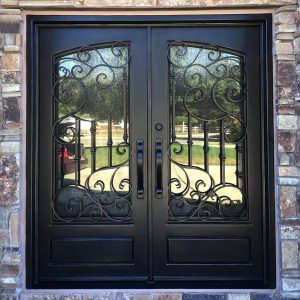
- Arched tops: Curved glass or frame profile above a rectangular lite. Classical and European styles.
- Sidelites and transoms: Separate fixed units flanking the door or above it, expanding the entry composition.
The market demand for each configuration varies by region. North American buyers favor 6-lite and full-lite designs. European projects often specify arched tops. Middle Eastern markets show strong preference for tall double doors with ornate glass patterns.
Application Segments
- Single-family residential: The largest segment. Buyers are typically distributors or contractors supplying builders.
- Villa and estate projects: Higher-end specifications, custom sizes, premium wood species, and decorative glass.
- Light commercial: Offices, clinics, boutique hotels. Requires compliance with local fire and accessibility codes.
- Renovation projects: Replacement doors must match existing openings, driving demand for custom dimensions.
Quality and Performance Factors: What Determines a Door’s Lifespan
A wooden front door with glass is a complex assembly. The wood, glass, seals, hardware, and finish must work together to withstand weather, temperature swings, and daily use. Failure in any component compromises the entire unit.
Wood Core Construction
Solid wood doors are milled from solid lumber. They offer the best acoustic performance and the most premium feel, but they are also the most susceptible to movement with humidity changes.
Engineered wood doors use a core of laminated or finger-jointed wood, with a veneer of the chosen species on the surface. The lamination process alternates grain directions, which dramatically reduces warping and splitting. Most export-grade doors sold internationally use engineered cores for this reason.
The moisture content of the wood at the time of manufacturing should be between 8% and 12%. Wood outside this range will continue to absorb or release moisture after installation, causing the door to swell, shrink, or crack. Kiln-dried lumber with documented moisture readings is the baseline for any serious manufacturer.
Joint Construction
The corners of a door frame and the joints where mullions meet the outer frame are structural weak points. Mortise-and-tenon joints with waterproof adhesive are the industry standard for quality doors. Dowel-reinforced or screw-reinforced joints are acceptable for lighter-duty interior applications, but exterior doors with glass need the strength of a proper mortise-and-tenon connection.
Glass Specifications
The glass is not just a transparent panel — it is a critical component of the door’s thermal and safety performance.
- Tempered glass: Heat-treated to be 4-5 times stronger than annealed glass. When it breaks, it crumbles into small, relatively harmless pieces. Required by building codes in most jurisdictions for door glazing.
- Laminated glass: Two or more glass layers bonded with a PVB interlayer. When broken, the glass stays in place. Provides security and sound insulation benefits.
- Insulated glass units (IGU): Two panes separated by a spacer, often filled with argon gas for better insulation. The U-factor of a door with double-glazed low-E glass can be 50% better than a single-glazed unit.
- Low-E coatings: Microscopically thin metallic layers that reflect infrared radiation while allowing visible light through. Reduces heat loss in winter and heat gain in summer.
The glazing method matters too. Wet glaze (silicone or butyl sealant applied over the glass edge) is simpler but less durable. Dry glaze uses a pre-formed gasket compressed around the glass — easier to replace and more weather-resistant.
Hardware and Seals
Entry door hardware must withstand high cycle counts. Ball-bearing hinges are rated for 100,000+ open/close cycles. Multi-point locking systems engage bolts at multiple points along the door edge, providing better security and a tighter seal than a single deadbolt.
Weatherstripping is the first line of defense against air and water infiltration. EPDM rubber and silicone are the preferred materials for their aging resistance. Magnetic weatherstripping creates a tighter seal than compression types, at a higher cost.
How to Evaluate Wooden Front Doors with Glass Suppliers
The supplier evaluation process is where procurement professionals earn their keep. A beautiful product catalog tells you nothing about the factory’s ability to deliver on time, meet specifications, and handle problems when they arise.
Manufacturing Capability Assessment
Before committing to a supplier, verify their production capacity. A factory producing 500 doors per month cannot handle a 300-unit order without disrupting other customers or cutting corners. Ask for:
- Monthly production capacity for the specific door type you need
- Current order backlog and delivery lead times
- Equipment list: CNC machining centers, edge banders, finishing lines, glass tempering or laminating lines (in-house vs. outsourced)
- Number of production shifts and skilled labor availability
Quality Control Systems
ISO 9001:2015 certification is a baseline indicator that the factory has documented quality management procedures. But certification alone is insufficient. Ask to see:
- In-process inspection checkpoints and what is checked at each one
- Final inspection criteria before packaging
- Test reports for air-tightness, water-tightness, and wind resistance (standards such as ASTM E283, E330, or EN 1026)
- How defective units are handled — repaired, replaced, or scrapped?
Customization Flexibility
B2B projects rarely involve entirely standard products. Verify the factory can:
- Produce custom dimensions without excessive surcharges or minimums
- Source and install specific glass types (low-E, laminated, impact-rated)
- Match hardware brands specified by your market (e.g., ASSA ABLOY, Schlage, or local brands)
- Adjust profile structures to comply with your target market’s building codes
Export Documentation Experience
A manufacturer that cannot produce correct export paperwork will cause delays at customs, storage fees, and potential legal issues. Confirm they provide:
- Packing lists with accurate weights and dimensions
- Proforma invoices for LC or TT payments
- Certificates of origin (for preferential tariff treatment)
- Compliance documentation for timber legality (FSC or equivalent)
Key Quality Indicators for Buyers
When evaluating a supplier, focus on measurable indicators rather than marketing claims.
Performance Test Reports
A credible supplier will have test reports from independent laboratories, not just their own internal testing. Key performance metrics:
- Air-tightness: Measured in m³/(h·m²) at a given pressure differential. Class 4 (highest per EN 12207) allows less than 0.75 m³/(h·m²) at 100 Pa.
- Water-tightness: Class 9A per EN 12208 means no water penetration at 600 Pa test pressure. Doors in exposed locations need this level.
- Wind resistance: Class C5 per EN 12210 or equivalent, indicating capability to withstand significant wind loads.
Finish Quality
The finish determines both appearance and longevity. A quality factory will have:
- Multi-stage coating processes: primer, intermediate, and topcoat with UV-resistant finishes
- Controlled drying environments to prevent dust contamination
- Documentation of coating thickness and adhesion test results
Glass Certification
Glass components should carry appropriate safety certifications. In North America, look for SGCC certification for tempered glass. In Europe, CE marking under EN 12150 (tempered) or EN 12543 (laminated) is required. Impact-rated glass for hurricane zones must meet ASTM E1996 or equivalent.
Relevant Industry Standards and Certifications
International buyers should verify compliance with the following standards when sourcing wooden front doors with glass:
- ISO 9001:2015: Quality management systems — the baseline for any serious manufacturer
- EN 14351-1: European standard for windows and doors — includes performance requirements for air permeability, water tightness, wind load resistance, thermal transmittance, and more
- ASTM E283 / E330 / E547: American test methods for air leakage, structural performance, and water penetration
- WDMA Hallmark Certification: North American certification program for wood doors
- FSC Chain of Custody: Ensures wood is sourced from responsibly managed forests — increasingly required for government and institutional projects
- CE Marking: Required for construction products sold in the European Economic Area
A supplier that can provide test reports and certifications for these standards demonstrates that their products have been verified by independent bodies, not just self-declared.
Production Process: From Raw Material to Finished Door
Understanding the manufacturing process helps buyers identify what to inspect and where problems might arise.
Lumber Selection and Drying
Quality starts with lumber selection. Logs are sawn into boards, then kiln-dried to the target moisture content (8-12%). The drying process takes 2-4 weeks, and improper drying causes internal stresses that lead to warping later. A factory that controls this process internally has a significant advantage over one that buys pre-dried lumber from third parties.
Core Assembly and Lamination
For engineered doors, individual wood strips are glued together under pressure to form the core. The grain direction is alternated to cancel out movement. The assembly is then cut to the final door dimensions using CNC machinery.
Veneering and Profiling
For veneered doors, the selected wood species (e.g., Sapele mahogany) is sliced into thin veneers, which are applied to the core using hydraulic presses. The door is then profiled — routed to create the panel recesses, edges, and any decorative details.
Glass Preparation
Glass panels are cut to size, edged (ground and polished), and tempered or laminated as required. Insulated glass units are assembled in a controlled environment to prevent moisture from entering the sealed cavity.
Finishing
The finishing process is critical. A quality finish involves:
- Sanding to a smooth surface (typically 180-220 grit)
- Applying wood stain or primer
- Multiple coats of UV-resistant topcoat or paint
- Curing in a dust-free environment
Hardware Installation
Hinges, locks, and weatherstripping are installed. The door is hung on a test frame to verify fit, alignment, and operation. Multi-point locks are adjusted to ensure smooth engagement.
Final Inspection and Packaging
The finished door is inspected for cosmetic defects, dimensional accuracy, and hardware function. It is then wrapped in protective material — typically a moisture barrier film, corner protectors, and a cardboard or wooden crate for export.
Customization and OEM/ODM Options
For B2B buyers, customization is often not optional — it is the requirement. A renovation project may need doors to match existing openings. A hotel chain may want a specific finish that matches their brand. A distributor may want their own label on the product.
What Can Be Customized
- Dimensions: Width, height, and thickness. Custom sizes require the factory to adjust their production setup, which may affect lead time and cost.
- Wood species and finish: From standard Sapele mahogany to custom-stained White Oak or painted finishes.
- Glass configuration: Number of lites, glass type, decorative options (beveled, frosted, patterned).
- Hardware: Brand, finish, and locking mechanism.
- Profile structure: Frame depth and profile shape to match local wall construction and building codes.
OEM vs. ODM
- OEM (Original Equipment Manufacturing): The buyer provides the design and specifications; the factory produces to those specifications. The buyer’s brand is applied.
- ODM (Original Design Manufacturing): The factory designs and develops the product (or has an existing design) that the buyer selects and brands as their own.
For buyers who need a quick market entry, ODM is often the faster route — the factory already has proven designs and tooling. OEM provides more control but requires the buyer to have detailed specifications and possibly their own quality control team or third-party inspectors.
Private Label and Branding
Private label is standard practice. The factory applies the buyer’s logo, branding, and packaging design. The buyer gets a consistent brand experience without investing in their own manufacturing facility.
Ordering Process: MOQ, Lead Time, and Shipping
The practical details of ordering are where many buyer-supplier relationships hit friction. Clarity upfront prevents problems later.
Minimum Order Quantities (MOQ)
MOQ varies by product complexity:
- Standard doors (stock designs): MOQ as low as 10-20 units
- Semi-custom (size or finish variation): MOQ around 50-100 units
- Fully custom (new design, tooling required): MOQ typically 100-200 units
The MOQ exists because of production economics. Setting up a CNC program, mixing custom stains, or ordering special glass has fixed costs. The MOQ spreads these costs across enough units to keep the unit price reasonable.
Lead Times
Realistic lead times for wooden front doors with glass:
- Stock items: 2-4 weeks after order confirmation
- Custom sizes with standard glass and finish: 4-6 weeks
- Fully custom doors with special glass or hardware: 6-10 weeks
These timelines assume the factory has production capacity available. During peak seasons (typically before major construction deadlines), lead times stretch. Buyers should plan for this.
Shipping and Logistics
Wooden doors with glass are bulky and fragile. Proper packaging is non-negotiable:
- Each door individually wrapped in moisture-resistant film
- Corner protectors to prevent damage during handling
- Wooden crates or reinforced cardboard for container shipment
Shipping options:
- FCL (Full Container Load): 20-foot or 40-foot containers. More cost-effective for larger orders. Doors are loaded directly into the container at the factory.
- LCL (Less than Container Load): For smaller orders, the goods are consolidated with other shipments. Lower shipping cost but longer transit time and higher risk of handling damage.
The factory should provide a packing list with accurate dimensions and weights. This documentation is essential for customs clearance and for planning the receiving side of the shipment.
Quality Control: Multi-Stage Inspection Process
A quality factory does not just inspect at the end — quality is built into each stage.
Incoming Material Inspection
Wood lumber is checked for moisture content, defects, and compliance with the specified species. Glass is checked for dimensions, edge quality, and certification marks. Hardware is verified against the order specification.
In-Process Inspection
At critical points — after core assembly, after profiling, after finishing — inspectors check:
- Dimensional accuracy (width, height, thickness, squareness)
- Surface quality (no tool marks, sanding defects, or finish runs)
- Glass seal integrity (no gaps, bubbles, or contamination)
Pre-Shipment Inspection
Before the container is loaded:
- Final functional test: hinges operate smoothly, locks engage correctly, weatherstripping seals properly
- Cosmetic inspection under standard lighting conditions
- Packaging verification: correct wrapping, labeling, and crate construction
- Loading supervision: doors are loaded and secured to prevent movement during transit
Third-Party Inspections
Many buyers engage independent inspection companies (SGS, Bureau Veritas, TÜV) to conduct pre-shipment inspections. This provides an unbiased assessment and protects both parties. A factory that welcomes third-party inspections demonstrates confidence in their quality.
Client Cases and Application Scenarios
Real-world examples illustrate how these factors play out in practice.
Residential Development Project
A developer in the Middle East needed 240 prehung wooden front doors with glass for a villa community. Specifications: Sapele mahogany, 6-lite configuration, double-glazed low-E glass, multi-point locking, custom dimensions to fit the villa openings. The factory produced the doors in three phased shipments over six months, with each phase inspected by the client’s representative before loading. The phased delivery allowed the developer to manage on-site installation schedules without warehousing all doors at once.
Renovation Supply for Historic Buildings
A European distributor sourced outswing double door units with arched glass for renovating early 20th-century townhouses. The critical requirement was custom dimensions — no two openings were identical. The factory’s CNC production line accommodated over 40 different size combinations within a single order. The distributor received doors that required minimal on-site adjustment, reducing installation time and cost.
Hospitality Project
A hotel chain required fire-rated wooden doors with full-lite glass for guest room entrances. The order involved compliance documentation for local fire safety regulations, consistent finish across multiple properties, and delivery to three different project sites. The factory managed the documentation, coordinated the multi-site delivery, and maintained finish consistency across the production runs.
Questions to Ask Before Ordering
Before committing to a supplier, ask these questions:
- What is your monthly production capacity for wooden front doors with glass? — Verify they can handle your order size without impacting other commitments.
- Can you provide test reports from independent laboratories for air-tightness, water-tightness, and wind resistance? — Self-reported data is not sufficient.
- What glass certifications do you hold? — Tempered and laminated glass must meet safety standards in your target market.
- What is your MOQ for custom dimensions vs. standard sizes? — This affects your cost structure.
- What is your typical lead time for a 100-unit order? — And what is the lead time during your peak season?
- How do you handle defective units? — Replacement, repair, or credit? What is the process for filing a claim?
- Can you provide FSC certification for the wood? — Required for some projects, increasingly expected for others.
- What packaging do you use for export shipments? — Proper packaging prevents damage claims.
Avoid Suppliers Who…
- Cannot provide test reports from independent laboratories
- Quote prices significantly below market rate without explaining how they achieve it
- Are vague about their production capacity or current order backlog
- Do not welcome third-party inspections
- Lack experience with export documentation
- Cannot adjust their products to meet your target market’s building codes
Choose A if… Choose B if…
Choose a factory-direct supplier if:
- You need custom specifications and want direct communication with the production team
- Your order volume justifies the container shipping costs
- You want to eliminate the middleman markup
- You are building a long-term supply relationship
Choose a trading company or intermediary if:
- Your order volume is small and you need consolidation with other products
- You need assistance with sourcing multiple product categories
- You want someone else to handle the logistics and documentation
- You are testing the market and not ready for a direct factory relationship
—
Here is how the industry works: the standards above are not optional extras — they are the baseline for a door that performs and lasts. A manufacturer that cannot meet them is not a viable partner for bulk supply.
As a factory-direct manufacturer, our approach at Jusen Door and Windows Manufacturing Co., Ltd. is built around these same standards. Our pre-shipment inspections include air-tightness, water-tightness, and wind resistance testing — the same parameters we have discussed in this guide. We adjust profile structures and fittings to match local building codes in your target market, and our foreign trade team provides packing lists, proforma invoices, and full customs documentation with every shipment.
We support both FCL and LCL shipping, delivering directly from our factory in China. For B2B buyers, we offer OEM and ODM services: custom designs, private label branding, and project-specific solutions for construction and villa developments. Our pricing reflects factory-direct economics — no middleman markup.
The procurement framework outlined above is exactly what we use to evaluate our own processes. If your project requires wooden front doors with glass, and you want to work with a manufacturer that can meet these specifications, contact our team to discuss your requirements.
—
References
- EN 14351-1:2006+A2:2010, “Windows and doors — Product standard, performance characteristics,” European Committee for Standardization. https://www.cen.eu/
- ASTM E283-19, “Standard Test Method for Determining Rate of Air Leakage Through Exterior Windows, Skylights, and Doors Under Specified Pressure Differences Across the Specimen,” ASTM International. https://www.astm.org/e0283-19.html
- ASTM E330/E330M-14, “Standard Test Method for Structural Performance of Exterior Windows, Skylights, Doors, and Curtain Walls by Uniform Static Air Pressure Difference,” ASTM International. https://www.astm.org/e0330_e0330m-14.html
- EN 12207:2016, “Windows and doors — Air permeability — Classification,” European Committee for Standardization. https://www.cen.eu/
- EN 12208:2000, “Windows and doors — Watertightness — Classification,” European Committee for Standardization. https://www.cen.eu/
- ISO 9001:2015, “Quality management systems — Requirements,” International Organization for Standardization. https://www.iso.org/standard/62085.html
- EN 12150-1:2015, “Glass in building — Thermally toughened soda lime silicate safety glass,” European Committee for Standardization. https://www.cen.eu/
- EN 12543-1:2011, “Glass in building — Laminated glass and laminated safety glass,” European Committee for Standardization. https://www.cen.eu/
- ASTM E1996-20, “Standard Specification for Performance of Exterior Windows, Curtain Walls, Doors, and Impact Protective Systems Impacted by Windborne Debris in Hurricanes,” ASTM International. https://www.astm.org/e1996-20.html
- Forest Stewardship Council, “FSC Chain of Custody Certification.” https://fsc.org/en/our-certificates