Content Menu
● 1. The Science Behind Double Door Performance
● 2. Material Science: Grades, Properties, Trade-offs
● 3. Manufacturing Process: From Raw Material to Finished Product
● 4. Quality Testing Methods and Standards
● 5. Industry Standards and Certifications Explained
● 6. Innovation Trends Shaping the Future
● 7. How to Evaluate Double Door Suppliers
● 8. Questions to Ask Before Ordering Double Doors
● 10. Choose This If, Choose That If
● 11. Our Technical Capabilities and R&D Approach
● FAQ
15 min read
The first container order is where most procurement plans go to die. The samples looked perfect. The drawings were approved. Then the shipment arrives and the door heights vary by 8 millimeters across the batch. The hardware feels loose. The powder coating has a visible orange-peel texture that was absent from the pre-production sample. This is not a rare story. It happens when buyers evaluate double door suppliers based on brochures rather than manufacturing depth.
This guide covers what procurement professionals, contractors, and distributors need to assess before committing to a factory. The focus is on technical capability, quality systems, and supply chain transparency.
The Science Behind Double Door Performance
A double door is a structural system where two door leaves share a frame system and closing mechanism. The performance envelope depends on the interaction between profile geometry, gasket compression, hardware alignment, and glass unit specifications. When these components work together, the door achieves targeted air infiltration, water penetration, and thermal transmittance values. When they do not, the problems appear within the first season of use.
Load Paths and Frame Dynamics
Double doors carry higher mechanical stress than single doors because the active leaf transfers load through the meeting stile. The frame must resist torsion when one leaf is closed and locked while the other remains open. This is why profile wall thickness matters more than overall profile depth. A 1.4mm wall thickness in a 60mm frame can outperform a 1.0mm wall in a 70mm frame under cyclic wind loading. Buyers should request the exact profile drawings, not just the marketing dimensions.
Thermal Performance Fundamentals
The thermal break in aluminum double doors is a polyamide strip that separates the interior and exterior aluminum sections. The width of this strip and the quality of the pour-and-debridge process determine the U-value. A 24mm thermal break typically achieves U-values around 2.0 W/m²K. A 34mm break with a foam core can reach 1.4 W/m²K. For solid wood doors, thermal performance depends on core construction — laminated veneer lumber (LVL) cores outperform hollow or honeycomb cores by a significant margin.
Acoustic and Security Considerations
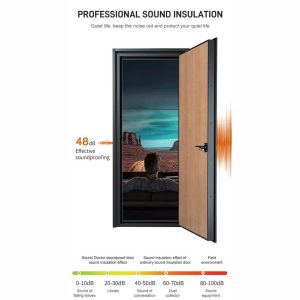
Sound insulation for double doors is measured in Rw (weighted sound reduction index) decibels. A standard double-glazed aluminum door achieves 32-35 dB. Acoustic packages with laminated glass and multi-chamber profiles reach 40-42 dB. Security ratings follow EN 1627 for burglar resistance. A door rated RC2 requires multi-point locking with at least three locking points and reinforced hinge side. Buyers should note that security certification applies to the entire assembly — door leaf, frame, hinges, and locks — not just the lock cylinder.
Material Science: Grades, Properties, Trade-offs
The material selection determines the cost, lifespan, and maintenance requirements of a double door installation. There is no single best material. There are only materials that fit specific project conditions.
Aluminum Alloy Grades and Temper
Architectural aluminum doors use alloy 6063-T5 or 6063-T6. The T5 temper is easier to extrude and offers adequate strength for residential applications. The T6 temper undergoes artificial aging to achieve higher tensile strength — approximately 240 MPa versus 205 MPa for T5. For coastal environments where salt corrosion is a concern, buyers should specify powder coating thickness of at least 60 microns, applied after chromate or chrome-free pretreatment.
Wood Species and Moisture Content
Solid wood double doors require timber with stable dimensional behavior. Oak (Quercus robur) is the most common choice for exterior doors due to its natural tannin content and resistance to fungal attack. Meranti (Shorea spp.) is a Southeast Asian hardwood with similar workability at a lower price point. The critical specification is moisture content — the timber must be kiln-dried to 10-12% for exterior use. If the moisture content exceeds this range, the door will cup or twist within the first year.
Glass Unit Composition
Double glazing for doors uses two panes separated by a spacer bar filled with desiccant. The standard configuration is 4mm glass / 12mm air gap / 4mm glass. For improved thermal performance, the air gap can be filled with argon gas and coated with a low-emissivity (low-E) layer. Tempered glass is required for safety in most commercial applications. Laminated glass, which consists of two panes bonded with a PVB interlayer, provides additional security and acoustic insulation. Glass thickness should be specified based on door leaf size — larger leaves require thicker glass to resist deflection.
Hardware Material Comparison
The hardware on a double door receives more cycles than any other component. Stainless steel hinges (grade 304 or 316) resist corrosion better than zinc-alloy hinges with a plated finish. Multi-point locks with stainless steel locking bolts provide superior security compared to single-point deadbolts. The choice between concealed hinges and surface-mounted hinges affects both aesthetics and adjustability. Concealed hinges are adjustable in three dimensions, which simplifies installation but requires precise routing during manufacturing.
Manufacturing Process: From Raw Material to Finished Product
Understanding the production sequence helps buyers identify where quality is created — and where it can be lost.
Profile Cutting and Machining
Aluminum profiles arrive at the factory in 6-meter lengths. They are cut to size using CNC double-head cutting saws with tolerance control within ±0.3mm. After cutting, the profiles move to CNC machining centers for routing of drainage slots, hardware mortises, and screw holes. The machining accuracy determines how well the hardware aligns when assembled. A deviation of 1mm in the hinge mortise position will create binding or gaps that are difficult to correct during installation.
Welding and Corner Construction
For aluminum doors, the frame corners can be joined using either mechanical corner keys or welding. Mechanical corners use die-cast aluminum brackets that are screwed and sealed into the profile chambers. Welded corners are stronger and more airtight but require precise post-weld machining to remove the weld bead. Buyers should ask which corner construction method the factory uses and how they verify corner squareness. A door frame that is out of square by more than 2mm will exhibit visible gaps at the meeting stile.
Surface Treatment Lines
Powder coating is applied using electrostatic spray guns in a controlled environment. The coating line must include a pre-treatment stage (degreasing, rinsing, and conversion coating) before the powder is applied. The coated profiles are cured in an oven at 180-200°C for 10-20 minutes. The final film thickness should be 60-120 microns. Anodizing is an alternative process that produces a metallic finish, but it is less resistant to scratches than powder coating.
Wood Door Fabrication
Solid wood doors require a longer production cycle. The timber is first kiln-dried to the target moisture content, then machined into stiles, rails, and panels. The components are joined using mortise-and-tenon joints or finger joints, depending on the structural requirement. After assembly, the door is sanded and finished with multiple coats of lacquer or oil. Each coat is sanded between applications to achieve a smooth surface. The finishing process takes 5-7 days for a quality result.
Glass Unit Assembly
Insulated glass units (IGUs) are assembled in a clean room environment. The glass panes are washed, the spacer bar is filled with desiccant, and the unit is sealed with a two-part sealant. The primary seal is butyl, and the secondary seal is polysulfide or silicone. The quality of the secondary seal determines the lifespan of the IGU. A poorly sealed unit will show condensation between the panes within 2-3 years.
Quality Testing Methods and Standards
Testing is not a formality. It is the difference between a door that performs and one that fails during the first storm season.
Air-Tightness Testing
Air-tightness measures the volume of air that passes through a closed door under a specific pressure differential. The test follows ISO 12152. The door is mounted in a test chamber, and air is extracted to create a pressure difference of up to 600 Pa. The air leakage is measured in cubic meters per hour per square meter of door area. A high-performance door achieves a rating of Class 4 — leakage below 3 m³/(m²·h) at 100 Pa pressure difference.
Water-Tightness Testing
Water-tightness testing (ISO 12154) subjects the closed door to a continuous water spray combined with increasing air pressure. The test simulates wind-driven rain. The door is classified from Class 1A (lowest) to Class 9A (highest). For commercial entrances in exposed locations, a classification of 7A or higher is recommended. This requires effective drainage channels in the frame and proper gasket compression at the meeting stile.
Wind Resistance Testing
Wind resistance testing (ISO 12153) evaluates the door’s structural integrity under wind load. The test applies increasing pressure while measuring deflection. The door must not exhibit permanent deformation or damage at the rated pressure. A door rated at 2000 Pa can withstand wind speeds of approximately 180 km/h. For high-rise buildings, the wind load rating must be calculated based on building height and local wind data.
Third-Party Certification
While factory testing provides useful data, third-party certification provides independent verification. Look for test reports from accredited laboratories such as TÜV, SGS, or Intertek. For the European market, CE marking requires compliance with EN 14351-1 for windows and doors. For the US market, ASTM E283 (air leakage), E547 (water penetration), and E330 (structural performance) are the relevant standards.
Industry Standards and Certifications Explained
Buyers face a confusing landscape of standards, marks, and certification schemes. Here is a practical breakdown.
ISO 9001:2015 Quality Management
ISO 9001:2015 is a quality management system certification. It does not guarantee product quality, but it indicates that the factory has documented procedures for production, inspection, and corrective action. For procurement purposes, ISO 9001:2015 certification reduces the risk of inconsistent quality between batches. It is a baseline requirement for serious suppliers.
EN 14351-1 for Windows and Doors
EN 14351-1 is the harmonized European standard for windows and pedestrian doors. CE marking under this standard requires the manufacturer to declare performance values for air permeability, water tightness, wind load resistance, thermal transmittance, and acoustic insulation. The standard does not require third-party testing for all properties, but it mandates a system of factory production control.
ASTM Standards for the US Market
The ASTM E series covers performance testing for fenestration products. ASTM E283 tests air leakage, ASTM E547 tests water penetration, and ASTM E330 tests structural performance. These standards are referenced in the International Building Code (IBC). For US projects, the manufacturer must provide test reports that demonstrate compliance with the local code requirements.
The Gap Between Certification and Reality
Certifications are based on production samples tested under controlled conditions. The actual product quality depends on the consistency of the production process. A factory with strong process control and in-house testing will produce doors that match the certified performance. A factory that outsources testing and lacks internal quality systems may produce doors that fall short. Buyers should ask for the factory’s internal inspection records, not just the certification documents.
Innovation Trends Shaping the Future
The double door market is evolving in response to energy codes, security requirements, and design trends.
Thermal-Break Aluminum with Foam Core
The next generation of thermal-break profiles uses polyurethane foam injection within the thermal break chamber. This reduces thermal transmittance by 15-20% compared to empty chambers. The foam also adds structural rigidity, allowing for larger door leaves without increasing profile dimensions.
Smart Lock Integration
Double doors are increasingly specified with smart lock systems that integrate with building management systems. These locks offer keyless entry, remote monitoring, and audit trails. The door manufacturer must coordinate with the lock supplier to ensure proper mortise preparation and alignment. This requires a higher level of engineering collaboration than traditional hardware.
Sustainable Material Options
The demand for sustainable materials is growing. Aluminum doors are already highly recyclable — the extrusion process uses a significant proportion of recycled content. Wood doors from FSC-certified sources are available but command a price premium. For projects targeting LEED or BREEAM certification, the door supplier must provide documentation on material sourcing and recycled content.
Larger Format Doors
Architects are specifying larger door leaves to create seamless transitions between interior and exterior spaces. A double door leaf can now reach 1200mm in width and 3000mm in height. These larger formats require reinforced profiles, heavy-duty hinges, and specially designed meeting stiles to prevent sagging and maintain weather performance.
How to Evaluate Double Door Suppliers
The evaluation process should be systematic, not based on impressions or the lowest quote.
Step 1: Verify Manufacturing Capability
Request the factory’s production equipment list. Look for CNC machining centers, automated cutting lines, and in-house glass fabrication. A factory that outsources glass, coating, and hardware is a final assembler, not a manufacturer. The risk is in the coordination — each outsourced step introduces a quality control gap.
Step 2: Audit the Quality System
Ask for quality control documentation: incoming material inspection records, in-process inspection checkpoints, and final inspection reports. A factory with a robust quality system will have these documents readily available. A factory that hesitates or provides vague answers likely has gaps in its process control.
Step 3: Request a Pre-Production Sample
Before committing to a bulk order, request a full-size sample. This is not the same as a sample section or a corner sample. The sample must include the complete door assembly with the specified hardware, glass, and finish. Evaluate the sample for dimensional accuracy, hardware operation, and surface quality.
Step 4: Review the Inspection Plan
Ask the factory to provide its pre-shipment inspection plan. The plan should include the sampling method (AQL — acceptable quality limit), the inspection criteria, and the documentation that will be provided. A factory that is willing to work with a third-party inspection company is generally more reliable.
Step 5: Compare Quotes on a Spec-to-Spec Basis
When comparing quotes, ensure that all suppliers are quoting the same specifications. If one quote includes imported hardware and another includes domestic hardware, the price difference is not a comparison of factory pricing. Create a specification sheet that lists every variable: profile wall thickness, thermal break width, glass configuration, hardware brand, coating type, and packaging standards.
Questions to Ask Before Ordering Double Doors
- What is the profile wall thickness at critical load points? (Request the technical drawings)
- Which thermal break material and width do you use? (Polyamide or PU foam? 24mm or 34mm?)
- What glass configuration is included in the quote? (Double glazing, tempered, laminated, low-E?)
- Which hardware brands are standard? (Offer imported and domestic options?)
- What is the maximum door leaf size without additional reinforcement?
- How do you handle warranty claims for hardware failure? (Replacement parts or door replacement?)
- Are your test reports from a third-party laboratory? (Request the actual report, not just the certificate)
- What is the tolerance on width and height? (±2mm is standard)
- What is your production lead time? (Sample production and mass production separately)
- What packaging standards do you use for sea freight? (Wooden crates, protective film, moisture barriers?)
Avoid Suppliers Who…
- Cannot provide profile drawings or technical specifications. If the supplier cannot document the product, they cannot manufacture it consistently.
- Quote prices that are 30% lower than the market average. The savings come from thinner profiles, lower-grade hardware, or cheaper glass.
- Have no in-house quality inspection. If the factory does not test, the buyer becomes the quality control department.
- Cannot provide a pre-shipment inspection report. This is a red flag that the factory has no formal inspection process.
- Offer vague lead times. A supplier who cannot commit to a production schedule will not meet your project deadline.
Choose This If, Choose That If
Choose aluminum double doors if:
- The project requires high wind load resistance (above 1500 Pa)
- The door is exposed to coastal or industrial environments
- Low maintenance is a priority
- The design is modern or minimalist
Choose solid wood double doors if:
- The project has a heritage or luxury aesthetic
- Acoustic insulation is a priority (wood has better inherent sound damping than aluminum)
- The client accepts the maintenance requirement (periodic re-finishing)
Choose aluminum-clad wood doors if:
- The project needs the warmth of wood on the interior and weather resistance on the exterior
- The budget allows for a premium product
- The building is in a high-rainfall or high-UV environment
Our Technical Capabilities and R&D Approach
The industry standards discussed above are not theoretical for us. As a manufacturing facility, we design our production process to meet these requirements.
Factory-Direct Manufacturing
We operate our own extrusion, machining, and finishing lines. This vertical integration means we control quality at every stage, not just at the final assembly. When a buyer orders from us, they are working with the engineers who manufacture the product, not a sales team relaying specifications to an unknown factory. Our pricing reflects production cost, not a distributor’s margin. This is how we keep bulk orders competitive without cutting corners on material quality.
Customization and OEM/ODM Services
We produce aluminum double doors (thermal-break and standard), solid wood double doors, and aluminum-clad wood hybrids. Our in-house team handles custom sizes, RAL color matching, glass selection, and hardware finishes. For OEM projects, we manufacture to your drawings. For ODM projects, we propose design improvements based on your target market’s building codes. Our adjustable profile structures can be adapted to meet local requirements — this is critical for buyers who have had issues with standard profiles failing local approval.
Pre-Shipment Inspection and Export Documentation
Every batch undergoes air-tightness, water-tightness, and wind resistance testing before packing. We provide packing lists, proforma invoices, and full customs documentation. We also photograph and document all goods before packing, so there is a clear reference for any transit damage claims. For buyers who require third-party inspection, we are comfortable coordinating with independent inspectors.
Shipping and Logistics
We handle both FCL and LCL shipments with direct delivery from our factory in China. For large construction projects, we coordinate production schedules to match your installation timeline. We know from experience that a delayed shipment on a construction site is more costly than the door price itself. We provide milestone updates during production so you can track your order.
If you are evaluating double door manufacturers for a commercial project, we can provide the technical documentation and samples you need to make an informed decision.
FAQ
What is the MOQ for double door orders?
The MOQ depends on the material and customization level. Standard aluminum double doors typically start at 20-50 units for bulk pricing. Sample orders (1-2 units) are available for evaluation before mass production. Contact us to confirm the MOQ for your specific configuration.
Can you match a specific RAL color or custom wood finish?
Yes. Our powder coating line supports the full RAL and NCS color ranges. For wood doors, we offer custom staining and lacquering to match your reference sample. We recommend ordering a color chip or small finish sample before mass production.
What are your lead times for a 40ft container of double doors?
For standard aluminum double doors, production takes 25-35 days. Custom sizes or specialty glass may extend this to 45-50 days. We provide a production schedule with milestone updates so you can track progress.
How do you handle warranty claims for damaged goods?
We photograph and document all goods before packing. If damage occurs during transit, we require photos and the bill of lading within 7 days of delivery. We then either replace the damaged units or send spare parts, depending on the extent of the damage.
Can you provide test reports for air-tightness and water-tightness?
Yes. We conduct these tests on every batch and can provide test reports upon request. For specific certifications required in your market (e.g., CE, ASTM), we can coordinate third-party testing at an additional cost. We also provide guidance on which certification applies to your project, based on our export experience across different markets.
References
[1] ISO 12152: Windows and doors — Air permeability — Test method. International Organization for Standardization. https://www.iso.org/standard/52689.html
[2] ISO 12154: Windows and doors — Water tightness — Test method. International Organization for Standardization. https://www.iso.org/standard/52690.html
[3] EN 14351-1: Windows and doors — Product standard, performance characteristics. European Committee for Standardization. https://www.cen.eu/
[4] ASTM E283: Standard Test Method for Determining Rate of Air Leakage Through Exterior Windows, Skylights, and Doors. ASTM International. https://www.astm.org/e0283-19.html
[5] ASTM E547: Standard Test Method for Water Penetration of Exterior Windows, Skylights, Doors, and Curtain Walls by Cyclic Static Air Pressure Difference. ASTM International. https://www.astm.org/e0547-16.html
[6] EN 1627: Pedestrian doorsets, windows, curtain walling, grilles and blinds — Burglar resistance — Requirements and classification. European Committee for Standardization. https://www.cen.eu/