Content Menu
● 1. H2: Our Factory’s Supply Chain Advantage: Why Sourcing 8 Exterior Doors Directly Matters
● 2. H2: 8 Exterior Door Categories We Supply for Commercial & Residential Projects
● 3. H2: Partnership Models: OEM, ODM, and Bulk Supply for Your “8 Exterior Doors” Order
● 4. H2: Price Competitiveness & Total Cost of Ownership
● 5. H2: Our Global Logistics Network: Delivering Your Doors Safely
● 6. H2: Quality Assurance: The Jusen Pre-Shipment Protocol
● 7. H2: Case Scenarios: How Developers Use Our 8 Exterior Door Options
● 8. H2:
● 9. H2: How to Choose the Right Exterior Door for Your Project
14 min read
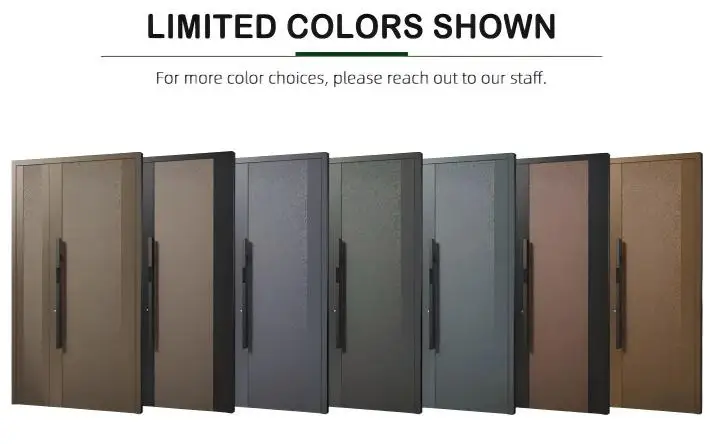
When a developer in Melbourne asked us to match a specific bronze finish across 200 apartment entry doors, we didn’t blink. The color chart they sent was from a European brand we had never seen. Our team matched it in three days using a powder coating formula we developed in-house. That order shipped on time, and the client has reordered twice since.
That is the reality of sourcing exterior doors from a factory. It is not about picking a catalog item. It is about finding a manufacturer that treats your project spec as their production target.
We are Jusen Door and Windows Manufacturing Co., Ltd. We have spent over a decade building doors for residential complexes, private villas, and commercial storefronts across dozens of countries. This article breaks down the 8 exterior door categories we manufacture, how our direct-from-factory model changes your cost structure, and what you need to know before placing a bulk order.
—
H2: Our Factory’s Supply Chain Advantage: Why Sourcing 8 Exterior Doors Directly Matters
The door itself is only half the equation. The other half is the supply chain behind it. When you buy from a trading company, you pay for their overhead, their margins, and their communication gaps. When you buy from us, you are talking to the people who operate the extrusion lines and the CNC routers.
H3: Direct Factory Pricing – Eliminating the Middleman Markup
Our pricing model is simple. We do not have a sales office in Hamburg or a distributor in Texas adding a layer of cost. You pay for the raw materials, the labor, the factory overhead, and our margin. That margin is thinner than a distributor’s because we move volume.
For a project requiring 500 doors, the difference between factory-direct pricing and distributor pricing can be 15% to 25% of the total door budget. On a large development, that is the difference between upgrading the lobby finishes or not.
H3: Raw Material Sourcing & Stock Availability
We procure aluminum billets, solid wood logs, and hardware components in bulk. This purchasing power means we secure better rates on raw materials, and we pass those savings down. It also means we hold stock. When you need 8 exterior doors for a quick renovation or a full container for a new build, we can often start production immediately rather than waiting for materials to arrive.
Our warehouse is set up to handle both FCL and LCL shipments. Whether your order is a single pallet or twenty containers, the logistics team knows how to consolidate cargo efficiently and get it on the water without delay.
H3: Engineering Support for Local Compliance
Building codes are not universal. A door that passes inspection in Saudi Arabia might fail in Germany. Our profile structures and fittings are adjustable. We can modify thermal breaks, reinforce hinges, or change glazing options to match the specific requirements of your target market.
Our engineers provide technical drawings and performance data to support your project approvals. If the local authority requires a specific wind load rating or a particular fire resistance level, we work with you to meet that spec before we cut a single profile.
—
H2: 8 Exterior Door Categories We Supply for Commercial & Residential Projects
Here is what we actually build. These are not renderings. These are products that come off our lines every week, packed for export, and installed in buildings you have probably seen on Google Maps.
H3: 1. Thermal-Break Aluminum Entrance Doors
Energy efficiency is not a luxury anymore. For residential towers and office buildings, it is a regulatory requirement. Thermal-break aluminum doors use a polyamide strip to separate the interior and exterior aluminum frames, stopping thermal transfer. This keeps heat inside during winter and outside during summer.
We test every batch of thermal-break doors for air-tightness and water-tightness before shipment. A door that leaks air fails the energy rating. A door that leaks water fails the client. Our pre-shipment inspection catches both problems before your container leaves our factory floor.
H3: 2. Heavy-Duty Aluminum Alloy Main Doors
For villas and storefronts, security is the primary concern. Our heavy-duty aluminum alloy doors use reinforced frames and multi-point locking systems. The hinge side is reinforced to prevent door removal attacks.
We offer full customization on size and glass for these units. If your architectural drawing calls for a 3-meter-tall door with a fixed sidelight, we can build it. The frame profile is engineered to handle the weight of oversized glass panels without sagging over time.
H3: 3. Solid Wood Entry Doors (Custom Villa Spec)
There is no substitute for the presence of a solid wood door. The grain, the weight, the sound when it closes — it communicates quality before anyone steps inside.
Our solid wood doors are crafted from kiln-dried timber to prevent warping and cracking. We offer various wood finishes and veneers, from American oak to African sapele. We understand that wood is a natural product, and we account for the climate where the door will be installed. A door for a dry desert climate gets a different sealant treatment than one for a humid coastal region.
H3: 4. Aluminum-Clad Wood Exterior Doors
This is the hybrid solution that gives you the best of both worlds. The exterior is aluminum, which handles weather and UV exposure without maintenance. The interior is wood, providing warmth and a premium feel.
The challenge with this construction is the interface between the two materials. If the profiles are not designed correctly, the wood can warp as it expands and contracts at a different rate than the aluminum. Our adjustable profile structure prevents this issue. We have shipped these doors to markets with extreme temperature swings, and the failure rate is minimal.
H3: 5. Large Sliding Exterior Doors (Patio & Terrace)
Modern architecture loves glass. Large sliding doors open up living spaces to the outdoors, flooding interiors with natural light. But a 3-meter sliding panel is heavy. The hardware has to be flawless.
Our sliding doors use heavy-duty rollers and multi-track systems that can handle panels weighing several hundred kilograms. We customize the hardware accessories to match the operating force you want. Some clients prefer a feather-touch glide; others want a more solid, weighted feel. We can tune that.
H3: 6. Casement Exterior Doors
For residential complexes, casement doors offer excellent ventilation and a classic look. They hinge on the side and swing outward or inward, depending on the local preference.
We manufacture casement doors as part of our standard line, which means they are available for OEM branding. You can put your logo on the hardware and your brand on the packaging. We provide the packing list and proforma invoice that allow you to import under your own brand name without complications.
H3: 7. System Windows with Door Functionality (Combined Units)
Sometimes the entrance door is not a separate element. It is part of a larger system window wall. This is common in commercial buildings where the facade is a continuous glazing system, and the door is just one operable section.
Our system windows are manufactured with the same quality control protocols as our doors. The profiles, gaskets, and hardware are designed to integrate seamlessly. When you order a combined unit, it ships as a complete system, not as separate parts that might not fit together on site.
H3: 8. Custom Sunroom Entry Doors
Sunrooms and conservatories require doors that handle high solar gain and temperature fluctuations. Standard doors may warp or fail in these environments.
This is where our ODM capabilities come into play. If you have a specific design for a sunroom door, our engineers can develop the profiles and hardware to bring it to life. We have built angled doors, curved frames, and doors with integrated ventilation panels. If it can be fabricated in aluminum or wood, we can likely produce it.
—
H2: Partnership Models: OEM, ODM, and Bulk Supply for Your “8 Exterior Doors” Order
How do you want to work with us? We offer three primary models, and each one changes the nature of the relationship.
H3: Private Label & OEM Manufacturing
You have a brand. We build the product. Under this model, we produce doors to your exact specifications, apply your logo to the hardware and packaging, and ship them as your product.
We provide the full documentation package — packing list, proforma invoice, and all customs documents required for your country. Our foreign trade experience means we know what paperwork your customs broker expects. We have shipped to North America, Europe, Australia, and the Middle East. The documentation requirements differ, and we handle them all.
H3: ODM Design Collaboration
If you have a concept but no manufacturing blueprints, this is the model for you. You tell us the performance requirements, the aesthetic direction, and the target price. Our engineering team develops the product.
We customize colors, glass types, and hardware accessories to create a unique product line that you can sell exclusively. This is not repackaged white-label work. This is product development.
H3: Construction Project Bulk Supply (B2B Focus)
For contractors and developers, consistency is everything. You do not want door #100 to look different from door #1.
Our production lines are set up for repeatability. We use jigs and fixtures to ensure every frame is square. We batch-test materials to ensure color consistency. When you order 500 doors, you get 500 doors that match the approved sample. Our lead times are communicated clearly in the proforma invoice, and we stick to them.
—
H2: Price Competitiveness & Total Cost of Ownership
Price per door matters. But the total cost of ownership matters more.
H3: Transparent Factory Pricing vs. Distributor Pricing
As a factory, we do not mark up our products to cover a channel partner’s margin. Our quote reflects the cost of materials, labor, and logistics. This makes your bid more competitive when you are tendering for construction projects.
We have seen developers switch from their local distributor to us and save enough on a single project to fund an entire additional floor of cabinetry. That is what factory-direct pricing means.
H3: Long-Term Durability Reducing Maintenance Costs
A cheap door that fails in three years is not cheap. It is an ongoing liability. Our doors undergo wind resistance testing and performance validation before shipment. This is not just about passing a test; it is about ensuring the door frame does not deflect under load, which would cause the seals to fail and the door to leak.
When you buy from us, you are buying fewer warranty claims, fewer service callbacks, and fewer angry homeowners. That is a financial advantage that shows up in your profit and loss statement, not just on the invoice.
—
H2: Our Global Logistics Network: Delivering Your Doors Safely
A door is a large, heavy, fragile item. Getting it from our factory to your job site without damage requires experience.
H3: FCL & LCL Shipping Options
If you need 8 exterior doors for a single villa project, a full container is overkill. LCL (Less than Container Load) allows you to share container space with other cargo, reducing your freight cost.
If you are stocking a development project, FCL (Full Container Load) is more cost-effective per unit. We help you decide which option makes sense based on your order volume and timeline. We handle the loading, ensuring the doors are properly braced and protected for the voyage.
H3: Export Documentation & Customs Support
Our team has handled exports to over 40 countries. We know that a missing certificate or a mismatched HS code can delay your shipment by weeks.
We provide complete export documentation, including the packing list, commercial invoice, bill of lading, and any certificates of origin required by your destination country. We coordinate with your freight forwarder or ours to ensure the paperwork matches the cargo exactly.
—
H2: Quality Assurance: The Jusen Pre-Shipment Protocol
We do not want our name associated with doors that fail. That is why we have a strict pre-shipment inspection process.
H3: Performance Testing (Air, Water, Wind)
Before any door leaves our factory, it is tested for air-tightness, water-tightness, and wind resistance. This is not a spot check. It is a standard procedure for every production batch.
We use calibrated equipment to measure airflow through the frame, water penetration under pressure, and frame deflection under wind load. If a door fails any of these tests, it is rejected and rebuilt. We do not ship “good enough” doors.
H3: Visual & Hardware Inspection
Performance is important, but so is appearance. Our QC team inspects every door for scratches, dents, and color mismatches. We verify that the glass is free of defects and that the hardware operates smoothly.
The finish must match the approved sample. If you approved a matte black frame, we do not ship a gloss black frame. The texture and color are checked against a physical reference sample under controlled lighting.
—
H2: Case Scenarios: How Developers Use Our 8 Exterior Door Options
Theory is useful. Examples are better. Here is how different clients use our products.
H3: Scenario A: High-Rise Residential Complex
A developer in Vietnam needed 600 doors for a 20-story apartment building. They chose thermal-break aluminum entrance doors for the units and casement doors for the balconies.
The key requirements were consistent quality and on-time delivery. We produced the order in three batches, matching the construction schedule. The developer saved roughly 20% compared to the quote from a regional distributor.
H3: Scenario B: Luxury Villa Project
A private client in California wanted a statement entrance for their oceanfront villa. They chose a solid wood entry door with a custom bronze finish and a heavy-duty aluminum alloy door for the side entrance.
The challenge was the salt air. Our team specified a marine-grade finish for the aluminum and a specialized sealant for the wood. The doors have been installed for three years without any corrosion or warping issues.
H3: Scenario C: Commercial Storefronts
A retail chain in the Middle East needed sliding doors and system windows for 15 storefront locations. The doors had to handle high pedestrian traffic and frequent wind storms.
We supplied heavy-duty sliding doors with reinforced frames and tested them for wind resistance. The chain has since used our doors for their new store openings across the region.
—
H2:
Frequently Asked Questions (FAQ)
What is the minimum order quantity (MOQ) for exterior doors?
MOQ depends on the model and customization level. For standard models, we can handle LCL shipments with relatively low quantities. For fully custom doors, a higher MOQ is often required to justify the tooling and setup costs. Tell us what you need, and we will give you a clear answer.
Can you customize the size of the 8 exterior doors listed here?
Yes. Full customization on size, color, glass, and hardware accessories is our standard practice. We do not force you into a fixed size chart. If your project requires a non-standard dimension, we adjust our production.
How do you ensure the doors survive shipping to the USA/Europe/Australia?
We use export-grade packaging. Doors are wrapped in protective film, secured with corner protectors, and placed in sturdy wooden crates or steel-framed export pallets. The crates are designed to withstand stacking and forklift handling. We also use desiccants inside the packaging to prevent moisture damage during the voyage.
Can you provide samples before a bulk order?
Yes, we can arrange samples. For standard models, we can ship a single door via express courier. For custom designs, we may need to produce a prototype, which takes additional time. The sample cost is typically borne by the buyer, but we deduct it from the bulk order if you proceed.
How long does production take for a container load of exterior doors?
Production time is typically 15 to 30 days, depending on the quantity and the level of customization. A standard order with no custom colors or profiles can be faster. Custom orders that require new tooling take longer. We provide a clear production timeline in the proforma invoice, so you know exactly when to expect shipment.
—
H2: How to Choose the Right Exterior Door for Your Project
Here is a practical guide based on what we see work in the field.
Choose a thermal-break aluminum door if your project is in a climate with extreme temperatures and energy efficiency is a regulatory requirement.
Choose a heavy-duty aluminum alloy door if security is the top priority, such as for a villa or a ground-floor commercial unit.
Choose a solid wood door if the project is a high-end residential property where aesthetics and prestige matter more than maintenance costs.
Choose an aluminum-clad wood door if you want the warmth of wood on the interior but the durability of aluminum on the exterior.
Choose a large sliding door if the design calls for maximizing natural light and connecting indoor and outdoor spaces.
Choose a casement door if you need a cost-effective, functional door for residential complexes or office buildings.
Choose a system window with door functionality if the entrance is part of a continuous glazing facade.
Choose a custom sunroom door if the door will be exposed to high solar gain and needs to handle temperature fluctuations.
—
We have covered the 8 exterior door categories we manufacture, the supply chain advantages of working with us directly, and the partnership models available. The next step is to define your project requirements and get a quote.
The procurement process starts with a conversation. Tell us about your project, your target market, and your timeline. Our engineers will review the specifications and respond with a detailed proposal, including pricing and production schedule.
Need a reliable supplier for your next project? Contact our team today to discuss your specifications.
—
References
[1] Jusen Door and Windows Manufacturing Co., Ltd. — Product Range Overview. https://doorwoodendoors.com/
[2] AS/NZS 4420:2016 — Windows, external doors, and shutters (Australia/New Zealand standard for performance testing). https://www.standards.org.au/standards-catalogue/standard-details?sid=AS-NZS-4420-2016
[3] ASTM E283 — Standard Test Method for Determining Rate of Air Leakage Through Exterior Windows, Skylights, Curtain Walls, and Doors Under Specified Pressure Differences Across the Specimen. https://www.astm.org/e0283-19.html
[4] ASTM E330 — Standard Test Method for Structural Performance of Exterior Windows, Skylights, Curtain Walls, and Doors by Uniform Static Air Pressure Difference. https://www.astm.org/e0330-14.html
[5] AAMA/WDMA/CSA 101/I.S.2/A440 — North American Fenestration Standard/Specification for Windows, Doors, and Skylights. https://aamanet.org/