Content Menu
● 1. The Single French Door Exterior: Engineering for Thermal Performance and Security
● 2. Why Choose a Factory-Direct Partner for Your French Door Inventory?
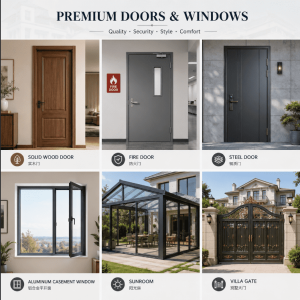
● 3. Our Exterior Door Product Range: From Casement to Custom Configurations
● 4. The Jusen Manufacturing Process: Quality Control and Technical Support
● 5. Logistics and Lead Times: Shipping FCL and LCL Worldwide
● 6. How to Partner with Us: A Simple B2B Process
● 7. Common Questions We Answer About Single French Door Exterior Orders
15 min read
The last container we loaded for a Melbourne distributor had 86 single french door exterior units in it. Every frame was powder-coated in a custom bronze finish that matched their local council’s heritage overlay requirements. That order taught us something we already suspected: the buyers who succeed with exterior french doors are the ones who treat the factory relationship as a engineering partnership, not a purchasing transaction.
We are Jusen Door and Windows Manufacturing Co., Ltd., a factory in China that has spent over a decade building exterior doors for importers, distributors, and construction firms across 30+ countries. This article walks through what we actually do when you order single french door exterior units from us — the material decisions, the testing protocols, the documentation, and the logistics that determine whether your project makes money or eats into your margins.
The Single French Door Exterior: Engineering for Thermal Performance and Security
A single french door exterior is not a patio door scaled down. It is a full-height glazed unit — typically 80 to 96 inches tall — designed to be the primary entry point or a dramatic side-light feature. The engineering demands are different from interior french doors because the unit faces wind loads, rain, UV exposure, and temperature swings.
Thermal-Break Aluminum vs. Solid Wood Options
We manufacture both thermal-break aluminum and solid wood single french door exterior units. The choice is not about which is “better” — it is about your target market’s climate and architectural preferences.
Thermal-break aluminum is our most requested option for exterior use. The frame uses a polyamide strip to separate the interior and exterior aluminum profiles, which stops thermal bridging. Our standard configuration achieves a U-value around 2.0 W/m²K with double glazing, and we can push that down to 1.4 W/m²K with triple glazing and low-E coatings. For buyers in Germany or Canada, that number matters for energy certification.
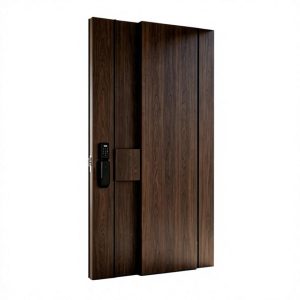
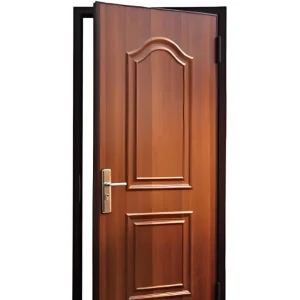
Solid wood doors — we work with oak, mahogany, and sapele — offer a traditional aesthetic that aluminum cannot replicate. Wooden doors are not always the cheapest option. For high-humidity coastal areas, buyers should prioritize moisture resistance over appearance. We treat all our exterior wood frames with a four-stage waterproofing process before assembly, but the reality is that aluminum will outlast wood in tropical climates unless the buyer is committed to periodic maintenance. We tell our clients this before they order, not after.
Multi-Point Locking and Hardware Integration
Security hardware on a single french door exterior is non-negotiable. We integrate multi-point locking systems — typically 5 to 7 locking points along the active door leaf — that engage the frame at multiple positions when the handle is lifted. This distributes the force of an attempted forced entry across the entire frame rather than concentrating it at a single latch.
We offer full customization on hardware accessories. This means you specify the handle style, finish (we stock satin chrome, matte black, brass, and stainless steel), hinge type, and lock cylinder. European clients often request DIN-compliant mortise locks; North American buyers usually prefer ANSI-grade deadbolts. We can fit both because our profile structures are machined to accept either standard. The hardware is sourced from established suppliers like Hoppe, Siegenia, and Kinlong — we do not use unbranded components on exterior doors because the failure cost is too high.
Glass Specifications for Exterior Use
The glass is where we see the most buyer confusion. A single french door exterior unit typically uses insulated glass (IGU) — two or three panes separated by a spacer and sealed. The spec sheet should include:
- Glass thickness: 5mm to 6mm per pane for most residential applications; 8mm to 10mm for commercial or high-wind zones
- Coating: Low-E coating to reduce heat transfer — we offer both hard-coat and soft-coat options depending on your climate zone
- Tempering: Tempered or laminated glass is required by code in most jurisdictions for doors and sidelites. We use tempered as standard; laminated for hurricane-rated projects
- Spacer type: Warm-edge spacers (stainless steel or thermoplastic) reduce condensation at the glass edge — a detail many buyers overlook until the first winter
We source glass from tier-one Chinese manufacturers with ISO 9001 certification, and we inspect every IGU before assembly. When you order from us, you specify the glass build-up in your technical drawing, and our production team assembles the unit to that exact specification. If you are unsure what your market requires, send us your local building code reference and we will recommend a configuration — we do this daily for clients in the Middle East, Southeast Asia, and South America.
Why Choose a Factory-Direct Partner for Your French Door Inventory?
The difference between buying from a trading company and buying from us is not just price — although price is part of it. It is about who is accountable when something goes wrong.
Eliminating the Middleman Markup
Because we are the direct factory, there is no trading company layer between you and production. Our pricing includes raw materials, labor, factory overhead, and profit — nothing else. When you compare our quotes against trading companies, you will typically see a 15% to 25% difference for the same specification. That margin is your competitive advantage when you bid for projects or set wholesale prices for your distributors.
We also control our raw material costs through volume purchasing. Our aluminum profiles come directly from the extrusion mills we partner with; our wood is sourced from managed plantations in Southeast Asia and Africa. This vertical integration means we are less exposed to price spikes than smaller factories that buy materials on the spot market.
Full Customization for Market Fit (Sizes & Colors)
We do not have a “standard size” catalog that we force you into. A single french door exterior must fit the rough opening of the building — and rough openings vary by country, by builder, and by decade of construction.
We offer full customization on size and color. Our aluminum profiles can be powder-coated in any RAL color, plus wood-grain finishes that mimic oak, walnut, or teak. Our wood doors are available in any stain color you specify. If you send us a drawing with dimensions, we will manufacture to those exact numbers — the only limitation is our profile cutting capacity, which handles up to 6-meter lengths in a single pass.
Our adjustable profile structure and fittings also allow us to match local building codes. For example, New Zealand requires specific wind load ratings for exterior doors; Saudi Arabia requires thermal insulation values that differ from European standards. We adjust the profile wall thickness, the number of reinforcement chambers, and the hardware rating to meet those requirements. You do not need to redesign your project around our product — we adapt our product to your project.
Ensuring Consistency Across Bulk Orders
The most common complaint we hear from distributors about other suppliers is inconsistency: the first container is excellent, the second container has paint defects, the third container has dimensional deviations. This happens when a factory does not have a documented quality system.
We do. Every batch of single french door exterior units undergoes our strict pre-shipment inspection, which includes air-tightness, water-tightness, and wind resistance testing. We test to GB/T 7106-2019 (the Chinese national standard for building door and window performance) and can test to ASTM or EN standards on request. The test results are documented and included in your shipment file.
For bulk orders — 50 units or more — we also conduct mid-production inspections. Our QC team walks the production line at 30% and 70% completion to catch issues before they compound. You are welcome to send a third-party inspector to our factory during production; we have hosted SGS, Bureau Veritas, and TÜV auditors multiple times per year for over a decade.
Our Exterior Door Product Range: From Casement to Custom Configurations
The single french door exterior is one product in a broader portfolio that we manufacture. This matters to you because it means we can supply multiple door and window types in one order, which simplifies your logistics and ensures visual consistency across a project.
Single Leaf vs. Double Leaf Configurations
A single french door exterior has one active leaf — the door you open — and either a passive leaf or a fixed sidelite beside it. The double leaf configuration has two active leaves that meet in the middle. We manufacture both on the same production line, using the same profiles and hardware systems.
The production difference is in the astragal — the vertical strip where the two leaves meet. For single leaf units, we use a fixed sidelite with a matching profile so the assembled unit looks like a single continuous glazed panel. This is a popular choice for narrow entryways where a full double door would be too wide. We also produce single french doors with a transom window above, which adds height without requiring a larger door leaf.
Aligning with System Windows and Sunrooms
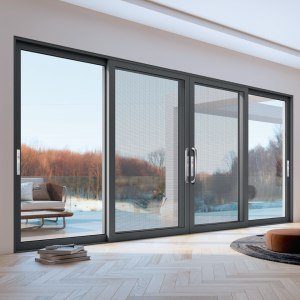
Buyers who order single french door exterior units for villa projects usually need windows too. If you order from us, you can consolidate — we manufacture system windows (casement, awning, and fixed), sliding doors, and sunrooms using compatible profiles and finishes. This means one purchase order, one production schedule, and one shipment for the entire glazing package of a project.
The aesthetic alignment is not an afterthought. Our system windows and french doors share the same frame depth and sightline dimensions, so when installed side by side, they look like they belong together. This is difficult to achieve when you source doors from one supplier and windows from another.
OEM and ODM Capabilities for Private Label
We support OEM and ODM services. For OEM, you provide the specification and we manufacture to your drawings. For ODM, our engineering team designs the product based on your performance requirements and target price point.
Private label branding is straightforward. We can apply your logo to the hardware, the glass spacer, and the packaging. Many of our distributors sell our doors under their own brand name — we provide the product, the quality assurance, and the documentation, while you own the customer relationship. We also offer ODM for profile design: if you want a unique frame profile that differentiates your brand, our engineering team can design the extrusion dies and have them manufactured exclusively for you.
The Jusen Manufacturing Process: Quality Control and Technical Support
The manufacturing process for a single french door exterior unit takes 15 to 25 working days, depending on complexity and order size. Here is what happens during that time.
In-House Testing: Air, Water, and Wind Resistance
Our pre-shipment inspection is not a visual check. It is performance testing. We use a dedicated testing chamber in our factory that applies air pressure differentials to the assembled door, sprays water at specified rates, and measures deflection under wind load.
The test parameters are based on your project location. For a coastal project in Florida, we test to higher wind load standards than for an inland project in Ohio. For a project in Singapore, we test water tightness to tropical rain conditions. The test report is included in your shipment documentation, so you have evidence of compliance when your doors arrive at customs or when your client requests certification.
Engineering Support for Your Project Specifications
Our technical team — 8 engineers with combined experience of 60+ years in door and window design — reviews every order before production begins. If your drawing has a dimension that creates a structural weakness, we will flag it and suggest an alternative before we cut any material.
This engineering support extends to code compliance. Our adjustable profile structure and fittings allow us to match local building codes of your target markets. For example, European buyers often require CE marking under EN 14351-1; we can provide the test documentation needed to support CE certification. Australian buyers require compliance with AS 2047; we have tested our products to this standard and can provide the reports.
Documentation and Compliance
The paperwork burden of importing is real. We provide a packing list, proforma invoice, and full customs documents with every shipment. This includes the commercial invoice, bill of lading, certificate of origin (if you need it for tariff preferences), and the test reports mentioned above.
We have rich experience in foreign trade. Our export team handles documentation for over 100 shipments per year, and we know the specific requirements of customs authorities in North America, Europe, the Middle East, and Southeast Asia. If your customs broker needs a specific document format, we will adjust ours to match.
Logistics and Lead Times: Shipping FCL and LCL Worldwide
Logistics is where factory-direct sourcing either delivers value or creates headaches. We have built our shipping process to minimize both cost and risk.
Flexible Shipping Options (FCL & LCL)
We support both FCL (full container load) and LCL (less than container load) shipment. For buyers testing a new market, LCL allows you to order 20 to 30 units without committing to a full container. For established distributors, FCL is more cost-effective — you get a dedicated container with no risk of your goods being mixed with other shippers’ cargo.
The choice affects your per-unit cost. FCL shipping for a 40-foot container from our factory in Guangdong to Los Angeles typically costs $4,000 to $6,000 depending on the season; LCL costs more per cubic meter but allows smaller initial orders. We advise buyers to calculate their landed cost — not just the FOB price — when comparing options. We provide freight quotes from our trusted forwarders if you need them.
Direct Delivery from Our China Factory
Your goods leave directly from our facility. We do not route orders through a third-party warehouse or trading company office. This reduces handling time and ensures that the product you inspected (or that our QC team inspected on your behalf) is the product that reaches your port.
Our production lead time for single french door exterior units is 15 to 25 working days from approval of the sample or drawing. For repeat orders with no specification changes, we can often shorten this to 10 to 15 working days because the production setup is already in place.
Packaging for Export Safety
Export packaging is not an afterthought — it is the difference between doors arriving pristine and doors arriving with scratches, dents, or broken glass. We use a three-layer protection system:
- PE film wrapped directly on the door surface to prevent scratches
- Foam corner protectors on all edges — the most vulnerable points during container loading and unloading
- Wooden crates or steel-framed crates for FCL shipments, with internal bracing to prevent movement
For glass units, we use additional plywood protection over the glazing area. Our packaging meets ISPM-15 standards for wood packaging material, which is required for shipments to the US, EU, and Australia. We have never had a shipment rejected due to packaging non-compliance.
How to Partner with Us: A Simple B2B Process
The process for ordering single french door exterior units from us is straightforward. Here is what to expect.
Step 1: Send Your Specifications
Send us your drawings, sizes, or just a description of your target market and project type. If you have a technical drawing, include the rough opening dimensions, wall thickness, and any performance requirements (wind load, thermal insulation, acoustic rating). If you do not have drawings, send us photos of the project or a reference product you want us to match. Our team will work from that.
Step 2: Get a Quote and Samples
Within 2 to 3 working days, we will send you a quotation with FOB or CIF pricing, depending on your preference. The quote includes a breakdown by component — frame, glass, hardware, packaging — so you can see where the costs are. This transparency helps you make informed decisions about upgrades or cost reductions.
For bulk orders, we recommend ordering a sample unit before committing to a full container. The sample cost is deducted from your first bulk order. This allows you to verify quality, test the product in your local conditions, and show it to your end customers before placing a large order.
Step 3: Production and Inspection
Once you approve the sample and place the order, we begin production. We send you production photos at key milestones — cutting, assembly, glazing, finishing — so you can monitor progress without visiting the factory. When production is complete, we conduct the pre-shipment inspection and send you the test reports. If you want to arrange a third-party inspection, we will coordinate the schedule with the inspector.
Common Questions We Answer About Single French Door Exterior Orders
Can you produce a single french door exterior in a non-standard size?
Yes. As a factory, we offer full customization on size. We do not limit you to standard dimensions. The only constraint is our profile cutting capacity, which handles up to 6-meter lengths. If your rough opening is 800mm wide, 2100mm high, or 1200mm wide, 2400mm high, we can manufacture to those exact measurements.
What is the MOQ for a bulk order?
We are flexible. We support both FCL and LCL shipment, so we can accommodate a trial order of 10 to 20 units to test the market before you commit to a full container load. For LCL orders, the MOQ is typically 10 units. For FCL orders, the MOQ depends on the container size — a 20-foot container holds about 40 to 50 units depending on the door dimensions; a 40-foot container holds about 80 to 100 units.
How do you ensure the doors meet our local building codes?
We have rich experience in foreign trade. Our engineering team reviews the building code requirements of your target market before production begins. We adjust the profile structure and fittings to match local wind load, thermal performance, and safety glass requirements. If your market requires specific certifications, we provide the test documentation needed to support your certification process.
Do you provide OEM or Private Label services for this door model?
Absolutely. We offer OEM, ODM, and Private Label services. We can customize the hardware branding, packaging, and even specific profile details to suit your brand identity. If you want a unique profile design that is exclusive to your brand, our engineering team can design the extrusion dies for you.
What documentation do you provide for customs?
We provide a packing list, proforma invoice, and full customs documents with every shipment. This includes the commercial invoice, bill of lading, certificate of origin, and performance test reports. Our export team ensures all documents are accurate and compliant with the destination country’s requirements.
Making the Sourcing Decision
Choose a factory-direct partner like us if you want competitive pricing without the middleman markup, full customization to match your market’s building codes, and a strict pre-shipment inspection process that protects your reputation with end customers.
Choose a trading company if you are ordering a single unit for a personal project and do not need bulk pricing or customization. For B2B buyers — importers, distributors, contractors — the factory-direct model delivers better margins, better quality control, and better support.
We have been building single french door exterior units for over a decade. We know what fails in the field — we have seen the warranty claims from other factories’ products that our clients switched away from. We build our doors to survive those conditions.
If you are ready to discuss your project requirements, send us your specifications and we will respond with a detailed quotation within 2 to 3 working days.
For specific technical drawings or bulk pricing, please Contact Our Team today.
References
[1] GB/T 7106-2019, “Performance Test Methods for Building Doors and Windows,” Standardization Administration of China. https://www.sac.gov.cn/
[2] “Thermal Performance of Windows, Doors, and Shading Devices,” Lawrence Berkeley National Laboratory. https://windows.lbl.gov/
[3] EN 14351-1:2006+A2:2016, “Windows and Doors — Product Standard, Performance Characteristics,” European Committee for Standardization. https://www.cencenelec.eu/
[4] “Wind Load Design for Building Envelope,” American Society of Civil Engineers (ASCE 7). https://www.asce.org/
[5] ISPM-15, “Regulation of Wood Packaging Material in International Trade,” International Plant Protection Convention. https://www.ippc.int/