Content Menu
● 1. Why Glass Sidelights Are Dominating Modern Entryway Design
● 2. Our Supply Chain: How We Ensure Stable Sourcing for High-Volume Projects
● 3. Product Range: Matching Sidelight Configurations to Your Project Needs
● 4. The Jusen Partnership Model: OEM, ODM, and Private Label Solutions
● 5. Quality Assurance: Pre-Shipment Testing on Every Sidelight Unit
● 6. How to Request a Quote and Start Your Sourcing Project
● 7. Frequently Asked Questions
12 min read
The phone rang at 2:00 AM. On the other end was a distributor from Melbourne who had just lost his previous supplier to a six-month production delay. He needed 120 aluminum entry doors with double sidelights for a townhouse development. The construction site was already pouring foundations. He asked one question: “Can your factory actually deliver on time?”
That question — the one about reliability — is what separates a factory from a trading company. We are Jusen Door and Windows Manufacturing Co., Ltd., and we have spent over a decade answering that question with shipped containers, not promises.
Front doors with glass sidelights present a unique challenge for B2B buyers. The glass-to-frame junction is where most failures happen. Water leaks. Air infiltration. Condensation between panes. A door that looks perfect in a showroom can fail catastrophically on a coastal installation site. This article explains how we manufacture these systems, what we test, and why our factory structure gives you leverage that trading companies cannot match.
Why Glass Sidelights Are Dominating Modern Entryway Design
Walk through any new residential development in North America, Australia, or Western Europe. The pattern is unmistakable. Narrow vertical glass panels flanking the entry door have become the default design language. Homeowners want natural light flooding into foyers. Architects want to create a wider visual entrance without expanding the actual opening.
Our team tracks these architectural trends across international markets because they directly influence what we produce. When we see sidelight demand rising in a specific region, we adjust our profile inventory and glass sourcing accordingly. This is not a passive observation — it affects our procurement decisions six months before you place an order.
The Shift Toward Aluminum Frames for Structural Support
Here is the engineering reality: a 300mm wide sidelight that is 2400mm tall creates significant wind load surface area. Traditional timber frames need thick profiles to handle this, which defeats the purpose of slim sightlines. uPVC has thermal benefits but flexes under load in tall configurations.
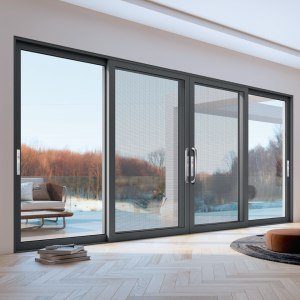
We manufacture thermal-break aluminum entrance doors specifically to solve this problem. The aluminum profile provides structural rigidity with narrow visible width. The polyamide thermal break strips separate the interior and exterior metal surfaces, preventing cold transfer. This is not a cosmetic feature — it is structural engineering that allows you to specify larger glass panels without compromising the frame’s integrity.
Balancing Natural Light with Thermal Efficiency
Large glass areas are thermal weak points. We will not pretend otherwise. A 1.2m wide sidelight unit loses more heat than a solid wall section of the same area. The solution is not to reduce glass size — it is to specify the correct glazing.
We offer double-glazed and low-E glass options across our sidelight configurations. Low-E coatings reflect long-wave infrared radiation while allowing visible light to pass. Argon gas fills between panes reduce convective heat transfer. For cold climate markets, we can specify warm-edge spacers that maintain the seal temperature at the glass edge, reducing condensation risk.
But glass specification only matters if the frame seals properly. Our quality control team performs strict pre-shipment testing on every sidelight unit — air-tightness and water-tightness tests that simulate heavy rain combined with wind pressure. We do this because a glazing bead that looks fine on paper can fail when a storm hits. [1]
Customization for Architectural Styles
Sidelights are not one-size-fits-all. A modern minimalist villa in Spain requires different proportions than a heritage-style home in Toronto. We offer full customization on size, color, and glass type. Our factory can produce a single sidelight on the hinge side for a narrow lot, or symmetrical double sidelights for grand entrances.
The practical implication for you: you do not need to compromise your architectural drawings to fit a standard catalog product. Send us your dimensions. We adjust the profile cutting and hardware placement to match.
Our Supply Chain: How We Ensure Stable Sourcing for High-Volume Projects
Supply chain stability is the difference between a profitable project and a penalty clause nightmare. When you order front doors with glass sidelights, you are not just buying a product — you are buying certainty that the units arrive when your installation crew is on site.
We control our production from raw material procurement through final packing. This vertical integration means we do not depend on third-party workshops to fulfill your order. Our factory floor handles profile cutting, CNC machining, glass assembly, hardware installation, and final inspection under one roof.
Direct Factory Pricing Without Middleman Markup
Trading companies add 15-30% on top of factory costs. That markup comes out of your margin. Because we sell direct from our factory, you pay production cost plus our margin — not a chain of intermediaries.
This pricing structure matters when you are bidding on construction projects. The difference between our quote and a trading company’s quote can be the difference between winning and losing the tender. We understand this because we work with contractors who face competitive bidding on every project.
FCL & LCL Shipping Options for Global Delivery
Not every order fills a 40-foot container. We accommodate both Full Container Load (FCL) and Less-than-Container-Load (LCL) shipments. For pilot projects or sample orders, LCL allows you to test our quality without committing to bulk volume. For established projects, FCL reduces per-unit freight costs.
Our foreign trade experience means we handle the documentation correctly. You receive a complete packing list, proforma invoice, and all customs documents needed for clearance at your port. This is not our first international shipment — we know what documentation different countries require.
Lead Time Management for Construction Schedules
Construction schedules shift. Foundations pour late. Framing takes longer than estimated. Our production planning team works backward from your required delivery date to schedule production. If your timeline compresses, we can prioritize your order in the production queue.
We will be honest about constraints. Custom glass with specific coatings requires lead time from glass suppliers. Complex color matches require additional powder coating time. But we communicate these constraints upfront — we do not discover them after you have placed the order.
Product Range: Matching Sidelight Configurations to Your Project Needs
Sidelight configuration affects both aesthetics and structural performance. We produce multiple configurations because different projects require different solutions.
Single Sidelight vs. Double Sidelight Configurations
A single sidelight on the hinge side creates an asymmetrical look that works well for narrower lots where the door is offset. Double sidelights on both sides create a symmetrical, formal entrance that reads as more prestigious.
The structural difference matters. Double sidelights mean the door frame must support loads on both sides. Our adjustable profile structure allows us to reinforce the frame internally where needed, ensuring the entire unit performs as one system rather than a door with two windows bolted on.
Matching Materials: Solid Wood vs. Aluminum Alloy
Our factory produces both solid wood doors and aluminum alloy entrance doors. This dual capability gives us the ability to recommend honestly based on your project requirements.
Solid wood offers classic warmth and traditional aesthetics. It suits heritage renovations and luxury villas where the door is a focal point. However, solid wood requires ongoing maintenance — repainting or refinishing every few years. It also moves with humidity changes, which can affect the seal around fixed glass panels.
Aluminum alloy offers superior durability and minimal maintenance. The slim profiles allow maximum glass area for sidelights. Powder-coated finishes resist UV fading and corrosion. For coastal installations, aluminum is the practical choice — salt air corrodes steel hardware and deteriorates timber finishes.
One honest caveat: aluminum doors with large sidelights are not always the cheapest option upfront. The thermal break profiles and structural reinforcement add cost compared to basic aluminum doors. But over a 10-year lifecycle, the reduced maintenance and energy savings often offset the initial investment.
Hardware and Accessory Integration
Glass sidelights add weight to the door assembly. The hinges and locking hardware must handle this additional load. We integrate multi-point locking systems that secure the door at multiple points along the frame — not just at the handle.
We allow you to select hardware accessories based on your local security standards. European markets often require specific locking cylinder standards. North American markets have different deadbolt requirements. Our adjustable profile structure and fittings accommodate these variations, so you do not need to source hardware from a separate supplier.
The Jusen Partnership Model: OEM, ODM, and Private Label Solutions
Different buyers need different support levels. A startup distributor may need a white-label product to build their brand. An established construction company may need custom engineering for a specific project. We structure our partnerships to accommodate both.
OEM Manufacturing: Building to Your Exact Specifications
If you have your own drawings and specifications, we act as your production line. Our technical team reviews your CAD files and provides feedback on manufacturability. We identify potential issues — profile thickness that cannot accommodate the specified glass, hardware placement that conflicts with reinforcement — before production begins.
This review process saves you money. Discovering a design flaw after tooling is expensive. Discovering it before production is free.
ODM Design Support: Leveraging Our R&D for New Products
If you need a new design for your target market, our R&D team can create it. We understand the building codes and performance requirements for different regions — European standards differ from North American standards, and both differ from Australian standards.
Our adjustable profile structure means we can modify extrusion designs to match local building codes. If your market requires specific U-factor ratings or wind load classifications, we engineer the profiles to meet those requirements. This is not a catalog product with a different label — it is a product engineered for your market. [2]
Private Label: Building Your Brand Identity
We keep our manufacturing discreet. When you order private label front doors with glass sidelights, your brand is the only one visible to the end-user. We do not apply our logo to the product or packaging unless you request it.
This allows you to build brand equity in your market without investing in manufacturing infrastructure. You focus on sales, distribution, and customer relationships. We focus on production quality and consistency.
Quality Assurance: Pre-Shipment Testing on Every Sidelight Unit
The junction between glass and frame creates potential leak points. Water can penetrate through the glazing bead. Air can infiltrate through the seal between the sidelight frame and the main door frame. These failures are invisible in a showroom but catastrophic in a storm.
Our quality control process addresses these risks through systematic testing.
Air-Tightness and Water-Tightness Testing
We test every sidelight unit for air-tightness and water-tightness before shipment. The test involves pressurizing the unit and spraying water at controlled pressure to simulate rain combined with wind. We check for any water penetration through the seals and any excessive air leakage.
This testing is standard procedure — not an added-cost option. We have invested in the test equipment because we know that a field failure costs far more than a factory test. When your client calls about a leaking door, you cannot blame the weather. You own the problem.
Wind Resistance for High-Rise Applications
High-rise installations face different wind loads than ground-level homes. At 20 stories, wind pressure on a sidelight can be several times higher than at street level. Our engineers calculate the reinforcement needed within the aluminum profiles to pass wind resistance tests.
We use structural silicone glazing in some configurations to bond the glass to the frame, distributing wind load across the entire surface rather than concentrating it at mechanical fixing points. This approach allows larger glass panels without increasing profile thickness.
Visual and Dimensional Inspection
Before packing, every unit undergoes visual inspection. We check for scratches on the glass, imperfections in the powder coating, and dimensional accuracy of the frame angles. A door that is 2mm out of square will not install correctly, causing gaps and alignment issues.
This final inspection is the last gate before packing. If a unit does not pass, it goes back to the production line for correction. We do not ship marginal quality in hopes that the installer will fix it.
How to Request a Quote and Start Your Sourcing Project
Starting a sourcing project with us is straightforward. You provide specifications. We provide a quote and technical drawings. You approve. We produce.
Information Needed for an Accurate Quote
To quote accurately, we need these details:
- Quantity — total units and any variations in size or configuration
- Size — width and height of the door and each sidelight
- Glass specification — single, double, or triple glazing; low-E coating; tinted or clear
- Color — RAL number or finish specification for the frame
- Hardware preferences — locking system, handle style, hinge type
The more details you provide, the faster we can return an accurate quote. If you are unsure about some specifications, our technical team can provide guidance based on your project location and requirements.
Requesting Samples and Technical Drawings
We provide technical drawings for your approval before mass production. These drawings show the profile cross-sections, glass specifications, and hardware placement. This documentation also helps you obtain necessary permits or approvals from local authorities.
For construction project bulk supply, we provide comprehensive technical documentation, including installation instructions and maintenance guidelines. Our engineering support team is available to answer questions from your installation crew.
Let’s Discuss Your Project
Whether you are sourcing for a single luxury villa or a multi-unit development, we want to understand your requirements. The conversation starts with a quote request.
Frequently Asked Questions
What is the minimum order quantity (MOQ) for custom front doors with glass sidelights?
Our MOQ is flexible depending on configuration. We accommodate LCL shipments for smaller orders and pilot projects. For new partnerships, we can discuss a sample order to validate quality before committing to bulk volume. For established projects, we typically work with bulk supply to optimize freight costs.
Can you match specific local building codes for energy efficiency?
Yes. We offer adjustable profile structures and fittings to match local building codes. We incorporate thermal break strips and specific glass types — Low-E, argon-filled — to meet U-factor and SHGC requirements for your target market. Provide us with the relevant code requirements, and our engineers will specify the appropriate configuration.
Do you provide installation instructions or technical support?
Yes. Our engineering support team provides detailed installation drawings and technical documentation. We guide your installation crew on correct fitting procedures and hardware adjustment. If issues arise during installation, our team is available to troubleshoot remotely.
How do you ensure the doors are not damaged during international shipping?
We use robust export packing methods. Protective film covers glass and frames. Plywood crates with foam padding secure each unit. For FCL shipments, we load and brace the container to prevent movement during transit. Our foreign trade experience ensures we provide a full packing list and customs documents for smooth clearance.
What is the typical lead time for a bulk order?
Lead time depends on quantity and customization level. After drawing approval and deposit, production typically takes 20-35 days. Custom glass with specific coatings may require additional time. We then coordinate FCL or LCL shipping according to your schedule. We communicate lead times clearly upfront so you can plan your project timeline.
Decision Guide: Choosing Your Sidelight Configuration
Choose aluminum frames with double sidelights if: Your project is in a coastal area, the building is over three stories, or you need slim profiles for maximum glass area. Aluminum offers durability and low maintenance.
Choose solid wood with single sidelight if: The project is a heritage renovation, the client prioritizes traditional aesthetics, and the building is in a moderate climate. Wood offers warmth but requires ongoing maintenance.
Choose double-glazed low-E glass if: Your market has strict energy efficiency requirements or the installation is in a cold climate. The insulation value offsets the additional cost through reduced heating bills.
Choose single-glazed glass if: The project is in a mild climate and budget is the primary constraint. Understand that you are accepting reduced thermal performance.
References
[1] American Architectural Manufacturers Association, “AAMA/WDMA/CSA 101/I.S.2/A440-17, Standard Specification for Windows, Doors, and Unit Skylights,” aamanet.org, 2017. https://aamanet.org/technical-resources
[2] European Committee for Standardization, “EN 14351-1:2006+A2:2016, Windows and doors — Product standard, performance characteristics,” cen.eu, 2016. https://www.cen.eu
[3] National Fenestration Rating Council, “Certified Product Directory,” nfrc.org. https://nfrc.org