Content Menu
● 1. Anatomy of a Door System: Why Sidelights Matter
● 2. Material Selection: Aluminum vs. Solid Wood for Entry Systems
● 3. Customization and Hardware: Tailoring to Project Requirements
● 4. The Jusen Manufacturing Advantage: Precision and Quality Control
● 5. Why Buy Direct from the Jusen Factory?
8 min read
A buyer from Rotterdam once asked us how we handle sidelight mullions for a project where wind speeds push 120 km/h. That question matters more than the door color. Because when you specify a door and sidelight combo, you are not buying a single product. You are buying a structural system that has to handle light, security, and thermal loads at the same time.
We are Jusen Door and Windows Manufacturing Co., Ltd. Our factory has spent over a decade building these entry systems for contractors, architects, and distributors across Europe, North America, and the Middle East. This guide walks you through the technical decisions, material trade-offs, and procurement steps you will face when sourcing doors and sidelights for your next project.
—
Anatomy of a Door System: Why Sidelights Matter
The main door gets all the attention. The sidelight is the quiet workhorse beside it. But from an engineering standpoint, sidelights create the biggest headaches.
Here is why: when you place a fixed glass panel next to an operable door, you create a mullion — the vertical post between the two units. That mullion carries the locking mechanism, the hinge loads, and the wind pressure from both panels. If the profile is too slim, it flexes. If it flexes, the lock misaligns. If the lock misaligns, you get callbacks.
Our engineering team reinforces mullion profiles based on the specific wind load requirements of your target market. We adjust the profile structure and fittings to match local building codes — not the other way around. For a high-rise project in Chicago, that means a thicker thermal-break profile. For a villa in Dubai, the same system gets different glass specifications.
The Role of the Sidelight Panel
Sidelights exist for one primary reason: natural light. A well-designed sidelight floods an entry hall with daylight without compromising privacy or security. But that glass panel is also a vulnerability. It is a large surface area that transfers heat, admits solar gain, and — if not properly specified — becomes a target for break-ins.
We offer full customization on glass for sidelights, including tempered, laminated, and insulated glass units (IGUs). For sidelights located near door handles or hinges, safety codes in most jurisdictions require tempered glass. We can also layer low-E coatings and argon filling to meet energy codes.
Configurations: Single, Double, and Multi-Panel
The layout of your entry system affects more than aesthetics. It affects egress compliance and traffic flow.
- Single door + one sidelight — the most common residential configuration. Sidelight sits left or right, typically 12 to 18 inches wide.
- Double doors + sidelights — used when you need a wide opening for furniture or equipment. Common in commercial back entrances.
- Full-lite systems — the entire entry wall becomes a glass facade with operable panels interspersed. This is where structural engineering gets serious.
For commercial applications, check your local egress codes before finalizing the configuration. A sidelight that narrows the clear opening width can fail inspection. Our team can guide you through these constraints during the design phase.
—
Material Selection: Aluminum vs. Solid Wood for Entry Systems
We manufacture both thermal-break aluminum and solid wood entry systems. Each material serves a different project type, and we are honest about the trade-offs.
Thermal-Break Aluminum Systems
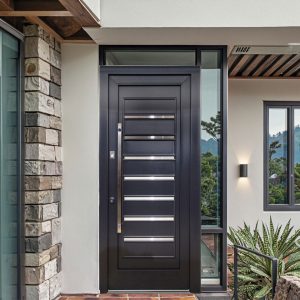
Aluminum is the rational choice for large formats. Slim sightlines, high structural rigidity, and zero rot risk make it ideal for sidelights that span two or three meters. The thermal-break technology — polyamide strips inserted between the interior and exterior aluminum shells — prevents condensation and heat loss.
Our thermal-break aluminum doors and windows are designed for high-rise and luxury villa projects where wind resistance and insulation are non-negotiable. For a beachfront property in Miami, the aluminum frame will outlast any wood alternative against salt corrosion.
But aluminum has a limitation. It is not the warmest aesthetic. If your client wants a classic, heritage look, aluminum can be thermally broken and powder-coated to mimic wood grain, but it will never fully replicate the material warmth of real timber.
Solid Wood and Engineered Wood Aesthetics
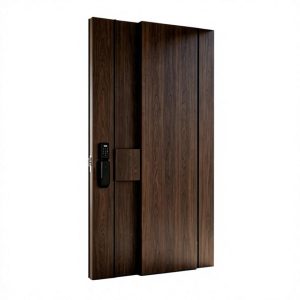
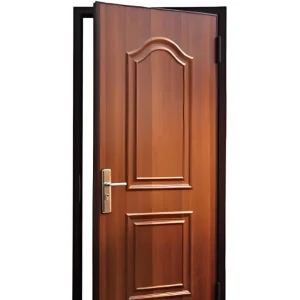
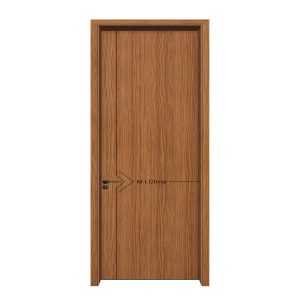
Wood is not always the best option. We say this honestly because we manufacture solid wood doors, and we know their limits. For high-humidity coastal areas, wood requires more maintenance than aluminum. But for heritage renovations, luxury residences, and projects where the entry door is the architectural centerpiece, nothing matches solid wood.
Our solid wood doors line uses engineered wood cores for dimensional stability. A solid wood slab will warp over time; an engineered core with veneer will not. We can produce specific veneers and finishes to match architectural drawings. Our OEM/ODM services allow you to send us a design sketch, and we will build it.
Choose aluminum if: you need slim profiles, large glass expanses, or maximum weather resistance.
Choose wood if: the project demands classic aesthetics and you have a maintenance plan in place.
—
Customization and Hardware: Tailoring to Project Requirements
Every project has a different set of constraints. We do not ask you to fit your specifications into our standard sizes. We adjust our production to fit your opening dimensions.
Glass Options: From Single Glazing to Triple Insulation
The glass in your sidelight determines the U-value, the solar heat gain coefficient, and the acoustic performance. For energy codes in colder climates, triple glazing with two low-E coatings and argon fill is becoming the standard. For warmer regions, a double-glazed unit with a spectrally selective coating reduces cooling loads.
Safety is another layer. Tempered glass shatters into small granules, reducing injury risk. Laminated glass holds together when broken, providing better burglary resistance. For sidelights near entry points, we recommend laminated inner panes and tempered outer panes — a combination that meets both safety and security requirements.
Hardware and Locking Systems
The main door gets a multi-point locking system. But sidelights need locking hardware too. Many buyers overlook this. A sidelight that does not lock independently is a security gap.
We supply adjustable fittings and hardware from global brands to match local building codes and security standards. This includes multi-point locks, hinge-side bolts, and strike plates that align perfectly with our mullion profiles. Hardware finish matters for aesthetic cohesion — matte black, brushed nickel, or bronze. We can match all of them.
One imperfect insight: multi-point locks are not always better. For a sidelight that is rarely opened, a single-point lock with a hardened strike plate is often sufficient and more reliable. More locking points mean more parts that can fail.
—
The Jusen Manufacturing Advantage: Precision and Quality Control
Buyers often ask why they should source from a factory in China rather than a local distributor. The answer is quality consistency at scale.
In-House Production and Testing
Our production process starts with profile cutting and milling, followed by frame assembly, glass installation, and hardware fitting. Every step is checked against the project drawings.
But the critical difference is what happens before the product is crated. We run strict pre-shipment inspection on every door and sidelight unit — air-tightness, water-tightness, and wind resistance tests. These are not random spot checks. Each unit is tested to its specified performance class. If a unit fails, it does not ship. This means fewer site callbacks for you.
Logistics and Compliance Support
The paperwork is often harder than the manufacturing. Customs clearance, certificates of origin, and packing lists can delay a project by weeks if handled poorly.
Our team has rich experience in foreign trade. We provide packing lists, proforma invoices, and full customs documents with every shipment. We also adjust the profile structure and fittings to match the local building codes of your target markets, which simplifies your approval process. For example, a project in Australia requires different wind load ratings than one in Germany. We know these differences and build for them.
—
Why Buy Direct from the Jusen Factory?
The economic case for factory-direct sourcing is straightforward. When you buy from a distributor, you pay for their warehousing, their sales team, and their profit margin. When you buy from us, you pay for the product and the shipping.
Cost Efficiency and Lead Times
Our pricing has no middleman markup because we are the source. We support both FCL and LCL shipments, so we can accommodate projects of varying scale — from a single villa to a large construction project with hundreds of units.
For a recent hotel project in the Philippines, we shipped 340 door and sidelight units in two FCL containers. The buyer saved approximately 18% compared to their previous supplier in Europe, with a comparable quality specification.
—
Frequently Asked Questions
Q: Can you provide custom sizes for non-standard sidelight dimensions?
A: Yes. As a manufacturer, we offer full customization on size. Our engineering team adjusts the profile structure to accommodate your specific opening dimensions, ensuring a perfect fit without standard size restrictions.
Q: How do you ensure the doors and sidelights meet our local energy codes?
A: We understand global compliance is complex. We adjust the profile structure and fittings to match the local building codes of your target markets. Additionally, we can customize the glass composition — low-E coatings, triple glazing, argon filling — to achieve the required U-values and SHGC ratings.
Q: What is your MOQ for a commercial project?
A: We are flexible. We handle both FCL and LCL shipments to optimize logistics for your order volume. For a single villa, we can consolidate with other orders. For a large construction project, we can dedicate full production lines. Contact us with your quantities for a tailored quote.
Q: What documentation do you provide for customs clearance?
A: We provide a complete set of shipping documents, including the packing list, proforma invoice, and full customs documents — Certificate of Origin, Bill of Lading, and any additional forms required by your port.
Q: Can you manufacture doors and sidelights that match a specific architectural design?
A: Absolutely. We specialize in OEM and ODM services. We can work from your architectural drawings or physical samples to create custom aluminum alloy entrance doors or solid wood doors with specific colors, hardware, and glass configurations.
—
Conclusion
Sourcing doors and sidelights requires a partner who understands structural integrity, thermal performance, and international logistics. As a manufacturer, Jusen controls the entire process — from the extrusion of the aluminum profile to the final pre-shipment test. That control translates into consistent quality, honest pricing, and fewer surprises at your job site.
Ready to discuss your project requirements? Let our team provide you with a factory-direct quotation and technical support.
—
References
- Window & Door Manufacturers Association (WDMA). “Hallmark Certification Program.” https://www.wdma.com/
- National Fenestration Rating Council (NFRC). “Understanding U-Factor and SHGC.” https://www.nfrc.org/
- American Architectural Manufacturers Association (AAMA). “AAMA/WDMA/CSA 101/I.S.2/A440-17.” https://aamanet.org/
- International Code Council (ICC). “International Building Code (IBC) — Egress Requirements.” https://www.iccsafe.org/
- Door and Hardware Institute (DHI). “Multi-Point Locking Systems Guide.” https://www.dhi.org/