Content Menu
● 1. Why Wooden Double Entry Doors Are a Strategic Choice for Premium Projects
● 2. Customization Capabilities: Engineering Your Exact Specification
● 3. The Manufacturing Process: Precision, Stability, and Durability
● 4. Critical Testing: Air-Tightness, Water-Tightness, and Wind Resistance
● 5. Navigating Logistics and Compliance for Global Shipment
● 6. Why Partner with a Direct Factory for Your Next Development?
● 7. What You Should Know Before You Order
12 min read
The first question a buyer asks when they walk into our factory in Foshan is rarely about price. They want to know if we can replicate the sample quality at scale. That concern is legitimate. A beautiful prototype tells you nothing about a production run of 200 units.
Wooden double entry doors are the most visible element of a building facade. They are also the most mechanically complex. Two leaves mean two sets of hinges, two locking points, and a meeting stile that must align perfectly for years. If the factory does not control moisture content, joinery precision, and hardware integration, the doors will sag, bind, or leak within a season.
This guide covers what we have learned from supplying wooden double entry doors to contractors and developers across North America, Europe, and the Middle East. We will walk through the technical decisions, the testing protocols, and the logistics that determine whether your project succeeds.
Why Wooden Double Entry Doors Are a Strategic Choice for Premium Projects
The market for grand entrances has shifted. Property developers building luxury villas in the UAE, boutique hotels in Spain, and high-end residences in Florida are all specifying double entry doors. The reason is simple: a wide entrance communicates status in a way a single door cannot.
From our perspective as a factory, the trend means more requests for doors that are six to eight feet wide, with sidelights, transoms, or custom glass inserts. These are not off-the-shelf products. Each unit requires engineering specific to the opening, the climate, and the architectural style.
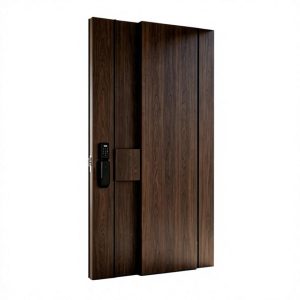
We manufacture solid wood doors and custom villa doors. Our team handles the full spectrum—from classic oak and mahogany to modern thermally-modified woods. You tell us the look you need. We handle the structure behind it.
Aesthetic Versatility and Design Impact
Wood species selection is the first decision. European oak offers a tight grain and uniform color. Sapele provides a rich, reddish-brown tone with excellent stability. Thermally-modified ash gives a contemporary matte finish that performs well in humid environments.
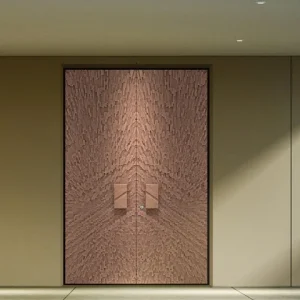
We help our clients match the door to the architectural style. A modern minimalist villa might call for a flush oak door with hidden hinges. A Mediterranean-style home might require a carved mahogany double door with arched glass. Our factory has produced both.
We also match finishes. If your project specifies a RAL color or a specific wood stain, our finishing line can replicate it across multiple units. Color consistency matters when you are supplying doors for a 50-unit development.
Beyond Looks: Thermal Performance and Insulation
Wood is a natural insulator. A 60mm solid wood door leaf has better thermal performance than an equivalent aluminum door without a thermal break. But the weak points are always the glass, the frame, and the seals.
We address this by integrating thermal-break aluminum technology into the frame structure and using double or triple glazing on the glass panels. The result is a wooden double entry door that can meet passive house standards in temperate climates.
For buyers in extreme climates, we recommend specifying the door’s U-value before production. We can adjust the core material, glass specification, and weatherstripping to hit your target.
Customization Capabilities: Engineering Your Exact Specification
Stock sizes do not work for double entry doors. Rough openings vary. Some projects need a 5-foot-wide opening, others need 8 feet. The height can range from 7 feet to 10 feet or more.
Our OEM and ODM services exist for this reason. We do not ask you to fit your building around our catalog. We engineer the door to fit your building.
Sizes, Configurations, and Glass Options
Full customization on size is standard for us. Whether you need a 6-foot-wide or 8-foot-wide double door, we adjust the profile structure accordingly. The challenge with wider doors is structural rigidity. Our engineering team calculates the load on the hinges and the deflection of the meeting stile. We then specify the appropriate hinge count, hinge type, and internal reinforcement.
Glass options are equally flexible. We supply clear, frosted, laminated, or low-E glass. We also handle decorative glass—beveled, leaded, or patterned. For security-conscious buyers, we can fit laminated glass that resists forced entry.
Hardware and Accessory Selection
Double doors require more than just a lock. You need a flush bolt at the bottom of the inactive leaf, a shoot bolt at the top, and a multi-point locking system on the active leaf. We offer full customization on hardware accessories.
Our hardware partners include brands like Hoppe, Siegenia, and Roto. We also source high-end handles from Italian manufacturers when the project demands it. We match hardware to the security requirements of your market. For example, doors destined for Europe typically need a multi-point lock with a euro-profile cylinder. In the US, you might require a deadbolt with a specific ANSI grade.
Color Finishes and Material Grades
The finish is what the client sees every day. We use a multi-layer coating system—stain, sealer, and topcoat—to protect the wood from UV degradation and moisture ingress. Our finishing line can match any RAL color or natural wood tone.
Material grade matters as well. We source wood from certified sustainable suppliers. We reject boards with knots, cracks, or color variation in the visible areas. For structural components, we use finger-jointed or laminated timber to ensure stability.
The Manufacturing Process: Precision, Stability, and Durability
A wooden double entry door is only as good as the manufacturing process behind it. We control every step in our factory. This is what allows us to offer competitive pricing without middleman markup.
The process starts with material selection. We kiln-dry the wood to a moisture content of 8-12%. This is critical. If the moisture content is too high, the door will warp or crack as it acclimates to the destination climate.
Kiln-Drying and Material Preparation
Kiln drying is not a single step. After the initial drying, we let the wood rest in our warehouse to equalize. Then we machine the boards to the required dimensions. We inspect every piece for defects before it enters the production line.
For double doors, we pay special attention to the stiles and rails. These must be straight and true. If they are not, the door will not hang correctly.
Joinery and Assembly Techniques
We use mortise-and-tenon joinery for the frame construction. This method is stronger than dowel or biscuit joinery. The tenon is glued and mechanically fastened, ensuring the joint does not fail under stress.
We also use laminated construction for the core of the door. This involves bonding multiple layers of wood together with alternating grain directions. The result is a door that resists warping and twisting, even in changing humidity.
The glass panels are installed using a dry glazing system. This means the glass is set into a frame with a gasket, rather than being glued. This allows for expansion and contraction without putting pressure on the glass.
Quality Control During Production
We have a two-stage quality control process. The first stage happens during production. Our line inspectors check dimensional tolerance, surface finish, and hardware alignment. We use a laser level to verify that the door is perfectly square.
The second stage is the final inspection before packing. This is where we test the operation of the door—opening and closing it multiple times to ensure smooth movement. We also check the alignment of the meeting stile and the sealing of the weatherstripping.
Critical Testing: Air-Tightness, Water-Tightness, and Wind Resistance
This is where we differentiate ourselves from smaller workshops. Our strict pre-shipment inspection includes air-tightness, water-tightness, and wind resistance tests. These tests are not optional for us. They are part of our standard protocol.
Large wooden double entry doors are particularly vulnerable to air and water leakage. The meeting stile is the weak point. If the seal is not correct, you will get drafts and water ingress during heavy rain.
Simulating Extreme Weather Conditions
We use a test chamber that simulates wind-driven rain and pressure differentials. The door is installed in the chamber, and we spray water at a controlled pressure while applying negative air pressure. This replicates a severe storm.
The test tells us if the door’s seals are effective. If there is any leakage, we identify the source and fix it before the door ships. This is not something we do on a sample basis. Every door that requires the test goes through it.
Structural Integrity and Wind Load
Wind resistance is about more than just the glass. The door frame and the anchoring system must be able to withstand the pressure. Our adjustable profile structure and fittings allow us to reinforce the door for high-wind areas.
For projects in coastal regions or high-rise buildings, we can engineer the door to meet specific wind load requirements. We have supplied doors for projects in Miami-Dade County, which has some of the strictest building codes in the US. Our team knows how to configure the frame and glass to meet those standards.
Pre-Shipment Inspection Protocols
The final inspection checks every aspect of the door. We verify the glass is free of scratches. We test the hardware function—locks, handles, and hinges. We check the surface finish for any imperfections.
We also inspect the packaging. A door that arrives damaged is a problem for you and for us. Our export-grade packaging uses a wooden crate with foam padding and a waterproof barrier. The glass is protected with bubble wrap and corner guards.
Navigating Logistics and Compliance for Global Shipment
Importing from China is straightforward if the factory knows what it is doing. We have rich experience in foreign trade. We handle FCL and LCL shipments, and we provide all the necessary documentation.
The paperwork is where many buyers get stuck. You need a packing list, a proforma invoice, and a bill of lading. You may also need a certificate of origin or a fumigation certificate.
Documentation and Customs Clearance
Our export department prepares the packing list and proforma invoice with precision. We ensure the HTS codes are correct and the declared values are accurate. We also provide the full customs documents required for clearance at your destination port.
We work with experienced freight forwarders who know the routes to North America, Europe, and the Middle East. We coordinate the booking, the container loading, and the documentation to ensure a smooth process.
Packaging for Transit
We design our packaging for the worst-case scenario. The door is wrapped in a moisture-proof film. It is then placed in a wooden frame with foam blocks that hold it in place. The glass panels are protected with a separate layer of foam and cardboard.
We have shipped thousands of doors this way. The damage rate is minimal. If a door does arrive damaged, we work with you to file a claim and arrange a replacement.
Adjusting to Local Building Codes
Building codes vary significantly across markets. A door that passes a European test may not pass a US test. Our engineering team can adjust the profile structure and fittings to match local building codes.
For example, we can configure the door with a specific fire rating. This is not just about the wood thickness. The frame, the seal, and the hardware all play a role. We work with our clients to understand the requirements and engineer the door accordingly.
Why Partner with a Direct Factory for Your Next Development?
The decision to source from a direct factory versus a trading company comes down to two things: cost and control.
When you buy from us, you are buying from the manufacturer. There is no middleman markup. This gives you a price advantage that you can pass on to your client or use to improve your margin.
Cost Efficiency and Supply Chain Control
Direct factory supply also means you have control over the production process. You can visit the factory, inspect the quality, and communicate directly with the engineers. You are not relying on a third party to relay your requirements.
We offer competitive pricing without sacrificing quality. Our factory overhead is managed carefully, and we have long-term relationships with our material suppliers. This allows us to keep our costs down while maintaining high standards.
Bulk Supply for Construction Projects
We handle construction project bulk supply. This means we can produce hundreds of doors with consistent quality. Our production planning ensures that we meet your delivery schedule, even for large orders.
We also understand the importance of spare parts. We keep a small inventory of hardware and glass for each project, just in case a unit is damaged during installation. This is a service we offer to our bulk customers, and it saves them time and money in the long run.
What You Should Know Before You Order
There is one honest caveat we share with every buyer. Wooden double entry doors are not the cheapest option. A well-made wood door will cost more than a steel or fiberglass door. The trade-off is aesthetic value and thermal performance.
For high-humidity areas, buyers should prioritize moisture resistance over appearance. That means choosing a species like teak or thermally-modified ash over a more decorative but less stable wood. We will give you this advice even if it means a smaller order. We would rather have a client who is happy with the door’s performance than one who is unhappy with a warped product.
Another point: fire-rated doors are not simply about thicker slabs. The frame, the seal, and the hardware matter just as much. If your project requires a fire rating, we need to know the specific standard early in the process. Retrofitting a fire-resistant seal after production is difficult and expensive.
Frequently Asked Questions
Can you customize the size of a wooden double entry door for a specific rough opening?
Yes. As a direct factory, we offer full customization on size. We manufacture wooden double entry doors to your exact specifications, ensuring a perfect fit for your architectural plans. We need the exact width, height, and wall thickness of the opening.
What is the MOQ for bulk orders of wooden double entry doors?
Our MOQ is flexible and depends on the specific model and customization level. For standard models, we can accommodate smaller quantities. For fully custom doors, a minimum of 10 units is typical. We encourage you to Contact Our Team with your project volume so we can provide a tailored quotation.
How do you ensure the doors are water-tight and air-tight?
We conduct strict pre-shipment inspections that include air-tightness, water-tightness, and wind resistance tests. This ensures our doors perform to high standards and meet the requirements of your local building codes. We do not ship a door that fails these tests.
Do you provide OEM or ODM services for a private label brand?
Absolutely. We provide OEM, ODM, and Private Label services. We can adapt our existing designs or build a custom solution based on your drawings and specifications. You can use your own hardware and finish, or we can supply our standard options.
What documentation do you provide for customs clearance during international shipping?
We have rich experience in foreign trade. We provide a packing list, proforma invoice, and full customs documentation, including the Bill of Lading and Certificate of Origin when applicable. This ensures smooth shipping and delivery to your port.
Decision Guide
Choose a direct factory partner if you need custom sizes, bulk supply, or specific compliance testing. Choose a local distributor if you need a single door immediately and are willing to pay a premium for convenience.
Choose wood if the project demands high aesthetic value and thermal performance. Choose aluminum or steel if the project is on a tight budget or is in an area with extreme weather conditions.
Choose a manufacturer that offers pre-shipment testing if the door will be exposed to severe weather. Choose a simpler supplier if the door is for an interior application.
References
- Timber Development UK. “Moisture Content and Wood Stability.” https://timberdevelopment.uk/resources/moisture-content/
- American Architectural Manufacturers Association (AAMA). “Testing Standards for Windows and Doors.” https://aamanet.org/
- Passive House Institute. “Component Certification: Windows and Doors.” https://passivehouse.com/
- US Department of Energy. “Energy-Efficient Window and Door Selection.” https://www.energy.gov/energysaver/energy-efficient-window-coverings
- Miami-Dade County. “Product Control and Building Codes.” https://www.miamidade.gov/building/product-control.asp
- European Committee for Standardization. “EN 14351-1: Windows and Doors – Product Standard.” https://www.cen.eu/
—
https://doorwoodendoors.com/contact-us/” style=”display:inline-block;padding:12px 24px;background:#2563eb;color:#fff;text-decoration:none;border-radius:6px;font-weight:600″>Get a Free Quote