Content Menu
● 1. Why Architects Are Switching to “Wood Look” Aluminum Exterior Doors
● 2. Customization Options: Tailoring Wood Look Doors to Your Project Specs
● 3. The Jusen Difference: Inside Our Factory and Quality Assurance
● 4. Applications: Where Do Wood Look Exterior Doors Excel?
● 5. Frequently Asked Questions
8 min read
When a client in Miami asked us for a 12-foot pivot door that could withstand a Category 4 hurricane, they had one condition: it had to look like walnut. Not painted metal. Not a veneer over steel. Real walnut grain, up close, where the finish meets the sun.
We shipped that door with thermal-break profiles, multi-layer wood-grain transfer, and test reports showing it passed air-tightness at 600 Pa. That project taught us something we now apply to every wood look door that leaves our factory: the finish is not decoration. It is performance.
Here is what we have learned about wood look exterior doors, from the factory floor to the construction site.
Why Architects Are Switching to “Wood Look” Aluminum Exterior Doors
The demand for wood look doors is not about aesthetics alone. It is about eliminating the callbacks that plague traditional timber entrances.
The Structural Limitations of Solid Wood
Solid wood doors have a fundamental problem: they move. Wood expands with humidity, contracts with dryness, and warps when the sun hits one side more than the other. UV radiation breaks down the finish, and moisture ingress causes the frame to swell.
Our early work in the solid wood door segment showed us the maintenance burden contractors face. A beautiful mahogany door requires refinishing every two to three years. In coastal climates, that cycle shortens. The labor cost alone often exceeds the price difference between wood and aluminum.
The Performance Advantages of Thermal-Break Aluminum
Aluminum does not swell, warp, or rot. But raw aluminum conducts heat, which is why our thermal-break aluminum doors and windows use a polyamide strip to separate the interior and exterior frames. This simple engineering decision reduces thermal transfer by up to 70% compared to non-thermal profiles.
The benefits go beyond energy bills. The thermal break also prevents condensation on the interior frame during winter, which would otherwise damage flooring and walls. For specifiers, this means fewer moisture-related complaints and a longer service life for the entire entrance system.
The Aesthetic Evolution of Wood Grain Finishing
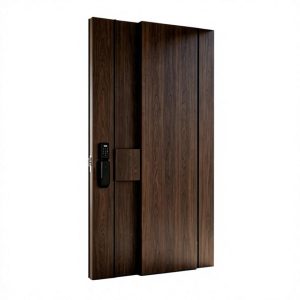
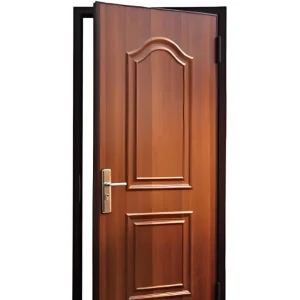
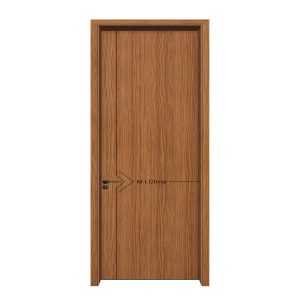
The wood grain finish on our aluminum alloy entrance doors is not a sticker. We use a two-step process: powder coating the base color, then applying a wood-grain transfer film under heat and vacuum. The film sublimates into the powder coat layer, creating a surface that is physically part of the aluminum.
This is why the finish does not peel. It is why we can offer oak, walnut, teak, and rosewood patterns that match the texture of real timber, down to the pores. The grain is not printed on the surface. It is embedded in it.
Customization Options: Tailoring Wood Look Doors to Your Project Specs
Every villa and commercial project has unique requirements. Our production line is built to handle them.
Beyond Standard Sizes: Custom Dimensions for Unique Openings
Luxury projects rarely use standard door sizes. A grand entrance might be 10 feet tall, or the opening could be asymmetrical with sidelights. We handle full customization on size without charging for tooling changes. Our CNC cutting and welding stations are programmed per order, not per product line. You send architectural drawings; we produce the profiles.
Integrating Glass and Hardware: The Complete System
A wood look door is not just a slab. It is a system that includes glazing, hardware, and sealing. We offer double glazing, Low-E glass, and obscure glass for privacy. Hardware finishes — matte black, brushed gold, stainless steel — are selected to complement the wood grain.
Our engineering team helps you choose the right glass and hardware for wind load requirements and security ratings. For high-rise projects, we calculate the glass thickness based on the building’s height and local wind codes. This integration prevents the common problem of mismatched components that fail at the joints.
OEM, ODM, and Private Label: Building Your Brand
Contractors and distributors often want to sell doors under their own brand. Our OEM and ODM services cover this. We apply your logo to the hardware, use your specified packaging, and even adjust the profile design to differentiate your product line.
You leverage our factory capacity without investing in machinery or training. We have seen small distributors grow into regional brands this way, simply by controlling the sales and marketing while we handle production.
The Jusen Difference: Inside Our Factory and Quality Assurance
Buying doors from overseas requires trust. Here is how we earn it.
Direct Factory Supply: Eliminating the Middleman
When you work with us, you are working with the manufacturer. There is no trading company in between, no agent taking a commission. This means direct supply from our factory, competitive price without middleman markup. It also means faster communication. A design change requested on Monday is in production by Wednesday, not bounced between three companies.
The Pre-Shipment Inspection Process: Ensuring Quality
International buyers cannot easily inspect goods before shipment. That is why we run strict pre-shipment inspections on every batch. Each wood look door undergoes air-tightness, water-tightness, and wind resistance tests before packing.
The water-tightness test is particularly revealing. We spray the door at increasing pressure until water penetrates, and we document the exact pressure level. This data goes into your test report, so you know precisely what the door can withstand. We do not claim “weatherproof” as a marketing term; we provide the numbers.
Global Logistics and Compliance: From Our Factory to Your Site
Our rich experience in foreign trade means you do not need to figure out customs clearance alone. We provide the packing list, proforma invoice, and full customs documents required for your port. We arrange FCL & LCL shipments and deliver directly from our China factory to your destination.
One thing many overseas buyers overlook is local building code compliance. Our engineering team can adjust profile structures and fittings to match local building codes in your target market. We have done this for projects in Europe, North America, and the Middle East, where wind load and energy efficiency standards differ significantly.
Applications: Where Do Wood Look Exterior Doors Excel?
The product range varies by project type, and we tailor production accordingly.
Luxury Villa & Residential Projects
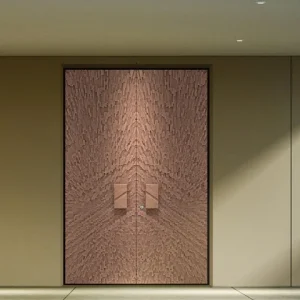
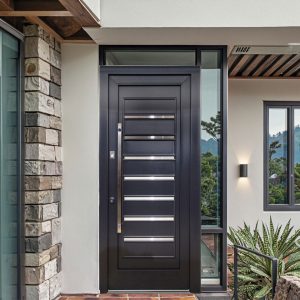
For high-end homes, the entrance door sets the tone. Large pivot doors, double doors, and custom sidelights create the “wow” factor clients expect. Our custom villa doors and windows and casement doors complement the main entrance, ensuring a consistent aesthetic across the entire facade.
Commercial Spaces & Storefronts
High-traffic areas demand durability. The scratch resistance of our aluminum finish matters here. A wood door in a restaurant entrance will show scuffs within months. Our wood look aluminum doors maintain their appearance for years, even with constant use. For construction projects, we handle bulk supply with consistent quality across the entire development. We have shipped hundreds of identical doors for hotel and apartment projects, and the finish matches from the first unit to the last.
Sunrooms & Transitional Spaces
Wood look doors also work well in sunrooms and as sliding doors connecting indoor and outdoor living spaces. The thermal break keeps the interior comfortable, while the wood grain finish ties the space to the natural surroundings.
Frequently Asked Questions
Are wood look aluminum doors more expensive than real wood doors?
The initial cost is comparable to mid-range hardwood. But the total cost of ownership is significantly lower. Wood doors require refinishing every few years, which costs hundreds of dollars per door in labor. Aluminum doors need no painting or sealing. Over a 10-year period, the aluminum door is almost always cheaper. Our factory-direct pricing also removes the middleman markup that inflates imported door costs.
How long does the wood grain finish last? Will it fade?
The powder coat and transfer film are UV-resistant. We have doors installed in Arizona and Dubai that show no significant fading after five years. The finish is also scratch-resistant up to a certain hardness level. It is not indestructible, but it outperforms painted wood by a wide margin. We guarantee the finish against fading and chipping for the warranty period, which varies by project.
Can you match the color of my specific wood veneer or interior trim?
Yes. Send us a sample, a Pantone code, or a photo of the interior trim. Our color lab will match the wood grain finish to your specification. We can produce small color samples for your design team to approve before full production. This is part of our full customization service, and it ensures the exterior door aligns with the interior design.
What is the typical lead time for a bulk order?
For a standard order of 50 to 100 doors, lead time is typically 25 to 35 days. This includes production and the pre-shipment inspection (air-tightness, water-tightness, wind resistance test). Custom profiles or unique hardware can extend this by a week. We provide accurate scheduling updates throughout production, so you know exactly when to arrange shipping.
What documentation do you provide for customs clearance?
We provide a complete export package: commercial invoice, packing list, bill of lading, and certificates of origin when required. For projects needing specific compliance documents, we work with your customs broker to supply the necessary paperwork. Our foreign trade experience ensures the documentation matches the requirements of your destination country.
Choosing the Right Door System
Here is a practical decision guide based on our project experience.
Choose a wood look aluminum door if:
- The project is in a coastal or high-humidity area where wood warps
- The client wants minimal maintenance over 10+ years
- You need large, slim frames that maximize glass area
- The building must meet strict energy efficiency codes
Choose real wood if:
- The client insists on authentic timber texture and is willing to maintain it
- The project is interior or protected from direct weather exposure
- Budget allows for periodic refinishing and potential replacement
For most exterior applications, the aluminum system wins on performance and lifecycle cost. The wood look finish gives you the aesthetic without the liability.
Conclusion
Wood look exterior doors are not a compromise. They are an upgrade in durability, energy efficiency, and long-term value. The key is working with a manufacturer who understands the engineering behind the finish — not just the appearance.
We have spent years refining our thermal-break profiles, wood-grain transfer process, and pre-shipment testing. We know what these doors can do, and we know their limits. That honesty is why contractors return to us for their next project.
Ready to specify wood look doors for your next project? Contact Our Team to discuss your architectural drawings and sourcing requirements.
References
[1] https://doorwoodendoors.com/
[2] https://doorwoodendoors.com/contact-us/
[3] https://www.energy.gov/energysaver/energy-efficient-windows
[4] https://www.finehomebuilding.com/project-guides/doors/window-and-door-installation
[5] https://www.wdma.com/