
Content Menu
● 1. Wooden Front Double Doors: Factory Capabilities, Engineering, and Export Reality from Jusen
● 2. Why Wooden Front Double Doors Demand a Different Manufacturing Approach
● 3. Our Factory Capabilities: Engineering Double Doors That Do Not Sag
● 4. Customization Options: Tailoring Double Doors to Project Specs
● 5. Quality Assurance: The Jusen Pre-Shipment Protocol
● 6. Logistics and Export: Simplifying Global Procurement
● 7. Frequently Asked Questions
● 8. Decision Guide: Choosing the Right Double Door Configuration
11 min read
Wooden Front Double Doors: Factory Capabilities, Engineering, and Export Reality from Jusen
The last container we loaded with wooden front double doors had a problem that had nothing to do with the doors themselves. The buyer’s freight forwarder had specified a 40-foot high cube, but the doors were 2.4 meters tall with full lite glass inserts. We re-arranged the crating scheme, reduced the packaging footprint by 12 percent, and made the container work. That is the kind of conversation you have when you buy directly from a factory that actually packs its own products.
Most procurement managers I meet understand the visual appeal of a grand double entrance. What they underestimate is the engineering required to make two large wooden slabs function flawlessly for decades. This article is not a sales brochure. It is a technical walkthrough of how our factory approaches wooden front double doors, where the pitfalls are, and what you need to specify to avoid them.
—
Why Wooden Front Double Doors Demand a Different Manufacturing Approach
A single door leaf of 900mm width has a straightforward load path. Double that width and the physics change completely. The bottom hinge carries significantly more weight. The top rail is subjected to greater torsional stress when the door is opened and closed repeatedly. The center meeting stile—where the two leaves join—becomes the critical sealing point that determines whether your building passes an air infiltration test or fails it.
The Architectural Payoff of a Double Entry
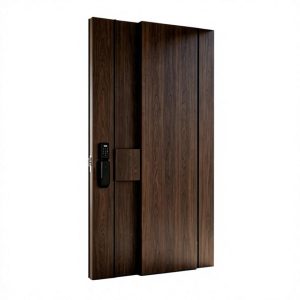
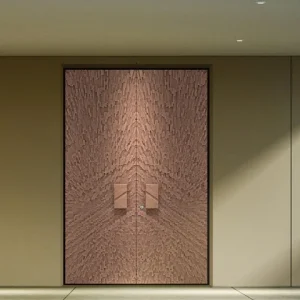
Symmetry matters in facade design. Architects specify double doors for villas, boutique hotels, and high-end commercial storefronts because the human eye reads balance as quality. When we supply wooden front double doors for custom villa doors and windows projects, we are not just delivering two slabs of timber. We are delivering the focal point of the entire elevation.
Our team frequently advises clients on how double entry doors interact with adjacent fenestration. A double door with sidelites, flanked by thermal-break aluminum windows, creates a cohesive facade system. If the door and window profiles are sourced from different manufacturers with different color finishes, the visual mismatch becomes immediately apparent. That is why we produce both wooden doors and aluminum system windows under one roof—to ensure color consistency and hardware coordination across the entire entrance assembly.
Functionality Beyond Aesthetics
Double doors solve a practical problem that single doors cannot. Moving furniture, equipment, or large artwork through a 900mm opening requires careful angling. A double door with an active leaf and a fixed or passive leaf opens to a full 1800mm clear width. For commercial spaces with accessibility requirements, the wider opening simplifies compliance with egress codes.
Both leaves can be specified with multi-point locking systems. We recommend this even for the passive leaf, because a door that cannot be secured independently creates a security vulnerability. Our hardware customization extends to panic bars, floor springs, and concealed hinges—whatever your local building code demands.
Solid Wood vs. Engineered Wood: The Trade-Off Nobody Talks About
Here is an imperfect insight that most marketing materials will not tell you: solid wood double doors look magnificent but they are not always the right choice. Solid timber expands and contracts with humidity changes. A 2400mm tall solid wood door can move 6-8mm across its width between dry winter and humid summer conditions. If the design does not accommodate that movement, the door will bind, warp, or split.
Engineered wood—laminated veneer lumber or plywood cores with veneer faces—offers dimensional stability that solid wood cannot match. The trade-off is a slightly less “premium” feel when you knock on the panel. Many of our B2B clients choose engineered cores for the passive leaf and solid wood for the active leaf, balancing aesthetics with function.
In our factory, we offer full customization on material grade and thickness. We will walk you through the wood species options—Sapele, Oak, Mahogany, or European White Oak—and recommend the right construction for your climate zone. For coastal projects with high humidity, we steer clients toward engineered cores with moisture-resistant adhesives. For interior applications in climate-controlled buildings, solid wood remains a viable option.
—
Our Factory Capabilities: Engineering Double Doors That Do Not Sag
The number one complaint about double doors is sagging. The active leaf drops over time, the bottom corner scrapes the threshold, and the lock no longer aligns. This failure mode is almost always a design problem, not an installation problem.
Structural Integrity for Wide Spans
Our approach to preventing sag starts with the core. We use kiln-dried timber with moisture content between 8-12 percent. The stiles and rails are joined with floating tenons rather than dowels—floating tenons provide three times the glue surface area of a dowel joint, which translates directly into joint strength.
For doors exceeding 2200mm in height, we integrate a concealed aluminum or steel reinforcement channel into the lock stile. This reinforcement carries the weight of the locking mechanism and prevents the stile from twisting under repeated use. The reinforcement is adjustable during production, which is part of our adjustable profile structure—we adapt the internal bracing to match the wind load requirements of your target market. A double door destined for a coastal high-rise in Miami receives different internal reinforcement than one heading to a sheltered courtyard in the UK.
Precision Hardware Integration
Double doors place enormous stress on hinges. A standard residential hinge rated for 60kg is insufficient for a 100kg door leaf. We specify heavy-duty ball-bearing hinges with a load rating of at least 150kg per pair for double door applications. For commercial projects, we recommend floor springs or pivot hinges, which distribute the weight across the top and bottom of the door rather than concentrating it on the side jamb.
Our full customization on hardware accessories means we source and install premium European hardware—multi-point locks from reputable brands, concealed hinges, magnetic door stops—based on your budget and security requirements. We pre-install the hardware at the factory, which eliminates the alignment problems that occur when hardware is installed on-site by different trades.
Thermal and Weather Performance
The center gap between two door leaves is the weakest point in the building envelope. If the meeting stile does not have an effective seal, air and water will infiltrate. We use a combination of compression seals and weatherstripping on the meeting stile, with an interlocking design that creates a labyrinth path for water to travel before it can enter the building.
Every batch of double doors undergoes our strict pre-shipment inspection for air-tightness, water-tightness, and wind resistance. We test to recognized standards and provide the test reports to our clients. These reports serve as evidence that the doors meet the performance requirements of your local building codes.
—
Customization Options: Tailoring Double Doors to Project Specs
No two projects are identical. A developer building twenty luxury villas needs consistency across all units. An architect designing a single signature residence needs one perfect door. Our OEM and ODM services accommodate both scenarios.
Glass and Glazing Configurations
The glazing options for double doors are extensive. Single pane with decorative grids for a traditional look. Double glazing with low-E coating for energy efficiency. Impact-resistant laminated glass for hurricane zones. Frosted or patterned glass for privacy applications.
We offer full customization on glass. The glazing is fabricated and installed in our factory before the door is crated. This ensures the glass is properly seated and sealed, and it eliminates the risk of glass damage during on-site installation.
Color, Finish, and Wood Species
The finish on a wooden door determines its appearance and its longevity. We offer full customization on color, from transparent stains that highlight the wood grain to opaque paints in any custom color. Our finishing line applies UV-resistant coatings that prevent fading and degradation during long sea freight transit. Doors that sit in a container for six weeks in tropical heat need a finish that can withstand that environment.
Private Label and OEM Manufacturing
Many of our clients are importers who sell under their own brand name. We support OEM and Private Label services. Your logo can be applied to the hardware, the packaging, and the documentation. The doors arrive ready for your market, branded as your product. For clients who prefer to sell under the Jusen brand, we support that as well. The choice is yours.
—
Quality Assurance: The Jusen Pre-Shipment Protocol
Buying doors from overseas involves a leap of faith. You cannot walk into our factory and inspect every batch personally. Our quality assurance protocol is designed to minimize your risk.
The Three-Test Standard
Every batch of wooden front double doors undergoes testing for air-tightness, water-tightness, and wind resistance. These tests are not performed on a sample door. They are performed on doors selected at random from your production batch. The test results are documented and provided to you before shipment.
The air-tightness test measures the volume of air that leaks through the closed door under a specific pressure differential. The water-tightness test sprays water at the door under simulated wind pressure to verify that no water penetrates the interior. The wind resistance test subjects the door to high wind loads to verify structural integrity.
These tests are particularly important for double doors because the center meeting stile is a potential weak point. A door that passes these tests has been verified to perform under real-world conditions.
Inspection and Packing Standards
Damage during transit is a leading cause of claims and disputes. We prevent this through rigorous packing standards. Each door is wrapped in a protective film, then placed in a wooden crate with foam corner protectors. The crates are designed to allow stacking without transferring load to the door surface. Desiccant packs are included to absorb moisture during transit.
We have rich experience in foreign trade. We provide a detailed packing list that documents the contents of every crate, the dimensions, and the weight. This documentation simplifies customs clearance and allows your receiving team to verify the shipment against the packing list.
—
Logistics and Export: Simplifying Global Procurement
International procurement involves more than just placing an order. You need to manage shipping, customs, and documentation.
Shipping Methods: FCL vs. LCL
For large orders of double doors, Full Container Load (FCL) is often the most cost-effective and safest option. The container is sealed at our factory and not opened until it reaches your destination. This reduces the risk of damage and theft during transit.
For smaller orders, Less than Container Load (LCL) allows you to share container space with other shipments. LCL is more flexible but involves additional handling, which increases the risk of damage. We offer both FCL and LCL shipment, directly from our China factory.
Documentation and Customs Support
Our team provides proforma invoices for deposit payments and full customs documents for clearance. We handle the export logistics so you can focus on installation and sales. The documentation includes the commercial invoice, packing list, bill of lading, and any certificates of origin required by your country.
MOQ and Lead Times
We cater to construction project bulk supply, supporting large developments with consistent quality across hundreds of doors. We also support smaller pilot projects for first-time B2B partners. The MOQ is flexible depending on the complexity of the customization. Contact our team to discuss current production lead times for customized wooden double doors.
—
Frequently Asked Questions
Can you manufacture wooden front double doors with an aluminum thermal-break frame?
Yes, we offer hybrid solutions combining solid wood interiors with our thermal-break aluminum cladding for exterior durability. This approach provides the aesthetics of wood with the performance of aluminum, which is particularly suitable for coastal environments or high-rise applications where weather resistance is critical.
How do you prevent the doors from warping during sea shipment?
We use engineered cores and kiln-dried wood with controlled moisture content. Our strict pre-shipment inspection includes moisture content checks. We pack with desiccant packs to protect against humidity during FCL or LCL transit. The crating is designed to allow air circulation while protecting the door surface from physical damage.
What is your MOQ for custom-sized double doors?
Our MOQ is flexible depending on the complexity of the customization. We encourage you to send an inquiry with your dimensions. We often accommodate lower MOQs for first-time B2B partners to allow them to test the market before committing to larger volumes.
Do you offer hardware kits or do we buy them locally?
We offer full customization on hardware accessories. We can supply the complete hardware kit pre-installed or pre-drilled to match local building codes. Pre-installing the hardware ensures perfect alignment and eliminates the labor cost of on-site installation.
Can you adapt the door design to meet European or North American building codes?
Absolutely. Our adjustable profile structure and fittings are designed to be modified to match the specific wind load, air-tightness, and egress requirements of your target market. We have experience exporting globally and understand the regulatory landscape in major markets.
What wood species do you recommend for double doors?
The answer depends on your climate and aesthetic preferences. Sapele and Mahogany offer excellent stability and a rich, dark appearance. Oak is harder and more durable but has a lighter color. European White Oak has a distinctive grain pattern that appeals to high-end residential projects. We will guide you based on your project requirements.
—
Decision Guide: Choosing the Right Double Door Configuration
Choose solid wood double doors if:
- The doors are for interior applications in climate-controlled environments
- Aesthetic authenticity is the top priority
- Budget allows for premium materials
- The building has a traditional or classic architectural style
Choose engineered wood double doors if:
- The doors are for exterior applications exposed to weather
- The project is located in a high-humidity or coastal climate
- Dimensional stability is more important than authentic wood feel
- The doors exceed 2400mm in height and require extra structural support
Choose a hybrid wood-aluminum configuration if:
- The doors face extreme weather conditions
- The project requires high thermal performance ratings
- The exterior appearance must be low-maintenance
- The design calls for large glazing areas that need aluminum reinforcement
—
Final Thoughts
Wooden front double doors are a significant investment. When sourced correctly from a factory that understands structural engineering, hardware integration, and export logistics, they deliver decades of reliable service. When sourced poorly, they become a recurring maintenance problem.
Our factory in China has the production lines, the engineering team, and the export experience to deliver double doors that meet international standards. We offer direct factory pricing without middleman markup. We offer full customization on size, color, glass, and hardware. We test every batch for air-tightness, water-tightness, and wind resistance.
If you are planning a project that requires wooden front double doors, we would welcome the opportunity to discuss your specifications.
—
References
[1] Wood Products Council. (2023). “Moisture Content and Wood Movement.” WoodWorks. https://www.woodworks.org/design-tools/moisture-content/
[2] Window & Door Manufacturers Association. (2022). “AAMA/WDMA/CSA 101/I.S.2/A440: North American Fenestration Standard.” WDMA. https://www.wdma.com/technical-resources/
[3] American Architectural Manufacturers Association. (2021). “AAMA/WDMA/CSA 101/I.S.2/A440-17.” AAMA. https://www.aamanet.org/
[4] International Code Council. (2021). “International Building Code: Chapter 10 Means of Egress.” ICC. https://codes.iccsafe.org/content/IBC2021P1/chapter-10-means-of-egress
[5] Forest Products Laboratory. (2020). “Wood Handbook: Wood as an Engineering Material.” USDA Forest Service. https://www.fpl.fs.usda.gov/products/publications/software/wood_handbook.php