
Content Menu
● 1. Wood and Glass Entry Doors: Factory-Direct Custom Solutions for Your Next Project
● 2. What Are Wood and Glass Entry Doors? Understanding the Product Category
● 3. Our Manufacturing Process: From Raw Timber to Finished Entry Door
● 4. Customization Options for Wood and Glass Entry Doors
● 5. Quality Assurance: Pre-Shipment Testing and Inspection Protocols
● 6. Logistics and Shipping: How We Deliver to Your Project Site
● 7. Why Partner with Jusen Door and Windows for Your Entry Door Supply
● 8. Frequently Asked Questions About Wood and Glass Entry Doors
17 min read
Wood and Glass Entry Doors: Factory-Direct Custom Solutions for Your Next Project
The last container we loaded left our factory in Foshan at 4:30 PM on a Thursday. Inside were 86 custom mahogany entry doors with double-glazed low-E glass, each one bound for a hotel development in Dubai. The client’s architect had specified a bronze finish that took our finishing team three rounds of samples to match. That level of precision is not exceptional for us — it is the baseline. When you order wood and glass entry doors from a factory that has been doing this for over a decade, you are not buying a product. You are buying a process that has been refined through hundreds of international shipments.
Our factory, Jusen Door and Windows Manufacturing Co., Ltd., produces solid wood doors, thermal-break aluminum windows, and custom villa entrances for B2B clients across North America, Europe, the Middle East, and Southeast Asia. We sell directly from the factory floor — no trading company in between, no markup added for someone who simply forwards your email. What follows is a detailed look at how we manufacture wood and glass entry doors, what you can customize, and how we ensure the doors you receive match the samples you approved.
Contact Our Team to discuss your project requirements.
What Are Wood and Glass Entry Doors? Understanding the Product Category
The Anatomy of a Modern Wood and Glass Entry Door
A wood and glass entry door is not a wooden slab with a window cut into it. The construction matters far more than the visual impression. We build these doors with a solid wood frame — typically oak, mahogany, walnut, or teak — that carries the structural load. The glass panels are insulated units (IGUs) that sit within the frame, sealed to prevent air infiltration and condensation between panes. The wood species you choose affects more than appearance. Mahogany offers superior dimensional stability in humid climates. Oak is harder and resists impact damage. Teak contains natural oils that repel moisture but costs significantly more per cubic meter. We stock all of them, and we will tell you honestly which species fits your project’s climate and budget — sometimes the cheaper option is the smarter one.
The glass options are equally varied. Double-glazed units with low-E coatings reflect solar heat while allowing visible light through. Tempered glass is four to five times stronger than annealed glass of the same thickness. Laminated glass holds together when shattered, which matters for security applications. Frosted or patterned glass provides privacy without sacrificing natural light. We combine these elements based on your requirements, not a fixed menu.
Popular Styles and Configurations We Manufacture
Our production line handles a broad range of configurations. Single entry doors are the most common, but we also manufacture double doors (French-style), single doors with sidelights, and configurations with transom windows above the door. Modern minimalist designs with narrow stiles and large glass panels are increasingly popular for contemporary villas. Traditional paneled styles with smaller glass inserts remain the standard for classic architecture. We produce both, and we produce hybrid designs that blend elements of each.
The same facility that makes your wood and glass entry doors also produces aluminum alloy entrance doors and thermal-break aluminum windows. This matters for one practical reason: if your project requires a consistent aesthetic across all openings, you can source everything from one factory. The color matching between the wood door’s frame and the aluminum windows’ powder coating is coordinated in-house, not left to chance.
Why B2B Buyers Choose Wood and Glass Over Other Materials
Wood and glass entry doors occupy a specific position in the market. Steel doors are stronger but offer limited aesthetic flexibility. Fiberglass doors resist moisture but lack the natural warmth of wood grain. For residential and hospitality projects where the entrance sets the tone for the entire building, wood and glass provides a perceived value that other materials cannot replicate. The combination also allows for true customization — you are not limited to the standard sizes and finishes that dominate steel and fiberglass catalogs. We can produce a door that matches your architectural drawings exactly, whether that means a 1.2-meter-wide single door or a 3-meter double door with arched tops.
One honest caveat: wood and glass entry doors require more maintenance than aluminum or steel alternatives. The wood finish needs periodic refinishing in harsh climates, and the glass-to-wood seals must be inspected over time. For buyers who prioritize low maintenance above all else, an aluminum door might be the better choice. We manufacture those too, so we can advise you objectively.
Our Manufacturing Process: From Raw Timber to Finished Entry Door
Timber Selection, Seasoning, and Preparation
The process starts with timber selection. We source hardwood from suppliers in Southeast Asia, West Africa, and South America, depending on the species and the project’s requirements. Every batch of lumber is inspected for defects — knots, cracks, insect damage — before it enters our kilns. The kiln-drying process reduces moisture content to 8-12%, depending on your destination market’s climate. This step is critical. Wood that ships with excessive moisture will warp, crack, or develop mold during ocean transit. Wood that is over-dried becomes brittle and difficult to machine.
Our profile structure is adjustable. This is not a marketing phrase — it means we can engineer the door’s frame geometry to match local building codes in your target market. If your project requires specific thermal performance ratings or wind load resistance, we adjust the profile dimensions and reinforcement accordingly. This capability comes from years of exporting to markets with different regulatory frameworks.
Precision Machining and Frame Assembly
Once the timber is seasoned, it moves to our CNC machining center. The CNC router cuts the frame components to precise dimensions — we work to tolerances of ±0.5mm on critical joints. The joinery is mortise-and-tenon, reinforced with waterproof adhesive and mechanical fasteners. We do not use staples or nails for structural joints. Glass seating channels are routed with precision so the insulated glass unit fits snugly without pressure points that could cause stress fractures.
Our team has experience producing both solid wood doors and wood-clad aluminum systems. The latter combines a wood interior surface with an aluminum exterior shell, offering the warmth of wood inside and the durability of aluminum outside. For coastal projects where salt air corrodes unprotected wood finishes, this hybrid approach is often the practical solution.
Glass Preparation and Sealing Technology
Glass cutting and edging are performed by our partner facilities, but the insulated glass unit assembly happens in our workshop. We assemble the IGUs with desiccant-filled spacers and dual-sealant systems — the primary seal is butyl, the secondary is structural silicone. This combination prevents moisture infiltration and argon gas leakage in double-glazed units. The glass is integrated into the wood frame with setting blocks and a weather seal that allows for thermal expansion without compromising the airtightness.
Proper drainage and ventilation are engineered into the frame. Weeps at the bottom of the glass channels allow any condensation to escape, while the seal prevents water from entering the interior cavity. This detail is often overlooked by less experienced manufacturers, leading to premature seal failure and foggy glass.
Surface Finishing and Hardware Installation
The finishing process begins with sanding — multiple passes from coarse to fine grit. We then apply stain or paint, followed by a UV-cured topcoat that provides superior scratch resistance compared to conventional lacquers. Color matching is done against your approved sample, and we keep a physical reference of every finish we produce. For large projects, we recommend ordering all doors in one production run to ensure consistent color across the entire batch.
Hardware installation is performed in-house. Hinges, locks, handles, closers, and multi-point locking systems are fitted and tested before the door is packaged. We work with major hardware brands — you specify the brand and model, and we source it. If you provide your own hardware, we will install it. The only requirement is that the hardware meets our dimensional specifications for the door’s thickness and weight.
Customization Options for Wood and Glass Entry Doors
Size, Configuration, and Design Customization
We build to your architectural drawings. If you have a design, send it to us — our engineering team will review it for structural soundness and manufacturing feasibility. If you do not have a complete design, we offer design assistance. Our standard sizes cover most residential applications, but we regularly produce oversized entries, non-standard widths, and unique shapes including arched tops and angled frames.
OEM and ODM services are part of our standard offering. Under an OEM arrangement, we manufacture doors to your specifications and brand them as yours. Under an ODM arrangement, we develop new designs from scratch based on your requirements or market research. Many of our distributor clients use ODM to launch exclusive product lines that competitors cannot source from the same factory.
Glass and Glazing Options
The glass options we offer include clear, frosted, tinted, patterned, and low-E coated variants. Double glazing is standard for most projects; triple glazing is available for cold climates where thermal performance is paramount. For security applications, we offer laminated glass with PVB interlayers that hold the glass together upon impact. Decorative options include beveled glass, leaded glass patterns, and glass with metallic interlayers for a distinctive appearance.
We recommend glass configurations based on your project’s location and orientation. A south-facing entrance in a hot climate benefits from low-E glass with a low solar heat gain coefficient. A north-facing entrance in a cold climate needs a higher insulation value. We provide these recommendations as part of our engineering support — we want the door to perform, not just look good.
Wood Species, Color Matching, and Hardware Selection
Available wood species include oak, mahogany, walnut, teak, ash, and engineered wood products. Each species accepts finishes differently — oak has an open grain that absorbs stain unevenly, while mahogany has a tight grain that produces a uniform color. We will show you samples of each species with your chosen finish before production begins.
Color matching extends beyond the door itself. If your project includes interior millwork or window frames from another supplier, send us a physical sample or a paint code, and we will match it. Hardware compatibility is another area where we provide practical guidance. Multi-point locking systems are recommended for wide doors, as they distribute the locking force across multiple points. We can advise on the appropriate hardware for your door’s size, weight, and security requirements.
Request a Quote with your custom specifications, and our engineers will respond within one business day.
Quality Assurance: Pre-Shipment Testing and Inspection Protocols
Air-Tightness, Water-Tightness, and Wind Resistance Testing
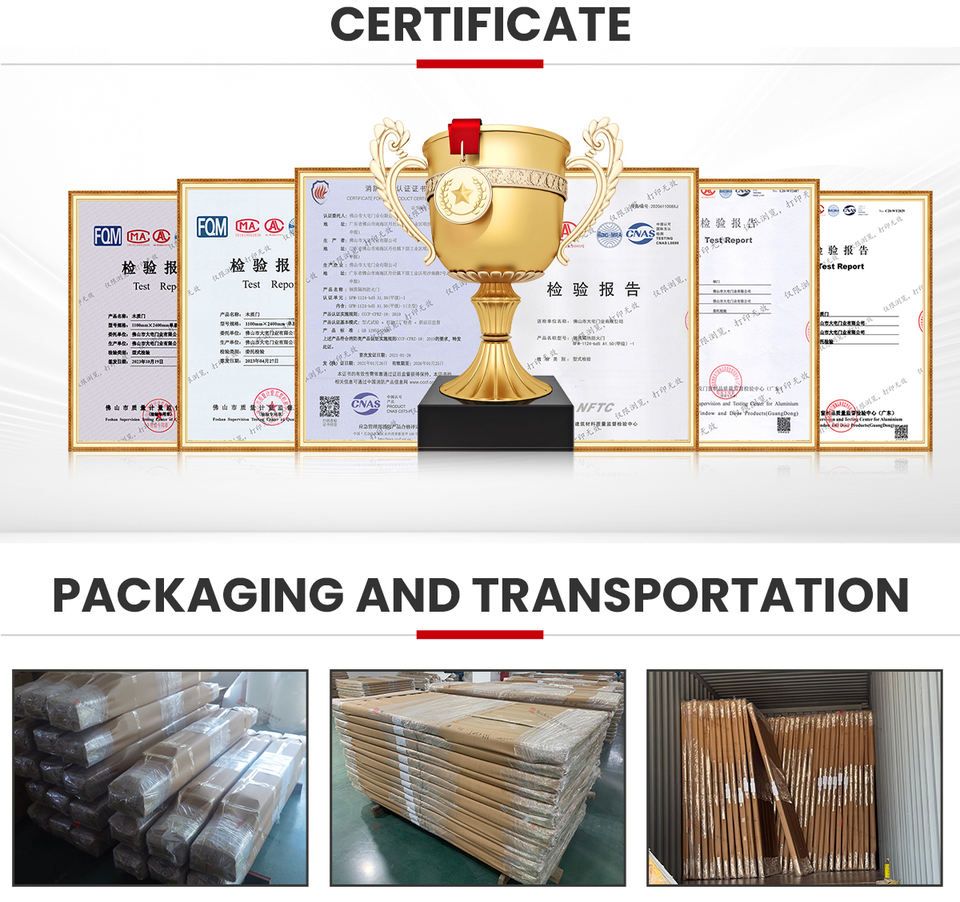
Every production batch undergoes three performance tests before shipment. The air-tightness test measures the rate of air leakage through the closed door assembly. The water-tightness test applies pressurized water to the exterior surface to verify resistance to rain penetration. The wind resistance test subjects the door to simulated wind loads to confirm structural integrity. These tests are conducted in our workshop using calibrated equipment, and the results are documented for each batch.
These tests matter because they simulate real-world conditions. A door that fails the water-tightness test will leak during a rainstorm — that is not a defect you want to discover after installation. A door that fails the wind resistance test could deform under high winds, compromising the seal and the hardware. For coastal or high-rise projects, these tests are non-negotiable.
Visual Inspection and Dimensional Verification
The pre-shipment inspection follows a documented checklist. Each door is examined for surface finish quality — no runs, sags, or orange peel in the coating. Glass is checked for clarity, scratches, and proper seal integrity. Hardware is tested for function: locks engage smoothly, hinges operate without binding, closers adjust correctly. Dimensional checks are performed against the approved shop drawings using calibrated measuring tools.
We also inspect the packaging before loading. The wooden crates must be structurally sound, the foam padding must be correctly positioned, and the moisture barriers must be intact. A door that passes quality inspection but fails in transit due to poor packaging is a failure of the entire process.
Documentation and Compliance Support
International shipping requires documentation, and our export team handles it completely. We provide packing lists, proforma invoices, certificates of origin, and full customs documentation. For markets that require product certifications or test reports, we provide the relevant documents from our testing records. Our experience in foreign trade means we know the documentation requirements for different countries — we have shipped to over 30 markets, and we understand the variations in customs procedures.
Logistics and Shipping: How We Deliver to Your Project Site
MOQ, Lead Times, and Production Planning
Minimum order quantities vary by product. Standard designs in common wood species have a lower MOQ — typically 20 to 50 units. Fully custom projects may require higher volumes, depending on the complexity of the design and the materials involved. We provide project-specific MOQs during the quotation phase, so there are no surprises later.
Production lead times depend on the order’s complexity. Standard designs typically ship within 2-4 weeks from sample approval. Custom projects with unique sizes, finishes, or hardware may take 4-8 weeks. We provide accurate timelines before order confirmation, and we update you if any delays arise. Construction schedules are tight, and we treat delivery dates as commitments.
FCL and LCL Shipping Options
We ship both Full Container Load (FCL) and Less than Container Load (LCL). FCL is cost-effective for large orders — you get the entire container, and the unit cost per door is lower. LCL is suitable for smaller orders or when you want to test our quality before committing to a full container. We consolidate orders from multiple clients to optimize freight costs, and we coordinate with freight forwarders to ensure smooth loading and departure.
All shipments are delivered directly from our factory in China to your port of entry. We do not use intermediate warehouses that add handling time and risk of damage. The container is loaded at our factory, sealed, and shipped to you.
Packaging Standards for Export
Our packaging is designed for ocean transit. Each door is wrapped in a moisture barrier, then protected with foam padding at all contact points. The wrapped doors are placed in wooden crates or on pallets with corner protectors, depending on the door size and the shipping method. The crates are reinforced to withstand stacking and handling during loading and unloading.
We supervise the loading of every container. This is not a task we delegate. Our team ensures that the crates are properly positioned, secured, and braced to prevent movement during transit. This attention to detail reduces the risk of damage in transit, which is the leading cause of claims in the door industry.
Why Partner with Jusen Door and Windows for Your Entry Door Supply
Factory-Direct Pricing Without Middleman Markup
As a manufacturing company, we control costs from raw material procurement to finished product. There is no trading company between you and the factory — no one adding a margin for forwarding your inquiry. Our pricing reflects our actual production costs plus a reasonable profit margin. This structure allows us to offer competitive prices for bulk orders while maintaining the quality standards that our clients expect. The price we quote is the price you pay — no hidden fees for documentation, packaging, or inspection.
One-Stop Shop for Multiple Product Lines
Wood and glass entry doors are not our only product. Our factory also produces thermal-break aluminum doors and windows, system windows, casement doors, sliding doors, custom villa doors and windows, and sunrooms. For projects that require multiple types of openings, sourcing from one factory simplifies procurement. You deal with one sales contact, one set of documentation, and one shipping schedule. The aesthetic coordination across different product lines is managed in-house, ensuring a consistent appearance across the entire building envelope.
Experienced Export Team and After-Sales Support
Our foreign trade team manages all communication, documentation, and logistics. We respond to inquiries within one business day, and we provide regular production updates throughout the manufacturing process. We understand that our clients work in different time zones, and we schedule calls accordingly. After-sales support includes warranty claims processing, replacement part supply, and technical advice for installation and maintenance. We view our clients as long-term partners, not one-time transactions.
Frequently Asked Questions About Wood and Glass Entry Doors
What is the minimum order quantity (MOQ) for custom wood and glass entry doors?
The MOQ depends on the design complexity and the wood species you select. Standard designs in common species like oak or mahogany typically have a lower MOQ — around 20 to 50 units. Fully custom projects with unique dimensions, specialized glass, or exotic wood species may require higher volumes. We assess each inquiry individually and provide a project-specific MOQ during the quotation phase. We do not apply a blanket MOQ across all products because that would not reflect the actual production economics.
Can you match specific architectural styles or replicate an existing door design?
Yes. We offer both OEM and ODM services. If you have drawings, photos, or an existing door that you want replicated, send them to us. Our engineering team will analyze the design, identify the materials and construction methods required, and produce a matching or improved version. We regularly replicate historical designs for renovation projects and adapt modern designs for new construction. The key is providing us with sufficient reference material — the more detail you provide, the more accurate the result.
What glass options are available for energy efficiency and security?
For energy efficiency, we offer double and triple glazing with low-E coatings and argon gas fill. The low-E coating reflects infrared radiation while allowing visible light to pass through, reducing heat transfer through the glass. For security, we offer tempered glass, laminated glass with PVB interlayers, and security laminates that resist impact and forced entry. We recommend configurations based on your climate, the door’s orientation, and the security requirements of your project. A door in a cold climate needs different glazing than a door in a hot climate, and we factor that into our recommendations.
How do you ensure the doors arrive undamaged after international shipping?
Our packaging is designed specifically for ocean transit. Each door is wrapped in a moisture barrier, protected with foam padding, and placed in a wooden crate or on a pallet with corner protectors. We supervise the loading of every container to ensure proper positioning and bracing. This process has been refined over years of international shipping, and our damage rates are consistently low. That said, no packaging can guarantee against mishandling by port workers or carriers. We recommend that you inspect the shipment upon arrival and document any damage for insurance claims.
Do you provide documentation for customs clearance and building permits?
Yes. We provide packing lists, proforma invoices, certificates of origin, and full customs documentation for international shipments. For building permits, we provide test reports and product specifications that demonstrate compliance with relevant standards. Our export team has experience with the documentation requirements of over 30 countries, and we prepare the paperwork to match your destination market’s regulations. If your project requires specific certifications, we can discuss the options during the quotation phase.
What is the typical production lead time?
Standard designs typically take 2-4 weeks from sample approval to ready-for-shipment. Custom projects with unique sizes, finishes, or hardware may take 4-8 weeks, depending on complexity and order size. We provide accurate timelines before order confirmation, and we update you if any delays arise during production. For projects with tight construction schedules, we recommend confirming your order as early as possible to secure production capacity.
Decision Guide for Choosing Your Entry Door
Choose a wood and glass entry door if your project prioritizes aesthetic warmth, natural light, and perceived value. Wood and glass doors offer unmatched customization flexibility and a premium appearance that enhances property value. They are ideal for residential, hospitality, and boutique commercial projects where the entrance sets the tone for the entire building.
Choose an aluminum or thermal-break aluminum entry door if your project prioritizes low maintenance, high thermal performance, or extreme weather resistance. Aluminum doors are more durable in coastal or industrial environments, require less maintenance over their lifespan, and offer superior thermal performance when equipped with thermal breaks. They are the practical choice for high-rise buildings, coastal properties, and projects with stringent energy efficiency requirements.
Choose a hybrid wood-clad aluminum door if you want the warmth of wood on the interior and the durability of aluminum on the exterior. This combination is ideal for projects where both aesthetics and performance are critical, such as luxury residences in harsh climates.
—
Jusen Door and Windows Manufacturing Co., Ltd. offers factory-direct wood and glass entry doors with full customization, rigorous quality control, and reliable international logistics. As a manufacturer, we control the entire production process — from timber selection to final inspection — ensuring consistent quality across every order. Our OEM and ODM capabilities allow you to source doors under your own brand or develop exclusive designs. Our pre-shipment testing and export documentation support ensure smooth delivery to your project site.
Beyond wood and glass entry doors, our factory produces thermal-break aluminum doors and windows, system windows, sliding doors, casement doors, and custom villa doors. If your project requires multiple types of openings, we can supply them all from one factory, simplifying procurement and ensuring aesthetic coordination.
References
- Jusen Door and Windows Manufacturing Co., Ltd. — Product Range. https://doorwoodendoors.com/
- Jusen Door and Windows Manufacturing Co., Ltd. — Contact Page. https://doorwoodendoors.com/contact-us/
- American Architectural Manufacturers Association (AAMA) — Window and Door Testing Standards. https://aamanet.org/
- National Fenestration Rating Council (NFRC) — Energy Performance Ratings. https://www.nfrc.org/
- Wood Products Council — Moisture Content and Wood Stability. https://www.woodworks.org/





