Content Menu
● 1. Why Choose Single Wood Front Doors with Glass for Your Next Project?
● 2. Our Factory Capabilities: Precision Manufacturing for Solid Wood Doors
● 3. Technical Specifications and Material Options for Single Doors
● 4. The Jusen Advantage: Quality Control and Export Logistics
● 5. How to Order: From Inquiry to Installation
● 6. Frequently Asked Questions
● 7. Decision Guide: Choosing Your Door Configuration
8 min read
A contractor from Toronto emailed us last Tuesday. He had won a bid for a 14-home custom build and needed 14 single wood front doors with glass — but the local distributor quoted him a 45% markup and a 16-week lead time. He asked if we could match the spec and beat the timeline.
We could. And we did.
That conversation sums up why architects and builders source entry doors directly from our factory in China. This article walks through what we manufacture, how we test it, and what you need to know before sending an RFQ.
—
Why Choose Single Wood Front Doors with Glass for Your Next Project?
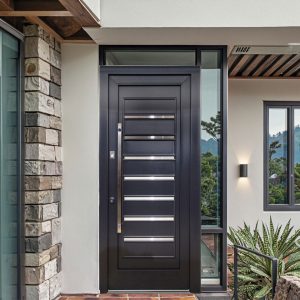
The front door is the first thing a buyer touches. It sets the tone for the entire property. Single wood front doors with glass combine the warmth of natural timber with the openness of glazing — a combination that works across modern farmhouse, contemporary, and transitional architectural styles.
Aesthetic Versatility and Curb Appeal
A solid slab door can feel heavy. A fully glazed door can feel exposed. A single wood door with a glass insert splits the difference — it invites light in while maintaining visual privacy where you need it.
Our factory allows full customization on size, color, and glass type to match the project facade. Want a 36″ x 80″ door with a narrow vertical lite in clear glass? Done. Need a 42″ x 96″ oversized entrance with frosted beveled panels for a luxury spec home? Also doable. We don’t push clients toward standard sizes because standard sizes rarely match custom architecture.
Balancing Natural Light with Thermal Efficiency
Here is the honest trade-off: glass is the weakest thermal point in any door assembly. A solid wood door insulates better than a glazed one. Period.
But modern double-glazing and low-E coatings close most of that gap. For a 1-3/4″ thick door with a double-glazed unit, you can achieve U-values that satisfy most North American and European energy codes.
Our adjustable profile structure and fittings allow us to tune the door assembly to your local building codes. A door bound for Minnesota needs different glazing than one headed to San Diego. We build accordingly.
—
Our Factory Capabilities: Precision Manufacturing for Solid Wood Doors
We have been manufacturing wood doors and aluminum window systems for over a decade. Our facility runs dedicated lines for solid wood entry doors, thermal-break aluminum windows, and custom villa door systems.
In-House Production and Direct Supply
When you buy from a distributor, you pay for their warehouse, their sales staff, and their profit margin. When you buy from us, you pay for lumber, hardware, glass, labor, and shipping — nothing else.
Our direct supply from the factory means wholesale pricing that typically lands 20–35% below what a local distributor charges for equivalent quality. For a 50-unit apartment project, that difference pays for the upgraded hardware package.
Advanced Woodworking and Glass Integration
The critical point in any wood door with glass is the junction between the frame and the glazing unit. If the wood isn’t properly machined, or the sealant isn’t applied correctly, you get air leaks, water infiltration, and condensation between the panes.
Our production process uses CNC machining centers for precise mortise-and-tenon joinery and accurate glass pocket routing. Each door is assembled with polyurethane adhesive and clamped under controlled pressure to prevent warping. The glass is bedded in butyl tape and sealed with structural silicone — the same method used in commercial curtain wall systems.
Customization Services (OEM & ODM)
We are not just a manufacturer. We are a private-label partner.
Our OEM and ODM services allow you to put your brand on a door we engineer to your specification. Several real estate developers we work with have created their own door lines — unique profiles and hardware combinations that differentiate their properties. When every unit in a building looks identical, the entry door is the one detail buyers remember.
—
Technical Specifications and Material Options for Single Doors
Let’s get into the details that matter for your specification sheet.
Selecting the Right Wood Species
The wood species determines durability, appearance, and price.
- Oak — the workhorse. Hard, dense, and naturally resistant to impact. Accepts stain evenly.
- Mahogany — the premium choice. Stable, rot-resistant, and holds paint exceptionally well.
- Walnut — the designer option. Rich chocolate color with striking grain patterns.
Our team can advise on the best wood based on your target market’s climate, drawing on our rich experience in foreign trade across North America, Europe, and Australia. We know which species hold up in humid coastal environments versus dry inland regions.
Glass and Hardware Configuration
Glass options include clear, frosted, beveled, tinted, and insulated units with low-E coatings. We also offer decorative brass or zinc alloy glass frames that add a layer of detail.
Hardware finishes range from brushed stainless steel to oil-rubbed bronze to matte black. Full customization on glass and hardware accessories means you can match the interior design theme exactly. We stock hinges, locks, handles, and deadbolts from established hardware brands, and we can source specialty items on request.
Ensuring Air-Tightness and Water-Tightness
Door warping is the number one complaint we hear from contractors who sourced cheap doors elsewhere. The fix is kiln-dried lumber and proper joinery — not thicker paint.
Every door we ship undergoes strict pre-shipment inspection that includes air-tightness, water-tightness, and wind resistance tests. We test with the door fully assembled, including the frame and weatherstripping. If a door fails, it does not leave the factory.
—
The Jusen Advantage: Quality Control and Export Logistics
Importing doors from China sounds complicated. It doesn’t have to be — if your supplier handles the paperwork.
Rigorous Pre-Shipment Inspection
We run a three-step quality gate:
- Incoming material check — lumber moisture content, glass defects, hardware finish.
- In-process inspection — joinery accuracy, glue squeeze-out, glass seal integrity.
- Final assembled test — air-tightness, water-tightness, and wind resistance under simulated conditions.
That third test is what separates us from suppliers who ship visual samples and hope for the best. We have invested in test equipment that replicates real-world weather exposure, so you do not discover problems on site.
Seamless Shipping and Customs Documentation
International trade involves paperwork. We handle it.
Our export team provides a packing list, proforma invoice, and full customs documents with every shipment. You will know exactly what is in each crate, the declared value, and the HS code classification. This reduces the chance of customs delays or unexpected duties.
Flexible Shipping Options (FCL & LCL)
We support FCL & LCL shipment, direct delivery from our China factory. If you are ordering a full container of doors, you get the best per-unit freight rate. If you need only 10 doors for a boutique project, we consolidate your shipment with other orders to keep costs reasonable.
One note: for small LCL shipments, the freight cost per door will be higher than for a full container. We are upfront about that calculation so you can budget accurately.
—
How to Order: From Inquiry to Installation
The process is straightforward. Here is how it works:
Step 1 — Send your drawings or specifications. Include door sizes, wood species, glass type, hardware preferences, and any architectural drawings.
Step 2 — Our engineers provide a technical review and quotation. They will flag any dimension conflicts or code compliance issues before you commit.
Step 3 — Production and quality control. Once approved, your order enters our production schedule. You receive progress photos at key stages.
Step 4 — Shipping and after-sales support. We arrange freight, provide tracking, and remain available after delivery for installation questions.
Our engineering support and technical team will adjust profile structures and fittings to match your local building codes, ensuring approval the first time.
—
Frequently Asked Questions
Q1: What is the minimum order quantity for custom single wood front doors with glass?
We accommodate both large construction projects and smaller boutique orders. For fully custom designs with unique dimensions, a 10-door minimum keeps production efficient. For standard sizes within our existing profile range, we can accept smaller quantities. Contact our team for specific MOQ details based on your design complexity.
Q2: Can you match specific architectural styles or historical designs?
Yes. Our ODM capabilities allow us to replicate or design custom profiles. Send us photos or blueprints of the style you need, and our engineers will create a production drawing for your approval. We have reproduced Victorian-era panel layouts, mid-century modern flush doors, and minimalist contemporary designs.
Q3: How do you ensure the glass doesn’t fog up or the wood doesn’t warp?
Fogging occurs when the glazing unit’s seal fails. We use double-glazed units with a warm-edge spacer system and desiccant-filled seals — the same specification used in high-performance windows. Wood warping is prevented by kiln-drying lumber to below 12% moisture content before machining, then applying a factory finish that seals all six sides.
Q4: Do you provide hardware, or do we need to source it separately?
We offer full customization on hardware accessories, including hinges, locks, handles, and deadbolts. Supplying hardware from our factory ensures compatibility — the hinge mortises are cut precisely for the hinges we ship. If you have a preferred hardware brand, we can often accommodate it if you provide the specifications in advance.
Q5: How long does production and shipping typically take?
Production takes 15–30 days depending on order size and complexity. A standard container of 40–60 single doors takes about 20 days. Shipping from China to North America’s west coast takes roughly 18–25 days; to the east coast, 30–40 days. Our logistics team will give you a precise schedule at quotation.
—
Decision Guide: Choosing Your Door Configuration
Choose a single wood front door with glass if:
- You want natural light in the entryway
- The architectural style calls for a warm, inviting appearance
- You need a balance between privacy and visibility
Choose a solid wood door without glass if:
- The entry faces a noisy street or high-traffic area
- Thermal performance is the absolute priority
- Security concerns outweigh aesthetic considerations
Choose a door with a smaller glass lite if:
- You want light without sacrificing privacy
- The door is on the north side of the building (less direct sun exposure)
Choose a door with a larger glass panel if:
- The entry is covered by a porch or overhang (less weather exposure)
- The design calls for a dramatic first impression
- The door faces a landscaped area or courtyard
—
Ready to Start Your Project?
We have produced thousands of single wood front doors with glass for projects across North America, Europe, and Australia. Our factory-direct model, full customization options, and rigorous pre-shipment testing exist for one reason — to deliver doors that perform as well on site as they look in the showroom.
Send us your drawings. We will return a technical review and a quote within 48 hours.
—
References
- https://www.energy.gov/energysaver/energy-efficient-door-selection“>U.S. Department of Energy — Energy-Efficient Door Selection
- https://www.wdma.com/“>Window & Door Manufacturers Association — Testing & Certification Standards
- https://www.aamanet.org/“>American Architectural Manufacturers Association — AAMA/WDMA/CSA 101/I.S.2/A440
- https://www.fpl.fs.usda.gov/“>Forest Products Laboratory — Wood Handbook: Wood as an Engineering Material