
Content Menu
● 1. Why Modern Entrance Doors Are Engineered Systems, Not Just Openings
● 2. Our Factory: Where Modern Front Entrance Doors Take Shape
● 3. Pre-Shipment Testing: We Simulate the Storm Before You Do
● 4. The Commercial Case for Factory Direct Sourcing
● 5. Meeting Local Building Codes: Not Optional
● 6. Scaling Production: From 50 Doors to 5,000
● 7. What You Should Ask Before Ordering Modern Front Entrance Doors
● 8. Choosing the Right Modern Front Entrance Door
8 min read
The last project we shipped to a developer in Auckland required 214 entrance doors, each with a different width because the architectural drawings had no repeating modules. That order taught us more about flexibility than any catalog ever could.
When a buyer sources modern front entrance doors, the conversation rarely starts with price. It starts with a question: can the factory actually build what the architect drew? For us at Jusen Door and Windows Manufacturing Co., Ltd., the answer determines everything else we do — from profile selection to final inspection.
This guide covers what we have learned manufacturing entrance systems for residential, commercial, and villa projects across more than a dozen countries. You will see how we engineer, test, and ship these products, and where our factory fits into your supply chain.
Why Modern Entrance Doors Are Engineered Systems, Not Just Openings
A modern front entrance door must manage air infiltration, thermal transfer, water penetration, and security — simultaneously. Get one of those wrong and the door fails, regardless of how it looks.
Thermal break aluminum is our primary material for modern entrance systems. The polyamide strips separate the interior and exterior aluminum profiles, reducing heat transfer by a significant margin compared to non-thermal profiles. For a buyer in a cold climate, this is not a luxury feature. It is the difference between a comfortable entryway and a persistent draft.
The aesthetic shift toward minimalist frames has pushed glass areas larger. That means the structural frame must carry more wind load while maintaining a slender sightline. Our thermal-break aluminum doors achieve this through reinforced profile geometry, not by adding bulk.
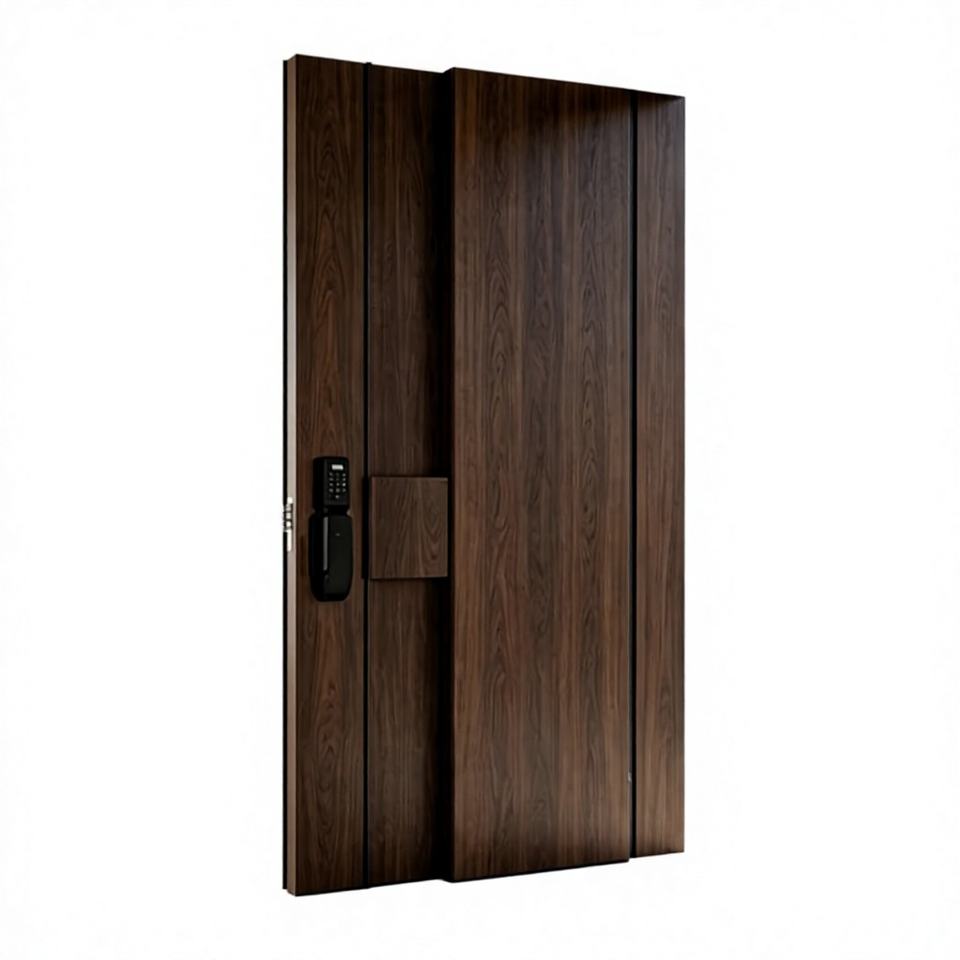
Here is the imperfect insight: aluminum is not always the right choice. For heritage renovations or specific high-end villa projects, we still manufacture modern front entrance doors in solid wood. Wood offers a warmth and acoustic quality that aluminum cannot replicate. But it requires more maintenance. We will tell you which material suits your project, even when it means a different product line for us.
Our Factory: Where Modern Front Entrance Doors Take Shape
Our production floor runs a mix of CNC machining centers, multi-head welding machines for steel reinforcement, and manual assembly stations for the finishing touches that machines cannot handle.
The process for a custom aluminum entrance door starts with profile cutting. Our saws hold tolerances within fractions of a millimeter. If the cut is off, the corner joints will show gaps, and the weather seals will not seat properly. We check every batch of profiles before assembly begins.
Assembly involves inserting the thermal break strips, crimping the profiles, and welding corners for steel-reinforced sections. Then we install the gaskets — EPDM, not the cheaper PVC alternatives — because EPDM holds its flexibility for years under UV exposure.
OEM and ODM are core to our workflow. When a client sends us their proprietary drawings, our engineering team reviews them for manufacturability. We have adjusted pocket depth, hinge locations, and glazing bead designs to optimize production without compromising the design intent. We are an extension of your team, not just a supplier.
For oversized entrance doors, the same engineering principles we apply to our sunrooms come into play. Wind load calculations, deflection limits, and drainage planning are non-negotiable. A two-meter-wide door that looks stunning but deflects under wind pressure will fail its weather seals within months.
Pre-Shipment Testing: We Simulate the Storm Before You Do
Every modern front entrance door we produce is subject to our pre-shipment inspection protocol. This is not a visual check. We run actual performance tests.
Air-tightness testing measures the volume of air passing through the closed door under a specific pressure differential. Water-tightness testing sprays water at the door while applying pressure, simulating wind-driven rain. Wind resistance testing loads the door to verify structural deflection stays within limits.
These tests matter because they catch problems before installation. A gasket that is slightly misaligned might pass a visual inspection but fail the water test. We find that on our floor, not on your job site. Our team documents the results, and we keep records for every batch.
We also test hardware integration. Multi-point locking systems must engage smoothly. Hinges must align perfectly. If the door has a floor spring or concealed closer, we adjust it to ensure the door closes properly every time. Hardware is not an afterthought — it is what makes the door last decades.
For buyers, this means fewer callbacks. We have seen too many projects where a cheap door failed within a year due to poor sealing or hardware failure. Our testing protocol is designed to prevent exactly those outcomes.
The Commercial Case for Factory Direct Sourcing
Working with a middleman adds a layer of cost that does not improve the product. When you source modern front entrance doors directly from our factory, you eliminate that markup.
We provide a proforma invoice so you know exactly what you are paying for — profiles, glass, hardware, packaging, and freight. No hidden fees. This transparency helps you plan budgets accurately, especially for large projects where door costs are a significant line item.
Our foreign trade experience means we handle the paperwork. Packing lists, commercial invoices, bills of lading, certificates of origin — we prepare everything. You do not need to chase documents or worry about customs clearance delays.
Logistics flexibility matters too. We ship both FCL and LCL. For a small villa project, a less-than-container-load shipment keeps costs reasonable. For a large development, a full container load reduces per-unit freight costs. We advise you on the optimal shipping method based on your order size and timeline.
Meeting Local Building Codes: Not Optional
A door that meets European standards may not satisfy North American energy codes or the typhoon ratings required in Southeast Asia. We adjust our profile structures and fittings to match the building codes of your target market.
This is not a one-size-fits-all approach. If your project requires a specific U-value, we can specify the appropriate glass and thermal break width. If you need impact-resistant glazing for hurricane zones, we source the correct laminated glass and reinforce the frame accordingly.
Our engineering team reviews the relevant standards for each market we serve. We have adapted our doors for the thermal performance requirements of the Canadian market and the wind load demands of coastal projects in the Middle East. Tell us where your project is, and we will ensure the doors comply.
Scaling Production: From 50 Doors to 5,000
Our production capacity handles both small custom orders and large construction projects. This flexibility is built into how we schedule production.
For bulk supply, we run parallel production lines to meet tight deadlines. A typical housing development order involves multiple door sizes, repeated across hundreds of units. Our team organizes the production schedule to minimize changeover time while maintaining quality.
Private label is another way we support your growth. If you are a distributor looking to expand your product line, we can manufacture modern front entrance doors under your brand name. You get a high-quality product without investing in factory equipment. We handle the manufacturing, you focus on sales and installation.
This is how we help our partners compete. They do not need to build a factory to offer a factory-direct product. They leverage ours.
What You Should Ask Before Ordering Modern Front Entrance Doors
What is the lead time for custom sizes?
Lead times depend on order volume and complexity. For standard sizes, we can usually ship within a few weeks. For fully customized doors with specific glass and hardware, allow additional time for engineering review and material sourcing. Contact our team with your project timeline, and we will give you a specific schedule.
Can you match RAL colors or specific glass specifications?
Yes. We offer full customization on color and glass. We can match RAL codes and provide double glazing, laminated glass, or low-E coatings based on your thermal and security requirements. Provide us with your specifications, and we will confirm what is feasible.
Do you provide installation instructions or technical support?
Every shipment includes detailed technical drawings and installation guidelines. Our engineering team is available for consultation if your installation crew has questions. We want the door to perform as designed, which means it must be installed correctly.
How is the door protected during shipping?
We use export-grade packaging with protective film on all surfaces and reinforced corners. Our packing methods are refined through years of shipping experience, ensuring the doors arrive in good condition for both FCL and LCL shipments.
What is the warranty on your doors?
We stand behind our manufacturing quality. The specific warranty terms depend on the product type and application. Discuss your project requirements with us, and we will outline the warranty coverage.
Choosing the Right Modern Front Entrance Door
Choose aluminum thermal break if you need slim profiles, large glass areas, and low maintenance. It is the best choice for contemporary architecture and high-traffic commercial applications.
Choose solid wood if your project demands a warm, traditional aesthetic and the building is in a climate where wood performs well. Be prepared for periodic maintenance.
Choose our factory if you need a partner who can customize, test, and ship internationally without the markup of intermediaries. We are built for B2B buyers who need reliability and flexibility.
Modern Front Entrance Doors: Built for Your Project
Sourcing the right entrance door affects your project’s aesthetics, energy efficiency, and long-term durability. When you work with us, you gain a manufacturing partner who understands the technical requirements and the commercial pressures of construction.
We have the factory capacity, the engineering expertise, and the international experience to deliver modern front entrance doors that perform. Send us your drawings, and we will show you what direct factory supply looks like.
—
References
- American Architectural Manufacturers Association. (2023). AAMA/WDMA/CSA 101/I.S.2/A440-17: North American Fenestration Standard. https://aamanet.org/“>https://aamanet.org/
- European Aluminium. (2022). Thermal Break Technology for Aluminium Windows and Doors. https://european-aluminium.eu/“>https://european-aluminium.eu/
- National Fenestration Rating Council. (2023). Understanding U-Factor and SHGC Ratings. https://www.nfrc.org/“>https://www.nfrc.org/
- International Code Council. (2021). 2021 International Building Code (IBC). https://www.iccsafe.org/“>https://www.iccsafe.org/





