Content Menu
● 1. Why Choose a 3 Window Front Door for Your Next Project?
● 2. Our 3 Window Front Door Product Range
● 3. The Jusen Factory Advantage: Precision Manufacturing for Large Units
● 4. Quality Control: Ensuring Airtightness and Durability
● 5. Bulk Supply, Logistics, and Export Documentation
● 6. How to Order: From Inquiry to Installation
12 min read
When a contractor in Montreal sends us a drawing for a 3 window front door with a 1500mm opening, the first thing we check is not the price. It is the wind load rating for that specific neighborhood. A door with two fixed sidelites spans a wide opening, and the header has to carry that load without sagging over time.
Our factory in China builds these units daily. We supply them to distributors in North America, Australia, and the Middle East. The configuration—one active door panel flanked by two fixed glass sidelites—has become a standard request for residential projects that prioritize natural light. But the engineering behind it is anything but standard.
This article explains how we manufacture the 3 window front door, what you should specify for your project, and how to avoid the common pitfalls of importing large glazed units.
Why Choose a 3 Window Front Door for Your Next Project?
The 3 window front door is not a single product. It is a system. The central door carries the hardware and daily use. The two sidelites are fixed panels that must match the door’s sightlines perfectly—otherwise, the whole elevation looks off by a few millimeters.
We build these as a matched set. The frames are cut from the same profile batch, and the glass is ordered as one unit. This matters because anodized aluminum or painted finishes can vary slightly between production runs. If you order the door and sidelites separately from different suppliers, you risk a color mismatch that is obvious from the street.
Maximizing Natural Light and Curb Appeal
The main appeal is obvious: a wall of glass at the entrance. For architects, this creates a bright foyer without the cost of a full glass wall. For homeowners, it is about curb appeal—a wide, symmetrical entry reads as more substantial and inviting.
We offer glass options that balance light and privacy. Clear tempered glass for maximum daylight. Frosted or acid-etched glass for entryways facing the street directly. Low-E coated glass for projects in extreme climates. The choice affects both the aesthetic and the energy performance, so we typically ask buyers about their project location before recommending a glass spec.
Energy Efficiency and Thermal Performance
Here is where the 3 window door gets complicated. A large glass area is a thermal weak point. The frame must be robust enough to hold the glass without creating a thermal bridge.
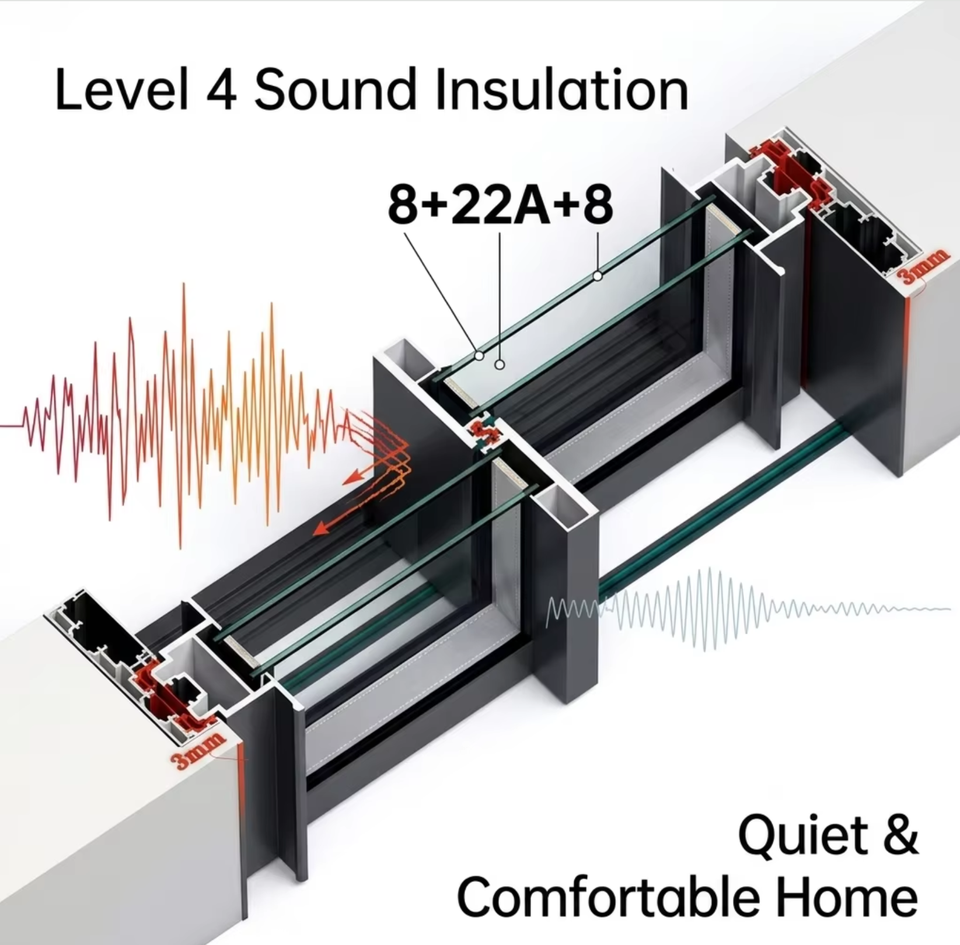
Our thermal-break aluminum profiles use polyamide strips to separate the interior and exterior frames. This is not a cosmetic feature. It is a structural requirement for any project where the outside temperature differs significantly from the inside. For buyers in cold climates, we also offer profiles with thicker thermal chambers. For hot climates, the priority shifts to solar heat gain coefficient—the glass matters more than the frame.
We adjust the profile structure and fittings to match the building codes of your target market. A door destined for Florida needs different wind load resistance than one for British Columbia. We do not build a one-size-fits-all product.
Our 3 Window Front Door Product Range
Our product range for the 3 window front door breaks into two main categories: thermal-break aluminum and solid wood. Each serves a different segment of the market.
Thermal-Break Aluminum Entrance Systems
This is our most popular option for bulk supply. Aluminum frames are lightweight, strong, and can be extruded into slim profiles that maximize the glass area. For a 3 window door, this means you get the “wall of glass” look without chunky frames.
The structural challenge is the weight of the glass. A sidelite measuring 600mm by 2400mm with 6mm tempered glass weighs roughly 22 kilograms. The frame has to hold that weight without twisting, especially under wind pressure. Our assembly line uses CNC cutting machines that hold tolerances of ±0.5mm on the mitered corners. If the cuts are off, the corners open up over time, and the door starts to leak air.
We run strict pre-shipment inspections on every batch. The air-tightness test, water-tightness test, and wind resistance test are performed on random samples before the container leaves our factory. For a product with this much glass, these tests are non-negotiable.
Solid Wood and Custom Villa Door Options
For high-end residential projects, we offer solid wood entrance doors with sidelites. This is a different product entirely. The wood is typically oak, mahogany, or sapele, and the construction is either solid stile-and-rail or engineered with a wood veneer over a stable core.
A solid wood 3 window door is heavy. A single door leaf can weigh 80 kilograms or more, and the sidelites add another 30 kilograms each. The hinges and multi-point locking system must be rated for that weight. We source heavy-duty stainless steel hinges and European multi-point locks as standard on these units.
We are not limited to standard sizes. We build to your architectural drawings. This is the core of our OEM and ODM service. If your project requires a 1900mm opening instead of the standard 1800mm, we adjust the profile and glass dimensions accordingly. No extra tooling fees, no minimum quantity penalties for custom sizes.
Hardware and Accessory Integration
The hardware on a 3 window door is not an afterthought. The main door requires a multi-point locking system that engages at multiple points along the frame—typically the top, bottom, and middle. This prevents warping and improves security. For the sidelites, we use fixed glazing beads that hold the glass securely while allowing for thermal expansion.
We offer hardware from brands that meet American (ANSI) or European (EN) standards. We also handle the installation of the hardware at the factory, which means the door arrives ready to install. For private label buyers, we can brand the hardware and packaging to your specifications.
The Jusen Factory Advantage: Precision Manufacturing for Large Units
The 3 window front door is a large, complex unit. It requires a factory with the right equipment and the discipline to use it correctly.
Advanced Cutting and Assembly Lines
Our factory uses double-head cutting saws and CNC machining centers for the aluminum profiles. The tolerances are tight because the door and sidelites must align perfectly. A 1mm error in the miter joint becomes a visible gap once the door is installed.
The assembly process for a 3 window door takes longer than a standard single door. The frame is assembled in a specific sequence—first the sill, then the jambs, then the header. The sidelites are attached before the glazing. This sequence matters because the frame needs to be square before the glass is installed. If the frame is out of square, the glass will crack under stress.
Our production planning accounts for this complexity. We schedule these units with sufficient time for the assembly and curing of sealants. We do not rush the process, and we do not compromise on the quality of the seals.
Custom Sizes and Design Flexibility (OEM/ODM)
Every project has different dimensions. A 3 window door in a suburban home in Texas is not the same size as one in a townhouse in London. Our factory is built to handle this variation.
We offer full customization on size, color, glass, and hardware. You send us the drawings, and we produce the units to match. We also offer private label services—your logo on the hardware, your branding on the packaging.
This flexibility extends to the profile structure itself. If your local building code requires a specific wind load rating, we adjust the profile thickness and reinforcement. If your market requires a specific energy efficiency rating, we change the thermal break width and glass specification. We do not force a standard product onto your project.
Engineering Support for Structural Integrity
The header of a 3 window door carries the load of the wall above it. This is often overlooked by buyers who focus only on the door itself. Our engineering team reviews your opening dimensions and advises on the header and sill design. We have seen too many installations where the header was undersized, causing the frame to bow and the door to stick.
We provide this engineering support as part of our service. When you send us an inquiry, we review the structural requirements and include our recommendations in the quotation. This is not a value-add we advertise heavily, but it is a critical part of what we do.
Quality Control: Ensuring Airtightness and Durability
Quality control is not a separate department in our factory. It is a process that runs through every stage of production.
Pre-Shipment Testing Protocols
Before we ship an order, we test samples from the batch. The tests are not cosmetic—they measure real performance.
- Air-tightness test: This measures the amount of air leakage through the closed door under a specific pressure differential. A poorly sealed 3 window door will leak air around the sidelites, causing drafts and energy loss.
- Water-tightness test: This sprays water at the door under pressure to simulate wind-driven rain. The door must prevent water from penetrating the interior.
- Wind resistance test: This applies a static load to the door to simulate wind pressure. The door must not deflect beyond a certain limit, and it must return to its original shape when the load is removed.
We run these tests on random samples from every production batch. If a sample fails, we investigate the cause and correct it before shipping. This is our commitment to quality, and it is why we can offer competitive pricing without cutting corners.
Material Selection and Hardware Durability
The aluminum we use is a 6063-T5 alloy, which is standard for architectural applications. It offers good strength-to-weight ratio and excellent corrosion resistance. The wood we use is kiln-dried to a moisture content of 10-12% to prevent warping.
The hardware is selected for durability. A 3 window door has more moving parts than a standard door, and each one is a potential failure point. We use stainless steel hinges and multi-point locks from reputable brands. We test the hardware cycles at the factory—a typical test involves 100,000 open-close cycles.
One honest caveat: no door is maintenance-free. Aluminum frames need periodic cleaning of the tracks and seals. Wood doors need refinishing every few years. We provide care instructions with every shipment, but the buyer should factor maintenance into their project planning.
Bulk Supply, Logistics, and Export Documentation
We are a factory, not a trading company. This distinction matters for buyers who need reliable supply and proper documentation.
Simplified Shipping (FCL & LCL)
We handle both full container loads (FCL) and less-than-container loads (LCL). For a 3 window door order, the volume depends on the size of the units and the packaging. Large units are shipped in wooden crates with protective padding to prevent damage during transit.
We pack the doors with the hardware installed, which reduces on-site assembly time. The crates are marked with the order number and unit number for easy identification. We also provide a packing list that matches the contents of each crate.
For LCL shipments, we consolidate multiple orders into a single container. This is a cost-effective option for buyers who are ordering a smaller quantity or testing a new product line. We handle all the consolidation and ensure that the cargo is properly secured for the ocean voyage.
Complete Export Compliance
Exporting from China involves a significant amount of paperwork. We have rich experience in foreign trade and provide all the necessary documents with every shipment:
- Packing list — details the contents of each package
- Proforma invoice — a preliminary invoice for customs and payment purposes
- Commercial invoice — the final invoice for the transaction
- Bill of lading — the shipping document issued by the carrier
- Certificate of origin — required for customs clearance in many countries
We also provide any additional documents required by your country’s customs authority. For example, some countries require a fumigation certificate for wooden crates. We handle these requirements as part of our service.
How to Order: From Inquiry to Installation
The process is straightforward, and we guide you through each step.
Step 1: Send us your drawings or dimensions. The more detail you provide, the more accurate our quote will be. Include the opening size, the desired profile color, the glass specification, and the hardware requirements.
Step 2: Receive a quote with customization options. We review your requirements and provide a quotation with a breakdown of costs. We also include our recommendations for glass and hardware based on your project location.
Step 3: Production and quality inspection. Once you confirm the order, we schedule production. We send you photos or videos of the units during production and before shipment. You can also arrange for a third-party inspection if you prefer.
Step 4: Shipping and documentation. We arrange the shipment and provide you with all the export documents. We track the shipment and keep you updated on the delivery status.
Ready to source a reliable supplier for your entrance doors? Contact Our Team for a detailed quotation.
Frequently Asked Questions
Can you manufacture a 3 window front door in non-standard sizes?
Yes. As a factory, we offer full customization on size and design. Send us your specifications, and we will provide a custom quote. We do not charge extra for non-standard sizes, as long as the profile and glass can accommodate the dimensions.
What is the typical MOQ for a bulk order?
We accommodate both FCL and LCL shipments. For LCL, the MOQ is typically a single unit for a sample order or a small batch for testing. For FCL, the MOQ depends on the size of the units and the container capacity. We can discuss the specifics based on your requirements.
How do you ensure the quality of the glass and seals for large door units?
We conduct strict pre-shipment inspections, including air-tightness, water-tightness, and wind resistance tests. The glass is sourced from certified suppliers, and we check it for defects before installation. The seals are applied at the factory, and we test the finished units to ensure they meet the specified standards.
Do you offer OEM or Private Label services?
Absolutely. We provide OEM, ODM, and Private Label services. We can brand the hardware and packaging to your specifications. We also work with you to develop custom profiles if your project requires a unique design.
Can you adapt the door profile to meet our local building codes?
Yes, our profile structure and fittings are adjustable to match the specific wind load and energy efficiency codes of your target market. Our engineering team reviews the requirements and adjusts the design accordingly.
Conclusion
A 3 window front door is a complex unit. It requires precise engineering, quality materials, and careful assembly. Buying it from a factory that understands these challenges makes the difference between a smooth project and a problematic one.
We are Jusen Door and Windows Manufacturing Co., Ltd. We build these doors daily, and we ship them worldwide. Our direct factory pricing means you get competitive rates without middleman markup. Our customization options mean you get a product that fits your project, not a standard size that almost fits.
If you are sourcing 3 window front doors for your next project, we want to be your supplier. Send us your drawings, and we will respond with a detailed quotation.
References
- National Fenestration Rating Council. “Understanding Energy Performance Ratings.” https://nfrc.org/understanding-ratings/
- American Architectural Manufacturers Association. “AAMA/WDMA/CSA 101/I.S.2/A440-17 Standard Specification.” https://www.aamanet.org/
- ENERGY STAR. “Windows, Doors, and Skylights.” https://www.energystar.gov/products/windows_doors_and_skylights
- Window & Door Manufacturers Association. “Technical Resources.” https://www.wdma.com/technical-resources/
- International Code Council. “International Building Code (IBC) – Fenestration Requirements.” https://www.iccsafe.org/