
Content Menu
● 1. Understanding the “Door Color Wood” Spectrum: From Stains to Veneers
● 2. Customization vs. Stock: How We Manage “Door Color Wood” for Bulk Orders
● 3. Why “Wood Color” Doesn’t Mean “Wood Maintenance”: The Aluminum Alternative
● 4. The Jusen Factory Advantage: Direct Supply for Color Accuracy
● 5. Frequently Asked Questions
● 6. Decision Guide: Choosing the Right “Door Color Wood” Approach
10 min read
The last container we loaded had 340 doors, all specified as “teak.” The client’s architect had sent us a 3 cm square of veneer from a showroom in Milan. That sample was the standard. Every door in that shipment had to match that tiny square—or the client would face a costly rework on site. We matched it. Not because we got lucky, but because our color lab mixes stains against physical samples, not against screen images.
This is the reality of specifying “door color wood” for a B2B project. It sounds like a simple finish choice. Behind the scenes, it involves material science, batch control, and a factory that understands how light, grain, and coating interact. Here is what we have learned from a decade of shipping solid wood and aluminum doors to international projects.
Understanding the “Door Color Wood” Spectrum: From Stains to Veneers
At Jusen, we approach “door color wood” through two distinct manufacturing paths. The first is natural solid wood staining, where the wood species itself dictates the base tone. The second is aluminum profiles with wood-grain transfer, where a photographic film applies the wood look to a metal substrate. These are not interchangeable. Each serves a different project requirement.
Classic Solid Wood Stains (Interior & Feature Doors)
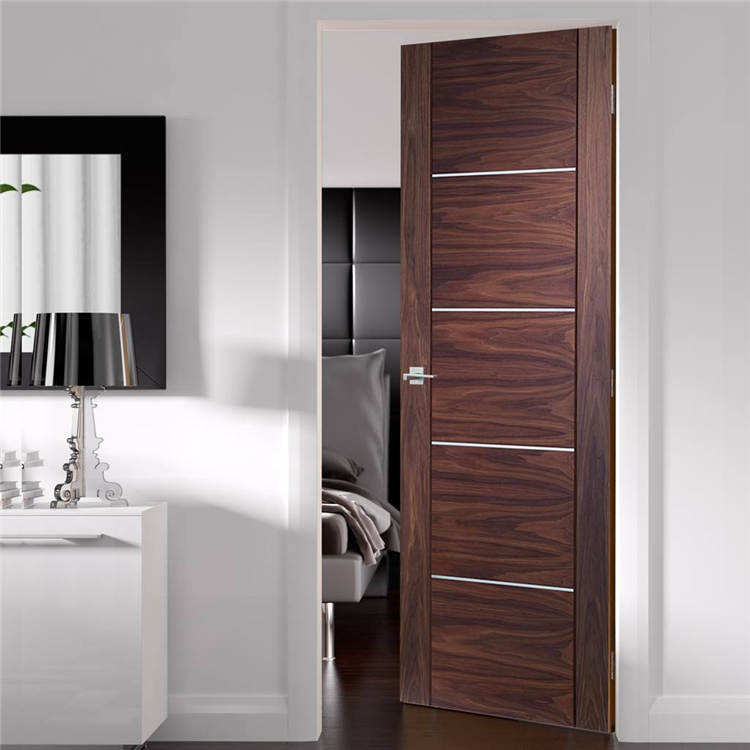
Walnut, oak, mahogany, teak—each species has a natural pigment structure. A clear coat on oak gives a honey tone. The same coat on mahogany turns it reddish-brown. When you specify a stain, you are not just picking a color; you are working with the wood’s cellular structure. Our finishing line applies stain in controlled layers, allowing the grain to remain visible rather than painting over it. This is why we offer full customization on color for our solid wood doors. We do not push clients toward a limited chart. We mix stains to match Pantone references, architectural samples, or the physical piece of wood you send us.
The Durability of Aluminum with Wood-Grain Finish
For exterior entrances, solid wood has a documented weakness: weather. UV radiation breaks down lignin, moisture causes expansion, and insects find their way into unprotected edges. This is where our thermal-break aluminum doors and windows and aluminum alloy entrance doors come in. We apply wood-grain transfer technology—a process where a heated roller presses a photographic film onto powder-coated aluminum. The result looks like wood. It does not warp, split, or fade the way timber does. If your project is a coastal villa or a high-rise facade, this is the “door color wood” you need.
Matching Wood Colors Across Different Materials
Here is a problem we solve regularly. A developer wants solid oak interior doors, but the exterior entrance needs to be aluminum for security and weather resistance. The two must look like they belong to the same family. Our factory has a color-matching protocol for this. We take the stain formula from the solid wood line and use it as a reference for the wood-grain film on the aluminum profile. We can adjust profile structures and fittings to accommodate the hardware that works with both materials. It is not a perfect match—wood and metal absorb light differently—but we get the undertones close enough that the human eye registers them as cohesive.
Customization vs. Stock: How We Manage “Door Color Wood” for Bulk Orders
In the B2B sector, a “standard” color rarely fits a unique architectural design. We treat every project as a bespoke request. A developer building 200 luxury apartments does not want the same brown door as the office block next door. They want their brown. This is where our OEM and ODM services become essential.
The OEM/ODM Color Matching Process
The process starts with submission. You send us a physical sample—a wood block, a paint chip, an anodized aluminum swatch—or a RAL number. Our color lab formulates a match. For solid wood, this means mixing pigments and testing on the actual species you selected. For aluminum, it means selecting the right powder coat base and the correct wood-grain film. We produce a sample door and ship it to you for approval. Only after your sign-off do we begin production. This is not a sales pitch. It is a control mechanism that prevents costly errors on the production line.
Consistency Across Large Volumes (FCL & LCL)
The real difficulty in bulk orders is not matching a sample once. It is matching that sample across 500 doors, produced over several weeks. Wood grain varies naturally. Aluminum film rolls can have slight batch differences. Our solution is threefold. First, we source stain pigments and wood-grain films in a single lot for your entire order. Second, we calibrate the spray equipment at the start of each production day. Third, our quality team performs a strict pre-shipment inspection that includes checking door color against the approved master sample. We also test for air-tightness, water-tightness, and wind resistance on our aluminum units. When we load your FCL & LCL shipment, you can be confident the first door and the last door in the container are visually identical.
Hardware and Glass Pairing
A wood door with the wrong handle looks unfinished. We offer full customization on hardware accessories. This is not just about function—it is about how a bronze handle interacts with a dark walnut finish, or how matte black hinges disappear against a grey oak tone. Our team advises on hardware pairing during the quotation stage. We send you finish samples for the metal components alongside your door color samples. This way, you approve the complete aesthetic package before production begins.
Why “Wood Color” Doesn’t Mean “Wood Maintenance”: The Aluminum Alternative
Wood is beautiful. It also demands upkeep. For exterior applications, many developers ask for “door color wood” but require the structural integrity of metal. Our engineering team has addressed this with a specific product line.
Thermal Break Technology with Wood Aesthetics
Our thermal-break aluminum doors and windows and system windows combine an aluminum frame with a polyamide thermal barrier. This breaks the thermal bridge between the interior and exterior. We then apply a wood-grain finish. The result is a door that looks like timber but performs like a modern aluminum system: low thermal transmittance, high wind load resistance, and no painting schedule for 20 years. For projects targeting LEED or passive house certification, this is a significant advantage.
Project-Specific Engineering Support
Dark wood colors absorb heat. In a desert climate, a black wood-grain door on a south-facing facade can reach surface temperatures that affect the thermal break performance. We have seen this happen on projects where the architect prioritized aesthetics over physics. Our team provides adjustable profile structure and engineering recommendations based on your local climate. We have rich experience in foreign trade, which means we know how building codes differ across markets. A wood-grain finish that works in Canada may not be suitable for the UAE. We tell you this before you order, not after.
The Jusen Factory Advantage: Direct Supply for Color Accuracy
When you order a specific “door color wood,” you need to know the factory is accountable for the result. If we make a mistake, there is no distributor to blame. There is no middleman to point fingers at. Just us.
Eliminating the Middleman for Better Quality Control
Our direct supply from factory model means your color specifications go straight to our production team. There is no interpretation loss. When you send a sample to us, it lands on the desk of the same technician who will mix your stain. This reduces errors. It also reduces lead time because we do not have to wait for a distributor to relay your requirements. You talk to the people who make the doors.
Full Documentation and Customs Support
A bulk door order involves more than the physical product. It involves packing lists, proforma invoices, and customs declarations. We provide packing list, proforma invoice, and full customs documents with every shipment. Our export team has handled customs clearance for projects across North America, Europe, the Middle East, and Southeast Asia. We know what documents your freight forwarder needs. We prepare them in advance. This saves you from the common problem of a container sitting at port while paperwork catches up.
Frequently Asked Questions
Q1: Can you match a specific wood color sample I send you?
Yes. As a factory, we offer full customization on color. You can send us a physical sample or a high-resolution photo. Our color lab will formulate a stain or wood-grain film to match it within a 95-99% accuracy rate. The remaining percentage is the natural variance of wood or the slight difference between a screen image and physical pigment.
Q2: What is the difference between a solid wood door and an aluminum door with a wood color?
Solid wood doors offer authentic texture and are ideal for interior use. Aluminum doors with wood-grain transfer offer the same visual appeal but are more durable and weather-resistant. For exterior entrances, sliding doors, and system windows, aluminum is the better long-term investment. For interior feature doors, solid wood is unmatched.
Q3: Do you offer OEM services for private label projects?
Absolutely. We provide OEM and ODM services. We can manufacture the “door color wood” style you need and apply your private label branding before shipping. This is common for importers and distributors who want to establish their own product line without investing in a factory.
Q4: How do you ensure color consistency in large bulk orders?
We use materials from the same production batch for large orders. Our quality control team performs a strict pre-shipment inspection on every batch. We compare each door against the approved master sample under standardized lighting. Any door that does not match is rejected and re-finished before shipment.
Q5: Can you customize the “wood color” on aluminum sliding doors and windows too?
Yes. Our wood-grain transfer technology is applied to our sliding doors and system windows. This allows you to maintain a consistent wood aesthetic throughout the entire building envelope—from the entrance door to the window frames.
Q6: How long does the color matching process take?
For a standard RAL or wood-grain film, we can confirm a match within 48 hours. For a custom match against a physical sample, the process takes 5-7 working days. This includes the formulation, a test spray, and a sample door production. We recommend starting this process early in your project timeline.
Q7: What is your MOQ for custom colors?
There is no minimum order for color matching itself. However, for production efficiency, we suggest a minimum of 20 doors per color for solid wood and 50 units for aluminum profiles. Below these quantities, the setup cost per door increases significantly. We will always advise you on the most economical batch size.
Decision Guide: Choosing the Right “Door Color Wood” Approach
| Project Factor | Solid Wood Stain | Aluminum with Wood-Grain Finish |
|---|---|---|
| Best Application | Interior doors, feature walls, high-end residential | Exterior entrances, sliding doors, system windows, commercial facades |
| Weather Resistance | Poor—requires regular sealing and maintenance | Excellent—UV resistant, moisture proof, no repainting |
| Color Consistency | Natural variance between wood pieces | High consistency—film is manufactured, not organic |
| Custom Color Matching | Yes—we mix stains to your sample | Yes—we select powder coat and film to your sample |
| Thermal Performance | Low—solid wood is not an effective thermal break | High—thermal-break aluminum profiles with polyamide barriers |
| Typical Lifespan | 10-20 years with maintenance | 30+ years with minimal maintenance |
| Cost per Unit | Higher for premium species | Lower for the same visual effect |
| Fire Rating Potential | Limited—depends on core material | Can achieve higher ratings with appropriate glazing and cores |
Choose solid wood stain if: Your project is interior-focused, you need authentic wood texture, and the building will have controlled humidity. You are willing to accept natural grain variations as part of the aesthetic.
Choose aluminum with wood-grain finish if: The doors are exposed to weather, you need long-term durability, or you require thermal performance for energy certification. You want the look of wood without the maintenance burden.
Conclusion
The “door color wood” you choose defines your project. It is the first thing a visitor touches. It is the element that either harmonizes with the facade or fights against it. Whether you select authentic solid wood for its warmth or aluminum with a wood-grain finish for its resilience, the key is working with a factory that understands both materials.
Jusen Door and Windows Manufacturing Co., Ltd. offers direct factory supply, full customization on color and hardware, and a quality control system that ensures your bulk order matches your approved sample. We provide the documentation you need for customs and the engineering support you need for local building codes. We have shipped thousands of doors to international projects. We know how to get the color right.
Ready to define the aesthetic of your next project? Send us your color sample and your specifications. Our team will provide a detailed quote and a production timeline.
—
References
- Wood Finishing Basics. Wood Magazine. https://www.woodmagazine.com/wood-finishing
- Wood-Grain Transfer Technology for Aluminum. KPMF. https://www.kpmf.com/wood-grain-film
- Thermal Break Technology in Aluminum Frames. Kawneer. https://www.kawneer.com/kawneer-north-america/products/thermal-performance
- UV Degradation of Wood Coatings. Forest Products Laboratory. https://www.fpl.fs.usda.gov/documnts/fplgtr/fplgtr190/chapter_15.pdf
- Aluminum vs. Wood Windows: A Comparative Life Cycle Assessment. Canadian Architect. https://www.canadianarchitect.com/aluminum-vs-wood-windows-life-cycle/
- Color Matching in Industrial Coatings. PPG Coatings. https://corporate.ppg.com/about-us/technology/color
- Import Documentation for Building Materials. U.S. Customs and Border Protection. https://www.cbp.gov/trade/basic-import-export





