11 min read
How Aluminum Doors Are Made: Inside Our Factory Floor
The difference between a cheap aluminum door that rattles in the wind and an architectural-grade system that performs flawlessly for decades isn’t magic—it’s manufacturing discipline. At Jusen Doors & Windows Manufacturing Co., Ltd., we’ve spent over 20 years perfecting that discipline across our solid wood and aluminum production lines. This guide walks you through the exact journey our aluminum doors take—from raw aluminum billets to finished, export-ready units—so you understand precisely what you’re sourcing when you partner with our factory.
Step 1 – Selecting the Right Aluminum Alloy (6063-T5 vs. T6)
Not all aluminum is created equal, and the grade you choose determines whether your door survives coastal salt spray or a high-rise wind load. For architectural applications, we primarily work with 6063 aluminum alloy, an extrusion-grade material prized for its corrosion resistance, weldability, and smooth surface finish. But the story doesn’t end with the alloy—the temper designation matters just as much.
T5 vs. T6 temper refers to how the extruded profiles are heat-treated and aged. T5 undergoes cooling and artificial aging, offering good strength with excellent surface quality. T6 receives a more intensive solution heat treatment and artificial aging, delivering roughly 10–15% higher tensile strength. We typically recommend T6 for structural door leaves supporting heavy glass panels, and T5 for lighter interior applications where surface aesthetics are the priority [1].
Billet Quality and Heat Treatment
Our raw material sourcing begins with certified aluminum billets from reputable mills. We verify material certificates for every batch, checking chemical composition and impurity levels. Billets undergo a homogenization process to eliminate internal stress and ensure uniform grain structure—this prevents warping during CNC machining and anodizing later in the line. Our engineering team documents the heat treatment parameters for each batch, so we can trace every profile back to its source if a project ever requires it.
Why Alloy Selection Matters for Your Project
The alloy and temper you choose directly impact soundproofing, insulation, and structural rigidity. For a coastal villa project in Miami, we’d steer you toward T6 with a thicker wall profile (2.0mm+) and a multi-chamber thermal break design. For an interior partition door in a commercial office, T5 with a sleeker profile might be the better economic choice. Our in-house engineering team reviews your project location and performance requirements before we cut a single profile—that’s the advantage of working with a manufacturer that offers full OEM & ODM customization rather than a distributor pushing stock products.
Step 2 – Cutting, CNC Machining, and Precision Mitering
Once the alloy is confirmed, we move to our aluminum processing workshop. Raw profiles are cut to exact length using high-speed double-head cutting saws. But this isn’t simple chop-saw work—we’re holding tolerances of ±0.1mm on every cut. For a 2-meter door frame, that’s the difference between seamless corners and visible gaps that compromise thermal performance.
The Role of CNC Machining in Custom Designs
Our CNC machining centers handle the complex operations that separate us from basic fabricators: drilling precision holes for hardware, routing hidden drainage slots, milling screw ports, and creating anchor systems for custom installation scenarios. When a client brings us an ODM project requiring a non-standard hinge pattern or a unique locking mechanism, our team programs the CNC path directly from the shop drawing. This capability lets us execute designs that standard suppliers can’t touch—like flush-bolt recesses or concealed hinge pockets that keep the exterior clean.
Ensuring Water Tightness Through Drainage Machining
One of the most critical CNC operations is cutting hidden drainage channels into the frame’s lower profiles. These channels allow any water that infiltrates the glazing pocket to escape to the exterior, preventing internal accumulation that leads to seal failure and corrosion. We position these slots precisely so they’re invisible from the finished exterior, maintaining the clean architectural lines your design demands.
Step 3 – Corner Crimping and Assembly (Frame Joining)
The corners of an aluminum door are its structural weak points if joined poorly. We use corner crimping—a process where the profile ends are mechanically interlocked under high pressure—for most of our door frames. This creates a joint that’s stronger than the parent material itself, unlike simple screwed corners that can loosen over time with thermal cycling.
Crimping vs. Screwed Corners: Which is Stronger?
Crimping presses the profile’s internal chambers together with a specialized crimping machine, forming a permanent mechanical lock. Screwed corners rely on fasteners that can back out under vibration or thermal expansion. For heavy-duty doors supporting 50kg+ glass panels, crimping is the only choice that gives us confidence in long-term structural integrity. We use corner braces—precision-machined aluminum plates—inserted into the hollow chambers at each joint to reinforce the connection further.
Applying Sealant and Corner Blocks
Before crimping, we apply structural sealant to the mating surfaces. Once the corner is crimped, a continuous seal forms that prevents air and water infiltration. We also insert corner blocks—small plastic or aluminum spacers—that maintain the profile’s internal geometry during crimping, ensuring the frame remains perfectly square. At this stage, our quality control team measures the frame’s diagonals on a granite surface table. If the diagonal difference exceeds 1mm, the frame is rejected and reworked. This is part of our strict quality control from raw materials to final production—we don’t let dimensional errors propagate downstream.
Step 4 – Surface Treatment: Anodizing vs. Powder Coating
The surface finish determines 90% of the door’s aesthetic appeal and long-term durability. We offer two primary processes: anodizing and powder coating. Anodizing is an electrochemical process that thickens the natural oxide layer on aluminum, creating a hard, corrosion-resistant surface. It’s ideal for coastal environments where salt spray attacks unprotected metal. Powder coating involves spraying finely ground pigment particles that are electrostatically charged, then baking them in a curing oven to form a tough, flexible skin.
The Powder Coating Process (Inside Our Spraying Workshop)
Our spraying workshop is a controlled environment—temperature and humidity are monitored to ensure consistent powder adhesion. The profiles are first cleaned and chemically pre-treated to promote bonding. Then, we apply the powder via electrostatic spray guns, which impart a negative charge to the particles while the profile carries a positive charge. This ensures even coverage, even on complex geometries with internal corners. The coated profiles move through a curing oven at 180–200°C, where the powder melts and cross-links into a durable film. We test cured samples for adhesion, hardness, and UV resistance on every batch.
Achieving a Premium Wood Grain Finish on Aluminum
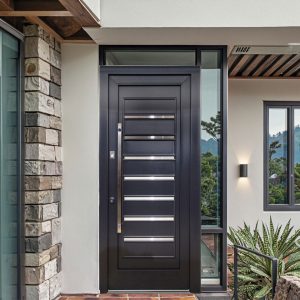
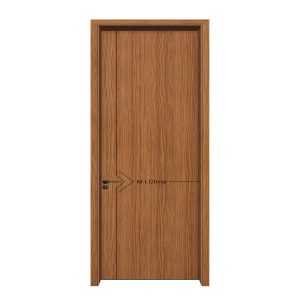
This is where our dual expertise shines. Because we’re also a solid wood door manufacturer, we understand premium wood finishes intimately. Our wood grain transfer finishing process uses sublimation printing—a specialized film printed with realistic wood patterns is wrapped around the powder-coated profile, then heated in a vacuum chamber. The heat causes the dye to sublimate and penetrate the powder coating, creating a durable wood grain surface that’s indistinguishable from real timber at a glance. This lets architects and designers match aluminum window frames to our solid wood entry doors, achieving a unified aesthetic across a whole project. It’s a capability few aluminum-only factories can offer.
Step 5 – Hardware Installation and Glazing (Insulated Glass)
With the frame complete and finished, we move to hardware installation. Our one-stop service includes supporting hardware accessories, so we can supply the complete package—hinges, locks, handles, and multi-point locking systems. For OEM projects, we install the specific lock brands your specification demands, whether that’s imported European hardware or a domestic brand preferred for after-sales service in your market.
Multi-Point Locking Systems for Security
Our CNC machining has already created the precise slots and pockets for multi-point locking systems—typically 3 to 5 locking points that engage simultaneously when the handle is lifted. This distributes the locking force across the entire door height, making forced entry significantly more difficult and improving the door’s weather seal by pulling the door leaf evenly against the frame’s gaskets.
Double vs. Triple Glazing and Gasket Compression
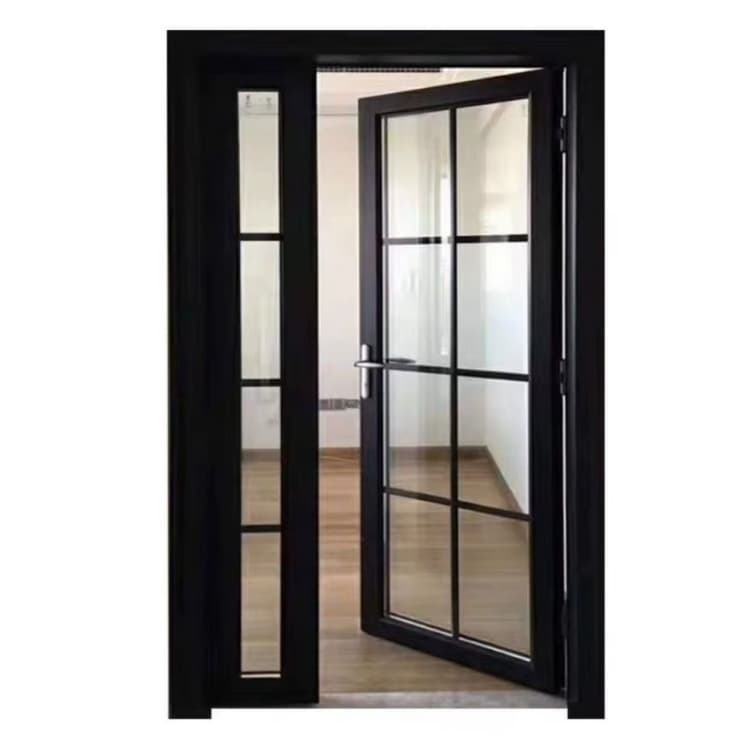
The frame profile’s glazing pocket is designed to accommodate various glass thicknesses—typically 24mm for double glazing and up to 48mm for triple glazing. We install the glass using setting blocks (which support the glass weight) and pressure plates (which hold the glass firmly in place). The critical element here is the EPDM rubber gasket—a synthetic rubber chosen for its resistance to ozone, UV, and temperature extremes. We compress the gasket to a precise specification, ensuring a watertight and airtight seal without over-compressing, which would make the door difficult to close.
Step 6 – Final Quality Control, Packaging, and Logistics
Before any door leaves our factory, it undergoes a final inspection against a zero-defect checklist. We verify dimensions against the approved shop drawings, operate the hardware through 50+ open-close cycles to check for binding, visually inspect the surface finish under bright lighting for scratches or color inconsistency, and test the gasket compression on a sample basis. Any unit that doesn’t meet our standards is reworked or scrapped—never shipped.
The “Zero-Defect” Checklist Before Packing
Our inspectors check: overall dimensions (height, width, diagonal squareness), hardware function (lock engagement, handle operation, hinge smoothness), glazing integrity (gasket seating, glass cleanliness), surface finish (color match to approved sample, no scratches, no runs or sags in powder coating), and drainage channel clearance. Each door gets a unique serial number that traces back to its production batch and raw material certificates.
Export Packaging for Sea and Air Freight
We understand that shipping damage is a major concern for global clients—it’s one of the most common reasons projects get delayed. Our export packaging is designed for the harshest ocean voyages. Each door is individually wrapped in protective foam, fitted with corrugated corner protectors, and then placed in a wooden crate or palletized with heavy-duty stretch film. For particularly fragile glass units, we use full wooden crates with internal bracing. Our after-sales support includes shipping damage protection, meaning we work with you to resolve any transit issues quickly—because we’d rather handle claims than have your project stall.
Why Partner with Jusen for Your Aluminum Door Projects?
When you source from Jusen, you’re not just buying a product—you’re accessing a one-stop OEM & ODM manufacturing partner. We combine 20+ years of solid wood processing expertise with dedicated aluminum manufacturing capabilities, giving you a single supplier for both timber doors and aluminum windows. This synergy lets us offer:
- Full Customization (OEM/ODM): Your designs, your hardware brands, your specifications—we execute them precisely.
- In-house Design and Engineering Team: We provide customized shop drawings and formal quotations within 24 hours, so your project stays on schedule.
- Stable Quality Control: From raw material certificates to final inspection, we control every step in our own workshops—wood drying, spray finishing, and aluminum processing.
- Flexible MOQs: We work with retail dealers stocking a few units and villa real estate developers ordering thousands.
- Comprehensive After-sales Support: Including shipping damage protection and responsive communication from our export team.
Our clients include global contractors, interior designers, retail dealers, and villa real estate developers who need a factory that understands both the technical demands of aluminum systems and the aesthetic requirements of high-end architecture.
—
Q: What is the difference between anodized and powder-coated aluminum doors?
Anodizing creates a metallic, slightly translucent finish by electrochemically thickening the aluminum’s oxide layer. It offers excellent corrosion resistance and is ideal for coastal environments, but color options are limited to bronze, black, and clear. Powder coating offers unlimited color options, including metallic and wood grain finishes, with good scratch and UV resistance. For most architectural projects, we recommend powder coating for its design flexibility, unless the project is in a severe marine environment where anodizing’s inherent corrosion resistance is preferred.
Q: Can you manufacture aluminum doors with the same color as wooden doors?
Yes—this is one of our specialties. Our wood grain transfer finishing process creates a realistic wood pattern on aluminum that can match the species and tone of our solid wood doors. You can specify, for example, an aluminum window frame with a walnut wood grain finish that complements our walnut solid wood entry door. This unified aesthetic is a significant advantage for villa projects and high-end residential developments.
Q: What is the minimum order quantity (MOQ) for custom aluminum doors?
Our MOQs are flexible and depend on the product type and level of customization. For standard profile colors and sizes, we can accommodate relatively small orders for retail dealers. For fully custom ODM designs requiring new CNC programming and custom tooling, a higher MOQ applies to amortize the engineering setup. Contact our team with your project details, and we’ll provide a specific MOQ within 24 hours.
Q: How do you ensure the aluminum doors are not damaged during shipping?
We use export-grade packaging tailored to the shipping method. Individual foam wrapping, corner protectors, and either heavy-duty stretch film palletization or full wooden crates protect the doors. We also include shipping damage protection in our after-sales support, meaning we’ll work with you to resolve any transit damage claims quickly and efficiently.
Q: How long does it take to get a quote and samples?
We provide customized shop drawings and formal quotations within 24 hours of receiving your inquiry. Physical samples can be produced within 2–3 weeks, depending on the finish and complexity. For urgent projects, we can also provide video walkthroughs of similar completed products to help you evaluate quality before samples arrive.
—
References
- The Aluminum Association. “Alloy and Temper Designation Systems for Aluminum.” Aluminum Standards and Data, 2023. https://www.aluminum.org/sites/default/files/2023-01/Alloy_and_Temper_Designation_Systems.pdf
- European Aluminium. “Aluminium in Building: A Guide to Best Practice for Architects and Engineers.” European Aluminium Association, 2021. https://european-aluminium.eu/media/2918/aluminium-in-building-2021.pdf
- ASTM International. “Standard Specification for Aluminum and Aluminum-Alloy Extruded Bars, Rods, Wire, Profiles, and Tubes.” ASTM B221-21, 2021. https://www.astm.org/b0221-21.html
—
Decision Guide: Choosing Your Aluminum Door Finish
- Choose Anodizing if your project is in a severe coastal environment, you need maximum corrosion resistance, and you’re comfortable with a limited color palette (bronze, black, clear).
- Choose Powder Coating if you want unlimited color options, need to match specific architectural finishes (including wood grain), or require a uniform appearance across a large project with multiple color specifications.
- Choose Wood Grain Transfer if you’re working on a villa or high-end residential project where aluminum windows must visually match solid wood doors—and you want the durability of aluminum with the warmth of timber.
—
Ready to source high-quality, custom aluminum doors for your next project? https://doorwoodendoors.com/contact-us“>Talk to our team today to discuss your specifications or request a detailed quotation.
https://doorwoodendoors.com/contact-us” style=”display:inline-block;padding:12px 24px;background:#2563eb;color:#fff;text-decoration:none;border-radius:6px;font-weight:600″>Get a Free Custom Quote