
13 min read
What Is the Best Aluminum Window System for Your Next Project?
Ask five suppliers what makes the “best” aluminum window system, and you’ll get five different answers—usually starting with price. But for contractors, architects, and developers, “best” means something far more specific: a system that meets performance codes, installs without headaches, arrives on schedule, and doesn’t generate callback complaints two years down the road.
At Jusen Doors & Windows Manufacturing Co., Ltd., we’ve spent over two decades processing aluminum and manufacturing windows for global projects. Our definition of “best” isn’t a single product—it’s the synergy of profile engineering, hardware integration, glass specification, and manufacturing precision. And critically, it’s backed by a factory that controls every step of production.
This guide breaks down what separates a top-tier aluminum window system from an average one, how to evaluate suppliers beyond their brochures, and why our Chinese factory is positioned to deliver systems that genuinely perform.
—
What Defines a “Best-in-Class” Aluminum Window System?
Before you can choose the best system, you need to understand what you’re actually specifying. Based on our production data and feedback from clients across different climate zones, we break down the critical components that determine performance.
Frame Profile Design and Thermal Break Technology
Standard aluminum is an excellent conductor of heat—which is terrible for building envelopes. A non-thermally-broken frame will transfer cold or heat directly through the profile, causing condensation, energy loss, and occupant discomfort.
The solution is a thermal break: a polyamide strip inserted between the interior and exterior aluminum sections. This interrupts the thermal bridge. But not all thermal breaks are equal. The width of the strip, the number of chambers in the profile, and the precision of the assembly all affect the final U-value.
Our in-house engineering team works directly with clients to select the correct profile thickness and thermal break configuration for their specific climate zone. We don’t just sell a window—we help you engineer a climate solution. If your project is in a cold Nordic region versus a hot Middle Eastern city, the optimal profile design will differ, and we have the technical capacity to accommodate both.
Hardware, Sealing Systems, and Gaskets
The best aluminum profile in the world performs poorly if the hardware fails or the seals leak. Air and water infiltration typically occur at the weakest points: the corners, the locking points, and the gasket interfaces.
Multi-point locking systems are non-negotiable for high-performance windows. They pull the sash evenly against the frame, compressing the gaskets uniformly and preventing air leakage. EPDM (ethylene propylene diene monomer) gaskets are the industry standard for durability—they resist UV degradation, ozone, and temperature extremes far better than cheaper alternatives.
Here’s where our one-stop service model creates real value. We don’t just extrude and machine aluminum frames; we supply the complete window system, including supporting hardware accessories. This means the locking mechanisms, hinges, and gaskets are selected for compatibility with our profiles—not sourced from three different suppliers and hoped to work together. For the buyer, this eliminates procurement headaches and warranty disputes when components fail.
Glass Configuration and Performance Ratings
The frame is only half the system. The glass unit determines the majority of the window’s thermal and acoustic performance. Double and triple glazing, low-E coatings, argon gas fills, and varying glass thicknesses all interact with the frame design.
A critical engineering challenge: thicker glass units weigh more and require deeper frame rebates. If the frame isn’t designed to accommodate the glass specification, you get installation problems or structural compromise.
Our experience with villa real estate developers has taught us the importance of this interaction. Luxury residential projects frequently specify acoustic glass or oversized panels for panoramic views. Our custom size & design service allows us to adjust frame profiles to support heavier glass units without compromising structural integrity—whether that means deeper profiles, reinforced mullions, or modified gasket geometry.
—
The Core Types of Aluminum Window Systems (And Which Is Best?)
As a manufacturer, we categorize window systems by opening style and structural application. There’s no universal “best”—only the best fit for your architectural requirements and performance goals.
Casement Windows vs. Sliding Windows
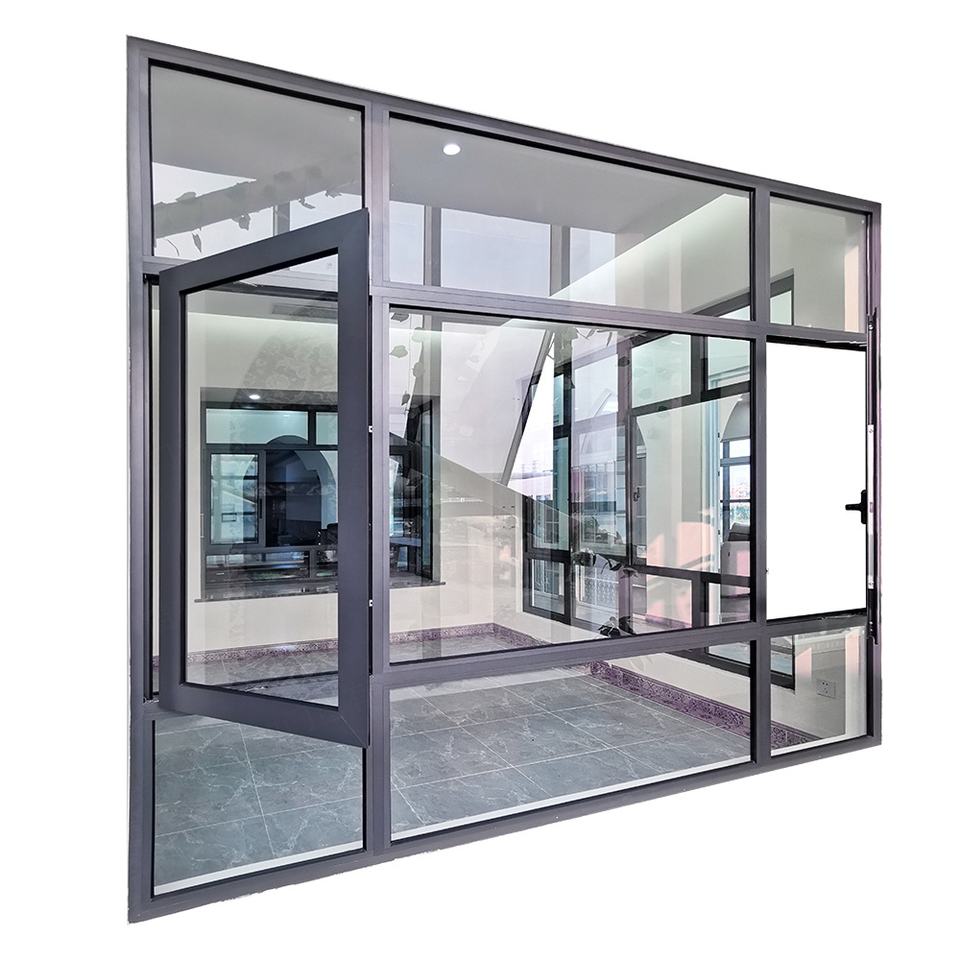
Casement windows hinge on the side and project outward. They offer superior energy efficiency because the sash compresses against the frame when closed, creating a tighter seal. They also provide excellent ventilation control—you can direct airflow by adjusting the opening angle.
Sliding windows move horizontally on tracks. They’re space-efficient, simpler in operation, and often more cost-effective for large openings. However, the sliding mechanism typically has a less effective seal than a casement, making them slightly less energy-efficient.
Our factory produces both systems to high standards. Our aluminum processing workshops handle complex multi-panel sliders with precision machining—critical when you have three or four panels that need to align perfectly on the same track. For casement systems, we ensure the hinge alignment and locking point spacing are exact, because even a 1-millimeter discrepancy becomes visible over a large sash.
Tilt-and-Turn Systems for High-End Residential
Tilt-and-turn windows are the gold standard for European-style residential architecture. One handle operates two modes: tilt (the top pivots inward for ventilation) and turn (the side hinges open fully for cleaning and egress). The hardware complexity is significantly higher than a standard casement.
This complexity makes manufacturing quality non-negotiable. The multi-point locking mechanism, the scissor arm, and the hinge system must all work in perfect synchronization. If any component is slightly off, the window binds, leaks, or fails prematurely.
We position JuSen as a specialist in high-end custom doors and windows, and tilt-and-turn is a core capability. Our ODM service allows us to manufacture these systems to exact European standards or to specific client drawings. We’ve produced tilt-and-turn systems for projects where the architect provided their own hardware specifications, and we integrated them seamlessly into our profiles.
Structural Glazing and Fixed Window Systems
For modern facades, fixed windows and structural glazing offer minimalist aesthetics—large expanses of glass with narrow sightlines. These systems rely on structural silicone to bond the glass to the frame, transferring wind loads through the adhesive rather than mechanical pressure plates.
The engineering calculations for structural glazing are critical. Wind load, glass weight, thermal movement, and silicone compatibility all need to be verified. Getting this wrong isn’t a minor defect—it’s a safety hazard.
Our Construction Project Bulk Supply capability covers these systems for commercial buildings where large glass areas are required. We provide structural engineering calculations alongside the product, ensuring the system meets local building codes and safety standards. This documentation is essential for architects submitting permit applications and for developers protecting themselves from liability.
—
Why the Supplier Matters as Much as the Window System
You can spec the best aluminum window system in the world, but if the factory can’t execute it accurately, it’s worthless. This is where the JuSen manufacturing advantage becomes the deciding factor.
In-House Manufacturing and Quality Control
When you source from a trading company, you’re dealing with a middleman who has no control over production quality. Tolerances vary between factories, communication is filtered, and if there’s a defect, you’re navigating a blame game between the trader and the actual manufacturer.
We eliminate that risk entirely. JuSen operates its own aluminum processing workshops. We control the cutting, milling, and drilling processes from start to finish. Our machines are calibrated regularly, and our QC team inspects at multiple stages—not just at final assembly.
This strict quality control from raw materials to final production means the “best” system you specified is actually built to the correct tolerances. When a profile arrives at your job site, the miters fit, the hardware mounts without forcing, and the glass sits correctly in the rebate. That’s what prevents installation delays and expensive field modifications.
The Importance of Customization (OEM & ODM)
“Best” often means “custom.” Off-the-shelf window systems rarely fit unique architectural visions—whether it’s a non-standard size, a specific profile depth, or a particular hardware configuration.
Our OEM & ODM customization service is designed for this reality. We’re not limited to our own catalog. If you have drawings, we can manufacture to your specifications. If you have a concept but no engineering drawings, our in-house team can design new profiles or adapt existing ones.
This flexibility is crucial for architects looking for a signature look. We’ve produced windows with custom sightlines, unique corner details, and specialized finishes that standard catalogs couldn’t offer. For retail dealers building their own brand, our Private Label service lets you sell windows under your brand name while leveraging our manufacturing capability.
Engineering Support and Technical Documentation
B2B buyers need more than products—they need documentation. Shop drawings, load calculations, thermal performance data, and installation instructions are all essential for project planning and permit approval.
Our experienced design and engineering team provides customized shop drawings and formal quotations within 24 hours. This rapid response allows your team to proceed without delays. We understand that in construction, time is money, and waiting two weeks for a drawing set can derail an entire schedule.
Beyond initial documentation, we provide ongoing technical support during production. If your project changes—a different glass spec, a revised opening size—we can adjust the drawings and production accordingly.
—
Evaluating Price vs. Lifetime Value in Aluminum Systems
Let’s address the elephant in the room: cost. The cheapest aluminum window system is rarely the “best” when you factor in installation costs, building lifespan, and energy performance over 20+ years.
Understanding the Cost Breakdown (Material vs. Labor)
Here’s a reality that experienced contractors understand: labor costs to install a poor-quality window often exceed the material savings. A rigid, well-machined frame installs faster—the openings are square, the hardware aligns, and the sealant application is straightforward. A poorly manufactured frame requires shimming, forcing, and rework, which burns labor hours and creates tension with the general contractor.
Additionally, callback costs are the hidden killer. If a window leaks or doesn’t operate smoothly after installation, you’re sending a crew back to the site—often at premium rates. These callbacks can wipe out any savings from choosing a cheaper supplier.
Our pricing is competitive for the quality level we deliver. Because we’ve been manufacturing for over 20 years, our production processes are refined, our scrap rates are low, and our lead times are predictable. This operational efficiency allows us to offer stable pricing for bulk orders without sacrificing quality.
MOQ Flexibility and Bulk Pricing
Pricing scales with volume, but not every buyer starts with a massive order. A retail dealer testing a new product line needs different terms than a developer procuring windows for a 200-unit apartment complex.
We offer flexible MOQs to accommodate both scenarios. If you’re a retail dealer needing a small first batch to validate quality and market demand, we can structure that. If you’re a developer needing a massive bulk supply across multiple phases, we can provide tiered pricing that rewards volume.
This flexibility reduces your risk. You can start with a trial order, verify our quality and communication, then scale up with confidence.
Logistics and Shipping Protection
The best window system is useless if it arrives broken. International shipping of aluminum windows involves container loading, handling at ports, and potential rough transit. Inadequate packaging leads to scratched profiles, broken glass, and damaged hardware—all of which create disputes and delays.
Our export-grade packaging standards are designed for the realities of international freight. Frames are wrapped, protected with corner guards, and secured within the container to prevent movement. Glass is crated separately with appropriate cushioning.
And if damage does occur despite our packaging, we have a shipping damage protection policy. We work with clients to resolve claims quickly, providing replacements or compensation as appropriate. This comprehensive after-sales support reinforces our commitment to total quality—not just at the factory gate, but through to your job site.
—
How to Partner with JuSen for Your Next Development
If you’re evaluating suppliers for an upcoming project, here’s what the procurement process looks like when you work with us.
The Procurement Process (From Inquiry to Delivery)
- Send your inquiry or drawings. Include your project specifications, window types, sizes, and performance requirements.
- Receive shop drawings and a formal quote within 24 hours. Our engineering team reviews your requirements and prepares documentation for your approval.
- Approve samples. For custom designs, we can produce samples for your verification before mass production.
- Mass production begins. Our factory schedules your order based on your delivery timeline.
- QC inspection. We conduct quality checks at multiple stages, and you can request third-party inspection if your project requires it.
- Shipping. We handle export documentation and container loading, coordinating with your freight forwarder or ours.
The speed of our initial response is a differentiator. Many suppliers take days or weeks to provide quotations. We deliver within 24 hours, streamlining your procurement cycle and allowing your team to maintain project momentum.
Why Global Partners Choose Us
The benefits of partnering with JuSen are straightforward:
- One-stop service. We provide windows, doors, and supporting hardware accessories—one supplier, one contract, one point of accountability.
- Stable quality. Our in-house manufacturing ensures consistent tolerances and finishes across every order.
- Long-term partnership. We’re not looking for one-off transactions. We build relationships with distributors, builders, and architects who need a reliable manufacturing partner for ongoing projects.
We welcome global distributors, builders, architects, and project partners. Whether you need OEM production for your brand or ODM design services for a unique project, we have the capability and the experience to deliver.
—
Common Questions About Aluminum Window Systems
What is the difference between a thermal break aluminum window and a standard one?
A thermal break window has a polyamide strip inserted between the interior and exterior aluminum profiles. This interrupts the thermal bridge, preventing heat from conducting through the frame. The result is significantly better insulation—reduced condensation, lower energy bills, and improved indoor comfort. At JuSen, we use thermal break technology for all energy-efficient systems, and we can adjust the strip width and profile chamber configuration based on your climate zone.
Can you match specific colors like RAL codes for our project?
Yes. Our spray finishing workshops handle custom colors and wood-grain finishes. Whether you need a specific RAL code for architectural compliance or a wood-grain effect for aesthetic consistency with timber elements, we can match it. This capability is essential for projects where the window finish is a design feature, not just a functional component.
Do you support OEM branding on the windows and hardware?
Absolutely. Our Private Label service allows you to build your own brand using our manufacturing capability. We can apply your logo, branding, and packaging to the windows and hardware. This is particularly valuable for distributors and dealers who want to offer a premium product under their own name without investing in their own factory.
What is the typical lead time for a bulk order of custom aluminum windows?
Lead times vary based on order size, complexity, and season. Generally, a bulk order of custom aluminum windows takes 20–35 days from sample approval to completion. Our fast production lead times and capacity to handle large-scale construction projects mean we can meet tight schedules when needed. For urgent projects, we’ll work with you to prioritize production.
How do you ensure the aluminum windows are not damaged during international shipping?
We use export-grade packaging standards—protective film on profiles, corner guards, and robust crate construction for glass. Frames are secured within the container to prevent shifting during transit. Our shipping damage protection policy means that if damage does occur, we work with you to resolve the claim quickly, providing replacements or compensation as appropriate.
—
Choosing the Right System for Your Project
Choose a casement system if: You prioritize energy efficiency and ventilation control, and your project has standard window sizes that benefit from the tighter seal.
Choose a sliding system if: You need space-efficient operation, large openings, and cost-effectiveness, and your climate doesn’t demand maximum thermal performance.
Choose a tilt-and-turn system if: You’re working on high-end residential projects where European-style operation, easy cleaning, and premium hardware are expected.
Choose structural glazing if: You’re designing a modern facade with large glass expanses and minimalist sightlines, and you have the engineering documentation to support the installation.
—
The “best” aluminum window system is more than a product specification. It’s the combination of quality profiles, correct glass configuration, precision manufacturing, and—most critically—a reliable manufacturing partner who delivers on time and stands behind their work.
At Jusen Doors & Windows Manufacturing Co., Ltd., we offer the technical expertise and production capacity to deliver these systems globally. With over 20 years of experience, in-house engineering support, and a commitment to quality at every stage, we’re ready to be that partner for your next project.
—
References
[1] European Aluminium Association. (2023). Thermal Break Technology in Aluminum Window Systems. https://www.european-aluminium.eu
[2] American Architectural Manufacturers Association. (2022). AAMA/WDMA/CSA 101/I.S.2/A440-22: North American Fenestration Standard. https://www.aamanet.org
[3] National Fenestration Rating Council. (2023). Understanding U-Factors and SHGC Ratings. https://www.nfrc.org
[4] International Code Council. (2021). International Building Code (IBC) – Fenestration Requirements. https://www.iccsafe.org
[5] Glass for Europe. (2022). Insulating Glass Units: Performance and Specifications. https://www.glassforeurope.com





