10 min read
Aluminum Windows Energy Efficiency: A Manufacturer’s Guide to Thermal Performance
The global push toward net-zero buildings has fundamentally changed what contractors, architects, and developers demand from fenestration. Energy codes are tightening across North America, Europe, and Asia-Pacific markets. For large-scale projects, windows are no longer just an aesthetic choice — they are a critical component of the building envelope that directly impacts HVAC sizing, operational costs, and occupant comfort.
When a window underperforms, the consequences are immediate: thermal bridging leads to condensation on interior frames, air leakage drives up energy bills, and premature seal failure results in costly callbacks. These are problems we see every day in our factory, and they are precisely why we approach aluminum window manufacturing as a system engineering challenge rather than simple frame assembly.
At Jusen Doors & Windows Manufacturing Co., Ltd., our 20+ years of experience in aluminum processing and solid wood manufacturing have taught us one thing: energy efficiency is not achieved through a single component. It requires “system thinking” — where profile geometry, thermal break placement, glazing specifications, hardware compression, and installation tolerances all work as a unified unit. This is the standard we apply to every window that leaves our workshops.
—
The Core Science of Aluminum Windows Energy Efficiency
Before specifying any window system, B2B buyers need to understand the three metrics that define thermal performance: U-value (heat transfer rate), SHGC (solar heat gain coefficient), and condensation resistance. For glazing units, U-values typically range from 0.5 to 1.4 W/m²K depending on configuration. For frames, the thermal performance depends almost entirely on whether a thermal break exists.
Thermal Break Technology: The Aluminum “Cold Bridge” Solution
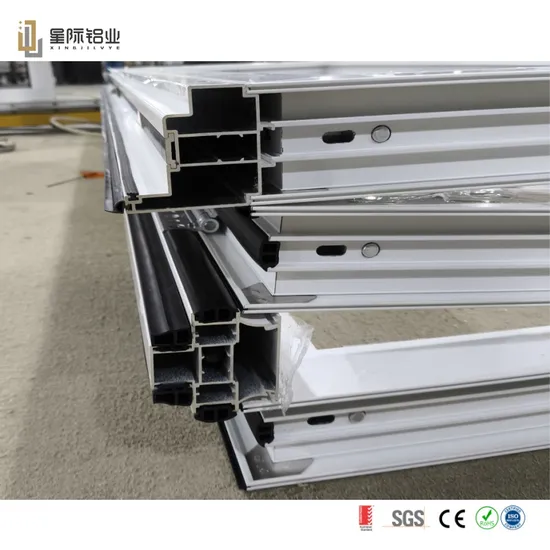
Bare aluminum is an excellent conductor of heat — which is why standard frames without thermal breaks perform poorly in extreme climates. The solution is a thermal break: a polyamide strip inserted between the interior and exterior aluminum profiles, creating a barrier that interrupts heat flow.
In our factory, this is not a cosmetic addition. Our aluminum processing workshops use precision insertion equipment to place polyamide strips with exact tolerances. The result is a structural connection that maintains frame strength while reducing heat transfer by up to 80% compared to non-thermal-break profiles. When a client asks us about “aluminum windows energy efficiency,” this is where the conversation starts.
We also offer different thermal break configurations depending on project requirements. For standard residential projects, a 14.8mm polyamide strip paired with double glazing delivers solid performance. For passive house projects or extreme northern climates, we can specify wider thermal breaks and triple glazing assemblies that achieve U-values below 0.8 W/m²K.
Glazing & Gas Fills: Double and Triple Pane Configurations
The glass unit typically accounts for 70-80% of a window’s total area, making glazing selection the single most important decision for energy performance. Low-E (low-emissivity) coatings reflect infrared radiation while allowing visible light to pass through. When combined with argon or krypton gas fills between panes, these coatings dramatically reduce heat loss.
Our engineering team customizes glass specifications based on the project’s geographic location. A villa project in Dubai has entirely different solar gain requirements than a commercial building in Toronto. For hot climates, we recommend Low-E coatings with low SHGC values to minimize cooling loads. For cold climates, we prioritize high SHGC values to maximize passive solar heating.
We work with established glass suppliers to source tempered, laminated, and insulated glass units (IGUs) that meet international standards. We also offer triple-glazed configurations with warm-edge spacers for projects pursuing LEED or Passive House certification.
Air Tightness & Weather Sealing
A window with excellent glass but poor sealing will still fail the energy efficiency test. Air leakage undermines the performance of even the best glazing units because conditioned air escapes through gaps between the sash and frame.
Multi-point gaskets and compression seals are essential. In our manufacturing process, we use EPDM (ethylene propylene diene monomer) gaskets that maintain elasticity across a wide temperature range. Unlike cheaper PVC gaskets that harden and crack over time, EPDM provides consistent compression for years — preserving the window’s air-tightness rating.
Proper drainage systems are equally important. If water accumulates inside the frame, it degrades insulation materials and accelerates seal failure. Our window systems incorporate concealed drainage channels that direct water outward while maintaining the pressure balance needed for effective weather sealing.
—
How Our Manufacturing Process Directly Impacts Thermal Performance
Theoretical U-values mean nothing if the manufacturing quality is poor. A window that performs at 1.0 W/m²K in a laboratory can easily perform at 2.5 W/m²K in the field if the frame joints are not properly sealed. This is where our factory capabilities make the difference.
Precision Machining for Perfect Seals
Our aluminum processing workshop is equipped with CNC cutting and crimping machines that ensure precise corner joints. Every mitre cut is held to tolerances within ±0.5mm — a level of precision that prevents the micro-gaps responsible for air and water infiltration.
Corner crimping is particularly important for thermal performance. When corners are not properly compressed, the thermal break can separate from the aluminum profile, creating a direct thermal bridge. Our dedicated crimping machines apply consistent pressure to every corner, ensuring the polyamide strip remains fully seated within the profile.
We also perform routine quality checks at each production stage. From raw material inspection to final assembly, our quality control team verifies that every profile meets dimensional specifications and that all thermal break components are correctly installed. This attention to detail is why we can offer stable quality across large production runs.
The Role of Hardware in Energy Efficiency
Hardware is often overlooked in energy efficiency discussions, but it plays a critical role. Multi-point locking systems press the sash tightly against the frame, compressing the gaskets and creating an effective seal. Single-point locks, by contrast, leave the sash slightly loose, allowing air to infiltrate.
We supply supporting hardware accessories — including multi-point locks, friction stays, and concealed hinges — that are matched to the specific profile system. Our hardware partners provide products with corrosion-resistant finishes and extended cycle testing, ensuring consistent compression over the window’s lifetime.
Customization for Climate-Specific Projects
The “most efficient” window is not a universal product — it depends on the project’s location, orientation, and architectural design. This is where our ODM capability becomes valuable.
For projects in extreme climates, we can modify profile depths to accommodate thicker glazing units or adjust the thermal break width. For projects with specific architectural requirements, we can integrate sunshades, fixed lites, or tilt-turn mechanisms into the same window system.
Our in-house design and engineering team works directly with architects and contractors to adapt our aluminum systems to their energy models. If the thermal simulation indicates that a standard profile is insufficient, we can engineer a custom solution without compromising the project timeline.
—
Comparing Energy Efficiency: Aluminum vs. Other Frame Materials
Contractors often ask us to compare aluminum with uPVC and wood. The answer depends on the project’s priorities — structural performance, lifecycle costs, and sustainability.
| Material | Thermal Break Available | Structural Strength | Minimum Frame Thickness | Typical U-value (Frame) | Recyclability | Maintenance |
|---|---|---|---|---|---|---|
| Aluminum | Yes | High | Slim (can be under 50mm) | 1.5–3.0 W/m²K | 100% infinitely recyclable | Low |
| uPVC | No (inherently low conductivity) | Low | Bulky (often 70mm+) | 1.2–2.0 W/m²K | Difficult to recycle | Low |
| Wood | No (inherently low conductivity) | Moderate | Bulky (often 68mm+) | 1.5–2.5 W/m²K | Biodegradable | High (requires painting/staining) |
Structural Strength and Slimmer Profiles
Aluminum’s tensile strength allows for significantly slimmer frames than uPVC or wood. This means larger glass areas with the same structural integrity — maximizing natural light and passive solar gain. For architects designing modern facades with floor-to-ceiling glazing, aluminum is often the only viable option.
Our in-house design team assists with structural calculations, verifying that our profiles meet wind load and deflection requirements for the specific project location. This engineering support ensures that the window system performs not only thermally but also structurally.
Longevity and Lifecycle Costs
Aluminum does not warp, rot, or degrade like wood. It does not become brittle and crack like uPVC under UV exposure. This durability directly impacts energy efficiency: a window that maintains its air-tightness properties for 30 years will outperform a cheaper window that loses its sealing effectiveness after 10 years.
Our experience in solid wood processing gives us a unique perspective on material selection. While we manufacture premium wood doors for interior applications, we consistently recommend aluminum for external fenestration — the material’s dimensional stability ensures that the thermal performance specified at design stage remains intact throughout the building’s life.
Recyclability and Sustainability
Aluminum is infinitely recyclable without losing its properties. This makes it a preferred material for LEED-certified projects and green building programs. When a building reaches the end of its life, the aluminum frames can be recovered and recycled — reducing the project’s overall environmental footprint.
For contractors pursuing sustainability certifications, we provide documentation on the recycled content of our aluminum profiles and our manufacturing processes’ environmental compliance.
—
The Jusen Advantage: Engineering Support for Architects and Contractors
Energy-efficient windows are not just products — they are engineered solutions. Our role extends beyond manufacturing to providing the technical documentation and support that global projects require.
Custom Shop Drawings and Thermal Calculations
We understand that contractors need more than a quotation. They need shop drawings, thermal performance data, and installation details to support permit applications and construction documentation.
Our experienced in-house design and engineering team provides customized shop drawings and formal quotations within 24 hours. For projects requiring thermal certifications, we can provide U-value calculations and condensation resistance assessments based on the specific profile and glazing configuration.
OEM & ODM Customization for Unique Facades
Every architectural project has unique requirements. Whether it is casement windows, tilt-turn systems, fixed lites, or custom-shaped openings, our OEM and ODM services adapt our aluminum systems to meet your specifications.
We offer private label manufacturing, allowing dealers and distributors to brand our products as their own. For developers managing multiple villa projects, we provide consistent product quality across all phases of construction.
Bulk Supply and Global Logistics
Large-scale construction projects require reliable supply chains. We are equipped to handle bulk orders with flexible MOQs, scaling production to meet your construction schedule without compromising quality.
Our logistics team coordinates export packaging and shipping to global destinations. We use reinforced crates and protective materials specifically designed to prevent frame distortion and glass breakage during transit. This shipping damage protection ensures that windows arrive ready for installation — reducing on-site delays and replacement costs.
—
Frequently Asked Questions
What is the typical U-value for your aluminum windows?
With thermal break profiles and double glazing, our standard configurations achieve U-values between 1.0 and 1.4 W/m²K. For triple glazing with wider thermal breaks, we can achieve U-values below 0.8 W/m²K. The exact value depends on the glazing specification and profile depth selected for your project.
Can we use aluminum windows for a high-humidity coastal project?
Yes. Coastal environments require corrosion-resistant finishes. We offer powder coating and anodizing options that protect the aluminum surface from saltwater exposure. These finishes maintain the frame’s structural integrity and thermal performance over decades of exposure to harsh marine conditions.
Do you provide thermal performance simulation reports?
Yes. Our engineering team provides thermal calculations and simulation reports to support permit applications and green building certifications. These reports include U-values, SHGC, and condensation resistance assessments based on your specific configuration.
What is your MOQ for a large villa project?
We offer flexible MOQs. For construction projects, we can accommodate bulk supply orders and scale production to meet your schedule. Whether you need 50 windows or 5,000, we work with you to structure production and delivery milestones.
How does your shipping damage protection work?
We use reinforced export packaging designed specifically for aluminum windows. Each frame is protected with corner guards, foam padding, and moisture barriers. Glass units are separated with shock-absorbing materials. This packaging prevents frame distortion and glass breakage during international transit.
—
Decision Guide: Choosing the Right Aluminum Window System
Choose a thermally broken aluminum window with double glazing if:
- Your project is in a moderate climate with seasonal temperature variations
- You need slim profiles for large glass areas
- You are working within a standard construction budget
Choose a thermally broken aluminum window with triple glazing and wide thermal breaks if:
- Your project is in an extreme climate (very cold or very hot)
- You are pursuing Passive House or LEED certification
- Energy costs are a primary concern for the building owner
Choose custom ODM aluminum windows if:
- Your architectural design requires non-standard shapes or configurations
- You need specific profile depths or integrated sunshades
- You have unique performance requirements not met by standard systems
—
At Jusen Doors & Windows Manufacturing Co., Ltd., we understand that aluminum windows energy efficiency is not a marketing claim — it is a measurable outcome of material selection, precision manufacturing, and engineering expertise. Our 20+ years of experience, in-house engineering team, and strict quality control processes ensure that every window we produce delivers the thermal performance your project requires.
Whether you are a contractor managing a multi-story commercial building, a developer building luxury villas, or a dealer seeking a reliable OEM partner, we are ready to support your energy-efficient window requirements.
—
References
[1] Efficient Windows Collaborative. “U-Factor and SHGC.” Efficient Windows. https://efficientwindows.org/ufactor/
[2] American Architectural Manufacturers Association. “AAMA/WDMA/CSA 101/I.S.2/A440: Standard Specification for Windows and Doors.” AAMA. https://aamanet.org/
[3] International Energy Agency. “Net Zero by 2050: A Roadmap for the Global Energy Sector.” IEA. https://www.iea.org/reports/net-zero-by-2050
[4] Aluminum Association. “Sustainability and Aluminum.” The Aluminum Association. https://www.aluminum.org/sustainability
[5] European Aluminium. “Aluminium in Buildings: Energy Efficiency and Sustainability.” European Aluminium. https://www.european-aluminium.eu/